David, the owner of the store into which the shower of our rented apartment was leaking, arrived on Sunday afternoon to escort us to our new place. It was on the border of the Beaubourg and the Marais, and David did a sterling job of selling both the space and the experience. “It’s very Parisian, yes? And you will get to enjoy an entirely new neighborhood as well!”
The apartment was cute, but not perfect. Internet access was nonexistent, and I didn’t fit in the otherwise comfortable bed. The instant I opened the window, a huge mosquito breezed in. How big? It was a driving a Peugeot. (Merci. Je serai ici toute le semaine.) Over the coming days it would give me a Barton Fink-style bite on the face and a stigmata-like one on the back of my hand. Of greater concern was the fact that the street outside was desolate. But that was because I didn’t yet understand the French concept of Sundays. Dimanche is different there; you’d think I’d have tumbled to that when Rosemarie and I had gone out earlier during prime brunching hours and were the only patrons in the café. Many restaurants and supermarkets don’t open at all on Sunday, which starts out slow but finishes strong.
The move forced us to scrap our initial plans. Instead we jumped on the Metro and headed out to Montmartre. We started at Sacré-Cœur. Maybe it was because the funicular railway was out of commission and we had to climb stairs to reach the cathedral, but it struck me as Donald Trump’s version of Notre Dame, a glossy edifice without a trace of the divine. The picturesque neighboring square was the only place we visited that felt like a tourist trap, thronged with bus groups and hustling street artists, and we made a hasty departure. Rewards lay further afield, like the Lapin Agile, the cabaret where Picasso was a regular, and the home Vincent Van Gogh shared with his brother Theo. As is so often the case in France, the day was redeemed by food. That evening we went to Camille, a restaurant in the Marais recommended by our friend Barry, where I had grilled beef skewers served with a ratatouille that provoked the rapture Sacré-Cœur failed to provide, as well as the finest peanuts I’ve ever sampled. Seriously. It’s like they were peanut butter already. Our new neighborhood proved plenty lively on Monday morning, which got us back into the swing at once. We headed to the Jardin des Tuileries adjacent to the Louvre to begin our saunter along the Champs-Élysées. There were some detours before we reached the Arc de Triomphe. The first came at David’s suggestion. He strongly encouraged us to stop by the Grand Palais, a monumental Beaux-Arts structure built for the 1900 World’s Fair that was currently housing Anish Kapoor’s Leviathan. This specifically-commissioned sculpture was a mind-altering way of viewing the space – you saw it from the inside first – and easily a high point of the trip. Odds are we would have missed it if our shower hadn’t been faulty. (We’re silver lining kinda people.)
Also on our list: seeing an English-language film with subtitles in a French theater. London Boulevard has been out in Europe for some time but seems to have fallen off the U.S. release calendar. The Departed screenwriter William Monahan’s loose adaptation of a Ken Bruen novel tells a familiar story – recently-released hard man Colin Farrell is determined to go straight – in sprawling fashion, with characters disappearing for great swaths of the movie. I still found it entertaining, thanks to Bruen’s inspired Sunset Boulevard riff and David Thewlis’ performance as the drug-addled Erich von Stroheim manqué. And of course, we were still searching for Amer Picon. Things had gotten desperate enough that Rosemarie decided to investigate a wine store, where the salesman suggested that we check ... the supermarket. It couldn’t be that simple, could it?
As it happens, it couldn’t. The supermarkets we visited stocked plenty of Suze, the aperitif that was a distant second on our Zig Zag shopping list, but no Amer Picon. In my darker moments I began to suspect that French storekeepers saw us coming and spirited our spirit of choice away for a laugh. We had two days left. Were we going to pull this off?
Wednesday, June 29, 2011
An Idiot, A Broad: Paris, Part Quatre

Monday, June 27, 2011
An Idiot, A Broad: Paris, Part Trois
It may seem like a charmed voyage so far, with the possible exception of the andouillette incident. But no trip is perfect, kids. Long about Day Six, things took a strange turn.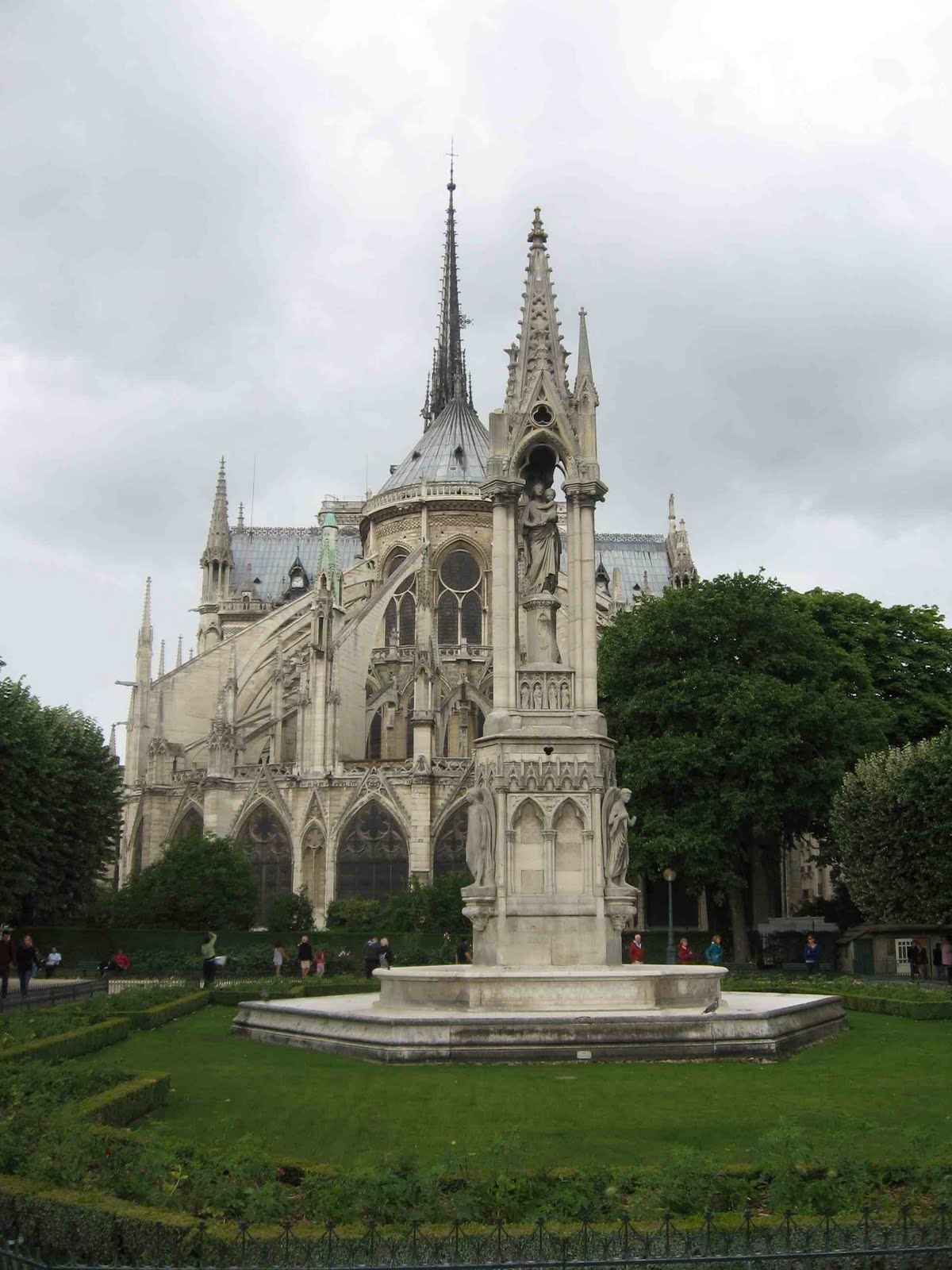 Saturday morning. We’re planning the day’s adventure when there’s a knock at the door. It’s the caretaker employed by the apartment’s owner accompanied by the proprietor of the store downstairs, a gent I’ll call David. David informs us that our shower is leaking into his electrical room, and he’d like us to stop using it so he can assess the damage. Half an hour later comes the verdict: he can look through a hole in his ceiling at the bottom of our bathroom tiles. If either of us uses the shower again, we could go crashing through the floor. Meaning the apartment is unsafe. But never fear. David and the apartment’s owner have already secured new digs that we can move into the next day. Without showering first.
Rosemarie and I chose to find this mishap, with its prospect of imminent death, hilarious. Later we’d learn that plumbing woes are very Parisian, as is David’s resourcefulness in solving our problem. We stuck to the plan and visited the cathedral of Notre Dame, as we now had something for which to give thanks. The glorious structure had a humbling effect on this lapsed Catholic. Hunchback hunting wasn’t in the cards, as a spate of bad weather convinced us not to climb the bell tower. Instead we crossed to Île Saint-Louis for some famous Berthillon ice cream, then over the Pont Neuf to try out a spirit store that the Mullers told us about in our search for Amer Picon. (It’s amazing how I can rope other people into my silly quests.) We came up empty. All I picked up there was the news that in France, it’s called Picon Amer.
I am beginning to fear for the success of the mission.
Next it was back out to Bercy for a film noir triple bill. First up: The Hunted, which we saw back in February at Noir City. It remains an odd duck of a film with a disappointing ending, but on second viewing the twisted dynamic between the two leads in Steve Fisher’s script, each feeling betrayed but desperately wanting to trust the other, registered even more strongly. And lead actress Belita certainly had ... something.
We had company for the next two features. I’ve raved about the work of Ray Banks here for years; Beast of Burden, the final entry in his brilliant Cal Innes series, comes out Stateside in August. Ray and his wife, the effervescent Anastasia, popped over to Paris for a pair of B-movie gems with a combined running time of less than two hours.
1944’s Strangers in the Night is an early film from future noir titan Anthony Mann. A soldier hurts his back during the War and is immediately rotated home, because it’s not like we need supply sergeants in fighting the Axis powers. He falls in love with Rosemary, a woman he begins corresponding with, and heads to California to visit her. En route he meets a gorgeous doctor (Virginia Grey) who instantly banishes Rosemary from his thoughts. He still goes to her rambling cliffside home. There’s no Rosemary, just her creepy mother (Helene Thimig) who is obviously harboring a Dark Secret. (What you think said Dark Secret is? Yeah, that’s it.) This is a straight-ahead Gothic, at times goofy and ludicrously plotted but always compelling. That’s due in equal measure to Mann’s direction and Thimig’s strangely moving performance. Adding to the fun: Thimig’s Austrian accent renders her daughter’s name as “Rosemarie.” Clearly the only suitable follow-up to that hothouse confection is the lunacy of The Devil Thumbs a Ride (1947). Lawrence Tierney – who better to play the devil? – is a robber who hitches a lift from amiable lunkhead Ted North. Soon there are girls, a highly ill-advised beach house party, and bodies galore. Surprises abound in this homicidal farce with whiplash pacing. All you can do is hang on and marvel at the mayhem. Ray said he could use a bit of Tierney, and brother, did he get the full serving.
Along with the Czar of Noir we headed to a nearby bar filled with what I’m going to guess was a Ukrainian football club celebrating a birthday. The ensuing conversation was far too brief; Anastasia proposed a theory about Kurt Russell that warrants an international symposium of its own, one that I will organize in the coming months.
What kind of apartment do we move into? Do I ever find Amer Picon? Or Picon Amer? Tune in to the next installment.
Saturday, June 25, 2011
An Idiot, A Broad: Paris, Part Two
Another source of sage counsel prior to our departure was Walter Satterthwait, fellow OSS: 117 fan and author of wonderful novels like Masquerade, set in Paris of 1923. Among the many tidbits that Walter passed along was the rigorous standards applied to the preparation of andouillettes, tripe sausages that tread the fine line between delicacy and dare. Rosemarie had this information in mind on Day Four when we ventured into a restaurant serving andouillette as the lunch special and she ordered it. (“It’s in tribute to my ancestors,” said Mrs. Keenan, née LeFave.) The only person more surprised than me was our waiter, who tried to talk her out of it. “It’s made from the stomach,” he warned, complete with extravagant hand gestures. He would ultimately present the dish to her with the words, “Good luck.” As for how it tasted, Rosemarie reports that the accompanying potatoes were very good.
Strong stomachs were needed for the next stop, the Paris catacombs. This subterranean ossuary holds the remains of approximately six million people transported from various cemeteries throughout the city. To move through this space – the ceiling low and dripping, mortal remains carefully stacked to maximize space and occasionally in symbolic shapes – is a profound, almost overwhelming experience. We followed our sojourn through a realm of shadows and dust with a walk through sunny Montparnasse. This in turn was broken up by our first experience with a Paris staple: the raucous protest march. We never did figure out what the hubbub was all about. We next visited the Musée Bourdelle so Rosemarie could see the exhibit on the fashion designs of Madame Grès. A grievous error regarding caffeine intake forced your correspondent to shut down for several hours, but he rallied in time for dinner followed by drinks at Le Fumoir, a cocktail bar that Eddie Muller and his fabulous wife Kathleen tipped to us. The drinks menu was simple, offering a fine whiskey sour. That night the bar was filled with groups of people dressed entirely in white, like cricket teams, involved in some activity at the nearby Louvre. We never ascertained what it was. Paris, we were learning, is about mystery. The bar served no Amer Picon, nor did we find any that day. Day Five was spent at the Louvre. Visiting the world’s most famous art museum was somewhat baffling. When did people start taking photographs of paintings? For a good length of our trip we were followed by a hangdog Italian man who stood grimly before each artwork as his wife snapped a picture, setting up the most dour slideshow in Christendom. Several people posed at the foot of El Greco’s The Crucifixion as if they were Wolf Blitzer in The Situation Room. “How do you feel about the death of Our Lord? Send us your Tweets.” The apex of ridiculousness was reached in the Mona Lisa room, with hundreds of tourists blindly snapping away and no one actually looking at La Jaconde, protected behind glass. I ended up mesmerized by the grounds of the museum and some astonishing work by Giovanni Paolo Panini.
 It was back to the Cinémathèque Française for more Perles Noires that evening. The Breaking Point is the lesser known but more faithful version of Ernest Hemingway’s To Have and Have Not. Eddie Muller has sung its praises for years, calling it the best adaptation of Papa’s work. But it’s been impossible to see. (Ironically, only days earlier the Warner Archive announced that they’d be making it available on DVD.) John Garfield, in easily his greatest performance, plays the fishing boat captain stretched to his limits by circumstance to learn that a man alone ain’t got no chance. Patricia Neal is the singular femme fatale who tempts him, Phyllis Thaxter the wife who keeps him grounded. The movie is devastating, ending on a note of existential dread rivaled only by Night and the City. It’s more than just the best screen Hemingway, it’s one of the great films of the 1950s.
Afterward, a party of noir fans and filmmakers adjourned to Le Fumoir again. Among them was Nicolas Saada, whose entertaining thriller Espion(s) would be my in-flight entertainment on the trip home. Sitting in a Paris cocktail bar, discussing Hitchcock and Preminger with a French director who actually used the term mise-en-scène in conversation, I thought I’d died and gone to heaven.
Friday, June 24, 2011
An Idiot, A Broad: Paris, Part One
When Midnight in Paris ended, Rosemarie turned to me and said, “You do realize that if we didn’t have this trip planned you’d have to carry me out of here in hysterics, don’t you?”
Occasionally you get lucky. Only a week after seeing Woody Allen’s beguiling bauble of a film we were winging our way to Paris to celebrate our twentieth wedding anniversary. It was the first visit to the city for both of us.
Some people consult guidebooks before an excursion. Others check with a physician. Me, I ask my bartender. A few days prior to our departure I stopped by the Zig Zag Café to find out where to drink in Paris. I could last ten days without watching baseball, but no way was I going to give up cocktails. Erik advised me that Paris, like much of Europe, didn’t have an active cocktail culture, then preceded to mention several suitable bars. Next, I asked if I could bring anything back.
“Amer Picon,” Erik said without hesitation, naming the bitter orange liqueur featured in drinks like the Liberal and the Brooklyn. “You can’t get it here. It can be tough to find even in France.”
I now had what I needed to make this vacation complete. I wasn’t just going to learn how long a man could subsist on nothing but gazpacho and Calvados. I had a quest.
Day One: Transit. A long but pleasant flight, punctuated with surprisingly decent airplane food. Air France’s many entertainment options allowed me to catch up with a terrific French film not yet released in the United States. In The Night Clerk, Jean-Pierre Bacri is the manager of an upscale mountain resort forced to cover up an accidental death caused by his son. The title character, a recently paroled young convict, knows what happened but keeps schtum, leading to a bond between the two men that is destined to be tested. It’s the kind of elegant, chilling thriller that only the French can make, and it got the voyage off on the right foot.
Day Two: Paris Fog. I know Day Two happened. I have receipts. But a readjusting biological clock has reduced most of it to a blur. We trained in from the airport, settled into the small, modern, functional apartment we’d rented near the Louvre for our stay, wandered out for a croque-monsieur, then slept most of the day. That evening we strolled over the Pont Neuf to the Île de la Cité for the first of many languorous French dinners. We found a lovely restaurant in a small square, which a pair of jazz musicians took over for the evening, and gazpacho was had. On the walk back, Rosemarie noticed that one of her brand new shoes sounded odd. Turns out the cobblestones on the street had pried loose the heel. Checking online, we discovered that a cobbler – the only one authorized to replace the red soles on Christian Louboutin shoes – was located directly across the street from us. Clearly, this was to be a charmed trip. (NOTE: The preceding is a literary technique known as foreshadowing.)
Day Three: Darkness in the City of Light. We spent the day strolling through the Marais, swinging past the Centre Pompidou and visiting the Musée Carnavelet, a town house now given over to the history of Paris. Fascinating shops abounded in the neighborhood. None carried Amer Picon. That evening we headed to the Cinémathèque Française for the start of the Perles Noires series. Our friend Eddie Muller, founder and capo of the Film Noir Foundation, had been invited to present some films, and we pushed our trip back a month to coincide with the festival. The opening night feature was the FNF-restored Cry Danger. I’ve written about the film twice before, and can only add that it plays as well in France as it did at Noir City. A late dinner with Eddie and the Cinémathèque staff followed. We’d be spending a lot of time at the theater in the days to come.
Tuesday, June 14, 2011
On The Web: L.A. Noire at Crimespree
One of several reasons why posting has been somewhat scarce around here lately is that I’ve gone down the rabbit hole that is L.A. Noire, the new video game from Rockstar and Team Bondi. Over at Crimespree, I offer a review.
I’d be remiss if I didn’t steer you toward this piece on the game by Extra Lives author Tom Bissell at Grantland. More than a review, it’s a consideration of how L.A. Noire prefigures massive changes in storytelling. A brilliant, must-read take.
Monday, June 13, 2011
Movie: Carancho (U.S. 2011)
Forget the Dos Equis ads. For my money the most interesting man in the world, as well as the best actor, is Argentina’s Ricardo Darín. Criminally charismatic and with a taste for dark material, he starred in the only two films directed by the late, much-missed Fabián Bielinsky as well as my favorite movie of last year. In the now-on-DVD Carancho, he’s working in the shadows again. Darín plays Sosa, a disgraced lawyer hustling for clients injured in collisions on the lethally dangerous streets of Buenos Aires. The title means “vulture,” and while we don’t actually see Sosa chasing an ambulance he does follow one very closely. He’s not above staging accidents to turn a buck. Doing so brings him into the orbit of Luján (Martina Gusmán), a hard-working doctor concealing a drug addiction. Trapped in a deeply corrupt system, they wonder if they can trust each other – and if so, whether they can make a clean break.
Carancho admirably doesn’t hold the viewer’s hand, although at times I wouldn’t have minded. It’s still unclear exactly why Buenos Aires’ traffic is so deadly, or how Sosa fell to his lowly state. But the intensity of emotion between these two broken people is unmistakable, setting up a hair-raising ending. Noir to its very core and further proof of Ricardo Darín’s unassailable awesomeness, Carancho is not to be missed.
Friday, June 10, 2011
Book: The Terror of Living, by Urban Waite (2011)
AMC’s The Killing aside, Washington State seems to get short shrift in the popular imagination. But this neck of the deep woods is front, center and fully alive in this strong debut thriller from Urban Waite. Phil Hunt killed a man during a botched robbery when he was younger. Now in his 50s, he lives just south of Seattle raising horses, supplementing his meager income by bringing in the occasional load of drugs. Deputy Bobby Drake prevents the delivery of one of those shipments, and the tentative grip Hunt had on stability gives way. Soon he’s on the run, hounded by a killer in the employ of his bosses, and his only hope out of trouble is the man who put him there.
Waite’s novel owes a debt to the work of Cormac McCarthy, as indicated by the ponderous title and his implacable hit man. But there’s nothing metaphorical about Grady, an assassin who enjoys his work but is no fearless killing machine. Waite creates a lovely tension between Drake, the lawman struggling to emerge from his father’s crooked shadow, and Hunt, “sure of himself in all the wrong situations. A good man, made up of all the bad things in the world.” Each man also has a spouse supportive in her own way. Muscular prose, relentless pacing, and a true sense of place make this a rock-solid thriller.
Tuesday, May 31, 2011
Movie: The Big Bang (2011)
In the wake of an extremely limited theatrical release earlier this month, The Big Bang is now available on DVD. No doubt you’re thinking, “Another particle physics neo-noir? Does Hollywood make anything else?” Ned Cruz (Antonio Banderas) is a bottom-feeding L.A. private eye having serious doubts about his profession. A boxer surprised to be sprung from prison following a homicide conviction shambles into his office with what should be an easy case: find his stripper penpal. But the Uncertainty Principle is in full effect. Before long Cruz finds himself dealing with Russian mobsters, a trio of angry cops (one played by habitual offender William Fichtner, who steals every movie he’s in), some missing conflict diamonds, and a hippie billionaire (Sam Elliott) who has bought a sizeable chunk of New Mexico to further his quest to discover the God particle.
The gaudy visual scheme deployed by director Tony Krantz is distracting and the polyglot of accents is, in the early going at least, tough to follow. But Erik Jendresen’s script has some genuine wit and cleverness, finding parallels between theoretical physics and detective fiction, between mysteries large (the universe) and small (the human heart). There are amusing riffs on Farewell, My Lovely and Kiss Me Deadly among other classic noirs. Johnny Marr of The Smiths provides the soundtrack. Jimmi Simpson has some good scenes late as Elliott’s boy genius. And Autumn Reeser explains fundamental scientific precepts in a most illuminating manner, featuring highly effective visual aids.
Is The Big Bang good? Probably not. But I was never bored. If you find the notion of Snoop Dogg shooting an existential porn film in Schrödinger’s warehouse amusing, then you may be in this movie’s burgeoning cult following. I’m there, and I hate being alone.
Friday, May 27, 2011
Sundays with Hitch: The Man Who Knew Too Much (1934)
Alfred Hitchcock is on the short list of directors who remade their own movies. The second version of The Man Who Knew Too Much is a globe-trotting adventure featuring a big star in James Stewart plus money and style to burn. It’s also one of the only Hitchcock films that I find boring.
The original is a full forty-five minutes shorter and a very British affair indeed. It shares the same basic plot as the remake. You’ve got a couple on holiday with their child. They befriend another man who is murdered – and with his dying breath reveals himself as a spy. The couple retrieve information the dead man was carrying about a planned assassination. The plotters kidnap the child in order to guarantee their silence. Can our heroes save their offspring and the day? Hitchcock said the 1956 version was better, calling it the work of a professional while the first film was made by a gifted amateur. If that’s the case, give me the gifted amateur every time. The command Hitchcock demonstrates in the years since The Lodger is astonishing, never more so in the famous Albert Hall sequence. It’s to be the site of the assassination. The conspirators (led by Peter Lorre with a skunk stripe in his hair and speaking his lines phonetically) listen to the concert on the radio, waiting for the fatal gunshot. Jill Lawrence (Edna Best) has slipped into the hall, desperate to foil the scheme but fearful that her daughter and husband will be killed if she does. Hitchcock briefly lets the film go out of focus as tears of frustration fill her eyes. Then Jill finds a suitably Hitchcockian way to prevail.
There are terrific set pieces prior to this. Bob Lawrence (Leslie Banks) showing resourcefulness at the office of the dentist who’s one of the villains, an extended sequence at a church where Bob and his pal Clive (Hugh Wakefield, bearing the stiffest of upper lips) try to blend in with the baddies. When the Lawrences resist entreaties to help the authorities they’re asked if they would have shown similar indifference toward the prospect of averting the death of Archduke Ferdinand, a speech given extra teeth considering that the events of Sarajevo were only twenty years earlier. The climactic shootout, modeled on a famous London showdown between police and anarchists in 1911, drags a bit and seems to be headed toward a grim outcome until you realize that Hitch is going to make every detail count. This was the first of the remarkable run of 1930s films that would bring Hitchcock to Hollywood’s attention, and it’s easy to see why.
Tuesday, May 24, 2011
Movie: Sorry, Wrong Number (1948)
Apparently it’s Classic Thrillers Involving Telephones That I’ve Seen But My Wife Has Not week, if two movies can be said to constitute a theme.
Sorry, Wrong Number is based on Lucille Fletcher’s famous radio play. I know it’s famous because the credits say so: “Screenplay by Lucille Fletcher, based on her famous radio play.” Barbara Stanwyck is a wealthy, bed-ridden woman who overhears a phone conversation between two men planning a woman’s murder to take place that night. But she can’t get anyone to believe her. Her husband (Burt Lancaster) is for some reason unreachable. And who, she wonders, could this poor targeted woman be? Fletcher’s play was clearly so famous that the producers were reluctant to change a word. Stanwyck’s character is introduced with a torrent of expository dialogue that might as well be streaming out of a Philco. Dialogue rendered largely unnecessary thanks to director Anatole Litvak; his camera glides through Stanwyck’s luxe digs highlighting details that convey everything Stanwyck insists on relaying to a procession of beleaguered operators. The story that follows, which includes flashbacks within flashbacks, is a daisy chain of contrivance. Stanwyck happens to be patched into a phone call that strikes close to home. The old flame still carrying a torch for Lancaster (Ann Richards) is, by coincidence, married to the D.A. who – can you beat that? – is investigating Lancaster’s business dealings. At one point, Richards tails her own spouse to a desolate stretch of Staten Island beach. There’s not a soul around, yet no one spots her in a scene that stretches credulity to the breaking point.
But, amazingly, not past it. Credit again is due to Litvak, whose direction gives the sequence an ethereal quality making it seem like a dream Richards is relaying to Stanwyck at the other end of a long, long telephone wire. We come to feel for the isolated, neurasthenic Stanwyck, and for Lancaster as a decent man frustrated to discover that marrying above his station means he can’t make his own way in the world.
The movie’s first half, with its labored set-up and on-the-nose speechifying, is dated but fun. Then comes a point when sheer narrative momentum takes over. Tension mounts with a sinister precision throughout the last act. The final three minutes are unbearable, with a denouement enshrined in the thriller hall of fame. Sorry, Wrong Number is like a ride on an ancient wooden roller coaster at some forgotten amusement park; the prospect that the rickety structure may shake itself to pieces is part of the excitement. Or to use another tortured metaphor, sometimes watching those toppling domino artists lay out every piece first only adds to your appreciation when that last one falls into place.
Friday, May 20, 2011
Sundays with Hitch: Dial M for Murder (1954)
Welcome to a very special installment of Sundays with Hitch.
The point of this series is for me to watch the Alfred Hitchcock films that I’ve missed. Rosemarie’s list of such titles is far shorter. The early English movies that are my biggest Hitchcock blind spot? She’s seen ‘em all. She even took a class taught by Donald Spoto, Hitch’s most prominent biographer. A few of the movies we’ve watched so far were new to her – good luck finding people who have made it through Topaz – but many were old favorites.
Dial M for Murder is different. It’s the only Alfred Hitchcock film that I had seen but Rosemarie had not. In the opening minutes of this adaptation of Frederick Knott’s stage thriller, Hitchcock manages to convey a complicated story of infidelity without dialogue. Tony Wendice (Ray Milland) could easily be Strangers on a Train’s Guy Haines a couple of years down the road, a one-time tennis pro who married well but now finds himself trapped in an unsatisfying job. Worse, the man his wife (Grace Kelly) truly loves – successful American mystery novelist Robert Cummings – has returned to England intent on winning her over. In a scene so long it becomes as thrilling as a high-wire act – how long can Hitch keep this up? – Wendice blackmails an old school chum into bumping off the missus and lays out how it’s to be done. But that only marks the start of Milland’s scheming, in a performance that reaches spectacular heights of both cunning and odiousness.
When I saw the film as a teenager I dismissed it as a lesser effort, thinking it stagy. But I was an idiot then. I disavow most of what I said in the 1980s. Hitchcock doesn’t make the expected attempt to open up Knott’s play, keeping the action almost entirely in the Wendices’ flat and using the claustrophobia to his advantage. He relishes every bit of Knott’s stagecraft no matter how hokey; he practically imposes a proscenium arch over the closing moments, making you appreciate how effective the piece must have been when performed live. John Williams reprises his Tony-award winning performance as Inspector Hubbard, the blandly implacable detective. There’s more than a hint of Lieutenant Columbo in the character, right down to the “one more thing” question as he’s heading out the door. The film was shot but not initially released in 3-D. To think that audiences missed all the excitement of a key going into a lock.
For the record, Rosemarie thought it was great.
Wednesday, May 18, 2011
On The Web: My Guilty Pleasure at Crimespree
Crimespree Magazine is your go-to source for information on crime no matter the format: in print, on TV, or at the movies. Redoubtable entertainment editor Jeremy Lynch has brought back his Guilty Pleasures series and was kind enough to ask me to participate.
I could have taken the easy way out. I could have waxed rhapsodic about Jade and been done with it, emerging with some of my dignity intact.
But no. I had to give poor Jeremy more than he bargained for. I’ll say this for myself: I am unafraid to put the guilt in guilty pleasure.
Skate on over to Crimespree to see which movie I picked.
Saturday, May 14, 2011
Extra, Extra!: Noir City
 The wait, ladies and gentlemen, is over. The all-new issue of Noir City is out. Completely redesigned by Michael Kronenberg, the house rag of the Film Noir Foundation is now a true magazine – and renamed to boot. (Noir City Sentinel, R.I.P.) To commemorate the new launch, this gorgeous issue is the biggest to date, tipping the scales at over 100 pages.
I’m particularly excited about this edition because yours truly penned the cover story. It’s a survey of songbirds in film noir, those world-weary chanteuses who step up to microphones in swank joints and dive bars alike to provide a few moments of comfort. The article covers dozens of films and includes a sidebar on forgotten thrushes, the singers who provided the vocals for some of noir’s most glamorous dames. The piece was a labor of love, and I hope readers enjoy it.
I also contributed to the exhaustive tribute to Raymond Burr and the Perry Mason stable of players with a salute to Della Street herself, Barbara Hale.
Also in this issue: Jake Hinkson on Orson Welles, Mark Fertig on the sad life of Alan Ladd, reviews of contemporary noir, and so much more. It’s an embarrassment of riches and I’m honored to be a part of it. To get your copy, simply donate a minimum of twenty dollars to the Film Noir Foundation. You’ll be supporting their important work.
While I’m at it, let me also note that the Noir City Sentinel Annual #3, featuring several of my articles including a history of the Whistler films, is now for sale at Amazon. Look at all those glowing reviews! You’d be a fool not to buy it.
Tuesday, May 10, 2011
Movie: A Somewhat Gentle Man (U.S. 2011)
 This somewhat gentle movie slipped into a handful of theaters at the start of the year and is now on DVD and Netflix Instant. Ulrik (Stellan Skarsgård) walks out of prison after serving 12 years for murder – and finds out everyone has his release date wrong. He’s got that kind of luck. His old boss sets him up with a hovel and a lousy job, expecting him to seek vengeance on the man who sent him away. But once Ulrik discovers he’s due to be a grandfather, he considers the completely alien prospect of simply living his life.
Everything about the movie is beautifully deadpan; even the composition of director Hans Petter Moland’s shots is funny. The Norwegian Tourist Board cannot be happy with the chosen locations. The characters are uniformly shabby and disreputable, grabbing for what they can at the margins, yet they’re treated with real affection. You generally know where the story is going but it still manages to sneak up on you. Much of the credit goes to Skarsgård. From the second you glimpse his ponytail, it’s clear he owns this character. He gives an epically Zen performance; the simple joy Ulrik is able to take in small things becomes a sizeable joy indeed. And if there’s not a soundtrack album, there ought to be. A lovely surprise of a film.
Thursday, May 05, 2011
Sundays with Hitch: Mr. & Mrs. Smith (1941)
Time now for the most atypical film Alfred Hitchcock ever directed. There’s plenty of humor in his work, provided you take it dark. (See: Harry, The Trouble with.) But Mr. & Mrs. Smith marks Hitch’s sole foray into screwball comedy. Robert Montgomery and Carole Lombard play a couple given to epic feuds and equally epic reconciliations. They learn separately that, owing to a legal oversight, they are not technically married. Thanks to assorted miscommunications, Lombard decides she’s in no hurry to tie the knot again. Hitchcock doesn’t break a sweat selling screenwriter Norman Krasna’s premise, wisely realizing that you’ll either buy it or you won’t.
There’s not enough of the nimble Jack Carson as the hound sharing Montgomery’s doghouse. Once Montgomery’s law partner Gene Raymond expresses romantic interest in Lombard, we get a lot of Southern-fried hokum, including a casual reference to “white trash,” and a shrill third act. And that goddamn whistling on the soundtrack? I never need to hear that again.
But a comedy, like a thriller, can be judged on the basis of its set pieces, and Mr. & Mrs. Smith features a pair of beauties. The first occurs when Montgomery arranges to meet Lombard at their former favorite restaurant to re-pop the question, only to discover that the old joint isn’t quite the same. The tone is both funny and wistful – maybe the restaurant isn’t all that’s changed – and Montgomery has some great business with the house cat. Even better is a hilarious extended sequence at a nightclub involving a “high class girl” named Gertie and a self-inflicted nosebleed. Factor in an effervescent performance by Carole Lombard, who would prove the most tragic of Hitchcock blondes, and the movie certainly merits a look.
Tuesday, May 03, 2011
Book: So Much Pretty, by Cara Hoffman (2011)
Haeden, New York is not one of those quaint upstate towns that serves as a weekend getaway for Manhattanites. It’s an isolated, hardscrabble town at the base of Appalachia’s spine. When the local girl dating the local golden boy disappears and eventually turns up dead, the residents immediately affix blame on some outsider, a “drifter.” Only those with roots elsewhere resist the explanation. Stacy Flynn, the transplanted tightly-wound journalist who has taken over Haeden’s newspaper. Gene and Claire Piper, a pair of unreconstructed hippie doctors who abandoned New York City to go back to the land. And above all their whip-smart daughter Alice. In her debut novel Cara Hoffman opts for a mosaic approach that ping-pongs back and forth through decades, assumes the POVs of a dozen characters, and incorporates a variety of documents. Despite the high degree of difficulty every voice rings true, none more so than Claire, a profoundly decent woman who is “exhausted ... from hearing nothing new for half a year at a time - not even a new joke or figure of speech - from constantly explaining what she’d said or what she meant, or putting the places she was talking about into context. Tired of being poor now for almost twenty years.” Hoffman’s facility with this complex technique is daunting, and at times makes one wish she’d stick with one thread a little longer. She also tackles a brace of issues like the environmental effects of factory farming without slowing the narrative, and expresses a righteous fury about the silence surrounding crimes against women without resorting to Stieg Larsson-style sensationalism.
Some readers will undoubtedly be frustrated by Hoffman’s emphasis on the why rather than the who of one of her book’s central mysteries. But there is absolutely no denying the potency of its shocking ending. So Much Pretty is occasionally maddening and frequently brilliant, an astonishing feat of storytelling. It’s a tough book to love and a tougher one to shake.
Thursday, April 28, 2011
Sundays with Hitch: The Lodger (1927)
The Lodger isn’t Alfred Hitchcock’s first movie. It’s just the first “Alfred Hitchcock” movie. Not only did it announce him as a singular talent, it sounded many of the notes that he would play like a virtuoso for decades: the hounded innocent, romance blossoming amidst suspicion, the merging of sex and danger, the personal cameo, and blondes blondes blondes.
So how was I introduced to it? As a poorly transferred bonus feature on a lousy DVD of Sabotage. The launch of one of the great cinematic careers reduced to an afterthought. The poor quality of the print was soon forgotten, though. A serial killer calling himself “The Avenger” claims his latest fair-haired victim, and word spreads like a contagion. Even the title cards in this silent film are disturbing. MURDER wet from the press, one cries as the tabloids feast on the story, followed by MURDER hot on the aerial as fearful people crowd around radios. There’s a lurid, lip-smacking glee to this coverage of the coverage that remains almost unseemly. Which, need it be stressed, is intended as a compliment.
The title character (heartthrob Ivor Novello) takes a room in the house owned by the parents of lovely blonde Daisy. Our heroine isn’t afraid of the killer lurking in the London fog, possibly because she’s seeing a policeman. Although that should be of little comfort, considering he resembles the sort of unfortunate chap described by Rowan Atkinson in Blackadder’s Christmas Carol as “the fish course.” Daisy and the mysterious stranger grow closer while Inspector Haddock fumes. When The Avenger strikes again, Daisy’s parents begin noticing their tenant’s unusual hours.
It would be churlish to complain about the occasional creakiness of the plot, taken from Marie Belloc Lowndes’ novel. The movie holds up astonishingly well, and the true thrill lies in seeing Hitchcock’s command of the medium so early. Daisy and her parents are adjusting to the idea of their new boarder when they hear him pacing the floor upstairs. Hitchcock shows us the ceiling – which then vanishes, revealing the soles of Novello’s shoes as he stirs relentlessly. And the ending is a still-chilling depiction of mob violence.
A far better DVD than the one I watched was released as part of the Alfred Hitchcock Premiere Collection in 2008. At some point I’ll seek it out. The Lodger is fascinating enough to watch more than once.
Monday, April 25, 2011
Book: The Savage City, by T. J. English (2011)
“It’s ten p.m. Do you know where your children are?”
For decades, New York’s WNEW led into their nightly newscast with that ominous pronouncement. It never failed to unnerve me, conjuring up visions of lost boys and girls huddled under streetlamps as darkness and the city itself closed in on them. That level of dread was endemic in the Gotham of the 1960s and ‘70s, the era laid bare in the new non-fiction book by T. J. English. Its chronicle of “race, murder and a generation on the edge” begins with a gruesome coincidence: the slaying of two young white women in their Manhattan apartment on the same day as Martin Luther King Jr.’s “I have a dream” speech. English weaves together the stories of three men who never met, but whose lives repeatedly intersect with the fallout of what became known as the Career Girls Murders.
There’s Dhoruba Bin Wahad, who became a key figure in the Black Panthers. This material, while fascinating, is the weakest of the book’s three legs as the Panthers get bogged down in paranoia and infighting. Bill Phillips, the bent cop who would end up a star witness for the Knapp Commission at which Frank Serpico testified, personifies the NYPD’s entrenched corruption. (ASIDE: Phillips’ book On the Pad, co-written by sportswriter Leonard Schecter, was an inspiration for Lawrence Block’s Matt Scudder. The latest Scudder novel A Drop of the Hard Stuff will be out shortly. I reviewed it a few months back.)
The book’s primary focus is George Whitmore, Jr., a young black man in the wrong place at the wrong time who would be charged with the Career Girls Murders and spend a decade protesting his innocence. Whitmore would become more symbol than man as the issues played out only to become an afterthought amidst the turmoil of the times, but English never strays from telling his personal story. A perfect example of Whitmore’s funhouse-mirror fate: what started out as a movie about his wrongful imprisonment ended up becoming the world’s introduction to Telly Savalas’ Kojak. Whitmore couldn’t even be the star in a film about his own life.
English, whose The Westies is another true crime favorite, has written a biography of both a place and a time that seem almost alien now but are closer than we care to think. The Savage City is a hugely ambitious book, and one that largely succeeds.
Friday, April 22, 2011
On The Web: The Mystery of the Guest Post
It’s vintage young adult fiction week over at the Abbott Gran Medicine Show, the must-read blog co-hosted by novelists Megan Abbott and Sara Gran. This week’s sterling posts include Megan’s interview with Lois Duncan, Sara on the Sweet Valley High books, and Alison Gaylin’s singular twinning of Helter Skelter and Judy Blume.
But boys read, too. So we hear from writer/cartoonist Ed Brubaker, offering a tribute to Encyclopedia Brown and The Great Brain. And, for some reason, me. In my post, I do what few will. I stand up for the Hardy Boys.
Many thanks to Megan and Sara for letting me into their clubhouse. Go read my post and all the others. Wonderful stuff galore.
Thursday, April 21, 2011
Sundays with Hitch: Sabotage (1936)
Sabotage is based on Joseph Conrad’s novel The Secret Agent. It’s not to be confused with Secret Agent, another Alfred Hitchcock film from 1936, adapted from W. Somerset Maugham. Or with Saboteur, which Hitch made in 1942. Also, Sabotage was released in the United States as The Woman Alone. Any questions? Charles Bennett’s screenplay loosely follows Conrad’s book, shifting the focus from Mr. Verloc (Oscar Homolka), a foreigner in London who has allied himself with a group of terrorists, to Verloc’s gorgeous young wife Sylvia Sidney. This change facilitates, if not quite a happy ending, at least a happier one than Conrad’s. Sylvia wants to be loyal to her husband, but doubts are stirred by an undercover detective masquerading as a greengrocer (John Loder).
The previous year’s The 39 Steps is a film that simultaneously invents and perfects an entire genre. Hitch is up to similar tricks here, building the template thrillers still follow. He stages a meeting between Verloc and his handler in the London Aquarium that prefigures decades’ worth of clandestine rendezvous in public places. (Hitch ends the scene with Verloc’s dream of the city in ruins envisioned in the glass of a fish tank, a potent moment achieved with an ingenious use of stock footage.) He cleverly integrates the movie theater that Verloc owns into the proceedings, and builds a real feel for the bustling London of the period.
Sabotage is best known for the sequence that illustrates Hitchcock’s classic dictum about the difference between suspense (There’s a bomb on that bus! When is it going to – ka-BOOM!) and shock (ka-BOOM!) Audiences at the time were upset by this passage of the film, and Hitchcock later told Francois Truffaut that he regretted including it. The scene still works beautifully, so much so that the remainder of the movie feels muted. We know we’ve already seen the worst that will happen. And yet nothing in that storied sequence is as unsettling as a simple off-center close-up of Sidney’s extraordinary face, her eyes looking nervously to the left as her questions begin to grow.
Oh, and birds in Hitchcock movies? Always bad.
