Book: World War Z, by Max Brooks (2006)
Years ago I interviewed horror writer and filmmaker Clive Barker. (That’s it for the name-dropping in this post.) He made the point that classic movie monsters like vampires and werewolves are basically conservative, representing the fear of man’s primal urges. Zombies, he said, are the exception. They are the great liberal nightmare, an entitlement program run amok.
Here’s what I know about zombies: they’re the only ghouls that scare me. I’m not talking about the genteel kind. I mean great George A. Romero hordes of the undead. It’s not the violation of taboos that gets me. It’s the sheer implacability of the zombie as enemy. Their numbers are always increasing, and they’re never going to desert or fall for propaganda. The remake of Dawn of the Dead didn’t help matters. No shambling for these new models, which made a bad situation worse. An uncompromising ending pushed that worse situation into hopeless. At the time the climax angered me, but secretly I respected it for its honesty: if the dead start walking the earth, we are capital-S screwed.
For proof, look no further than World War Z. Max Brooks – Mel’s son! – has written an ingenious book, a mock Studs Turkel-style oral history of the apocalypse. Brooks spans the globe to talk to a variety of “sources,” tracking the chaos from the initial outbreaks in China to the years known as ‘the Great Panic,’ sketching a world in which skirmishes with the undead are a constant.
It’s a richly imagined story, filled with versions of real-life figures. (If you’ve ever wondered how Howard Dean would fare against zombies, this is the book for you.) But it’s the details that give WWZ its charge; there’s a reason why it features blurbs from military affairs correspondents and National Center for Disaster Preparedness personnel. It’s a post-9/11 novel that feels like a post-Hurricane Katrina novel, drawing drama from government’s catastrophic failure to respond to crises.
But don’t let that observation turn you off. Read it if you’re retaining a lot of bejesus and want some of it scared out of you.
Miscellaneous: VHS, RIP
It’s official. Variety says so.
Wednesday, November 15, 2006

Sunday, November 12, 2006
Movie: Borat (2006)
In criticism and on op-ed pages, questions are being raised about this comedy. Who, exactly, is it mocking? Are the jokes at the expense of foreigners? Or is the movie’s target Americans? If so, which kind? Those who secretly harbor prejudices? Or who are so politically correct that they stand idly by while others air those prejudices? Or who live in such cultural ignorance that they will accept, if not expect, boorish behavior from those unlike them? Are the wrong people laughing at this movie, or are people laughing at the wrong things? Are you going to finish that?
I’m not going to answer any of these questions. I lost my Congressional bid; I don’t have to have a position on everything. I will, however, offer the following observations:
1. Borat is hilarious.
2. It’s the first genuine cultural phenomenon in who knows how long. We saw it at a sold out late Saturday matinee. Entire families were there, from little kids to grandmothers. The atmosphere in the theater as the lights went down was more like that of a rock concert.
3. For all the emphasis on Borat’s improvised encounters with people, it’s the scripted scenes that show Sacha Baron Cohen’s peerless understanding of comedy.
4. I cannot get the phrase “like the sleeve of a wizard” out of my head.
5. I’m sure I’m missing the point here, but I haven’t seen a movie that filled me with such love of country since The Right Stuff. The U.S. and A. isn’t perfect, but a boob like Borat can work his way from one end to the other without being arrested or beaten to a pulp. That is something to be proud of.
Friday, November 10, 2006
Book: A Dangerous Man, by Charlie Huston (2006)
Earlier this year, I raved about Caught Stealing and Six Bad Things, a pair of novels by Charlie Huston. Now he’s brought the Henry Thompson saga to a kick-ass close in A Dangerous Man.
Hank was once a regular enough guy, albeit one packing a few too many regrets. Agreeing to do a friend a favor plunges him into a brutal underworld where he’s shocked to find he’s right at home. At the start of A Dangerous Man, he’s a hit man forever indentured to a Russian mobster. When the boss sends him back to New York, where his nightmare began, Hank stumbles onto what may be a way out. But it’ll take a lot more killing to get there.
Hank’s voice remains Huston’s greatest accomplishment, raw and recognizably human no matter how hardened the character becomes. Dangerous has its share of the fluid action scenes that Huston writes so well. He’s even brought the Mets back for an encore.
Each book recounts a stage in Hank’s hellish journey: the downward spiral, the bottoming out, the final shot at redemption. Together, they make for one lethal ride. Make sure to read ‘em in sequence for the full effect. Trust me. Once you start, you’ll tear through all three in no time.
Miscellaneous: Link
Sid Davis was the king of the “social hygiene” film, with classics like The Bottle and the Throttle and Live and Learn to his credit. This New York Times obit does justice to a fine career.
Wednesday, November 08, 2006
Miscellaneous: Early And Often
I know I’ve been neglecting you. Blame recuperation and a final frenzy of rewrite work. I’ve been focused on nothing else, so even if I had time to post I don’t have anything to post about. I still haven’t seen Borat, fer cryin’ out loud. (Although I did manage to catch The Last King of Scotland. Forest Whitaker’s performance as Idi Amin is spellbinding. The rest of the movie is good, too.)
I did, however, make time to exercise my franchise yesterday. Also, I voted.
I went to the polling place for two reasons. One, to preserve lap dancing within the Seattle city limits. The pursuit of happiness, people. It says it right there in the Declaration of Independence. Although in this case, you don’t have to pursue it. It’s already in your lap.
And two, to cast my biennial protest vote. Metropolitan Seattle (which is actually metronatural, according to our godawful new slogan) is a one-party town, the kind of place where NPR tote bags are handed out as you enter the city. I use mine to muffle my screams. We’re represented in the House by ultra-liberal Jim McDermott. He routinely receives over 75% of the vote. The GOP has never mounted a credible challenge to him, which means the seat is his until he keels over. And possibly well after that if he has the right handlers.
Personally, I like a little variety. Keeps our representatives on their toes. So I vowed several years ago never to vote for McDermott again. Whenever he’s up for re-election, I go with a write-in candidate.
To date, I have put my support behind advice columnist Dan Savage, the anchor of the Mariners’ starting pitching staff, Seattle’s most accurate weatherman, and Rosemarie. Any of whom would do a fine job in the other Washington.
When I got to the polls yesterday, I was offered a choice: standard paper balloting or electronic voting. I’ve never used the latter, and I didn’t want to pass up a chance to have my vote hacked. The precinct only had one such machine available, leading to a fifteen minute wait. When it was my turn, all went swimmingly. I told the machine I wanted to vote for a write-in candidate, and it took me to touch screen keyboard. All I had to do was type in the candidate’s name, and it would appear electronically on the ballot.
So I voted to send myself to Congress. I just had to see how my name looked on an official ballot. Damn good, I must say. McDermott currently has a commanding lead, but you never know. There could be a late-breaking groundswell. Maybe the people have had enough.
Sunday, November 05, 2006
Sort-Of Related: The Wire/Freedomland (2006)
Consider this the under-the-weather report. Everybody seems to get sick when they travel now. It’s how you know the trip is over. (Orbitz will soon allow you to pre-select the virus that fells you, but the software is still in beta.) Me, I wait until whatever projects were left hanging fire are completed, and then I succumb. I’m nothing if not efficient.
Throw in a spate of truly lousy weather, and it’s been the perfect time to catch up on episodes of HBO’s The Wire. For a while, season four threatened to get away from me. Which would have been a shame, because the best show on TV continues to get richer and deeper as it progresses. Expanding the focus from police work to the public school system underscores that the program has always been more than a crime drama. It’s a ruthless anatomization of American urban life. Some fans have groused about the mayoral election subplot, but those have been my favorite scenes so far this year, beautifully detailing old-school retail politics at the door-to-door level.
It was only appropriate that I also watched Freedomland, the adaptation of Richard Price’s brilliant 1998 novel. Price has penned episodes of The Wire, and the film features a couple of key members of its cast. The incendiary plot would work on the show – a poor white woman’s claim that a black carjacker kidnapped her son escalates tensions in a racially-mixed New Jersey city.
Price, in condensing his 700+ page book, eliminated my favorite character as well as any mystery about what really happened on the night in question. But the power of his storytelling – his ability to capture the day-to-day burdens of big city life, the wellsprings of humanity that flow in the darkest of places, the ways in which well-meaning people can talk past each other – still registers strongly. It’s far from a perfect movie, but it certainly didn’t deserve the critical brickbats it received earlier this year. Wire fans in particular should check it out.
Miscellaneous: Links
A while back I linked to the short film Terrill Lee Lankford made of the opening chapter of Michael Connelly’s latest novel Echo Park. The L.A. Times reports on how the film may have bolstered the book’s sales. I prefer that approach to treating books as design accessories. But whatever works, right?
In excellent news, Ed Gorman returns to the blogosphere. Ed, you have been missed.
Wednesday, November 01, 2006
Miscellaneous: How I Spent My Halloween, Or A Fistful of Zagnuts
Once again, not a single costumed child turned up on Chez K’s doorstep. They must have been at the mall or, God help us, trunk-or-treating. They were probably all wearing helmets, too. Halloween has certainly changed since I was a kid.
Later, we watched a ripped-from-the-headline episode of Law & Order: Criminal Intent about John Mark Karr, with Liza Minnelli as Jon-Benet Ramsey’s mother Patsy.
Then it was on to the Sundance Channel for their night with Jess Franco. Franco has made over 180 movies, most of them soft-core horror. Judging from the furniture and artwork on display, he’s also the only director to shoot all of his films in international departure lounges. Jess is still active at age 76; he recently made a movie called The Killer Barbys vs. Dracula, which I am prepared to recommend sight unseen.
Sundance focused on a trilogy of films Jess made with the striking actress Soledad Miranda, aka Susann Korda. The first, She Killed in Ecstasy, is an erotic revenge thriller, words that have been used to describe my own life. From the opening titles, in which acid jazz plays over images of deformed fetuses in jars, the mind sits back and says What the hell?
Soledad’s doctor husband commits suicide after a small-minded medical panel condemns his unauthorized experimentation on human subjects. Peer review, my ass. His widow then seduces and murders each member of the panel, usually while wearing nothing but a purple crocheted body sheath. Jess gets points for having Soledad kill another woman with a transparent inflatable pillow – and shooting the scene through the pillow. There may also be necrophilia in the movie, but I’m honestly not sure.
I had already seen the second and best-known film in the trilogy, Vampyros Lesbos, at a Knights of Columbus outing. I gave The Devil Came From Akasava a shot but by then it was 1:30 in the morning, and the movie’s plot – secret agent Soledad goes undercover as an exotic dancer in order to recover a metal that turns people into zombies – is only comprehensible after a good night’s sleep. Maybe not even then.
The kicker? Liza was scarier than anything Jess could dream up.
Tuesday, October 31, 2006
Movie: The Queen (2006)
I’ve been meaning to say something about this movie since I saw it near the start of my New York trip, but I’ve been swamped. And that may be a good thing, because time has only confirmed my initial reaction. As I’m still swamped, I’ll keep it brief: this intimate drama about the British royal family’s reaction to the death of Princess Diana is one of the best movies of the year. High praise from someone raised not to give the royals the steam off my piss, as my earthy Irish forebears would say. Extraordinary acting, Stephen Frears’ customarily subtle direction, and an uncommon script by playwright Peter Morgan that endows public figures with rich inner lives and treats the grief-as-spectator-sport mindset that swept England as the grotesque exhibition it was. Go see it.
Miscellaneous: Links
Two from today’s New York Times: Neil Gaiman on ghost stories, and word of a Jim Thompson/Stanley Kubrick collaboration given new life.
Someone has to put an end to this madness, so I’ll start. My name’s Vince, and I’m a napper. Via Arts & Letters Daily.
Sunday, October 29, 2006
Movie: Slither (2006)
If horror movies are so big right now, how is it that this ridiculously entertaining one – which scored good reviews to boot – came and went earlier this year without even leaving a slimy trail behind? I’m kicking myself for missing it in the theater, or even better, a drive-in; if ever there was a film to see with an audience, this bad boy is it. Still, it’s available on DVD in time to make your Halloween.
Troma veteran James Gunn returns to the gory glory days of ‘80s schlock, concocting not one, not two, but three ways for his characters to buy it: extraterrestrial squid being, parasitic slugs, and acid-coughing zombies. Firefly’s Nathan Fillion is our dimwitted, sarcastic hero. There’s also another great performance from Elizabeth Banks, a Chez K favorite thanks to The 40-Year-Old Virgin and her appearance as the world’s loveliest New York Giants fan in Invincible. (Rosemarie favors the Jets.) Plus in-jokes and homages galore. Pick this one up. It delivers the gruesome goods.
Miscellaneous: Boo!
Need more tips for All Hallows’ Eve fare? Stop by my friend Tony Kay’s blog Pop Culture Petri Dish, where he’s in the midst of his second annual Horrorpalooza. He’s got you covered from A (Argento, Dario) to Z (Zombies, Nazi).
Friday, October 27, 2006
Sports: The World? Serious?
So my prediction was wrong, and a St. Louis Cardinals team statistically proven to be the worst ever to appear in the World Series has won the whole thing. I have decided to take solace in the fact that the Cards needed all nine innings of Game 7 to get past the weakened New York Mets, while dispensing with the AL champion Detroit Tigers in a mere five games.
Look, I know these rationalizations are pathetic. But I’ve got an entire off-season to get through.
Miscellaneous: For Your Listening Pleasure
A recent episode of The Bat Segundo Show, the podcast from esteemed blogger Edward Champion, features an interview with my hero (see below) Joe Eszterhas. As much fun as Joe is on the page, there’s something about hearing that great ruined rasp of a voice. Don’t miss it.
Wednesday, October 25, 2006
Book: The Devil’s Guide to Hollywood: The Screenwriter as God!, by Joe Eszterhas (2006)
How could I not love a book with that title? I’m a sucker for an exclamation mark.
And for Joe Eszterhas, as I’ve mentioned before. Whatever you think of his movies, there’s no denying that they have a bravura energy that compels you to keep watching. Give me Showgirls over any dozen solidly-made, well-meaning indie dramas any day of the week. And Joe’s battles with Hollywood powers that be are legendary. We could use more of his type, on screen and behind the scenes. (At least he’s blogging. Sort of.)
Devil’s Guide collects pearls of wisdom from such luminaries as Paddy Chayefsky, William Faulkner, and Joe’s fellow Hungarian, femme fatale Zsa Zsa Gabor. Much of it I’ve encountered before, but not with Joe’s unique spin. And some of it is new to me, like this advice David O. Selznick received from his father:
“Spend it all. Give it away. Throw it away. But get rid of it. Live expensively. If you have confidence in yourself, live beyond your means. Then you’ll have to work hard to catch up. That’s the only fun there is: hard work.”
That is genuinely inspired. Spend your way to success. That I think I can do.
Joe’s writing tips are simple. Read plays from the ‘30s and ‘40s to learn how to write dialogue. Don’t talk your story away; get it down on paper. And fight for something every once in a while.
OK, Joe. I will. Your movie Jade.
It’s another of Joe’s patented mixes of sex and murder set in San Francisco. It’s nowhere near as stylized as Basic Instinct, and that only makes it more lurid. I’ve always preferred its crackpot charms to Verhoeven’s movie. It’s long been a Chez K favorite.
For years I thought I was alone. Then I saw The 40-Year-Old Virgin, in which Seth Rogan tells Steve Carell that in order to attract women, he has to be a jerk. He has to “be David Caruso in Jade.” Recently, ESPN’s The Sports Guy Bill Simmons wrote that since moving from the Colts to the Arizona Cardinals, running back Edgerrin James “has the same look on his face that David Caruso had in Jade.” Clearly, the film has a following.
Then how come there’s only a lousy pan-and-scan version on DVD? One that doesn’t include the additional kinky scenes and the different ending featured on pay TV? David Caruso himself once said: “Jade will be rediscovered by audiences in the future. In fact, I will make a prediction that this film will have a resurgence.”
That future is now. The time has come for a Jade Special Edition. A Resurgence Edition. Draft those emails. Do it for me, for Joe, for Edgerrin James. Do it for all of us.
Miscellaneous: Power To The People
My smartmouthery now extends to Thursday’s letters page of the paper of record. I take a cheap shot at the Democratic party. Scroll to the end. They saved the best for last.
If the politics offend, note that my last letter to the Times not only criticized President Bush, but Russian President Putin as well. I fear nothing and no one.
Tuesday, October 24, 2006
Miscellaneous: Multimedia Grab Bag
I’m keeping strange hours and watching bad television. Like VH1’s latest dive to the bottom of the reality TV barrel, The Celebrity Paranormal Project. Have there been any ads for this show, or was it slipped onto the air under cover of darkness? Assorted C-listers prowl haunted houses in search of ... OK, that part eludes me. It’s Scooby Doo meets The Love Boat! As if the restless spirits of children who died of tuberculosis at the turn of the previous century want to commune with the sixth runner-up on America’s Next Top Model. I’m pretty sure ghosts are afraid of Gary Busey and not the other way around.
Sometimes it pays off to monitor the tube in the wee hours. Tonight the Sci-Fi Channel plugged a hole in its schedule with two episodes of Tales From The Darkside. One of them was ‘Distant Signals,’ which I wrote about when actor Darren McGavin passed away earlier this year. I haven’t seen it in ages, and now it’s parked safely on the DVR.
A new edition of the 1999 Mel Gibson thriller Payback will apparently be coming to DVD next year. The movie - based on The Hunter, the Richard Stark (aka Donald E. Westlake) novel previously filmed as Point Blank - had a troubled history; it was taken away from writer/director Brian Helgeland and extensively reworked. I hated it myself. But I wouldn’t mind checking out Helgeland’s original version, which by all accounts is closer to Stark’s lean-and-mean style.
Sunday, October 22, 2006
Movies: All Your Script Are Belong To Us
Sparse posting of late for several reasons. Rewrite work has me jumping. I’m still recovering from the Mets’ playoff ouster. And I’m making my way through the magazines I missed while on vacation.
So I’m late in calling attention to this Malcolm Gladwell article in the October 16 issue of The New Yorker on a computer program designed to predict hit movies. It’s actually an artificial neural network that analyzes screenplays using weighted values for various story elements; so many million bucks in projected box office for the right action beats or key bonding moments in the third act.
As a screenwriter I am entitled to hate such software, but I can’t completely, at least not as Gladwell depicts it. The software allegedly shows that audiences are primarily concerned with story, and don’t care who the stars of a movie are. You’re preaching to choir here, Univac.
Gladwell’s trademark digressions into history and theory bog the article down somewhat, but it’s still worth reading for its insights into how movies are written. The software designers demonstrate their handiwork for Gladwell using the 2005 Sean Penn/Nicole Kidman thriller The Interpreter. The computer analyzes the original draft of the screenplay by Charles Randolph, plus the shooting script revised by several writers including Scott Frank, one of the best there is. (Frank is brutally honest in his comments, saying he reached a point where he didn’t believe what he was writing. “I don’t know that I made (the movie) better. I may have just made it different.”) The computer then serves up a rewrite of its own.
I’ll say this for Epagogix (the name comes from Aristotle); it nails the flaws in the finished film. The Interpreter has some solid set pieces, but it doesn’t fully exploit its U.N. location and the ending doesn’t make a lot of sense. The computer apparently had nothing to say about my main problem with the movie: too many scenes saddling Penn’s character with an unnecessary tragic backstory. Rosemarie and I now call them “abutment scenes” in honor of this film, because Penn is constantly rambling about his not-quite-yet-ex-wife’s death when her car ran into a bridge abutment. (Note to screenwriters: if you’re going to make an actor, even one of Penn’s caliber, repeat a word endlessly, make it more lyrical than “abutment.”)
As for the computer’s version of the movie, it’s the worst kind of hackwork. And I have no doubt that it would indeed have grossed the $111 million that the program projects. I know I would have gone to see it.
Miscellaneous: Link
We’re rolling into prestige movie season, and I have to admit I’m not feeling a whole lot of enthusiasm. Then I saw the trailer for Guillermo del Toro’s Pan’s Labyrinth.
Thursday, October 19, 2006
Sports: Wait ‘Til Next ... Aw, Hell
Damn it. Damn it. Damn it. Damn it. Damn it.
Let’s be honest. No National League team is going to beat Detroit in the World Series this year. We all know that. Even so, I still wanted the Mets to be the ones facing them.
And they should have been. Their untested starting pitchers delivered in games six and seven. They had ample opportunities to finish the Cardinals off tonight but failed to close the deal. When Endy Chavez made one of the most spectacular catches I’ve ever seen, turning a two-run shot into a double play, I figured a win was in the books. Didn’t happen. Still, the Mets played one hell of a season, and are primed to dominate their division for the next few years.
So now St. Louis will be fed to the lions, or should I say Tigers. I’ll shake off the blues and watch the October Classic, mainly because Tommy Lasorda says I have to. And whatever Tommy says, I do.
One pop culture note. A fan in the stands at Shea was waving a sign reading “Oliver’s Army,” in honor of Mets starter Oliver Perez. A 25-year-old Elvis Costello reference. I love this team.
TV: MMM, We Hardly Knew Ye
A moment of silence, please, for TBS’ Midnight Money Madness. The live late night game show, which grew progressively sleazier throughout its eight-week trial run, airs for the final time tonight. I won’t miss MMM, but I will miss the traffic generated by the nasty post I wrote after stumbling onto it by accident.
Wednesday, October 18, 2006
Miscellaneous: Big Time
From the How Did I Miss This? Department: Congratulations to Jess Walter, whose novel The Zero is one of five finalists for this year’s National Book Award.
I write a glowing review of his book before I go on vacation, and by my return he lands one of the loftiest of accolades. Such is the power I wield.
Miscellaneous: Conversations at the Whitney Museum
Elderly woman standing before a Jackson Pollock painting: Thank God ours isn’t glooped up like that one.
Ours?
Thus marking one of the rare uses of ‘glooped’ when it is not the operative word in a sentence.
Me, spotting a sign for an upcoming exhibition of the work of artist Kiki Smith: Didn’t she used to sing with Louis Prima?
Rosemarie, playing along with my dumb joke: Yeah, she had that great haircut.
Helpful woman behind us: No, Kiki Smith.
Monday, October 16, 2006
Miscellaneous: The New York Experience
The first order of business on this New York trip was acquiring a Mets home cap. The away one I’ve worn all season wasn’t fit to make the trip. A truck driver on the Upper East Side blasted his horn and gave me the thumbs up, then yelled that the hat looked a little new. No one accuses a Queens native of jumping on the Mets bandwagon, so I yelled back that it was replacing one I’d worn out. He found the answer acceptable. Wearing the cap on the street prompted several such conversations, including a few with disgruntled Yankee fans.
We were able to visit our friends Terry and Tom at their house in the country, the restoration of which I’ve been reading about on their blog. It was a treat to see the place in person at last. Fortunately, our hosts didn’t ask us for remodeling help. I only pick up a claw hammer to fight off hordes of the undead.
On this trip, Rosemarie and I decided to do a couple of things we’d put off for too long. I got into jazz through the recordings the Bill Evans Trio made at the legendary Village Vanguard. When I saw that Brad Mehldau, another piano player with a long Vanguard history, would be in town with his trio, I knew the time had come to make my pilgrimage. Mehldau played a terrific set, including a dynamic cover of Soundgarden’s ‘Black Hole Sun’ and a version of ‘Secret Love’ that would break your heart.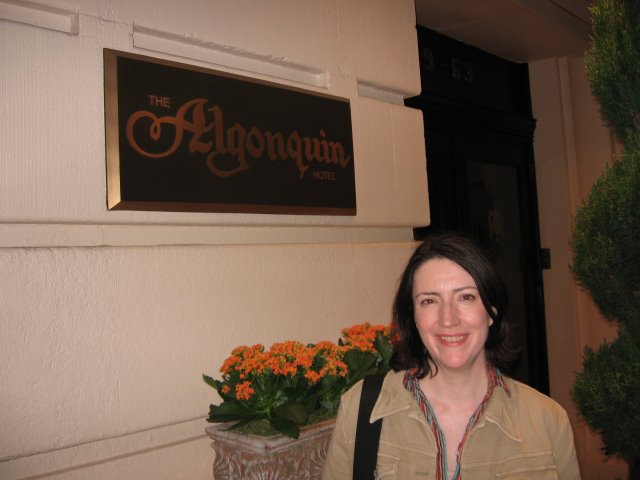
As for Rosemarie, she finally got to follow in the footsteps of her idol Dorothy Parker and enjoy a few cocktails at the Algonquin Hotel.
Visiting several of the city’s mystery bookstores yielded plenty of treasures. I snagged a copy of Damn Near Dead, the anthology edited by Duane Swierczynski. It’s signed by several of the contributors – but not, alas, by Bill Crider, Mr. Legible himself.
Friends provided plenty of suggestions for which Broadway show to see, but we arrived with our minds made up. We opted for Martin Short’s Fame Becomes Me, because we knew it would be funny. And we were right. Our celebrity mystery guest was none other than the former first lady herself. That’s right, Stockard Channing.
The cultural high point was the Edward Hopper exhibit at the Whitney Museum of American Art, which includes his immortal Nighthawks as well as all of Hopper’s studies for the painting. The culinary high points were too numerous to mention – although I have to single out S’Mac, which only serves macaroni and cheese.
Celebrities sighted: Philip Seymour Hoffman and Richard Belzer, both dining at outdoor cafes. The strangest encounter, though, occurred at the Whitney. Moments after leaving the gallery named for the family of Hollywood power broker Michael Ovitz, we passed the man himself - or a reasonable facsimile - in the museum’s lobby. Seeing such a rarified presence in the flesh was a bizarre, otherworldly experience, like spotting the devil at a pay phone. It raised the possibility that the world of movers and shakers was not as far away as you’d imagined.
Speaking of hidden universes revealed, here’s the secret to having a great time in New York: ask your best local bartender for recommendations on where to bend an elbow. The staff at the Zig Zag Cafe, Seattle’s finest, gave us a list of five spots and we hit ‘em all. By the time our trip was over we were semi-regulars. To be greeted like a friend by a roomful of strangers in the greatest city in the world is an experience like no other.
I’ve posted a few photos of the trip at Flickr, if you’re interested.
Update: Back At My Post
D’ja miss me?
This New York trip was pure bliss. Good times, great drinks, and promising news about several projects. I’ve got a lot of writing to do between now and the end of the year, but don’t worry. Regular posting will resume shortly. Possibly as soon as later today. There may even be photographs.
One observation before I collapse into bed: all commercial aircraft without individual seatback television sets should be grounded. If I can’t watch the Law & Order rerun of my choice while flying over the flyover states, I’d prefer to travel via catapult.
Thursday, October 05, 2006
Book: The Zero, by Jess Walter (2006)
It’s funny how you can have a proprietary interest in a writer. That’s how I feel about Spokane-based Jess Walter. I’ve been reading him since he started as a novelist, with Over Tumbled Graves and the heartbreaking Land of the Blind. He took home a much-deserved Edgar Award last year for Citizen Vince, and I thought: I knew him when. Sort of.
His follow-up novel, The Zero, is big, ambitious, and wild. How ambitious? It’s billed as a novel of September 12. How wild? It’s a comedy in the Joseph Heller mode, one of the blackest hue. It’d have to be.
New York cop Brian Remy was at the World Trade Center on the morning of September 11. He goes to work assisting in the clean-up until he shoots himself in the head. He’s pretty sure it’s an attempted suicide. But he doesn’t really know. Remy doesn’t really know anything anymore. He’s suffering from gaps in his memory, waking up in the middle of situations with no clear idea of how he got there.
That condition makes him the ideal candidate to undertake certain tasks for a top secret branch of the Office of Liberty and Recovery, charged with tracking down every piece of paper blown out of the Twin Towers.
Walter had a front row seat for much of what occurred in the wake of the attacks because he was helping then-NYC police commissioner Bernard Kerik with his memoirs. That access informs the book’s scabrous take on those early days. Politicians milk the tragedy for every advantage. Police officers complain about which celebrities they’re assigned to squire around Ground Zero, with Sarah Jessica Parker outranking a Yankees middle reliever. And the emotions stirred by events are commodified before they’re understood.
The book’s righteous anger finds the perfect vehicle in Remy’s stop-and-start perspective. It effortlessly conveys the nagging sensation that Remy – and the rest of us – have become caught up in something sinister without any understanding of what it is or how it can be stopped. The book’s sole misstep is a beautifully-wrought but on the nose paragraph that articulates:
“the general incongruity of life now – the cyclic repetition of events on cable news, waves of natural disasters, scientists announcing the same discoveries over and over ... wildly famous people who no one could recall becoming famous ... as if some faulty math had been introduced to all the equations, corrupting computer programs and causing specious arguments to build upon themselves, and sequential skips – snippets of songs sampled before their original release, movies remade before they came out the first time, victories claimed before wars were fought.”
I don’t know about you, but I feel like that all the time. Jess Walter wrote my favorite novel of last year, and he may have written my favorite of this one, too.
Update: Brief Hiatus
Time to head to New York for a little business and a lot of relaxation. Internet access remains a question mark. In the meantime, head over to the Links page and visit any of those fine bloggers. They’ll take good care of you.
Wednesday, October 04, 2006
Movie: A Sound of Thunder (2005)
Let’s just say that expanding Ray Bradbury’s classic short story wasn’t a good idea. The movie had a troubled production history (it sat on the shelf for several years), nowhere near enough money for special effects, and an unrealistic vision of the future. Like men’s hats would ever come back.
Early on Ben Kingsley, in a hairpiece that does not at all make him look crazy, launches into a stock speech about his company’s time travel technology. He compares it to “Columbus discovering America, Armstrong stepping on the moon, Brubaker landing on Mars.” It’s your classic science fiction variation on the triple, the dialogue equivalent of having someone drink something blue to remind us that our story is set in the future. Star Trek used this gambit regularly.
But the last part of the line stuck in my head. Brubaker landing on Mars? Why did that sound familiar?
Then it hit me. Growing up one of my favorite movies was Capricorn One, a thriller that riffs on the conspiracy theory that the moon landing had been faked. The commander of the movie’s phony Mars expedition is named Colonel Charles Brubaker. The film’s director? Peter Hyams, who also made Thunder.
I was way too excited about figuring this out.
Later, there’s a scene set in a store called Spota’s Market. It occurred to me that in the thriller The Presidio, directed by guess who, there’s a character named George Spota. (Don’t ask me why I remember this. I just do.)
Turns out that in several films written or directed by Peter Hyams, characters named Spota appear. And it also happens that talent manager/theatrical producer George Spota was Hyams’ father-in-law.
Clearly, I have seen too many movies. At least too many Peter Hyams movies. But discovering these connections made my day.
Monday, October 02, 2006
Movies: The Devil With Hitler (1942)/Nazty Nuisance (1943)
Sometimes, the cable gods are very, very good to me. This afternoon, they allowed me to stumble onto Turner Classic Movies’ double bill of Hal Roach oddities, in which Hitler, Mussolini and “Suki Yaki” (apparently, Japan’s WWII leadership had better representation) make like the Three Stooges. It’s the Axis of Hilarity! Think of Adolf as Moe, only more genocidal. But about as funny.
In the first film, Hell’s board of directors is so impressed with the Fuhrer’s moxie that they want him to take over their operation. The Devil Himself is forced to head topside and trick Hitler into committing a good deed. Number of laughs: one, when an American spy puts Adolf in his place by calling him “a cheap non-union house painter.”
The New York Times called Devil “as malodorous a film as has been placed on a Broadway screen in many a month.” Yet it proved popular enough to warrant a sequel. In Nazty, the fascist hijinkery moves to a tropic isle. At one point steam shoots out of Hitler’s ears, and later he and Mussolini have a pillow fight with a monkey. I am not making this up. Number of laughs: zero, but in a larger sense I was in hysterics the entire time.
Bobby Watson plays Hitler. In fact, he made a career of the role, donning the little mustache at least ten times. Mostly in comedies. What an odd career that must have been. “Get me that Hitler. No, the funny Hitler.”
The movies are fascinating, both tasteless and toothless; Saddam suffers far worse. I couldn’t begin to guess when they last aired on television. TCM is in the midst of a push to lure younger viewers with new programs like Underground, hosted by Rob Zombie. I just hope they continue to blow the dust off relics like these.
Sunday, October 01, 2006
Update: Shame-Faced Podcast
In the latest episode of the spin-off blog’s podcast, Rosemarie and I finally right a great wrong by watching Billy Wilder’s The Lost Weekend along with another classic treatment of alcoholism, Days of Wine and Roses.
For our straight-no-chaser conversation, direct download it here or get it at iTunes.
Book: Death’s Dark Abyss, by Massimo Carlotto (2004, U.S. 2006)
Great title, isn’t it? Read this in a coffee shop and have Goth chicks flocking to you. Assuming Goth chicks frequent coffee shops and engage in flocking behavior. I should look into that.
It’s been too long since I sang the praises of Europa Editions. I raved about The Goodbye Kiss, an earlier Carlotto title, in Mystery*File. His follow-up is every bit as strong.
A criminal takes a woman and child hostage during a botched robbery, killing them both. Fifteen years into a life sentence, he’s diagnosed with cancer and seeks a pardon so he can receive treatment outside the prison walls. Little does he suspect that the third victim of his crime, the husband and father he left bereft, will seize this opportunity for revenge.
Carlotto knows how to make a reader uncomfortable. He twists our automatic sympathy for the victim, who in this case is a man incapable of participating in life until his first taste of vengeance renders him a monster. By contrast, the criminal is a savvy, almost amiable hustler all too aware of the toll of his actions. The ending achieves a kind of shocking grace. This one is as spare (less than 150 pages!) and as dark as they come.
