Showing posts with label Sundays with Hitch. Show all posts

Wednesday, November 13, 2013

Movies: Lights, Camera, Hitchcock

Attending this summer’s run of Alfred Hitchcock’s surviving silent films was a mighty step toward achieving my goal of seeing every one of his movies. (And it gave me a new cocktail to try.) My Sundays with Hitch project covered many of the later suspense titles I’d missed, so only some of his early efforts remain. Thanks to Turner Classic Movies’ recent Sundays With Hitch project – no relation, but if they wanted to send a few bucks my way I wouldn’t say no – I was able to cross a few more entries off my list.

The film business essentially started anew when talkies came in. You can see that rough transition play out over a single career with Hitchcock. Even a single movie; he made silent and sound versions of 1929’s Blackmail, the former still supple and occasionally breathtaking, the latter frequently stilted. “The silent pictures were the purest form of cinema,” Hitchcock said, adding, “When we tell a story in cinema, we should resort to dialogue only when it’s impossible to do otherwise ... Dialogue should simply be a sound among sounds.” His early attempts to incorporate the new technology show flashes of the élan evinced in his most accomplished silent efforts like The Lodger and Blackmail, but for the most part he fumbled along like everyone else.

You know you’re in trouble as soon as 1931’s The Skin Game begins, the credits identifying it as “A Talking Picture by John Galsworthy.” And brother, do they talk. In this stuffy drama from Galsworthy’s play about rival families feuding over a piece of land, much of the dialogue – one character prefaces every utterance with “I say” – now reads as comic. When the plot finally generates some melodramatic momentum, it’s too late. Hitch’s sympathies clearly lie with the self-made sort played by Edmund Gwenn, or maybe it’s just that Gwenn manages to give a lively performance. So does Hitchcock favorite Phyllis Konstam as Chloe, the silly girl who pays the price for the machinations of the gentry. Whenever Hitch dispenses with dialogue, as in an auction scene or the local lord’s hellish vision of what will become of the real estate should he not acquire it, the movie briefly sparks to life.

The same is true of Rich and Strange, also from 1931. The opening sequence, showing the protagonist’s journey home on a rainy evening, unspools like an entertaining silent comedy. Then he gets there, and everything falls apart. A feckless young married couple, about whom it’s impossible to care, are given the resources to live the good life. They set out on an ocean voyage and in no time flat are eyeing other partners. The ‘strange’ portion of the title is bang on, as the movie’s tone varies wildly from limp comedy to knockoff Noel Coward to apocalyptic dread. Hitch gets to stage his finale on a sinking ship, but by then expectations have sailed over the horizon.

Tone isn’t the issue in Secret Agent (1936). It’s a Hitchcock movie through and through, following the template established in its predecessors The Man Who Knew Too Much and The 39 Steps. It’s the plot that’s half-baked and ultimately irrelevant in this oddball adaptation of W. Somserset Maugham’s Ashenden stories. John Gielgud’s novelist learns he’s been killed off by the British government, the better to be shanghaied into the intelligence service, and his response buries the needle on the “pip-pip, cheerio” meter. A full complement of Hitchcock set pieces is on display; when you hear Gielgud’s contact is an organist at a remote Swiss church you settle in, knowing what you’re going to get. The film doesn’t make a lot of sense and is disturbingly indifferent about collateral damage, but one must admire the verve. Best of all is Peter Lorre’s performance as an amiable psychotic who happens to be working on the side of the Union Jack. I couldn’t help thinking of the Lorre/Hitchcock relationship as a precursor to that between Christoph Waltz and Quentin Tarantino. Cast an Austrian-born actor as a villain (the original Man Who Knew Too Much, Inglourious Basterds) and fall so hard for his performance that you have him back to give it again, this time as a good guy (Agent, Django Unchained).

I’m down to Hitch’s curios and obscurities now. I intend to press on.

Thursday, August 01, 2013

Movies: The Hitchcock 9

The British Film Institute recently undertook the massive project of restoring all of Alfred Hitchcock’s surviving silent films. (Of the ten he made, only his second, 1927’s The Mountain Eagle, is lost.) The nine movies span and frequently combine genres, linked mainly by the director’s restless cinematic intelligence. The series is currently on tour, and recently wrapped up a run at Seattle’s SIFF Cinema. Where else would you expect your correspondent to be?

It’s a mixed bag of titles, but essential viewing for any Hitchcock fan. The thrills come from watching the director discover his voice, charting his burgeoning command of visual narrative, glimpsing the first Hitchcock blonde, his debut cameo. Adding to the experience was the performance of a live original soundtrack, making each screening a singular event.


Blackmail (1929). Czech actress Anny Ondra of the hugely expressive eyes is Alice, who slips away from her boyfriend to respond to the flirtations of an artist (a magnificently odious Cyril Ritchard). When he attempts to rape her, she kills him. Alice is still reeling from the discovery that the investigating detective is her boyfriend when a criminal who witnessed everything threatens to destroy them both unless they pay up. A masterful piece of work, stronger than Hitchcock’s more celebrated The Lodger. It already shows the director’s love of climactic set-pieces with a chase through the British Museum achieved through camera trickery, and features an unsettling ending that never would have passed muster at a U.S. studio. Hitch made a sound version simultaneously, with Ondra lip-syncing dialogue spoken by off-camera actress Joan Barry. That version closes SIFF’s tribute tonight, but having seen this gorgeous print of the silent film I’m in no hurry to watch a weaker iteration. The soundtrack was by Diminished Men, their music described as a combination of Link Wray and Ennio Morricone. Not what one typically associates with Hitchcock but their surf noir sound worked wonderfully, adding a contemporary dimension to a nearly-85-year-old film that remains plenty lively on its own.

The Farmer’s Wife (1928). Billed as a comedy but steeped in sadness. A gentleman farmer and widower watches his daughter marry and leave home. Afraid of spending the rest of his days alone, he and his devoted housekeeper draw up a list of eligible women, and the farmer goes a’-courtin’. Once romance is in the offing the stoic farmer becomes a stubborn, hapless fool, forever saying the wrong thing. The women who are his quarry are given definition, each spurning him for her own reasons. This warm and funny film, also a gentle burlesque of village life, was the find of the festival, abetted by the strongest soundtrack. Violinist Julie Baldridge and a DJ whose name I didn’t catch played in deft counterpoint, the DJ using samples to serve as motifs for the characters.

The Pleasure Garden (1925). Hitch’s first film, made when he was twenty-five, is a strange one. It begins as a backstage melodrama, with a penniless chorine arriving from the sticks only to be watched over by “poor but honest” Patsy Brand. Then it becomes a bizarre tale of Far East survival. I wish it had stayed in the theater, a proto-Showgirls. You can tell from the opening shot of chorus girls’ legs that’s where Hitchcock’s heart lies. A jumble goosed along by an inventive, multi-instrument soundtrack courtesy of Miles & Karina.

The Ring (1927). Hitch’s boxing drama was the film I was most excited about, so naturally it proved the biggest disappointment. Like many of his early efforts it’s a love triangle, about a carnival fighter signed to be the sparring partner for an up-and-coming heavyweight – only to have the champ fall for his wife. While the midway milieu feels authentic and lived-in, the boxing world (aside from the use of champagne to spritz the pugs between rounds) is never remotely believable. And there’s not enough boxing. The cello/vocal score emphasized that The Ring is a chamber piece and only made a constrained film seem even smaller.

Downhill (1927). Schoolboy honour leads to disgrace. Then-heartthrob Ivor Novello, fifteen years too old for the role, willingly besmirches his own name to save a chum’s and winds up a taxi dancer in the south of France. It’s impossible to tell how seriously to take this story when Hitchcock himself seems to be playing it for laughs. Further complicating my reaction was the soundtrack, provided by a local DJ and the one authentic misfire. The DJ wasn’t scoring the film so much as commenting on it, playing obvious yet inappropriate selections (The Police’s ‘Don’t Stand So Close To Me’ during scenes of schoolroom romance) and banking on the audience’s associations with tracks by the Doors and Rihanna. Worse, of all the films in the series Downhill has the most opportunities for music to make an impact given its structure and the DJ squandered them all, settling for glib choices. SIFF’s programmers deserve credit for thinking out of the box, but here the music nearly overwhelmed Hitchcock’s artistry.
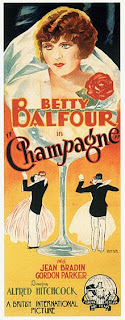
Champagne (1928). Screwball Hitchcock, complete with runaway heiress. Betty Balfour is the flapper who finally pushes her wealthy father to the point of feigning poverty – but that only unleashes the girl’s inner moxie. The sole surviving print is a back-up consisting of second-best shots and takes, but even B-level Hitchcock has its charms. Featuring Rosemarie’s new all-time favorite line of dialogue: “I’ve met some lively people, invented a cocktail, and bought a lot of snappy gowns!” Harpist Leslie McMichael contributed a suitably effervescent score.

The Manxman (1929). Anny Ondra again stars in yet another triangle drama set on the Isle of Man. Possibly the best-looking film of the bunch, but a one-note melodrama only occasionally enlivened by the director’s eye, and with too many instances of histrionic “silent movie acting” by the male leads. Another cello/vocal score, heavy on the keening, only underlined how frightfully intimate the action is.

Easy Virtue (1928). The restoration of this adaptation of Noel Coward’s play was struck from a 16mm print with more than fifteen minutes whittled out of it. As such it feels fragmentary, only hinting at the expansive approach to the source material. Another fine Miles & Karina score helped.

I skipped 1927’s The Lodger because I’ve already seen it, it didn’t feature live music (instead using a recording of the BFI-commissioned score), and nine movies in three days is too much even for me. SIFF continued the Hitchcock tribute with a selection of his early U.K. films. I ventured back to the Uptown for a few that I’d missed.

Murder! (1930). A famous actor (Herbert Marshall) seated on a jury reluctantly votes to find a fellow thespian guilty of the title offense, then applies the tools of his trade to clear her name. A who-done-it was not the ideal vehicle for exploring the use of sound in a movie. Hitchcock occasionally succeeds, as in a multi-party interrogation set in the wings of a theater during a play, and even pushes what the medium was then capable of; to achieve the relatively simple effect of having Marshall hear his thoughts while listening to the radio, Hitchcock played a recording of the actor’s voice while an orchestra thundered on the other side of the set’s wall. More often than not, though, the new technology results in scenes in which dialogue is barked too fast to be processed. And the plot is ridiculous. The curio does have a tip-top big top climax, though.

Number Seventeen (1932). An old dark house story. Mysterious characters – including a hobo best described as The Wire’s Dominic West meets Gollum – turn up at said structure, all lying about who they are. Hitchcock wasn’t a fan of the original play and didn’t want to direct the film, so his solution was to treat the entire enterprise as a joke, piling on the twists and keeping the pace moving. It’s a fleet hour of gimcrack nonsense culminating in a daring race between a model bus and a model train. Once I embraced its silliness, I had a fine time.

Young and Innocent (1937). By the time Hitch made this film, which he felt great affection for, he’d already become ‘Alfred Hitchcock’ with the original The Man Who Knew Too Much, The 39 Steps and Sabotage. He’d reached the point where he was capable of tossing off bon-bons like this – about a wrongly accused man on the run, a favorite theme – effortlessly. Sly, flirtatious banter, barbed send-ups of social mores, and multiple bravura shots. It’s a Hitchcock movie, fully formed, and he’d be in America soon enough. With the divinely named Nova Pilbeam.

Friday, May 27, 2011

Sundays with Hitch: The Man Who Knew Too Much (1934)

Alfred Hitchcock is on the short list of directors who remade their own movies. The second version of The Man Who Knew Too Much is a globe-trotting adventure featuring a big star in James Stewart plus money and style to burn. It’s also one of the only Hitchcock films that I find boring.

The original is a full forty-five minutes shorter and a very British affair indeed. It shares the same basic plot as the remake. You’ve got a couple on holiday with their child. They befriend another man who is murdered – and with his dying breath reveals himself as a spy. The couple retrieve information the dead man was carrying about a planned assassination. The plotters kidnap the child in order to guarantee their silence. Can our heroes save their offspring and the day?

Hitchcock said the 1956 version was better, calling it the work of a professional while the first film was made by a gifted amateur. If that’s the case, give me the gifted amateur every time. The command Hitchcock demonstrates in the years since The Lodger is astonishing, never more so in the famous Albert Hall sequence. It’s to be the site of the assassination. The conspirators (led by Peter Lorre with a skunk stripe in his hair and speaking his lines phonetically) listen to the concert on the radio, waiting for the fatal gunshot. Jill Lawrence (Edna Best) has slipped into the hall, desperate to foil the scheme but fearful that her daughter and husband will be killed if she does. Hitchcock briefly lets the film go out of focus as tears of frustration fill her eyes. Then Jill finds a suitably Hitchcockian way to prevail.

There are terrific set pieces prior to this. Bob Lawrence (Leslie Banks) showing resourcefulness at the office of the dentist who’s one of the villains, an extended sequence at a church where Bob and his pal Clive (Hugh Wakefield, bearing the stiffest of upper lips) try to blend in with the baddies. When the Lawrences resist entreaties to help the authorities they’re asked if they would have shown similar indifference toward the prospect of averting the death of Archduke Ferdinand, a speech given extra teeth considering that the events of Sarajevo were only twenty years earlier. The climactic shootout, modeled on a famous London showdown between police and anarchists in 1911, drags a bit and seems to be headed toward a grim outcome until you realize that Hitch is going to make every detail count. This was the first of the remarkable run of 1930s films that would bring Hitchcock to Hollywood’s attention, and it’s easy to see why.

Friday, May 20, 2011

Sundays with Hitch: Dial M for Murder (1954)

Welcome to a very special installment of Sundays with Hitch.

The point of this series is for me to watch the Alfred Hitchcock films that I’ve missed. Rosemarie’s list of such titles is far shorter. The early English movies that are my biggest Hitchcock blind spot? She’s seen ‘em all. She even took a class taught by Donald Spoto, Hitch’s most prominent biographer. A few of the movies we’ve watched so far were new to her – good luck finding people who have made it through Topaz – but many were old favorites.

Dial M for Murder is different. It’s the only Alfred Hitchcock film that I had seen but Rosemarie had not.

In the opening minutes of this adaptation of Frederick Knott’s stage thriller, Hitchcock manages to convey a complicated story of infidelity without dialogue. Tony Wendice (Ray Milland) could easily be Strangers on a Train’s Guy Haines a couple of years down the road, a one-time tennis pro who married well but now finds himself trapped in an unsatisfying job. Worse, the man his wife (Grace Kelly) truly loves – successful American mystery novelist Robert Cummings – has returned to England intent on winning her over. In a scene so long it becomes as thrilling as a high-wire act – how long can Hitch keep this up? – Wendice blackmails an old school chum into bumping off the missus and lays out how it’s to be done. But that only marks the start of Milland’s scheming, in a performance that reaches spectacular heights of both cunning and odiousness.

When I saw the film as a teenager I dismissed it as a lesser effort, thinking it stagy. But I was an idiot then. I disavow most of what I said in the 1980s. Hitchcock doesn’t make the expected attempt to open up Knott’s play, keeping the action almost entirely in the Wendices’ flat and using the claustrophobia to his advantage. He relishes every bit of Knott’s stagecraft no matter how hokey; he practically imposes a proscenium arch over the closing moments, making you appreciate how effective the piece must have been when performed live. John Williams reprises his Tony-award winning performance as Inspector Hubbard, the blandly implacable detective. There’s more than a hint of Lieutenant Columbo in the character, right down to the “one more thing” question as he’s heading out the door. The film was shot but not initially released in 3-D. To think that audiences missed all the excitement of a key going into a lock.

For the record, Rosemarie thought it was great.

Thursday, May 05, 2011

Sundays with Hitch: Mr. & Mrs. Smith (1941)

Time now for the most atypical film Alfred Hitchcock ever directed. There’s plenty of humor in his work, provided you take it dark. (See: Harry, The Trouble with.) But Mr. & Mrs. Smith marks Hitch’s sole foray into screwball comedy.

Robert Montgomery and Carole Lombard play a couple given to epic feuds and equally epic reconciliations. They learn separately that, owing to a legal oversight, they are not technically married. Thanks to assorted miscommunications, Lombard decides she’s in no hurry to tie the knot again. Hitchcock doesn’t break a sweat selling screenwriter Norman Krasna’s premise, wisely realizing that you’ll either buy it or you won’t.

There’s not enough of the nimble Jack Carson as the hound sharing Montgomery’s doghouse. Once Montgomery’s law partner Gene Raymond expresses romantic interest in Lombard, we get a lot of Southern-fried hokum, including a casual reference to “white trash,” and a shrill third act. And that goddamn whistling on the soundtrack? I never need to hear that again.

But a comedy, like a thriller, can be judged on the basis of its set pieces, and Mr. & Mrs. Smith features a pair of beauties. The first occurs when Montgomery arranges to meet Lombard at their former favorite restaurant to re-pop the question, only to discover that the old joint isn’t quite the same. The tone is both funny and wistful – maybe the restaurant isn’t all that’s changed – and Montgomery has some great business with the house cat. Even better is a hilarious extended sequence at a nightclub involving a “high class girl” named Gertie and a self-inflicted nosebleed. Factor in an effervescent performance by Carole Lombard, who would prove the most tragic of Hitchcock blondes, and the movie certainly merits a look.

Thursday, April 28, 2011

Sundays with Hitch: The Lodger (1927)

The Lodger isn’t Alfred Hitchcock’s first movie. It’s just the first “Alfred Hitchcock” movie. Not only did it announce him as a singular talent, it sounded many of the notes that he would play like a virtuoso for decades: the hounded innocent, romance blossoming amidst suspicion, the merging of sex and danger, the personal cameo, and blondes blondes blondes.

So how was I introduced to it? As a poorly transferred bonus feature on a lousy DVD of Sabotage. The launch of one of the great cinematic careers reduced to an afterthought.

The poor quality of the print was soon forgotten, though. A serial killer calling himself “The Avenger” claims his latest fair-haired victim, and word spreads like a contagion. Even the title cards in this silent film are disturbing. MURDER wet from the press, one cries as the tabloids feast on the story, followed by MURDER hot on the aerial as fearful people crowd around radios. There’s a lurid, lip-smacking glee to this coverage of the coverage that remains almost unseemly. Which, need it be stressed, is intended as a compliment.

The title character (heartthrob Ivor Novello) takes a room in the house owned by the parents of lovely blonde Daisy. Our heroine isn’t afraid of the killer lurking in the London fog, possibly because she’s seeing a policeman. Although that should be of little comfort, considering he resembles the sort of unfortunate chap described by Rowan Atkinson in Blackadder’s Christmas Carol as “the fish course.” Daisy and the mysterious stranger grow closer while Inspector Haddock fumes. When The Avenger strikes again, Daisy’s parents begin noticing their tenant’s unusual hours.

It would be churlish to complain about the occasional creakiness of the plot, taken from Marie Belloc Lowndes’ novel. The movie holds up astonishingly well, and the true thrill lies in seeing Hitchcock’s command of the medium so early. Daisy and her parents are adjusting to the idea of their new boarder when they hear him pacing the floor upstairs. Hitchcock shows us the ceiling – which then vanishes, revealing the soles of Novello’s shoes as he stirs relentlessly. And the ending is a still-chilling depiction of mob violence.

A far better DVD than the one I watched was released as part of the Alfred Hitchcock Premiere Collection in 2008. At some point I’ll seek it out. The Lodger is fascinating enough to watch more than once.

Thursday, April 21, 2011

Sundays with Hitch: Sabotage (1936)

Sabotage is based on Joseph Conrad’s novel The Secret Agent. It’s not to be confused with Secret Agent, another Alfred Hitchcock film from 1936, adapted from W. Somerset Maugham. Or with Saboteur, which Hitch made in 1942. Also, Sabotage was released in the United States as The Woman Alone. Any questions?

Charles Bennett’s screenplay loosely follows Conrad’s book, shifting the focus from Mr. Verloc (Oscar Homolka), a foreigner in London who has allied himself with a group of terrorists, to Verloc’s gorgeous young wife Sylvia Sidney. This change facilitates, if not quite a happy ending, at least a happier one than Conrad’s. Sylvia wants to be loyal to her husband, but doubts are stirred by an undercover detective masquerading as a greengrocer (John Loder).

The previous year’s The 39 Steps is a film that simultaneously invents and perfects an entire genre. Hitch is up to similar tricks here, building the template thrillers still follow. He stages a meeting between Verloc and his handler in the London Aquarium that prefigures decades’ worth of clandestine rendezvous in public places. (Hitch ends the scene with Verloc’s dream of the city in ruins envisioned in the glass of a fish tank, a potent moment achieved with an ingenious use of stock footage.) He cleverly integrates the movie theater that Verloc owns into the proceedings, and builds a real feel for the bustling London of the period.

Sabotage is best known for the sequence that illustrates Hitchcock’s classic dictum about the difference between suspense (There’s a bomb on that bus! When is it going to – ka-BOOM!) and shock (ka-BOOM!) Audiences at the time were upset by this passage of the film, and Hitchcock later told Francois Truffaut that he regretted including it. The scene still works beautifully, so much so that the remainder of the movie feels muted. We know we’ve already seen the worst that will happen. And yet nothing in that storied sequence is as unsettling as a simple off-center close-up of Sidney’s extraordinary face, her eyes looking nervously to the left as her questions begin to grow.

Oh, and birds in Hitchcock movies? Always bad.

Thursday, April 14, 2011

Sundays with Hitch: Jamaica Inn (1939)

Alfred Hitchcock made three films based on the work of Daphne du Maurier. One is Rebecca (1940), Hitch’s American debut and his only Best Picture winner. Another is The Birds, which remains a signature work. It’s the least known of the bunch that concerns us today.

Jamaica Inn was the last movie Hitchcock made in England before heading for the bright lights of Hollywood. Speaking of bright lights, there aren’t any on display here. Jamaica Inn is in the public domain, and the available prints on DVD aren’t of the highest quality. The one I saw was murky and missing almost ten minutes of footage, a gap not mentioned anywhere on the disc. Which is unfortunate, because while Jamaica Inn is far from top-shelf Hitchcock it’s still entertaining. At any rate, it’s better than the movies watched the last few Sundays.

A battery of fine writers adapted du Maurier’s novel: Sidney Gilliat (Hitch’s The Lady Vanishes and the wonderful Green for Danger), regular Hitchcock collaborators Joan Harrison and Alma Reville (aka Mrs. Hitchcock), with additional dialogue by J. B. Priestly. We get off to a brisk start: a band of scalawags douses beacons along the rocky Cornish coast as a ship approaches, then loots the wreck and butchers the survivors. Into this wretched hive of scum and villainy rides the virginal Mary (Maureen O’Hara). She’s meant to live with her aunt and uncle at the hostel of the title, but the place is so disreputable that the coach abandons her by the side of the road. Local nobleman Sir Humphrey Pengallan (Charles Laughton) comes to her aid. Things turn a bit stagy once Mary arrives at the inn and realizes that her uncle has thrown in with the rogues. More reversals follow, none surprising and none really supposed to be.

Laughton is the entire show here, at times to the movie’s detriment. He seems to have found a way of enlarging his forehead, giving his eyebrows more room to roam. His performance verges on being a cartoon, but Laughton tethers it to reality; Sir Humphrey needs money, he explains, because he knows how to spend it. The result is perhaps the first great villain in the Hitchcock canon, one who meets a fitting end. The movie’s rousing last act makes up for the earlier lulls with frantic horse chases via moonlight and a grand harbor-set climax.

Hitchcock and Laughton sparred frequently, with Laughton practically taking over production. Du Maurier disliked the movie so much that she almost withheld the rights to Rebecca. She fortunately changed her mind, and Hitchcock and Laughton eventually worked together again on The Paradine Case. (And we all know how that turned out.) Enough of Hitch’s panache survives to make Jamaica Inn worthwhile ... if you can find a complete version.

Thursday, April 07, 2011

Sundays with Hitch: Under Capricorn (1949)

Comes now another title from the middle of Alfred Hitchcock’s filmography that tends to provoke blank stares. Let’s find out why, shall we?

The costume drama begins with Michael Wilding as a young wastrel arriving in Australia. (Oh, under Capricorn. Now I get it.) He’s instantly befriended by the unfortunately named Samson Flusky (Joseph Cotten), ex-convict turned wealthy landowner, who offers to set Wilding up in a shady deal that will make his fortune. Things turn promisingly lurid as Wilding arrives at Casa Cotten and finds the maid whipping the household retainers. But then he meets Lady Flusky (Ingrid Bergman), a childhood friend now drunk and unstable, still reeling from the scandal of having married Cotten, a mere groom. Wilding, with Cotten’s blessing, sets out to reintegrate Bergman into society but in the process various ardors are flam’d and past sins confess’d.

We’ve got three main characters who are supposed to be from the Emerald Isle played by an Englishman, an American and a Swede. This non-Irish stew of accents tackles a talky script containing some true howlers; at one point Bergman, in loon mode, cleaves to a staircase and says, “Now I have the balustrade. Good old balustrade.” Her affections toward the two men in her life go through a few too many unmotivated reversals. The rest of the plot unfortunately echoes Rebecca, and while Margaret Leighton’s maid is no Mrs. Danvers she still gives the film’s strongest performance.

Hitchcock again used 10 minute takes as he did in the previous year’s Rope, but for all the fluid movement of the camera in and around Cotten’s cabin the sequences call attention to themselves. The best moments are less ostentatious: Wilding using his coat to turn a window into a mirror for Bergman, a shot that holds on Cotten’s hand holding a necklace behind his back that he is at first eager to present as a gift and then desperate to hide.

Ultimately, Under Capricorn is a disappointing, static film from a period when the bloom had gone off the Hollywood rose for Hitchcock. Things would soon improve; Strangers on a Train, which depending on the day you ask may be my favorite of Hitch’s movies, is only two years in the future. But I’ll be moving into the past and watching some of Hitchcock’s earlier English films next.

Wednesday, March 30, 2011

Sundays with Hitch: The Paradine Case (1947)

First lesson: It’s pronounced Para-DEEN, not Para-DINE. I’ve been getting the title of this Alfred Hitchcock courtroom drama wrong for years.

Second lesson: Never let it be said that Hitch didn’t make a bad movie. Because The Paradine Case stinks on ice. How bad is it? I didn’t turn it off, because I vowed to watch every Hitchcock film and I pride myself on being thorough. But a Scrabble board did make an appearance partway through the proceedings.

Maddalena Paradine is accused of poisoning her much older retired colonel husband. He was also blind, because if you’re gonna stack a deck you might as well shoot the moon. Her attorney is Gregory Peck, who promptly falls for Mrs. Paradine and compromises both his marriage and her defense. The rest is hokum; it’s a strain on my memory to recall even that much of the plot.

Paradine was the last collaboration between Hitchcock and producer David O. Selznick, and the tension in their relationship is evident in the film. Selznick is credited with the screenplay, and if ever a movie was written by its producer this is it. Critical events happen off-screen and are relayed to us after the fact. Peck’s wife and her friend Greek chorus their way through the trial, underlining the blatantly obvious for those not paying attention (maybe because they’re too busy trying to land on those coveted triple word score squares). And Peck’s feelings for his client are never dramatized, simply asserted.

The casting, a bone of contention between Hitchcock and Selznick, further compromises the movie. Peck is wildly out of place as a barrister. I know actors and audiences weren’t as particular about accents then, but hearing that oh-so-American voice break out the m’lords is too much. Selznick discovery Alida Valli never registers as the alleged object of his affection, the worst-written part in the film. And how do you underuse Charles Laughton?

The few overtly Hitchcockian flourishes – shadows of clouds scudding across Valli’s face during an interview with Peck – come across as desperate attempts to liven up staid material. A passage where Peck visits the forbidding Paradine estate briefly grants Hitch firm footing on the Gothic ground he knew so well, but it’s too little too late.

An interview with the director excerpted on the DVD reveals that he essentially disowned the film because of Selznick’s interference throughout production. I hereby do likewise. Making matters worse, I also lost at Scrabble.

Thursday, March 24, 2011

Sundays with Hitch: The Trouble with Harry (1955)

Everyone has their limits, some act of cruelty that they don’t care to see rendered onscreen. For me it’s any disrespect paid to a dead body. I’ve never watched Weekend at Bernie’s for that reason. Much less Weekend at Bernie’s II. My God, what that poor man went through …

It’s therefore a sign of Alfred Hitchcock’s skill that I was able to enjoy his black comedy The Trouble with Harry, in which the entire plot revolves around a corpse that is buried and dug up repeatedly.

Gorgeous credits establish the mood, Bernard Herrmann’s first score for the Master playing over a child’s drawing of the bucolic setting in which mystery man Harry turns up stiff. We transition to the leafy magnificence of the Vermont locations, the screen bursting with color. Harry’s dead up in the woods, and most of the local residents have a reason to blame themselves for his demise. Hence the repeated spadework.

Harry has a very English feel - that’s where the original novel by Jack Trevor Story unfolded - and would function better in that setting. The dynamic in the town would certainly make more sense, as would the madcap painter who comes across as a neo-Beat. Cary Grant or David Niven, for instance, would have been ideal. (Dream actor for the role: Leslie Howard.) Still, the very American John Forsythe does his best with a tricky characterization. And the rest of the cast – Edmund Gwenn, Mildred Natwick, and especially Shirley MacLaine in her screen debut – is perfect.

The shenanigans start out as arch, occasionally veering into twee. But Hitchcock eventually establishes a more interesting tone, using fades between scenes to lend the film the feel of an adult fable. By the close, it has struck a note of silliness spiked with gravitas. Life goes on in the midst of death, and Hitchcock finds the notion both right and rather amusing. Harry is a slight bit of business, but it’s a film no one else could have pulled off.

Friday, March 18, 2011

Sundays with Hitch: Topaz (1969)

In conversations about Alfred Hitchcock, Topaz doesn’t come up. It’s not one of Hitch’s weird psychological movies like Marnie that has a cadre of ardent admirers. It’s simply never mentioned. Going in, I wasn’t even sure what it was about.

It’s about the Cold War, inspired by a scandal that occurred in the run-up to the Cuban Missile Crisis. It’s about two and a half hours long. Considering that it’s based on a novel by Leon Uris, whose books snap the needle on the Michener meter, that’s no small accomplishment on the part of Hitchcock and screenwriter Samuel A. Taylor (Vertigo).

The globetrotting thriller opens in Copenhagen, with a Soviet official and his family defecting to the U.S. in the care of intelligence operative John Forsythe. Upon learning about the Russians’ plans in the Caribbean, Forsythe reaches out to a French counterpart (Frederick Stafford) for assistance. Stafford journeys to New York, Washington and Cuba to confirm the threat at great risk to both life and career. He then returns to Paris where he must square off against the title spy ring, a group of officials in his own government who are relaying information to Moscow.

In many ways Topaz feels like Hitchcock’s reaction to his disappointments on his previous film Torn Curtain. The studio forced stars on him; here he relies on a cast of little-known European actors. There is no love story. Stafford and his wife are jaded sophisticates, each having an affair that has bearing on the plot. Hitchcock puts the narrative squarely at the center, emphasizing tradecraft and the incremental gathering of knowledge and not his flamboyant visuals. He allows himself one “Hitchcock” moment in the Cuba section, a dazzling overhead shot granted additional impact because it stands alone.

The director’s genius expresses itself in more subtle ways. Like the cunning use of silence during the set piece in Harlem, where the Cuban legation to the U.N. stayed. We don’t hear Stafford’s instructions to his agent Roscoe Lee Browne, and when Browne tries to suborn a Cuban official we watch their conversation from across the street, filling in the blanks ourselves. Hitchcock takes this adult approach throughout.

Poor responses during test screenings led to changes in the film’s ending. The DVD print uses the climax Hitchcock preferred, but the disc includes the intriguing original coda and the slapdash one put together for the American release. Watching the Washington scenes I became convinced that several of the same locations were used in the Coen Brothers’ Burn After Reading. It’s the kind of oblique tribute I wouldn’t put past those scamps.

Topaz is low-key but consistently engrossing, a procedural with a markedly Continental feel. It’s atypical Hitchcock, more akin to The Day of the Jackal than any of his own films. Hitch partisans may not care for it, but I do.

Thursday, March 10, 2011

Sundays with Hitch: Family Plot (1976)

Alfred Hitchcock’s final film has its admirers, including Rosemarie. I don’t know why I’d never seen it. Maybe it’s because I’m a fan of Hitch’s previous movie Frenzy and wish that had been his curtain call: a psychological thriller brimming with black humor and shot on the streets of London. Or maybe I’m still holding out hope of a comeback, that somehow there’ll be another new Hitchcock. But I don’t abide magical thinking. Let’s put this one to bed.

Family Plot announces itself as an odd duck from the start. Barbara Harris (wonderful) plays a bogus psychic whose spirit guide sounds a lot like Sydney Greenstreet. A client offers her ten thousand dollars to find a nephew put up for adoption decades earlier so that he can be made an heir. Harris’ cab driver boyfriend (Bruce Dern) turns out to be a decent detective, and soon is on the trail. But the nephew, played by William Devane, has been a bad boy – he’s carrying out a series of shrewdly orchestrated kidnappings with his girlfriend Karen Black – and is in no hurry to be found, blithely unaware that the bumbling twosome dogging his steps can make him legitimately wealthy.

The cast is the film’s best feature. Considering Devane played this silky psychotic the same year as his memorable turn in Marathon Man, it’s a wonder he ever worked again. (Devane said Hitchcock’s main direction was “think William Powell.” When Devane proved initially unavailable, Hitchcock cast Roy Thinnes in the part. Thinnes still appears in several long shots.) The script by Hitch’s North by Northwest cohort Ernest Lehman has a rambling quality suitable to its time that occasionally verges on Altmanesque, especially whenever Dern’s loquacious loser is onscreen. Hitchcock underscores the seedy vibe by shooting in nondescript corners of the Northern California landscape he loved.

At this point Hitch was set in his ways. The rear projection he insisted on using looks terrible and feels woefully out of place in a film made in the 1970s. A comic car chase is simply leaden. But Hitchcock could still work his magic. A slow-building crane shot at a cemetery keeps Dern and his quarry in the frame to amusing effect. And the wit and playful spirit is intact. Family Plot is a shaggy dog story of a movie, taking its time to reach a payoff that’s never in doubt. But the trip is an engaging one. There are worse ways of leaving the stage.

Friday, March 04, 2011

Sundays with Hitch: Torn Curtain (1966)

A particular scene in Alfred Hitchcock’s Torn Curtain came up in reference to a project I’m working on. I’d seen the sequence in question several times – it’s one of those signature Hitchcock moments that is regularly excerpted and studied – but never in context, because Torn Curtain is one of the Hitchcock films that I’d missed. I set out to rectify that at once. And because I never do anything in half-measures, desperately crave structure, and need something to stave off the crippling ennui that attacks at the end of every weekend, I decided to devote Sunday evenings to Hitchcock films that are new to me, along with some that I want to revisit.

Torn Curtain finds Hitch working with a script credited to the brilliant novelist Brian Moore and indirectly inspired by l’affair Guy Burgess. Physicist Paul Newman arrives for a conference in Copenhagen with his assistant/fiancée Julie Andrews but then takes an unannounced detour to Berlin, where he defects. A flummoxed Andrews follows him, but of course our all-American boy isn’t really switching sides. He’s simply taking a brief foray behind the Iron Curtain to see what the Reds know about missile defense. It’s a deeply flawed premise: Newman’s harebrained scheme is without government sanction, aided only by a poorly-defined civilian intelligence network. And it’s all so Newman can steal information from the Russians that he can’t figure out on his own. Not exactly the strongest position to put our protagonist in.

The script is a series of set pieces, the best of them the one I already knew. At a secret meeting with his contact Newman is surprised by his Stasi handler and must take drastic action to keep his ruse alive. Done without music, it’s a lengthy, grueling sequence meant to demonstrate how physically difficult it is to kill someone. Hitchcock at his best, this passage makes Torn Curtain worthwhile all by itself.

The other set pieces are good ideas in theory – a slow-motion chase involving a bogus bus operated by the intelligence network, a bit with Lily Kedrova as an exiled Polish noblewoman who may or may not aid Newman and Andrews in their escape to the West – but muddled in execution. The climax cleverly pays off a running gag about a prima ballerina, but is too reminiscent of the ending of The Man Who Knew Too Much. That the stars have little chemistry doesn’t help matters. Both leads were forced on Hitchcock by the studio. In addition, he had a falling out with longtime collaborator Bernard Herrmann that ended their relationship.

It was a troubled production, and the seams show. Aside from one episode of brilliance Torn Curtain is a misfire. It’s utterly impersonal yet thoroughly competent. Even when Hitchcock’s heart wasn’t in his work and he clearly feared losing his way, he was still able to bring his talent to bear. Which makes Torn Curtain thrilling in a completely different way.