Showing posts with label TV. Show all posts

Thursday, May 11, 2023

Walking That Line

I’m on strike at the moment, and that moment may last a while. Might as well keep limber by making a few recommendations.

What I’m Watching

Rabbit Hole (Paramount+). I waited until all eight episodes of the first (only?) season of this show dropped to make sure it stuck the landing. It did, so now I can say this Kiefer Sutherland series is the best thing I’ve seen on TV in a while, and stronger than any thriller novel I’ve read recently. And I won’t tell you why.

Doing so would spoil the fun. More than one episode of Rabbit Hole ended with a reveal that had me saying “What the fuck?” aloud to my TV. But every twist feels organic, thanks to the show’s devilishly intricate structure and to its premise. Sutherland’s John Weir specializes in shaping perceptions to aid his corporate clients, his tactics and slippery morals perfectly illustrated in the extended sequence that opens the premiere episode; right off the bat, you’re advised not to trust what you see. An old friend hires Weir and his team for a job that ends with Weir framed for murder. Where the show goes from there is … well, you’ll have to watch for yourself.

Rabbit Hole is consistently funny, which shouldn’t have surprised me considering it’s the brainchild of Glen Ficarra and John Requa (Bad Santa). They write beautifully for Sutherland, wringing laughs out of his gruff persona. The show’s sensibility and Weir’s character are established in this early exchange between Weir and the FBI agent determined to take him down.

FBI Agent: Corporate espionage is a dirty way to get rich.
Weir: Espionage? What are you talking about? I’m not a spy.
FBI Agent: Manipulating people and situations to influence markets for client advantage is … what, then?
Weir: Consulting.

A sequence when Weir, the target of a city-wide manhunt, strolls into a New York police station to see the “evidence” against him is a marvel of low-tech deception and social engineering. And a running gag involving Kiefer and hammers got me every time.

But the show also succeeds as a thriller, tackling thorny topical subject matter in a manner that consistently raises the stakes. The supporting cast is richly idiosyncratic, and when the actor playing the show’s Big Bad finally showed their face, I was ecstatic. (And even that reveal has a reveal.) If the show doesn’t return, its sole season goes into the books a winner, ending on a perfect note of 1970s-style paranoia.

Paramount+ may be primarily known for Yellowstone and Star Trek spinoffs, but it’s also the home of The Offer (my favorite show of 2022) as well as the bonkers Catholic X-Files, better known as Evil. That’s a solid batting average for a streaming service.


Transatlantic
(Netflix). I wrote about it in my guise as Renee Patrick, but nowhere near enough people are paying attention to this lush limited series, so I’ll also laud it here. It’s about the ragtag efforts of the Emergency Rescue Committee to transport artists from Europe to the United States in 1940. Like Rabbit Hole, it employs a tone you don’t expect; it’s light and even fizzy, which only lends the dark moments more impact. Watch it for Justine Seymour’s costumes, each and every one a knockout, and the haunting score by Mike Ladd & David Sztanke.

What I’m Reading

The Pitfall, by Jay Dratler (1947). The 1948 film noir Pitfall has been rediscovered, due in part to the efforts of my friend and colleague Eddie Muller. It also stands out by having a femme fatale who’s no seductress, but a woman simply trying to do her best. It’s not the fault of Mona, played by Lizabeth Scott, that men are drawn to her, like bored suburban family man/insurance investigator Forbes (Dick Powell) and sleazy stalker shamus Mac (Raymond Burr). The source novel is by Jay Dratler, who didn’t work on the film but whose own impressive string of noir credits includes the Hitchcock knockoff Fly-by-Night (1942) and Laura (1944). Dratler’s book is back in print, part of Stark House Press’s Film Noir Classics line. (Hat tip to Saturday Evening Post columnist Bob Sassone for reminding me about this series.) Reading it is an object lesson in adapting material, particularly under the strictures of the Production Code.

Which is ironic, given that in the novel, Forbes is no insurance man but a screenwriter. Mac isn’t a private eye but a Beverly Hills cop. He had a hand in arresting Mona’s purse-snatcher husband and wants to make a move on her, but knows he doesn’t stand a chance … unless his buddy Forbes, whose wife is currently very pregnant, sleeps with her first, then vouches for good ol’ Mac. Nothing that sleazy or disturbing occurs in the film version; in the 1940s, it never could. Mona remains the same, a goodhearted woman powerless before her power over men.

The book is packed with vintage Hollywood detail. Forbes says of Schwab’s: “It’s movie-town’s drugstore, and better stories are enacted at its counters and in the rear of the prescription counter than many a studio shapes into its best product.” Toiling on assignment at Fox while he agonizes over Mona, he thinks, “I knew I’d lick the story. I never met one that couldn’t be pounded into shape if you beat your head against it long enough and if you made real people live in it.” Dratler certainly did that here. The Pitfall is a close-quarters study of obsession, as short and sharp as a kidney punch. And it features an extended metaphor involving a centipede that’s still wriggling away in my brain.

What I’m Drinking

I discovered this Martinez riff courtesy of Cocktails with Suderman and was sold on it before sip #1 because:

a) it’s concocted by genius bartender Phil Ward, whom I’ve had the pleasure of seeing in action at the New York bars Death & Co. and Mayahuel and who has gifted us with modern classics like the Oaxaca Old Fashioned and the Final Ward;
b) it features the artichoke-heavy amaro Cynar, a personal favorite;
c) it’s named after a modern noir classic. Forget it, reader, it’s …

Cynartown

2 oz. London dry gin
¾ oz. sweet vermouth (Ward recommends Carpano Antica)
½ oz. Cynar

Stir. Strain. Garnish with a Luxardo maraschino cherry.

Monday, February 13, 2023

A Few February Recommendations

Fake Money, Blue Smoke, by Josh Haven (2022). Nothing beats going into a novel cold and having it completely knock you out. A veteran of the war in Iraq is released from prison and finds an ex-girlfriend, one he’s pined for but also written off, waiting for him. Turns out all these years later she’s a damn good counterfeiter, and has a job on which her old beau might be able to provide assistance. Of course, she’s not telling him the whole truth, and he’s got a duffel bag full of secrets himself. Haven writes in a sleek third-person-omniscient style that leaves room for unexpected deadpan asides. He also pits his half-hearted lovers against some truly odious villains. The result is a globetrotting, thoroughly disreputable heist novel that I loved straight through to the slam-bang finish.

Reboot (Hulu). The main thing I want from a sitcom? Jokes, and lots of them. They’re served up at a furious clip with deadly accuracy in this behind-the-scenes series from Modern Family’s Steve Levitan. When a schmaltzy family comedy series gets a makeover twenty years later, the cast reunites with their problems intact. There’s Keegan-Michael Key as the stage actor who thinks the material is beneath him; Johnny Knoxville as the stand-up comic terrified that he has lucked into the best gig of his life; and Judy Greer as a woman who viewed acting as a stepping stone to a future that didn’t pan out. Even better are Rachel Bloom (Crazy Ex-Girlfriend) as the young writer/producer forced to fight for her edgy vision of the retooled show against the original’s creator—her own father, played by Paul Reiser. Over the last few years Reiser has been the best part of everything he’s appeared in, from The Kominsky Method to Red Oaks, an Amazon show that somehow survived three seasons despite my being the only person to watch it. The highlight of Reboot is the writers’ room scenes, with two generations of hacks kvetching and eventually figuring each other out. (MVP to Rose Abdoo’s Selma, whose every filthy line kills.) I was about to press play on the season finale when I read that the show hadn’t been renewed, and attempts to move it elsewhere have sadly failed. Watch it before it gets disappeared like so many other programs and I’m convinced it was all a beautiful dream I had.


Life on Delay: Making Peace with a Stutter
, by John Hendrickson (2023). I hate when reviewers open by telling you something about themselves, but in this case I feel it’s necessary, so here goes: I have a stutter. It occurs rarely now, usually only in moments of stress, and I have a lifetime of workarounds for when I feel it coming on. Journalist Hendrickson wrote an acclaimed article about President Joe Biden’s history of stuttering, which forced him to reconsider his own. This memoir is the result, a powerful book about dealing with a lifelong condition that whenever it rears its head, in the words of writer and fellow stutterer Nathan Heller, leads to “a kind of tightening of the leash, and you can’t ever escape what you were at five years old.” There’s a lot of fascinating material about the science behind stuttering; different neural pathways are used for spontaneous speech and memorized speech, which is why many prominent actors are able to perform in spite of pronounced stutters—including Samuel L. Jackson, who uses the word “motherfucker” to help overcome blocks. Hendrickson also dives into how his stutter has shaped his life, conducting interviews with friends, family, speech therapists, and others to dig into the awkwardness stutterers frequently encounter. (He participated in this terrific short documentary about the subject last year.) It’s given me plenty to think about, including what Joe Biden’s debate coach—and fellow stutterer—described as the condition’s two gifts, one good and one bad: “immense empathy” and “an anger that is very deep … an anger that comes out of frustration.”

Sunday, January 22, 2023

Mid(ish) January Ramblin’ Recs

I made some noise earlier this month, back in new year’s resolution season, about updating the blog on a more regular basis. Trouble is, you need to have something to talk about. Expect semi-regular posts like these, where I jabber about what I’ve liked recently.


The Menu
(2022)
. Once you’ve heard the premise of this pitch-black comedy, you’ll have a fairly good idea of where it’s going. But sometimes there’s nothing wrong with heading to a recognizable destination, particularly when you travel there in style. The Menu serves up savage satire courtesy of a script by Seth Reiss and Will Tracy studded with sharp lines, committed performances from the entire cast, and direction from Mark Mylod, who has been behind the camera for many of the best episodes of Succession and knows his way around the foibles of the super-rich. Some critics have carped about the obviousness of the film’s targets, but the news about the shuttering of fine-dining landmark Noma has only given The Menu added topicality. (Also, hat tip to that article for teaching me that “luxetarian” is apparently a word.)

Complicit, by Winnie M. Li (2022). Jordan Harper, whose new novel Everybody Knows wowed me, cited this book as part of the new L.A. crime canon. It’s a powerful and powerfully honest look at the pervasiveness of sexual assault and harassment in Hollywood, told from the perspective of a woman compelled by an escalating #MeToo scandal to revisit her derailed career as a producer—and, as the title implies, to confront her own possible culpability in perpetuating the system. Li, who is sadly all too familiar with many aspects of this story, writes about it with clear-eyed force. The perspective makes for a marked contrast with the adaptation of She Said (2022), about the New York Times investigation of Harvey Weinstein, a dutiful film that lacks the crackle of great newspaper dramas and only comes to life when Weinstein’s victims are given voice. (One minor caveat: much of the late action in Complicit revolves around an independent film nominated for a Golden Globe for editing, when the Hollywood Foreign Press Association has never given such an award. But then the HFPA has never cared about the technical aspects of filmmaking; after all, this is the outfit that split the lead acting categories into comedy and drama so they could double the nominees and pack the house with stars, which is the only thing it gives a damn about.)

Slow Horses (Apple TV+). I’m a huge fan of Mick Herron’s scabrously funny spy novels; read this recent New Yorker profile for a taste of his skewed sensibility. The debut season of Apple’s adaptation improved as it went along, and its sophomore outing, based on Dead Lions, builds on that momentum. Christopher Chung seems to have been set loose to make Roddy Ho as obnoxious and oblivious a character as he is in the books; my favorite bit of backstory is that while Ho’s MI5 colleagues have been exiled to Slough House because of mistakes they’ve made in the field, he’s there simply because nobody likes him. Gary Oldman is understandably having the time of his life as shambling wreck Jackson Lamb, and I’m fairly sure that in season’s two first episode he lapses into his George Smiley voice from Tinker, Tailor, Soldier, Spy (2011) as an in-joke.


Detectorists
(Acorn TV). The release of a special Christmas movie (OK, a 75-minute episode) reminded me of how much I love this show. Mackenzie Crook of the original The Office created the series and stars alongside Toby Jones, the duo playing amateur historians and metal-detector enthusiasts. (As the show points out more than once, a detector is a piece of equipment, a detectorist its operator.) Its meditative rhythms and its celebration of hobbies and camaraderie as necessary balms against the grind of daily life give it a healing quality, so much so I looked into buying a metal detector myself. The movie isn’t the place to jump in—better to experience the full series in all its glory—but it was great to revisit these characters and it features one honest, boozy heart-to-heart between Crook’s Andy and his wife Becky (played by the fabulous Rachael Stirling) that prompted Rosemarie to say that if the lead characters on Fleishman Is in Trouble had engaged in one such conversation, neither Fleishman would be in trouble.
 

Tuesday, January 03, 2023

Adieu, 2022

Among the lessons of this odd year was one that shouldn’t have needed reinforcing: corporations are not to be trusted. As social media continues its death spiral—I’m still working out how I feel about that impending collapse—I toyed with other outlets. Medium? Substack? ThoughtHub? OverShare? Maybe even, God help us, a newsletter?

Then I remembered how this all started for me: with this blog. In 2023, I plan on making a concerted effort to update this site on a regular basis. Each post, of course, to be touted on every platform that has not yet winked out of existence. May as well start with a rundown of what I liked in the year we just put to bed.

Books—Show Business

I read so many of these as a result of my Renee Patrick and Noir City duties that they warrant their own section.

The Method: How the Twentieth Century Learned to Act, by Isaac Butler

“Method acting” has become a catchall term. In this electrifying book, Butler traces the twisted (in every sense) history of this school of performance, from Moscow to New York to Hollywood, bringing each milieu to brilliant life while not being stingy with opinions.

Camera Man: Buster Keaton, the Dawn of Cinema, and the Invention of the Twentieth Century, by Dana Stevens

Not a biography of the Great Stone Face but an atlas of his times, using Keaton as a prism through which to view a host of subjects: child labor laws, early chain restaurants, the evolving understanding of addiction, and the Hollywood disappointments of F. Scott Fitzgerald, with Keaton’s genius as the thread somehow holding it all together. Fascinating, endlessly playful.

Shy: The Alarmingly Outspoken Memoirs of Mary Rodgers, by Mary Rodgers and Jesse Green

Rodgers was stage royalty—the daughter of composer Richard Rodgers and mother of Tony winner Adam Guettel, she wrote the music for Once Upon a Mattress and the novel Freaky Friday—and seemed to know everyone involved with American musical theater. Her book, cowritten with New York Times critic Green, more than lives up to its title. 


Books—Fiction

Tomorrow, and Tomorrow, and Tomorrow, by Gabrielle Zevin

Breathlessly inventive, spanning decades in a partnership between two videogame designers that’s deeper than a friendship but never quite a romance, this is my favorite novel of the last few years.

Silent Parade, by Keigo Higashino

Technically a December 2021 title, but I didn’t get to it until this year. Higashino is perhaps the best current writer of traditional mysteries, and Silent Parade is his latest triumph, riffing on both locked-room stories and Agatha Christie’s Murder on the Orient Express while offering a dense, idiosyncratic portrait of contemporary Tokyo.

Everybody Knows, by Jordan Harper

Technically a January 2023 title, but I got to it early. The big, bruising LA noir we need right now.

Books—Nonfiction

Unmasking Autism: Discovering the New Faces of Neurodiversity, by Devon Price

This look at people on the autism spectrum who “mask” as neurotypical hit hard.

The Storm is Here: An American Crucible, by Luke Mogelson

A war correspondent returns home to the US in 2020 and covers the country … like a war correspondent. Ends with Mogelson’s harrowing reportage from inside the Capitol on January 6.

G-Man: J. Edgar Hoover and the Making of the American Century, by Beverly Gage

Drawing on new research, Gage’s biography depicts Hoover as a creature of Washington DC (he was born and raised there, which shaped him more than you’d think), of racist fraternities (the impact they made on him was considerable), and of bureaucracy, all of which molded the FBI and in turn 20th century America.


I also would like it noted for the record that 2022 was the year that I started and finished Robert A. Caro’s The Power Broker: Robert Moses and the Fall of New York. I even took a photo to commemorate the occasion, with Godzilla added for scale.

TV

The Offer (Paramount+). I went in to this 10-episode limited series about the making of The Godfather with low expectations. It ended up being my favorite program of the year, the one I recommended non-stop. Sure, it’s a love letter to the Paramount lot where Renee Patrick’s Edith Head novels are set, but it’s also a canny piece of mythologizing boasting some terrific turns, chiefly Matthew Goode’s as studio kingpin Robert Evans. If this show had aired on HBO, Goode would be a slam-dunk to win an Emmy. Instead, it’s the performance that got away.

Irma Vep (HBO). I didn’t think Olivier Assayas needed to remake his 1996 film, itself about the attempt to remake the 1915-16 silent film serial. I was wrong. With a beguiling Alicia Vikander and Vincent Macaigne in a terrifically funny/sad performance as a director who loses his confidence and his mind.

Severance (Apple+). As good as everyone says it is.

Reservation Dogs (FX). No sophomore jinx here. Season two was every bit the equal of season one.

Ghosts (CBS). A big network hit and a comedy to boot that still doesn’t get enough love for the quality of its writing.

Extraordinary Attorney Woo (Netflix). I haven’t finished the show yet, so according to my own rule I should reserve judgment. But the way I’m rationing episodes of this South Korean series about a novice autistic lawyer is the highest compliment I can pay it. Related: it would have been great to get a second season of As We See It, with actors who are on the spectrum playing similar characters seeking their places in the world, but Amazon recently announced it wouldn’t return.

Movies

Decision to Leave. I could describe Park Chan-wook’s film as a brilliant contemporary noir, or a policier with heart, or a dazzling reinterpretation of Hitchcock’s Vertigo. Instead, I’ll call it the movie that utterly wrecked me.

The Banshees of Inisherin. Quotes from this movie are already cropping up in my conversation.

Nope. A horror film that is truly horrifying, and that left room for awe.

Top Gun: Maverick. Does some of my affection stem from its status as The Blockbuster That Saved Theaters? Sure, probably. (It’s worth noting that I saw the first four movies on this list on the big screen, which only added to their impact.) But seeing a movie star do movie star things on a huge canvas is no minor thing.

RRR. The one movie I wished I’d seen on the big screen.

Tár. Halfway through, I asked myself if I hated it and considered tapping out. Then it clicked into place for me, and I understood the huge swing writer/director Todd Field was taking.

All that said, the 2022 movie I will end up seeing the most times will likely be Confess, Fletch. And after I’d badmouthed the trailer to anyone who would listen. We’d better get another of these movies with Jon Hamm. We deserve it.


Friday, September 16, 2022

Noir City Two Directors for the Price of One Edition

Is it unseemly for me to say that this is best issue of Noir City yet?
Very well then I am unseemly.
(I am the editor, I contain multitudes.)
(Also, sorry, Uncle Walt.)

The latest edition of the magazine published by the Film Noir Foundation is now available in your choice of digital or print—or what the hell, why not both? I guarantee you’re going to want in on this.

Let’s start with the cover story. Back when FNF honcho Eddie Muller and I cooked up the Modern Noir Master award, we drafted a list of dream recipients. One of the first names we both mentioned was John Dahl, who merits a place in the neo-noir pantheon for two movies alone: Red Rock West (1993) and The Last Seduction (1994).

(Fun fact: I attended one of the earliest screenings of Seduction, at the Seattle International Film Festival. When the movie ended, I joined the silent, dumbstruck line for the restroom. Finally, the guy in front of me blurted out, “Men are so stupid!” We unanimously agreed with him.)

Sam Moore interviews Dahl at length, about those movies, other gems like Rounders (1998) and Joy Ride (2001), and his work on noir-inflected TV shows including Breaking Bad, Justified, and Ray Donovan.

But wait, there’s another director! Nick Kolakowski talks to Michael Mann and his Heat 2 coauthor Meg Gardiner about moving the world of his 1995 magnum opus to print, and pushing the story into both the past and the future. Also in this issue—

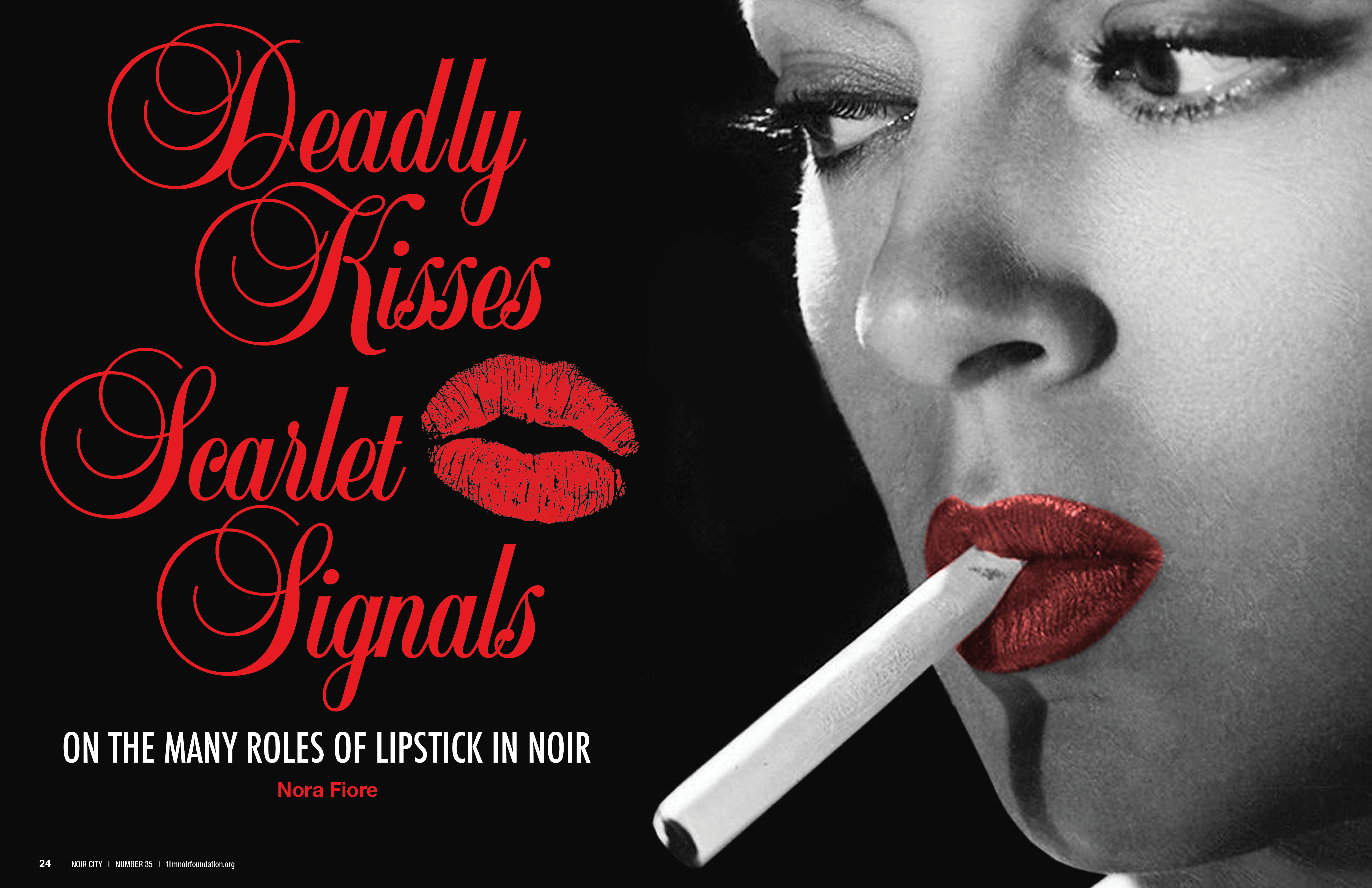
Nora Fiore, the Nitrate Diva, on the many uses of lipstick in film noir. I have to say this piece is among my favorites to appear in the magazine on my watch: a brilliant concept by Nora, written evocatively, and brought to vivid life on the page by ace designer Michael Kronenberg.


A one-of-a-kind memoir by Chris D., front man for the Flesh Eaters turned film scholar, on the surprising overlap between his two passions: punk rock and film noir.

A deep dive from John Wranovics on Harry Popkin, the onetime fight promoter who produced a series of noir titles that pulled no punches.

Noir City stalwart Jake Hinkson on noir’s dark vision of academia.

Joseph Moncure March’s epic poem The Set-Up already spawned the 1949 cinematic adaptation regarded as a classic of both noir and boxing films. Now it’s been turned into a graphic novel, and Nathalie Atkinson talks to artist Erik Kriek about it.

Plus more goodies, including my usual cocktail recipe.

Donate to the Film Noir Foundation, and in addition to supporting our restoration efforts you’ll receive a subscription to Noir City. You can also purchase the print edition exclusively at Amazon. Then settle in, because you’ll want to read this bad boy cover to cover.


Monday, April 24, 2017

The Rundown

Hang on, let me blow the dust off the—there we go. That’s better.

Things have been hectic lately, what with the launch of the second Lillian Frost & Edith Head novel from Renee Patrick Dangerous to Know. My co-alter ego has the scoop, and believe me when I say there’s more in the works. All kinds of fun and games are coming, including a few things I can’t believe. I’m popping in amidst the promo push to recommend a few items for your delectation.

Under the Midnight Sun, Keigo Higashino (2016). Here’s how busy it’s been: a new Chinese adaptation of Higashino’s The Devotion of Suspect X—easily my favorite mystery novel of the past 20 years—was playing two blocks for me and I missed my chance to see it. Higashino’s latest is also his most ambitious, at least of the novels that have been published in the United States. It’s a sprawling crime story-cum-social novel, spanning decades and touching on, among other things, the growth of the Japanese computer industry. In 1973, a man is murdered and a woman identified as the likely killer. Each has a child. Higashino tracks this pair through the years, but never as the viewpoint characters. Instead, they’re at a remove, always seen through the prism of others who fall into their orbits. It’s a daring structural choice that for the most part deepens the intrigue. As is so often the case with Higashino, any reservations are swept away by a climax at once elegant and charged with emotion. It’s not Suspect X, but then nothing is.

Five Came Back, Netflix. I raved about Mark Harris’s book, which cast a clear eye on a long-overlooked piece of Hollywood history. The three-part documentary based on it has the added advantage of film clips, and pairs contemporary filmmakers with some surprisingly simpatico predecessors (Guillermo del Toro and Frank Capra make an inspired match) who walked away from their Hollywood careers during World War II to make propaganda films.

Cork Dork, Bianca Bosker (2017). I was occasionally frustrated, frequently spellbound, and always fascinated by this memoir from a reporter-turned-sommelier. I remain a cocktail fanatic, but this opened my eyes (and nose) to vino in a way few books have.

Brockmire, IFC. What threatened to be a one-joke character is the centerpiece of a soulful if deeply, deeply profane comedy, thanks to Hank Azaria’s performance and a low-rent atmosphere out of Slap Shot. Granted, it helps knowing that lifelong Mets fan Azaria based Jim Brockmire in part on the team’s original announcers, specifically Lindsey Nelson’s wardrobe and Bob Murphy’s cadences. Hearing him wax rhapsodic about rye whiskey in that home run call voice is all my worlds colliding. And pontifidrinking is real. Not that I’ve done it or anything.

Tuesday, January 17, 2017

Extra, Extra! Noir City!

One of the benefits of being on the masthead of Noir City, the magazine of the non-profit Film Noir Foundation, is pitching in on the planning. I’ve known about the all-TV issue, which went out to subscribers last weekend, for ages, and had my pick of subject matter. I could have cherry-picked a vintage series that provided a small screen home for the migrating talent responsible for the twisted cinematic crime dramas of the 1950s. Or I could have claimed the contemporary cable antihero of my choice. It’s good to be the king, or in this case the managing editor.

Instead I pitched the only story I wanted to write. Which is why the issue features a look back at HBO’s two Phil Lovecraft films. Cast a Deadly Spell (1991) somehow knew Raymond Chandler and H.P. Lovecraft were two great tastes that taste great together. The result is a sly salute to classic noir that’s also genuinely, consistently funny. The disappointing follow-up Witch Hunt (1994) is an object lesson in the powers that be preparing a sequel while not comprehending what makes the original work.

Joseph Dougherty wrote both films, and proved a funny and candid interview. An acclaimed playwright and TV hyphenate, he’s spent the past seven years working on Pretty Little Liars, which he describes as “mini-Hitchcock movies for teens.” Dougherty wrote and directed “Shadow Play,” a film noir-inspired episode that became a fan favorite. We did a second interview about that show, complete with the welcome news that PLL has introduced a new generation to classic cinema as well as Dougherty’s brilliant advice for penning dialogue for teenage girls: “think of them as a bomber crew in a Howard Hawks movie.”

I’ve also got my usual Cocktails & Crime column, plus reviews of a new Douglas Sirk/George Sanders Blu-ray set and Edward Sorel’s offbeat book Mary Astor’s Purple Diary, covered in the New York Times by some wet-behind-the-ears stringer named Woody Allen.

But I’m not the only person in this issue. You also get—

- A double dose of FNF honcho Eddie Muller, interviewing Warner Bros. Home Entertainment George Feltenstein and holding forth on the small screen-spawned Mulholland Dr.

- Cartoonist/illustrator Daniel Clowes’ one-of-a-kind list of his five favorite noir films

- Imogen Smith on the definitive noir TV show, The Fugitive

- Jazz aficionado supreme Brian Light’s appraisal of the offbeat Johnny Staccato

- Alan K. Rode charting the noir roots of Perry Mason

- Steve Kronenberg’s assessment of the noir episodes of The Twilight Zone and Thriller

- Danilo Castro’s remembrance of Fallen Angels, the ‘90s cable series that brought pulp to primetime

- Sharon Knolle on the recent bumper crop of noir on cable, including Quarry and Animal Kingdom

- Ben Terrall’s very personal history of the pulp origins of Shane Black’s The Nice Guys

And, believe it or not, even more. It’s a true gem of an issue, and it’s yours by making a contribution to the Film Noir Foundation.

Thursday, December 29, 2016

The Best TV Show You’re Not Watching!

Titles like the above irk the hell out of me. That’s the peril of PeakTV®: no matter how many hours you clock in front of your various screens, you know you’re missing something.

Unless you’re me, in which case you’re missing everything. I used to joke that watching TV was a skill set I didn’t possess. At some point in the last few years, it stopped being a gag. Television viewing became serious business—maybe the real business of America nowadays—and I lacked the chops for it. I also used to joke that when I could watch whatever I wanted whenever I wanted, I’d wallow like a pig in a trough. Came that very day and I couldn’t be bothered to waddle over from the sty.

Game of Thrones? Haven’t seen it. The Walking Dead? Not one episode. My televisual diet consists of baseball and old movies. I have the occasional spasm of sensibility—I flew through Stranger Things this summer, the show scratching an itch I didn’t know I had—but for the most part I bluff my way through conversations about TV. It’s actually not that hard to do.

That said, allow me to tell you about the best TV show you’re not watching.

I’d never heard of Count Arthur Strong when I queued up the first episode. I simply read a description of the show on Acorn TV, a streaming service that offers British television fare, saw that it was a comedy about an aging entertainer, and figured it was worth a look. (Savvy readers may be wondering why I, as someone who professes not to watch much TV, subscribes to such a service. My accountant has raised the very same question.)

What followed was the exact opposite of a binge. What followed was me doling the episodes out incrementally, not wanting them to end. Because Count Arthur Strong is without question one of the funniest shows I’ve ever seen. Discovering Count Arthur Strong was a rare high point in a dire year. If you have access to Acorn TV, which you might via Amazon Prime, you still have time before the bells toll the deserved demise of this annus horribilus to make the acquaintance of Count Arthur Strong yourself.

Count Arthur, honorific never explained, is the brainchild of writer/actor Steve Delaney. The Count is a bit player in his dotage now known for his “raconteuring,” a legend in his own mind whose greatest claim to fame is a brief partnership with a man who broke up the act to become a titan of English entertainment. The ex-partner dies and his hapless writer son (played by Rory Kinnear, best known to U.S. audiences as the prime minister in that episode of Black Mirror) is pressed to pen about a book about the old man, which sends him careering into the orbit of Count Arthur and his friends.

That’s it. That’s the show in its entirety, now at thirteen episodes and counting, every one of them packed with laughs. Delaney created Count Arthur in the 1980s and revived him for the Edinburgh Festival in the 1990s, where his popularity led to a radio series. He then teamed up with Graham Linehan (Father Tim) for the TV version, which combines their strong suits: Delaney’s genius at inhabiting a fully three-dimensional character, and Linehan’s flair for lampooning sitcoms while honoring their traditions. Kinnear sends the show deliriously over the top, the putative straight man every bit as mad as his partner. The six episodes of Season One form a nearly perfect whole, unified by the storyline of Kinnear’s dogged efforts to write the biography of the father he never knew and studded with moments of surprising emotional impact. Season Two is looser but frequently more hilarious, as in the episode that is a meticulously detailed send-up of Misery. I told my compadre Ray Banks about my love for Count Arthur. He welcomed me to the brotherhood and steered me toward the trove of Delaney’s radio broadcasts, which I am now again doling out gradually until Season Three crests on these shores.

It’s a few days late, but for a taste here’s Count Arthur Strong’s Christmas message.


While I’m at it, a few other lesser publicized shows I’ve enjoyed this year—

Occupied (Netflix). Created by crime novelist Jo Nesbø and brought to the screen by filmmaker Erik SkjoldbjÇ£rg (Insomnia), this political thriller details the slow-motion takeover of Norway by Russia in order to commandeer its energy resources. Over the summer I recommended it to people as preparation for the Trump administration, because I’m such a cut-up. Now I’d call it mandatory. Its daring structure, with each episode set in a subsequent month, means key plot business sometimes occurs offscreen and we only witness the fallout. It also makes it a potent exploration of normalization.

Difficult People (Hulu). We pay for Hulu solely to watch Billy Eichner and Julie Klausner say what we’re all thinking. The show that makes me miss living in New York City.

Red Oaks (Amazon). Of course I’m in the tank for a series set in the 1980s about a high school kid who dreams of being a filmmaker. Season One was so flawless I almost resented its return, but the sophomore year brought an abundance of pleasures beginning with a Paris-set premiere directed by Hal Hartley (who helmed the bulk of the episodes) that plays like an independent film. And every single music cue this season broke my fucking heart.

People of Earth (TBS). A comedy from Conan O’Brien and some of the Parks & Recreation team about a recovery group for alien abductees—though they prefer to be called “experiencers” because it gives them more agency—that’s funny, deeply human and astonishingly soulful.

Tuesday, November 24, 2015

Miscellaneous: November Roundup

Facing multiple deadlines, I look up at the ol’ calendar on the wall to notice November is in its dotage and I haven’t posted yet. I don’t update the blog as much as I used to, but I haven’t missed a month since I started it in April 2004 and I aim to keep the streak going. I swore a sacred oath years ago: The show goes on. The Stardust is never dark. It never has been. It never will be. Not while I’m alive.

Herewith, some recommendations.

Dietrich & Riefenstahl: Hollywood, Berlin and a Century in Two Lives, by Karin Wieland. Wieland’s wide-ranging, meticulously researched dual biography stems from a remarkable happenstance. Marlene Dietrich and Leni Riefenstahl barely knew each other in Weimar Berlin despite living close enough for Riefenstahl to see into the windows of Dietrich’s apartment. Yet they would end up as icons of the opposing sides of the conflict that defined the twentieth century: Dietrich the imperious seductress who sacrificed herself for the boys during World War Two, Riefenstahl the filmmaker willing to glorify the Nazi regime in exchange for a budget as unchecked as her ambitions. Wieland’s book, featuring a supple translation from the German by Shelley Frisch, cuts back and forth between lives, the juxtaposition revealing surprising commonalities. It also benefits from judicious use of archival resources previously unavailable, specifically Dietrich’s letters and telegrams as well as Joseph Goebbels’ diaries, which illuminate Riefenstahl’s relationship with Hitler and the mechanics of the production of Triumph of the Will and Olympia. The closing chapters are particularly strong; decades after the war Dietrich, imprisoned by a glamorous image age will no longer permit her to live up to, retreats from the world while Riefenstahl, her films now viewed in a broader context, inhabits it more fully as she seeks the validation as an artist she believes history has denied her. A compelling look at two extraordinary women, both of whom appear in the just-completed second Lillian Frost & Edith Head mystery by Renee Patrick (aka me and the missus).

The Comedians: Drunks, Thieves, Scoundrels and the History of American Comedy, by Kliph Nesteroff. Anyone with a passing interest in show business will devour this book by standup comic-turned-scholar Nesteroff. Starting with vaudeville and ending with the death of Robin Williams, it chronicles decades of entertainment in a style simultaneously breezy and nuanced. Nesteroff is acutely aware of influences, tracking different strains of technique through generations of performers. Along the way, he offers deft thumbnail sketches of neglected names like pioneering female standup Jean Carroll, she of the evening gloves, and acerbic radio comic Henry Morgan. Even as the book moves into the modern era, Nesteroff still finds offbeat angles on familiar names. Bonus points for mention of the long-forgotten scandal that factors into Lillian & Edith #2.

Blandings. Our new favorite show here at Chez K. We blew through both seasons in no time flat. Available on Acorn TV, this P.G. Wodehouse adaptation boasts a peerless cast. Timothy Spall is Lord Emsworth, the daft nobleman preoccupied with the health and well-being of his prize pig. Feckless Freddy is his son, played by the pitch-perfect Jack Farthing. Jennifer Saunders pointlessly tries to impose order as Emsworth’s sister. Familiar faces aplenty turn up as various relatives, bounders and braggarts. The biggest surprise was discovering that the location for Blandings Castle is in County Fermanagh, Northern Ireland, home to the Keenan family for millennia, in a tiny town I’ve visited several times.

Friday, June 05, 2015

Reminder: TCM’s Summer of Darkness

Another heads up, gang, about the coolest event of the summer of ’15, which kicks off today.


Turner Classic Movies has turned over Fridays in June and July to film noir. That’s all Friday, every Friday, for twenty-four hours each day. TCM is calling this bonanza the Summer of Darkness, and made the very wise decision of naming your friend and mine Eddie Muller, honcho of the Film Noir Foundation, as your prime time host.

Regular readers know the FNF is an outfit near and dear to my heart. I’m the co-managing editor of the Foundation’s magazine Noir City, as well as a columnist and contributor. So naturally I’m thrilled to see our charismatic kingpin taking to the air.

TCM has pulled out all the stops, setting up a gorgeous website for the entire festival and starting a free online course on film noir in conjunction with Ball State University. As for programming tips, Eddie kicks things off at 8 PM EST/5 PM PST tonight with Nora Prentiss, a movie yours truly considered in detail for Noir City. The must-see is the world television premiere of the FNF’s restoration of Woman on the Run (1950) tonight at 10:15 PM EST/7:15 PM PST. A second FNF restoration, of 1949’s Too Late for Tears, debuts on July 17.

Honestly, you want my advice? Turn on TCM every Friday for the next nine weeks and leave it on. Get yourself an education.

Tuesday, December 31, 2013

The Good Stuff: 2013, Recapp’d

First, the year in me. Rosemarie and I moved to a deluxe apartment in the sky. We won an award. And I published a book. All in all, not a bad twelve months.

2013 was the least active year in the history of ye olde website, and most of the posts were about cocktails. But blogs are dead anyway, as Jason Kottke was the most recent to remind us. Still, I feel bad that I didn’t manage to rattle on about everything I watched, read, listened to or otherwise ingested. Hence, this rambling roster of recommendations, in the order consumed. It is by no means complete; there are highly touted titles I have yet to catch up with, others I’ve seen and am still chewing over. But such lists are always written in the sand, aren’t they? Consider this a snapshot of how I feel on New Year’s Eve. Come New Year’s Day I’ll be another person entirely. And so will you.

Drinking with Men, by Rosie Schaap. A heartfelt memoir about the pleasures and occasional perils of being a regular in a bar near you. My favorite book of the year.

Side Effects. New age noir, slyly updated for the era of prescription drugs. In the words of my friend Ray Banks, “classically sleazy.” And with that, Steven Soderbergh retires.

Noir City. A high point every year. Saw it in both Seattle and Portland this annum!

Claire DeWitt and the Bohemian Highway, by Sara Gran. Miss Gran continues to toy with the conventions of the mystery novel even as she probes the deepest mystery. This entry in the best series going is, sadly, the only novel on this year’s list. It was a strange reading year for me.

Behind the Candelabra (HBO). And with that, Steven Soderbergh returns! (I never bought that retirement story for a minute.) Featuring a bravura performance by Michael Douglas as Liberace, it doesn’t stint on the dirt or the garish period details while proving to be a riveting portrait of a long-term relationship falling apart.

Pacific Rim. The movie I always wanted to see when I was eight years old made me feel eight years old again.

The Hitchcock 9. Seeing the Master of Suspense’s first directorial efforts, completely restored and with live musical accompaniment, was an event of the first order. Kudos to the British Film Institute – and to Seattle’s SIFF Cinema, for innovative musical choices and following the series with several days of Hitchcock’s early U.K. sound films.

Hollywood and Hitler, 1933-1939, by Thomas Doherty. Engaging social history looking back at how the studios and the predominately Jewish moguls who ran them did and did not respond to the rise of Nazism in the years before World War II. Doherty has a thorough understanding of movies and of Hollywood as a business and a community. (Would that the same could be said for Ben Urwand. His shoddy and sensationalistic The Collaboration, which covers much of the same ground, is the worst book I read in 2013.)

Drug War. You can have your superheroes. Give me bad-ass cops. Johnnie To goes to mainland China and makes an epic thriller.

This Town, by Mark Leibovich. The one book that almost makes me say “The one book you have to read.” It serves up in clinical detail why American politics is broken – because once elected, the people who run this country essentially move to a separate realm, one without connection or consequence. Told with the gleeful abandon that only comes when an insider (Leibovich is a longtime political correspondent for the New York Times) decides to set the palace walls ablaze himself.

Blancanieves. A bewitching black-and-white silent film that retells the tale of Snow White and the Seven Dwarves in 1920s Spain. With bullfighting. I can’t believe it wasn’t more popular.

The Bling Ring. In a year of movies about the hollowing out of the American Dream, Sofia Coppola’s up-to-the-minute look at fame-obsessed teenagers turned bandits takes the prize. Also deserving of consideration in this category: Michael Bay’s underappreciated Pain & Gain.

Rush. Ron Howard returns to his Grand Theft Auto roots and makes the film of his career and my favorite of 2013. Peter Morgan’s script transforms the battle for the 1976 Formula One championship into the essential existential question: how do you live your life? Magnificently photographed by Anthony Dod Mantle, with Daniel Brühl giving the performance of the year as Niki Lauda.

Captain Phillips. Harrowing all the way through, never more so than when the damage has been done; the closing scenes depicting shock are impossible to shake. Tom Hanks at his finest.

Frances Ha. The great dilemma of your twenties – finding your own music to dance to – put on screen in a truly unique way. Greta Gerwig beguiles even while she maddens. Thinking of the final shot puts a smile on my face even now.

A Life of Barbara Stanwyck: Steel-True 1907-1940, by Victoria Wilson. At times frustratingly thorough, the first of this two-volume biography gives our greatest movie actress the treatment she deserves.

Collision Low Crossers, by Nicholas Dawidoff. A confession: I didn’t watch a single snap of the 2013 NFL season after skipping January’s Super Bowl for the first time in years. One unpleasant story after another – too many deaths of former players with signs of serious brain trauma, the New Orleans Saints bounty scandal, a rash of player suicides culminating in Jovan Belcher’s death by his own hand at the Kansas City Chiefs’ practice facility after he murdered his girlfriend – had drained all pleasure from football for me. Dawidoff’s book chronicling his 2011 season embedded with the New York Jets coaching staff thus came along at an interesting time. Beautifully written and packed with inside info, it perfectly captures football’s grind both on the field and off; George Will was not wrong when he said the sport combines the two worst aspects of American life, namely violence and committee meetings. Coaches and players alike acknowledge the risks inherent in the game and undertake them willingly, but don’t care to discuss them in depth. I feel better about football knowing that. I’m still not planning to watch the Super Bowl, even if the Seahawks are in it.

Six by Sondheim (HBO). A biography in the form of half a dozen songs, and one of the best treatments you’ll ever see of a writer writing.

Nebraska. Alexander Payne’s film (written by Seattle’s own Bob Nelson) is an elegy for a life and an entire way of life – as well as a reminder that time passes for the young as it does for the old. Will Forte should be getting more love for his performance here.

Inside Llewyn Davis. In many respects the evil twin of Frances Ha. Structured like a folk song, which is why it’s going around and round in my head. What happens when you’re good enough to make it – and you don’t make it? It’s also a meta, there-but-for-the-grace-of-God-go-we self-portrait by Joel and Ethan Coen, two artists dogged by questions of likability who may only be able to create with a partner.

Here’s wishing all of you the best in 2014. Thanks for stopping by on occasion. I’ll leave the light on. Odds are I’ll still mostly be talking about cocktails, though.

Tuesday, September 25, 2012

Movies: Day and Date Theater

Once more into darkest cable box, armed only with blog and remote, to spotlight a pair of movies released to theaters and on demand simultaneously.

Arbitrage. There are heroes, and then there are protagonists. Richard Gere clearly plays the latter here. His Robert Miller is a respected financier, an oracle of Wall Street. Only he’s shorted himself on magic. Having taken a multimillion dollar bath on Russian copper, he’s borrowed a fortune to make his firm seem solvent in order to hoodwink a competitor into buying it. The papers haven’t been signed yet, and his CIO daughter is on the trail of his skullduggery. What he needs is a relaxing night upstate with his French mistress. But Miller dozes off behind the wheel, wrecking the car and killing her. He flees the scene with the aid of his late driver’s son, unintentionally putting the young man’s future in jeopardy.

Astonishingly, you end up rooting for Gere’s master of the universe to get away with, if not murder, then massive fraud and manslaughter. As writer/director Nicholas Jarecki provides a behind-the-velvet-ropes-and-curtains tour of Manhattan’s tonier precincts, the film plays like a particularly luxe episode of Law & Order with no order and precious little law. (You do get Tim Roth as an outer borough Columbo who knows Miller is guilty and will cut corners to prove it.) A terrific Gere is ably supported by several actors portraying the celestial objects drawn into Miller’s orbit, like Susan Sarandon as the wife who has learned a thing or two about negotiating and Stuart Margolin as his cagey attorney. A sleek, suspenseful look at how the other 53% lives.
 
Knuckleball! In some sense, this engaging documentary came out a year early. It focuses on the 2011 baseball season as Tim Wakefield prepares to close out a lengthy career based on the fluttery pitch of the title, leaving the Mets’ R.A. Dickey as the game’s last such hurler. One season later, Dickey is an All-Star and a factor in the Cy Young conversation, having notched 19 wins and counting, leading the league in ERA and innings pitched, and ranked second in strikeouts. In perfecting an 80 mph version of the knuckler, Dickey has come as close as anyone to doing the unthinkable: inventing a new pitch. A brief primer on mechanics would have been welcome, but otherwise the film does an admirable job explaining the commitment required to master a pitch that, in the words of Jim Bouton, demands “the fingertips of a safecracker and the heart of a Zen Buddhist,” as well as profiling the handful of members of the brotherhood.

Wednesday, January 12, 2011

TV on DVD: Ellery Queen (1975-76)

For a series that only lasted a single season, Ellery Queen casts a long shadow. A cult favorite among mystery fans, the show would occasionally surface on cable but I’d never seen it. With its DVD release late last year, I blitzed through all 23 episodes and wish there were more.

Based on the detective created by cousins Frederick Dannay and Manfred Lee, who also penned the books under that pseudonym (confused yet?), Ellery Queen is a genuine fair play mystery. Crime writer Ellery (Jim Hutton, affability incarnate) helps his detective inspector father (the permanently irascible David Wayne) on some of the NYPD’s most difficult cases. Every clue required to unravel the riddle appears onscreen. In the show’s signature innovation, once the penny drops for Ellery he turns directly toward the camera and asks if you’ve figured it out, helpfully recapping the suspects, key bits of information and even offering a hint. Never before has the pause button on our remote gotten such a workout. As soon as Hutton broke the fourth wall, we’d stop the show and hammer out our theories. Once I even made a sketch of the crime scene.

Co-creators William Link and Richard Levinson bring to bear the same sharp writing they deployed on Columbo. The first few episodes rely heavily on “dying clues,” cryptic bits of information left by the murder victims – the one in the pilot film, Too Many Suspects, verges on preposterous – but as the series progresses it slyly subverts that convention. The show also fully exploits the period 1947 New York setting. The locations and costumes aren’t always convincing but the atmosphere is, blending nostalgia for a bygone age (radio dramas and the Brooklyn Dodgers) with anticipation for the modern era (television).

Each episode brings a fresh cast of special guest stars. Familiar faces from Hollywood’s golden era abound (Vincent Price, Donald O’Connor), with many drawn from the ranks of film noir (Ida Lupino, Dana Andrews, Rhonda Fleming, Howard Duff). But the show’s secret weapon is John Hillerman. His rival “radio detective” Simon Brimmer, a cross between Orson Welles and Claude Rains’ character in The Unsuspected, appears in a third of the episodes. Neither as famous as he wants to be nor as smart as he thinks he is, he regularly sets out to unmask the culprit before Ellery does. Hillerman makes a sublime foil, plummy voice and bogus bonhomie setting him up for a fall.

Some favorite episodes:

The Adventure of the Mad Tea Party, a Lewis Carroll-themed show adapted from a Dannay/Lee story

The Adventure of Veronica’s Veils, with George Burns as the victim of the week and a great burlesque background

The Adventure of the Wary Witness, a surprisingly effective minor key outing

The Adventure of the Sinister Scenario, set in Hollywood and taking swipes at earlier screen incarnations of the character

The Adventure of Caesar’s Last Sleep, for finally allowing the long-suffering Sgt. Velie (Tom Reese) to have a moment in the spotlight

If only I’d watched the show in time to ask William Link about it at Bouchercon. To ease my pain, here’s a song that namechecks Ellery Queen. Hat tip to Russell Atwood, whose fine novel East of A is now available as an eBook.

Monday, December 27, 2010

Book: The War for Late Night, by Bill Carter (2010)

The true wisdom in New York Times reporter Carter’s chronicle of the Jay Leno/Conan O’Brien debacle comes from someone who isn’t on TV anymore. Jerry Seinfeld recalls telling Johnny Carson not long after his retirement that for twenty years, comedians speculated on who would take over The Tonight Show. “And the one thing we never realized was that, when you left, you were taking it with you.” The creation of a viable late night alternative on CBS ended an era in television; as Seinfeld points out, comics say Jay or Dave or Conan now, not The Tonight Show. In retrospect, the writing was on the wall when Garry Shandling chose to do a behind-the-scenes comedy about a talk show as opposed to the real thing on NBC.

The slow-burn succession plan put in place in 2004 by NBC’s Jeff Zucker – Leno agreeing to step down as Tonight Show host in 2009 to make way for Conan – is usually characterized as the root of the problem. But by the end of Carter’s book I was convinced that the network unintentionally made the best of a bad situation. There was no way NBC could hope to hold on to both stars in the long run; one was always going to end up the competition. The current landscape, with Leno leading in the ratings and Conan on basic cable, no doubt suits the suits just fine.

Conan comes off as funny, decent and somewhat naïve. Leno, meanwhile, reads as hard-working and deeply uninteresting. When he does reveal something of himself, you wish he hadn’t; his explanation for why he refuses to take vacations (“I understand how people spend money to buy things they need or like. But spending money on an experience? That seems like an extravagance to me.”) seems utterly alien, especially when as Carter points out it’s people on vacation who pay for Leno’s fabled collection of vintage cars. It’s a sign of Leno’s lack of presence in spite of his success that his valid take on the situation – fiftysomething guy is forced out of his job, but returns triumphant – never caught on. Letterman, as always, remains inscrutable, while Carter gets plenty of good material from a savvy and scrappy Jimmy Kimmel.

The book is compulsively readable but evenhanded to a fault. Carter’s Gray Lady insistence on reporting everyone’s side as if he’s covering arms negotiations weakens the fascinating opening at the May 2009 upfronts, when Leno flopped with a long set of dated material. And he shies away from any assessment of The Tonight Show with Conan O’Brien, including the commonly held one that it was never vital television until it was on the verge of extinction.

Overall, there’s a sense that Carter is missing the boat. 11:30 on the broadcast networks may be where the money is, but not the excitement. Jay Leno couldn’t get millions of people to turn up for a rally on the Washington mall or shame Congress into passing a bill. The boldest late night personality is Chelsea Handler on E! The only late night clips I’m sent these days are from Jimmy Fallon’s show, and the one show I try to regularly watch is Craig Ferguson’s, where actual conversations occur. Carter’s book is filled with the crack of buggy whips. It’s diligent reportage on the final mastodon’s struggles in the tar pit.

Wednesday, December 15, 2010

Music: The Bad Plus

The Bad Plus has been together for ten years. Their show at Jazz Alley last night drew entirely from Never Stop, their new album celebrating that anniversary. As always, it was a sensational performance. The trio played one of my favorites, “Bill Hickman at Home,” a salute to the stunt driver of Bullitt and The French Connection, and Reid Anderson’s heartbreaking “People Like You.” Drummer Dave King truly got to shine, using his box of toys to full effect. They’re at Jazz Alley again tonight, with upcoming dates in Chicago, Minneapolis and New York. Go, go, go.

After the show, Rosemarie and I spent some time chatting with pianist and crime fiction connoisseur Ethan Iverson. Talk turned to ‘70s era detective shows and we mentioned Columbo, season one of Mannix, and the short-lived Ellery Queen. (We’ve been making our way through the recent DVD release; expect a post when we’re done.) At his blog Do The Math, Ethan details his recent reading.

Of course, this post is simply an excuse to link to Ethan’s astonishing overview of Donald E. Westlake’s career, now back on the web and somehow expanded. As it happens, Ethan’s classic rendering of the opening of The Da Vinci Code in the style of one of Westlake’s Richard Stark novels is today’s guest post at The Violent World of Parker.

All the TV shows mentioned above were created by the team of William Link and Richard Levinson. In another nice bit of serendipity, today is William Link’s 77th birthday. Mr. Link is still going strong; we recently had the pleasure of hearing him speak at Bouchercon. Extend your birthday greetings at The Rap Sheet.

And one final link to a piece on a subject that is also near and dear to my heart: Ethan’s wife Sarah Deming on cocktails bars that go too far. Who doesn’t serve Amaretto sours?

Monday, June 07, 2010

Miscellaneous: Cable Box Theater

Ondine (U.S. 2010). The latest film from Neil Jordan is in theaters and on demand. Colin Farrell, continuing his string of strong performances, plays a down-at-the-heel Irish fisherman who catches a mysterious woman in his net. Farrell’s young daughter suspects that she’s a selkie, an outlandish explanation that Farrell himself is inclined to believe even in the face of evidence suggesting a more earthbound – and dangerous – origin. It’s a lovely, delicate film, essentially a fable, helped enormously by Christopher Doyle’s cinematography that captures an Ireland where sea, sky and sod are at times indistinguishable.

Jordan is one of the few filmmakers whose work I never miss no matter the venue. In a spoiler-packed interview in Cineaste, he explains his move into television. Depressing quote of the day: “... the kind of cinema that we used to make is drying up, I’m afraid. The distribution is vanishing. The funding is vanishing.”

Related depressing story: Variety on the fate of literary adaptations in a world where “Clint Eastwood is single-handedly holding up the adult drama at the studio level.”

The Special Relationship (2010). Peter Morgan and Michael Sheen’s third collaboration about Tony Blair, now on HBO, focuses on the PM’s tricky relationship with Bill and Hillary Clinton (Dennis Quaid and Hope Davis), especially post-Lewinsky. The familiarity of the material makes it the least successful of the trio, but it deepens their joint portrait of Blair as a glib leader with sharp instincts who is all too easily starstruck, at times even by himself.

I Knew It Was You: Rediscovering John Cazale (2009). Cazale only appeared in five movies before his death at age 42, but every performance still haunts. And all five films – The Godfather, The Conversation, The Godfather: Part II, Dog Day Afternoon and The Deer Hunter – were nominated for Best Picture. Director Richard Shepard (The Matador) has assembled a lively tribute featuring those who worked with and loved the actor (Al Pacino, Sidney Lumet, Meryl Streep) and those who were inspired by him, like a very astute Sam Rockwell. My favorite observation comes from one of Cazale’s friends, who says that the secret to his technique was to find what caused his character pain and build the performance around that. On HBO.

Sunday, April 18, 2010

TV: Roku Like A Hurricane

Never let it be said that I can’t see the writing on the wall. Netflix starts signing deals with studios to delay the rental of new DVDs in exchange for more streaming content. My only problem with this arrangement is I already spend enough hours in the day staring at my computer screen. Sometimes I want to stare at my TV.

So we got a Roku. Hundreds of titles in my Netflix queue are now instantly available on my TV.

We’re tooling around the new setup and see that additional channels are available for a nominal fee. One of them, Moonlight Movies, bills itself as offering classic films from the 1930s through the ‘70s.

It’s actually the noir channel, including several hard-to-find and unavailable on video titles. We christened the Roku with a double-bill featuring an unintentional theme: mental derangement and characters named Vince.

First up, 1949’s The Crooked Way. Eddie Rice (John Payne) is a decorated WWII veteran with amnesia thanks to a chunk of shrapnel lodged in his brain. He heads back to Los Angeles to learn about his past only to discover he was both a crook and a bastard.

The Crooked Way is conveniently plotted; Eddie starts running into people who know him the second he steps off the train at Union Station. And the villainous Vince is played by Sonny Tufts, living up to his billing as a lousy actor. But Payne as always is terrific, disappointed in the man he can’t remember being. And cinematographer John Alton does some of his most extraordinary work, shooting one scene in stark silhouette and later offering an astonishing close-up in which Payne’s face is completely obscured, his character’s character unknown to the audience as well as himself.

Next, Fear in the Night (1947), a low-budget Cornell Woolrich adaptation made with ingenuity. DeForest “Bones” Kelley has a vivid nightmare about killing a man – and then finds hints that perhaps it wasn’t a dream. Like Kelley’s Vince, I couldn’t shake the unnerving sense that I’d experienced all this before. I soon figured out why: writer/director Maxwell Shane remade the movie nine years later, and that one I’d seen.

Also available via Roku is an MLB.TV package that puts the coverage I get from my cable company to shame. I’d have made the switch already, but I do have to work sometime. Speaking of baseball ...

Baseball: Let’s Play Two and Then Some

Yesterday’s epic Mets/Cardinals tilt was not televised in Seattle. I ended up blowing off plans to see a movie and instead sat in my favorite bar tracking the (in)action on my phone. The battery almost died before the game finally ended after twenty innings – eighteen of them scoreless – and nearly seven hours with a 2-1 Mets victory.

It was a strange way to follow a game, both old-fashioned and modern, like receiving a telegram on an iPad. Without the commentary, some nuances took a moment to register. “Wait, Felipe López is now on the mound for St. Louis? Isn’t he a shortstop? And he’s pitching to the reliever who gave up the grand slam to him on Friday night? Who the hell is Joe Mather?” The Mets couldn’t score runs off the Cardinals position players sent to the hill while their All-Star closer failed to nail down the save. But an ugly win is still a win. At the very least there’s something to put on the team’s 2010 highlight DVD.

Meaningless Milestone: Blog Out the Candles

Six years? I’ve been blogging for six years?!?