Friday, June 21, 2013

Cocktail of the Week: The Brown Derby

Let’s head to California for this next libation, even though doing so is probably incorrect. A drink called the De Rigueur with the virtually identical recipe appears in Harry Craddock’s The Savoy Cocktail Book and therefore predates this one, but honestly, I’ve talked about Harry enough. It’s the first day of summer and it’s still overcast in Seattle. I could use a little sun. So we’re sticking with the version appearing in the 1933 collection Hollywood Cocktails by Buzza & Cardozo. (Purists will point out that there’s even a second, very different drink called the Brown Derby. Considering the Hollywood connection, maybe it was a reboot of this one.)

Our Brown Derby is indeed named after Los Angeles’ famed hat-shaped eatery, but it wasn’t created there. The drink was born in the Vendôme Club, operated by nightlife impresario Billy Wilkerson. Wilkerson is one of those characters about whom enough can never be written. He started the Hollywood Reporter, using the paper’s gossip columns to stir interest in his clubs like the Trocadero and Ciro’s. He broke ground on the Flamingo Hotel in Las Vegas only to be muscled out by partner Bugsy Siegel. He discovered Lana Turner at a soda fountain.

The Vendôme became the first place where one had to lunch in Hollywood, an essential venue where luminaries went to see and be seen. It was at the Vendôme that Louella Parsons learned about the pending split between Mary Pickford and Douglas Fairbanks, a landmark divorce in that both parties had cocktails named after them. Many spirits historians note that the Vendôme dubbed this drink after its neighbor then cite the original Brown Derby on Wilshire Boulevard. But given the Vendôme’s location on Sunset the more likely namesake is the Derby’s second outpost on Vine Street, alleged birthplace of the Cobb Salad.

The cocktail is basically a showbiz sour – spirit, sweetener, citrus – with the elements given additional pizzazz. Bourbon and honey are perfectly cast opposite each other, while above them grapefruit walks a tart tightrope. The recipe below comes from Jim Meehan’s The PDT Cocktail Book, as does the stronger-than-usual formula for honey syrup: a 2:1 ratio of honey to water, simmered over medium heat until the honey dissolves. If you’re going to include a flavor as distinctive as honey, you might as well taste it.

The Brown Derby

2 oz. bourbon
1 oz. grapefruit juice
¾ oz. honey syrup

Shake. Strain. No garnish.

Friday, June 14, 2013

Cocktail of the Week: The Fancy Free

And then there are the drinks where you don’t have much to say about them other than: I like this one, you should try it. Although it is appropriate for June 14, which is National Bourbon Day.


The Fancy Free had fallen out of my home bartending repertoire. I was reminded of it by Lesley M. M. Blume’s recent book Let’s Bring Back: The Cocktail Edition, and it’s worked its way into the rotation again. Few drinks serve as a better showcase for maraschino, the clear spirit distilled in Italy from sour cherries and typically found in a lanky bottle with a base swaddled in straw. It has hints of sweetness – Ernest Hemingway preferred it in his daiquiri in place of sugar – balanced by notes of almond, and no other commonly used modifier so says ‘cocktail’ to me. The Fancy Free rightly gives it center stage.

The recipe apparently first appears in the immortally titled Crosby Gaige’s Cocktail Guide and Ladies’ Companion (1941). Crosby suggests an unnecessarily fussy presentation, serving it like a Sidecar in a glass with a sugared rim. The Fancy Free is essentially a variation on the Old Fashioned, with maraschino subtly substituting for muddled sugar or simple syrup, and some contemporary adherents treat it thusly, pouring it over ice in a tumbler. I split the difference and enjoy mine up, skipping the added business on the glass’s rim. Bourbon and maraschino complement each other so well they don’t require accessories.

The Fancy Free

2 oz. bourbon
½ oz. maraschino
dash of Angostura bitters
dash of orange bitters

Stir. Strain. No garnish.

Friday, June 07, 2013

Cocktail of the Week: The Dark & Stormy

Let me help you clear that ginger beer from last week out of your fridge. Here’s another drink to use it in. Only be careful what you call it.

The Dark & Stormy, one of the two unofficial national cocktails of Bermuda, has a marvelously evocative name. Dark rum, ginger beer. What could be simpler? A lot, it turns out, once the lawyers get involved.

Blame the Royal Navy for the drink’s existence. Back when it was still issuing a daily ration of rum to sailors, it opened a ginger beer bottling plant at its primary base in Bermuda. The rest of the story writes itself. Gosling Brothers, Ltd., founded in the islands in 1806, became best known for a particularly dark variety of rum first sold only in barrels, then in repurposed champagne bottles liberated from the officers’ mess and resealed using black wax. Hence the name Gosling’s Black Seal rum.

In the 1970s, the company trademarked the Dark & Stormy name, usually rendered Dark ‘n Stormy. As this Diffords Guide article explains, “it is the name of the drink that is protected under law, not its ingredients.” What does this mean? You won’t get hassled by the man if you pour a dark rum other than Gosling’s Black Seal into your ginger beer. But if you choose another brand, choose another name for the resulting beverage while you’re at it, because in the eyes of the law it ain’t a Dark & Stormy. Or a Dark ‘n Stormy. Sorry. The nuances of trademark elude me.

For decades Barritt’s Ginger Beer of Bermuda was the favored partner in this drink. Now Gosling’s makes their own. (I’m still using Crabbie’s out of England.) In America lime juice is typically added, a Yankee innovation that would be frowned on in the islands where even the lime garnish is deemed optional. Some recipes use simple syrup, and at least one deploys peeled ginger root for an additional boost of spice. Dale DeGroff cooked up an alternate take that deploys two kinds of rum as well as pineapple and orange juice, which at least in terms of ingredients pushes the drink closer to a rum swizzle, Bermuda’s other unofficial national cocktail.

My own version trusts the ginger beer to do its job but ups the ante with lime bitters for an extra tropical punch. I haven’t consulted with my attorneys to see whether this change violates the law, so as the legal fog clears I’ve filed a claim on the name The Tenebrous & Gusty. Whatever you call it, it’s one of the great refreshments of summer.

The Dark & Stormy

2 oz. Gosling’s Black Seal rum
3 oz. ginger beer
2 lime wedges
2-3 dashes of lime bitters

Add the bitters to a highball glass filled with ice. Pour in the Gosling’s Black Seal rum. Top with ginger beer. Squeeze the lime wedges into the drink, then add them to the glass. Stir.

Friday, May 31, 2013

Cocktail of the Week: The Moscow Mule

An anniversary is a time to step back and reappraise. To break with tradition. To venture into new terrain. To listen, finally, to all those requests and complaints.

That’s right. In this, the second year of Cocktail of the Week posts, I am at long last featuring a vodka drink. Stop sending me your emails.

Understand, I’m not one of these people who hates vodka. Like Kingsley Amis, who wrote in Everyday Drinking that the role of vodka “is to replace gin in established gin drinks for the benefit of those rather second-rate persons who don’t like the taste of gin, or indeed that of drink in general.” He said it, folks, I didn’t.

I have no strong feelings about vodka, which is why I seldom drink it. It brings nothing to the party in the terms of taste. (Do not start in about flavored vodkas, I beg of you. You do not want to go down that road with me.) When people ask me to suggest a vodka cocktail, I’ll usually opt for something like the Jasmine, which has a few other elements to do the heavy lifting.

There is one vodka cocktail that I enjoy, because it asks the spirit to provide the kick and lets the remaining ingredients, specifically one, shoulder the burden. That the drink was concocted by a major corporation solely to sell booze doesn’t bother me in the least.

In 1939, the food and beverage giant Heublein purchased the North American rights to Smirnoff vodka for next to nothing. This was at this insistence of company president John Martin and over the objections of Heublein’s board of directors. (Heublein may have scored with brands as varied as A1 Steak Sauce, Kentucky Fried Chicken and Grey Poupon, but they also sold a line of pre-made cocktails like Manhattans and sidecars in cans, so it’s not like the outfit had the Midas touch.) Vodka had always struggled in the U.S., and initially Heublein had difficulty marketing it as well. Ultimately they chose to play to the familiar by rebranding it “white whiskey” and in an ad campaign touted the fact that it had no taste or smell by saying Smirnoff left you breathless. Focus groups deemed this approach more subtle that the original slogan, “Ah, Screw It, Get Hammered At Lunch.”

Success was still some distance off in 1946 when Martin found himself in Los Angeles dining with Jack Morgan, proprietor of the Cock ‘n Bull, the faux-British pub to the stars on the Sunset Strip. (The bar lasted until 1987, making it one of the last of the ‘40s Hollywood hot spots to close its doors.) Martin was saddled with Communist hooch nobody wanted, while Morgan made a strong ginger beer few customers could stomach. What to do, what to do?

Their answer, of course, was to combine them. A buck or a mule is a category of cocktail made with a base spirit, ginger ale or beer, and citrus. Given the Cock ‘n Bull’s Tinseltown ties the vodka buck, rechristened the Moscow Mule, became a hit with movie folk and was consequently written up in fan magazines, which fueled its popularity nationwide. So if you ever wondered who to blame for the ascension of vodka in this country, there’s your answer: Hollywood liberals.

The Martin/Morgan origin story sounds too good to be true. Drink historian Eric Felten says credit for the drink’s creation actually belongs to Cock ‘n Bull bartender Wes Price. His inspiration, according to Felten? “I just wanted to clean out the basement.” Price also claims that the first Moscow Mule ever made was sold to film noir favorite Broderick Crawford, so I’m buying his version of events.

Whenever possible, the Moscow Mule is served in a small copper mug. Why, you may ask? This is my favorite part of the story: because Jack Morgan’s girlfriend had inherited a factory that made them, and she couldn’t unload the things. Why shouldn’t she get well along with Morgan and Martin? Many bars maintain this unnecessary tradition and here in Seattle of late, the mugs have been the cause of a crime wave. I would like my parole officer to note that one of them is not pictured.

Key to this drink is a potent ginger beer. In The Fine Art of Mixing Drinks, David A. Embury pushes for Schweppes, an English brand. I’m honoring that request by making mine with Crabbie’s Alcoholic Ginger Beer, a U.K. product with a terrific sharp flavor and a punch of its own. Add a little lime and you have a perfect summer cooler.

The Moscow Mule

2 oz. vodka
4 – 6 oz. ginger beer
½ oz. lime juice

Pour lime juice over ice in a Collins glass or a small copper mug that you probably stole from a reputable bar, in which case you should just turn yourself in to the authorities. Add vodka. Top with ginger beer. Stir. Garnish with a lime wedge.

Friday, May 24, 2013

Cocktail of the Week: The Old Tom Old Fashioned

You don’t need me to tell you that the Old Fashioned has made a roaring comeback. You’ve got lifestyle blogs and magazines illustrated with Mad Men stills for that.

You don’t need me to tell you that the simpler the preparation of your Old Fashioned, the better off you are. You’ve got Old Fashioned 101 for that.

I will say this of the “fruit salad” that used to litter this cocktail: I bought a muddler solely for the purpose of making Old Fashioneds, and I never use it anymore. What a waste of money. On an unrelated note, be sure to pick up my new children’s book Morty The Mournful Muddler, the heartwarming tale of a lonely discarded bar tool that finds redemption through bird watching and community service.

What do you need me to tell you about a drink that’s been analyzed to death? Let me check my notes ... one of David A. Embury’s six basic cocktails ... born in Louisville, Kentucky’s Pendennis Club in the 1880s ... toss in an authentic maraschino cherry if you feel like it ... rye’s really your better option, but you knew that ...

Oh, here you go. Have one with gin. Specifically Old Tom gin.

I’ve raved before about the return of this sweeter variety of gin, closer to the pre-Prohibition incarnation of the spirit. Ransom Old Tom is barrel-aged, resulting in a highly distinctive taste that’s a bit like gin, a bit like whiskey, and very much its own. It makes for a satisfying Old Fashioned, lighter than one made with brown liquor.

A rare warm day put me in the mood for one, so I stopped by the Zig Zag Café. I asked stalwart bartender Ben Perri for an Old Tom Old Fashioned, and he stalwartly asked which brand I preferred, Ransom or Hayman’s. I was poised to reply Ransom, but hesitated. Hayman’s, a U.K. product based on an archival recipe, has become a Chez K staple, my go-to for a Tom Collins. But I’d never considered it in an Old Fashioned. It’s closer to London dry gin, and far sweeter. I was torn, and did what I always do when faced with such conundrums: I asked my bartender for his opinion.

Ben said both make excellent, very different Old Fashioneds. His default choice for Old Tom was Hayman’s, because it was a) English, where Old Tom came from, and b) more gin-like in flavor.

I was torn. Ransom seemed a better fit for an Old Fashioned, but it always tasted like Ransom. The prospect of Hayman’s intrigued, but it was already fairly sweet. What’s a smart man to do?

I have no idea. I only know what I would do, and that’s have Ben make both versions so I could subject them to an on-the-spot taste test.

During this preparatory phase, a dark horse came onto the track. Ben pointed out that Dutch genever, the rich juniper liquor that was an original Old Tom contemporary, is available again from Bols – and is also well-suited to the Old Fashioned. What the hell, said I, let’s have one of those, too. I’m nothing if not thorough. Thus, when Rosemarie arrived at the bar to find multiple cocktails, pony glasses and bottles before me, I got to utter the three words that have been a refrain throughout our marriage: “I can explain.” At least she got to participate in the experiment as well.

The result was a three-way photo finish. There were no losers that night, only winners, with me the biggest winner of all. Ben was right about Hayman’s. Its sweetness was no impediment, Ben’s rendition of the drink beautifully balanced. It took the title by a nose over the Bols genever, which held the middle ground between a more classic gin style and the robust iconoclasm of Ransom. I’ve made Old Fashioneds with Hayman’s since, but still find myself craving the idiosyncratic notes present only with Ransom. I’m not worried, though. I’ve got all summer to wrestle with the problem.

Old Tom Old Fashioned

2 oz. Old Tom gin
¼ oz. simple syrup
3 dashes Angostura bitters

Stir. Strain into an Old Fashioned glass over ice. Garnish with a nice, thick lemon peel and a cherry for old times’ sake. Don’t let your muddler see what you’re doing. You’ll hurt its feelings.

Friday, May 17, 2013

Cocktail of the Week: The Toronto

Pure happenstance. I swear to you. These things aren’t planned in advance. It’s a complete coincidence that I’m highlighting a cocktail called the Toronto right as the mayor of that metropolis apparently turns up in a video speaking way, way, WAY off the record while smoking crack cocaine. We all of us have our vices.

The Toronto is another drink exploiting the peculiar charms of Fernet Branca. For more on Fernet’s history and its idiosyncratic scent and taste, please to consult last week’s post on the Hanky Panky. Further Fernet factoids:

I was desperately hoping there would be a spike in sales of this abrasive amaro following its cameo appearance in The Dark Knight Rises as Alfred’s aperitif of choice. Presumably Bruce Wayne also drinks it; that would account for the Batman voice.

Costume designer Edith Head, of whom Rosemarie and I are inordinately fond, was introduced to Fernet by the English actress Madeleine Carroll. Edith’s take on the Italian liqueur? It’s “guaranteed to save you on the day you want to kill yourself.”

My favorite, oft-repeated Fernet story took place in 1960. Betsy von Furstenberg, the actress born a baroness, was suspended from Actors’ Equity because of a prank she played on her co-star Tony Randall. She playfully poured Fernet into the glass Randall had to drink from onstage. Randall took one sip – and immediately assumed he had been poisoned.

Knowing that, you’re even more keen to use some in a cocktail, right?

The Toronto was originally created to showcase Canadian whiskey. (Irony #1: It’s never made with Canadian whiskey anymore, thanks to the boom in quality American ryes.) The drink was created in the early 1900s, and survived because its recipe was enshrined in David Embury’s The Fine Art of Mixing Drinks. (Irony #2: In Embury’s opinion, “a brief word about Canadian whiskey” was “all it deserves.” His brief word(s) on the subject: “I don’t like it.”) The drink is a variation on the Manhattan – although the presence of simple syrup means it also owes a debt to the Old Fashioned – so naturally it was named after Canada’s first city. (Irony #3: Early in the classic cocktail revival the Toronto was hard to come by in much of Canada because of a scarcity of Fernet Branca there.)

There’s no mistaking Fernet’s presence in a glass, but for all its assertive flavor it complements the base spirit it’s paired with. While it adds a playful edge to gin in the Hanky Panky, in the Toronto – or the T’ronta, as I’ve heard locals pronounce it – it lights a fire under the rye. Strange how a taste so distinctive can be so versatile.

The Toronto

2 oz. rye
¼ oz. Fernet Branca
¼ oz. simple syrup
2 dashes of Angostura bitters

Stir. Strain. Garnish with an orange twist.

Friday, May 10, 2013

Cocktail of the Week: The Hanky Panky

I have reached another milestone on this path I tread. I have at long last purchased my own bottle of Fernet (pronounce the T) Branca. I have joined the ranks of the hardcore cocktail fanatics.

Fernet Branca is the most bitter member of the amaro family. I’ve heard it called Jägermeister for grown-ups but that’s not at all fair – not to Fernet, or Jägermeister, or grown-ups. Fernet’s taste is so, ahem, bracing that most people first drink it as a dare. Before that distinctive taste you’ll notice its aroma, which contains notes of eucalyptus, menthol, roofing tar and regret. (I kid. It’s only two of the four. And maybe not the two you think.) Like many liqueurs it consists of a hodgepodge of ingredients, the exact formula held in secret. Known elements include myrrh, assorted fungi and gargantuan amounts of saffron, with some speculating that production of Fernet Branca consumes the bulk of the world’s supply of the spice. Almost since its genesis in 1845 it’s been bruited as a potent digestif, capable of preventing hangovers and the pains of gustatory excess before they start.

Despite being the working definition of an acquired taste, Fernet has found devotees beyond its birthplace in Italy. How it’s consumed will tell you something about the person who ordered it. Odds are anyone asking for Fernet and Coke is from Argentina. Fernet and ginger ale = San Francisco. And if someone seated next to you orders it straight, turn to them and ask is-THIS-your-card? style, “What bar do you work at?” It never fails. Love of Fernet is a badge of honor in the service industry.

A small amount of this pungent potable makes a noteworthy addition to a handful of cocktails. One of the best known is the Hanky Panky, a variation on the sweet Martini with a history that sets a world record for sheer bloody Englishness. It was created by Ada Coleman, the former bar mistress at Claridge’s who was installed at the American Bar at the Savoy Hotel by her benefactor Rupert d’Oyly Carte, scion of the family famed for producing the work of Gilbert and Sullivan. (See what I mean? And I’m not done yet.) Coley, as she was known, devised the drink at the behest of Sir Charles Hawtrey, the lion of the British stage who appeared in several silent films. More importantly, he taught a young Noël Coward everything he knew about the theater. When Sir Charles sipped Coley’s creation he is said to have thundered in true Wodehousian fashion, “By Jove! That is the real hanky-panky!,” the term then meaning witchcraft as opposed to serving as a Match Game euphemism for, you know, whoopee.

Hawtrey’s remark was an apt one. Some sort of trickery is involved for the miniscule amount of Fernet to become a dominant but never overwhelming taste amidst the gin and sweet vermouth. There are worse ways to be introduced to this most intriguing of flavors.

The Hanky Panky

2 oz. gin
1 ½ oz. sweet vermouth
¼ oz. Fernet Branca

Stir. Strain. Garnish with an orange twist.

Tuesday, May 07, 2013

Me Elsewhere: Memories of Malice

First, an apology: there will be no photographs. I didn’t take many. I was too busy being flabbergasted. Also, eating.

Rosemarie and I are back from our first-ever Malice Domestic conference. It won’t be our last. We’ll enjoy them all, but I daresay that future installments of this convention devoted to the traditional mystery novel won’t quite match this one, and not only because it was Malice’s silver anniversary edition.

As explained earlier, we ventured to deepest Bethesda, Maryland in order to receive this year’s William F. Deeck-Malice Domestic Grant for Unpublished Writers. We’d won the honor for our novel Design For Dying: An Edith Head Mystery. We were eager to meet our fellow recipient Ellen Byron, whose book Reality Checked is set in that most murderous of environments, the private school world of L.A.

The grants committee members gathered us up early and took fantastic care of us. Among the first things that we learned was the incredible number of previous winners who had returned to Malice as published novelists and nominees for the Agatha Awards. More impressive was the willingness of these writers to share their wisdom with us.

This year’s convention featured quite the array of special guests, with Laurie R. King, Aaron Elkins, Carolyn Hart and Peter Robinson receiving honors. There was also a stellar array of panels covering a host of crime fiction topics.

Saturday night was the Agatha Awards banquet, where the missus and I got our moment in the sun. It’s not a moment either of us is likely to forget. When grants committee chair and unofficial guardian angel Harriette Sackler announced the premise of our book – that Hollywood’s most famous costume designer must turn detective to solve a young actress’s murder – an encouraging buzz rolled through the ballroom. In the bar after dinner, newly-minted Mary Higgins Clark Award winner Hank Phillippi Ryan told us, “That was the sound of a roomful of writers saying, ‘Why didn’t I think of that?’” We received congratulations and advice from plenty of attendees including Agatha winners Louise Penny and Catriona McPherson and toastmaster Laura Lippman, who closed the event on Sunday with an inspirational Q&A. (The full round-up of Agatha nominees and winners is here.) And we had several conversations with agents and editors that were, in a word, extremely promising. (OK, that’s two words. Clearly, I need an editor.) I cannot stress this enough: if you have ever harbored any interest in writing a mystery novel, you owe it to yourself to look into this grants program. It is a transformative experience.

But what had the greatest impact was easily the sheer number of mystery readers – Rosemarie and I lost count at two dozen – who walked up to one or both of us to say how much Edith Head meant to them. Not only as a style icon, but as a professional woman who blazed a trail that is still being followed. Writer Carole Nelson Douglas told us about reading an interview in Parade magazine in which Edith described essentially conning her way into a job at Paramount Pictures despite having no training as a sketch artist. “Edith taught me to say yes to things,” Carole said. It’s an invaluable life lesson, and one our Malice whirlwind has made us take to heart anew. We are saying yes to all of this.

Random notes: if you want cocktails in the District of Columbia, I heartily second all the recommendations I heard for The Passenger. The bartender there made me a whiskey smash with pear liqueur that I can taste even now. And I have to commend the staff at the Hyatt Regency in Bethesda, who truly got into the spirit of the occasion including a doorman dressed as Sherlock Holmes and nightly themed drinks at the hotel bar. One was called the Who Done It?, which meant I had Tavares in my head all weekend. Here’s the song. Maybe it will make up for the lack of photographs.

Wednesday, May 01, 2013

Book: The Disaster Diaries, by Sam Sheridan (2013)

Sam Sheridan is an MMA veteran as well as a former EMT and wilderness firefighter – and he feels unprepared for catastrophe. If he’s not ready for The End of the World as We Know It (or TEOTWAWKI, as he helpfully abbreviates it), then yours truly is even worse off. No cocktail ice or Major League Baseball? I might as well lie down and wait for the rampaging hordes to come to me.

In his book subtitled How I Learned to Stop Worrying and Love the Apocalypse, Sheridan asks what you can actually do to prime yourself for The End. He visits with experts and undergoes training on a host of skills that will come in handy in the wake of society’s downfall. Battlefield medicine, hunting, rudimentary auto theft, knife fighting 101 – everything you’ve seen in the movies. His focus always returns to what individuals can do to brace themselves physically and especially psychologically for high-pressure situations. The best material surveys the existing science, much of it conducted by the U.S. military, on how the brain responds to stress.

In addition to the scrupulous research and a surprisingly clear-eyed and optimistic closing chapter, Sheridan frames all of this information in terms of an epic and ongoing calamity. It starts with The Big One striking the West Coast, followed by a mysterious viral outbreak, zombies, an alien invasion, bad weather and cannibalism. Any two of these things in combination would break lesser men yet Sheridan is resolute, curing his own clothes and wood-smoking gunshot wounds. Seriously, I will be of no use to you when shit goes bughouse.

Actually, scratch that. There is one thing I can do. I can lead a ragtag band of survivors to the ruins of a library and point them toward this entertaining, useful book. With any luck, they’ll eat me last.

Friday, April 26, 2013

Cocktail of the Week: The Corpse Reviver #2

In which a fire that had not lost its spark is nonetheless rekindled.

Tackling the obvious question first: what happened to the Corpse Reviver #1? It was hushed up by a covert government agency in the wake of an unpleasant incident at a suburban Pittsburgh shopping mall in 1978. Obviously.

In truth there’s an entire brood of Corpse Revivers, all part of an unruly genus of cocktails. Call them what you like: the bracer, the eye-opener, the hair of the dog. Drinks meant to get you up and out following a night of being down and dirty. Corpse Reviver #1 (now declassified thanks to my Freedom of Information Act request) calls for Cognac, apple brandy and sweet vermouth, and there are a host of other formulae. But #2 has become the standard, to the extent that the number is often omitted. In the Savoy Cocktail Book (1930), Harry Craddock famously warned that “four of them taken in swift succession will unrevive the corpse again.”

It’s a simple recipe, originally consisting of equal parts gin, Cointreau, lemon juice, and Lillet. Which brings us to our problem.

In 1986, Kina Lillet became Lillet Blanc. The new formulation of this French aperitif wine resulted in a product that was both less alcoholic and less bitter, the latter due in large part to the reduction of cinchona bark, a source of quinine. (This recalibration also necessitated a name change, Kina being a diminutive of quinquina.) It’s an all too common story in the cocktail kingdom, one I encountered firsthand while searching every arrondisement in Paris for a bottle of Amer Picon. When I finally scared up a bottle, I was told it was nothing compared to the old version; deep down, hardcore cocktail fanatics are like the eternally wistful Burt Lancaster in Atlantic City, saying the ocean was better in his day. Lillet Blanc was regularly used in place of its progenitor even though it tasted different, meaning that if you’ve been knocking back Vespers since Daniel Craig’s Casino Royale you have not experienced the cocktail Ian Fleming described.

Deliverance came from Italy in the form of Cocchi (pronounced co-key) Americano. This aperitivo, from the same people responsible for the Vermouth di Torino that has of late been elevating my Manhattans, reasonably approximates Kina Lillet. It’s as close as we’re going to get to recapturing lightning in a bottle. I’d always enjoyed a Corpse Reviver #2 made with Lillet Blanc. But substituting Cocchi Americano gives it a structure I’d never noticed it was lacking, the additional bitterness only augmenting the drink’s ebullience. It’s like meeting the cocktail again for the first time, and falling even harder for it.

This discovery will pay immediate dividends. The Corpse Reviver #2 is my go-to selection whenever I’m asked to play bartender at a summer party, to the extent that I even bought a mister. The strong citrus presence means it’s refreshing. Because it’s an equal parts drink you can prepare them by the pitcher, with one in the refrigerator in advance of your guests. When you have to make refills – and you will – everybody gets into the act, one partygoer juicing lemons while another prepares the glasses with absinthe (or Pernod). Try it yourself and tell me I’m wrong. The name may say Walking Dead, but for Mad Men season there’s nothing better.

The Corpse Reviver #2

¾ oz. gin
¾ oz. Cointreau
¾ oz. Cocchi Americano
¾ oz. lemon juice
dash of absinthe (or Pernod)

Shake. Strain into a glass rinsed or misted with absinthe (or Pernod). Garnish with a cherry.

Wednesday, April 24, 2013

Books: Double Down

Quick takes on new titles from veteran hands.

Thomas Perry’s The Boyfriend (2013) kicks off with a strong chapter depicting an awkward lunch between a trio of former sorority sisters, the most content of whom is lying about her livelihood as a high-priced call girl. When she’s brutally killed, the woman’s heartbroken parents hire private eye Jack Till. Till expects to come up as empty as the LAPD did, but instead stumbles onto several other murders of similar looking escorts across the United States. Till’s attempt to outthink the killer sets up a twist that startles even as it anchors the book firmly in Perry’s wheelhouse. The pattern Till unearths stretches credulity considerably, but Perry commands attention with his otherwise compact plotting, the all-too-plausible history of his villain, and a thorough exploration of how technology has altered the business of prostitution.

The great joy of Loren D. Estleman’s mysteries featuring “film detective” Valentino is learning which piece of obscure cinema history sets the story in motion. In Alive! (2013) it’s a screen test for the role of the monster in Frankenstein. Not Boris Karloff’s, but Bela Lugosi’s disastrous, long-thought-destroyed one. The resurrection of the recovered reels has already claimed the life of Valentino’s fading B-list actor buddy, and puts the archivist on a collision course with a Hollywood heavy who’s not playing a role. The set-up is primarily an excuse to spend time with Valentino and his academic colleague Kyle Broadhead as they revel in the pleasures of yesteryear while navigating the world of today, including an excursion into steampunk subculture. Breezy, inconsequential fun.

Friday, April 19, 2013

Cocktail of the Week: The Manhattan

In a serendipitous convergence, the ninth anniversary of this blog coincides with the fiftieth – the fiftieth! – Cocktail of the Week installment. I’m going to celebrate the occasion by paying tribute to the mixed drink you are most likely to find in my glass. And why are you nosing around my glass, anyway? Get yer own. Bar’s over there.

Along with the Martini, the Manhattan is one of the twin titans of the cocktail kingdom. It is enshrined as one of David Embury’s six basic cocktails in his The Fine Art of Mixing Drinks. Kingsley Amis declared it “an excellent drink,” even though it “is in practice the not very energetic man’s Old-Fashioned.” Greater scholars than I have plumbed its history, with many debunking the print-the-legend tale that it was born in New York’s Manhattan Club at an 1874 party thrown by Winston Churchill’s mother in honor of newly-elected governor Samuel Tilden. There is a good chance, though, that the Manhattan Club is indeed where it was first poured.

Quoting the estimable bartender/historian Gary Regan: “(T)he Manhattan is the best cocktail on earth. It’s so simple, but so darn complicated.” Of course, in Chinese the word for complication is also the word for opportunity. (OK, I know it’s actually “crisis” and “opportunity,” and I’m also aware that that saying isn’t technically true. But work with me here. I’ve cranked out fifty of these things.) The Manhattan consists of three ingredients – whiskey, vermouth and bitters – and altering any one of those elements transforms the entire drink. My golden ratio is below, but you owe it to yourself to find the balance of ingredients that works best for you. All cocktails are matters of personal preference, none more than the oh-so-malleable Manhattan.

Whiskey. The Manhattan began as a rye cocktail. For decades, though, it was made with bourbon. It’s only with the recent rye revival that the pendulum has swung back. I still enjoy bourbon Manhattans, but the original will always be my first choice.

Vermouth. “Perfect” Manhattans, featuring equal amounts of rosso and dry vermouth, are now popular, but I have to confess I’m not a fan. Dry vermouth tends to flatten the whiskey’s taste. Plus sweet vermouths offer a great avenue for experimentation. Lately I’ve been making Manhattans with Cocchi Vermouth di Torino, based on a recipe from 1891 and boasting strong notes of cocoa that you won’t find in any other members of its family.

Bitters. I ordered a Manhattan at a bar in Los Angeles once and the chagrinned bartender told me he didn’t have bitters. Any bitters. At all. I did not immediately cancel the order and walk out, mainly because a) I was young and didn’t know any better; b) there were no other bars close by; and c) the place had been a regular haunt of the Rat Pack and I couldn’t bring myself to take my foot off the same rail where Dean Martin had once rested a loafer. (Later, I stood up to use the restroom and literally walked into William L. Petersen, who could not have been nicer. Here ends my best Hollywood story.)

Learn from my rookie mistake, people: it ain’t a Manhattan if it ain’t got bitters. Angostura is the standard in this drink with orange running second, although nowadays you’re spoiled for choice. I often reach for Berg & Hauck’s Jerry Thomas Bitters, a modified version of the formula created by the dean of American bartending. I’ve paired the Cocchi Vermouth di Torino with Fee Brothers Old Fashion Aromatic Bitters. Their savory blend of flavors runs the aforementioned hints of chocolate up the flagpole so high you can’t help but salute. The resulting Manhattan has an extraordinarily dense taste unlike any I’ve encountered, so rich I’d never make it for a neophyte – and yet it’s simply another combination of whiskey, vermouth, and bitters.

Oh, and a cherry. I should probably say a word about the garnish. Man up and get the cherry, just make sure it’s the right cherry. Not one of those sickly sweet maraschino jobs out of a bottle; veteran bartenders have told me that in the bad old days of the 1970s, Manhattans were not only served with these gaudy neon ringers but with some of the juice from the jar slopped in for good measure. You can make your own by steeping sour cherries in maraschino liqueur or you can go to the source – Luxardo, primary producers of the liqueur – and buy a jar. One you sample the genuine article, you won’t be satisfied with anything else. Cheers.

The Manhattan

2 oz. rye (or bourbon) (but ideally rye)
¾ oz. sweet vermouth
2 – 3 dashes of bitters

Stir. Strain. Garnish with an authentic maraschino cherry.

Friday, April 12, 2013

Cocktail of the Week: The Income Tax

It’s too easy, spotlighting the Income Tax around April 15. I should have thought outside the box and featured the Millionaire instead. But I don’t have any apricot brandy on hand. There’s always next year.

Plus, the drink deserves to be remembered, and not just during the IRS’s busy season. That’s because its foundation is a classic that once stood astride the cocktail world like a colossus. In the 1930s, the Bronx was mentioned in the same breath as the Martini and the Manhattan. In the film version of The Thin Man, William Powell’s Nick Charles counsels bartenders to shake the drink in two-step time.

The Bronx is a perfect Martini – gin plus equal parts sweet and dry vermouth – tarted up with orange juice. (I don’t have to tell you fresh orange juice, right? I assume you bon vivants know to treat yourselves well.) Popular lore has it that the drink was created by Johnnie Solan, fabled barman at the then-Waldorf Hotel, and is named not after the borough but the zoo. Johnnie visited it soon after the gates opened and said that it and his domain were virtually indistinguishable.

The Income Tax takes the Bronx and simply adds bitters, an act I am wholeheartedly in favor of. I put bitters in my breakfast cereal. Well-chosen bitters add complexity to any drink and, lest we forget, were an original ingredient in the Martini. Angostura and OJ work particularly well together. The thinking is that the presence of bitters is how the Income Tax got its name. No one’s exactly happy about kicking in their fair share to the government.

Where it gets confusing is that a drink called the Maurice turns up in several older cocktail books including my trusty Duffy’s Official Mixer’s Manual with the identical recipe. Where it gets more confusing is that there are alternate versions of the Maurice where the only difference is the presence of absinthe instead of bitters.

So think of it this way: you just got three cocktail recipes for the price of one. The Bronx, The Income Tax, and The Maurice. Good luck getting that kind of return from Uncle Sucker come Monday.

The Income Tax

1 ½ oz. gin
¾ oz. dry vermouth
¾ oz. sweet vermouth
juice from ¼ of an orange
2 dashes of Angostura bitters

Shake in two-step time, just like William Powell advises. Strain. Garnish with an orange twist.

Wednesday, April 10, 2013

Movies: Paul Williams Still Alive (2011)/Phantom of the Paradise (1974)

Alarm bells go off at the very start of Paul Williams Still Alive. Director Stephen Kessler describes his childhood affection for the once-ubiquitous singer/songwriter/actor Paul Williams only to confess his amazement at discovering Williams is – SPOILER ALERT – not dead. You’re taking a mighty risk building your entire movie on a premise that at best is disingenuous and at worst makes you look like a putz.

Consider it part of an entirely new genre: the cinema of the oblivious. Documentaries in which the filmmakers insist on inserting themselves into the proceedings in order to demonstrate their love of their subject only to reveal their ignorance of its essentials. My favorite example of the form is Ultrasuede: In Search of Halston, which is more about director Whitney Smith’s vintage wardrobe and affinity for period hairstyles than the fashion designer.

Kessler tracks down his one-time idol, now twenty years sober and still possessed of a heroic work ethic, and goes on the road with him. Kessler is at times spectacularly irritating, wondering why he and Williams aren’t hitting it off, grousing about the performer’s wife ruining their time together, interrupting Williams mid-story to focus on the narrative he wants to tell.

What stymies him is Williams’ genial refusal to play along. Like Kessler, I remember Williams as a pop culture staple. A talk show fixture who’d guest on any crime drama, Williams would win an Academy Award one night then parachute out of a plane on Circus of the Stars the next. He’s also genuinely talented, writing terrific songs (“The Rainbow Connection”!) and some brilliant, deliberately bad ones for Ishtar. He’s got a hard-won understanding of what fame has cost him and given him, and he won’t allow Kessler to put him in a convenient box. When the director asks if all those game show appearances harmed his career, Williams essentially says sure, but: “Some part of Paul Simon wishes he’d done more Hollywood Squares, and I wish I’d written ‘Bridge Over Troubled Water.’” Williams’ only regrets stem from his behavior when he was an addict. His dogged refusal to view himself as a has-been or a failure means that Kessler can’t see him that way, either. Williams pointedly tells Kessler that the fact that his life in the last few years has been interesting “fucks up your movie – and I love that.” By the time it’s over, Kessler has grown to love it, too, and the curious bond that develops between putative chronicler and alleged subject makes the film a compelling investigation of celebrity. Here’s Williams appearing, shall we say, in character with Johnny Carson on The Tonight Show.


I followed up the documentary with a project from the height of Williams’ fame. Phantom of the Paradise is Brian DePalma’s rock opera take on The Phantom of the Opera. You’d think that Williams, with his diminutive size and his songs’ facility for tapping into isolation, would make a haunting phantom. Instead he’s cast as the villain, and he offers a game performance. An antic William Finley plays the title role without a hint of tragedy – and, bizarrely, with Williams’ singing voice. Childhood crush Jessica Harper is a rock goddess equal parts Stevie Nicks and Debbie Harry. Only Brian DePalma would end a musical with a split-screen assassination attempt. It’s like the man can’t help himself. Enjoy the trailer.

Monday, April 08, 2013

Extra, Extra!: Noir City

The Spring 2013 issue of Noir City was heaved off the trucks and hawked by our upstanding crew of clean-cut young newsboys on Friday. No doubt you heard their melodious, church-trained voices at appropriate hours throughout your weekend as they enticed you with the wonders contained within the pages of this fine e-lectronic periodical, the house rag of the Film Noir Foundation.

If perchance our adorable cadre of industrious ragamuffins left this tidbit out, permit me to inform you that yours truly took pen in hand to write the cover story on remakes of classic films noir. In the article I go through the decades, trying to figure out what each generation took from the past, and what these return trips to the shadows tell us about the times during which they were made. Don’t expect me to trash all the newer films. While many of the remakes are abysmal, several can stand alongside the films that inspired them – while one or two improve upon the originals. But which ones are the winners? The blaxploitation Asphalt Jungle? The Postman Always Rings Twice that includes the sex scenes? The shitty retread of D.O.A.?*

Also on hand is the latest installment of Keenan’s Korner, featuring crime fiction and cocktails. This outing includes reviews of the latest books by Dennis Lehane, Max Allan Collins and Lawrence Block. Plus a host of other terrific articles like Jake Hinkson on Frank Lovejoy, Imogen Smith’s profile of Jean Gabin, Carl Steward’s tribute to smoky songstress Julie London, Dan Akira Nishimura’s interview with director Monte Hellman (Two-Lane Blacktop), and Philippe Garnier on the dirty little secret of France’s fabled noir publisher. All of it gloriously interactive and impeccably designed by Michael Kronenberg. Seriously, just look at Michael’s amazing cover, inspired by the work of the late comics artist and publisher Carmine Infantino.

All this goodness sent to your inbox with the contribution of twenty dollars or more to the FNF. Help support the restoration of classic films and provide nutritious gruel for our corps of orphaned urchins. Go on, you know you want to.

*I can’t lie to you. The shitty retread of D.O.A. is not one of the winners.

Friday, April 05, 2013

Cocktail of the Week: The Dandy

What we have here is a tale of two mixed drinks. Both with the same basic ingredients – rye whiskey, Dubonnet Rouge, triple sec and bitters. The first, the Deshler, is named after a boxer, the second for a fop. The difference is one of balance and attitude. Or in a word: élan.

Don’t let the handle or the peacock tendencies fool you. Dandies are not to be trifled with. In a recent profile, Andrew Bolton, curator of the Costume Institute at the Metropolitan Museum of Art, said, “Beau Brummell, the original dandy, was defying previous sartorial codes, all that male plumage. He was the grandfather of punk, although he insisted that he wanted to be invisible.” Bolton also cites the Incroyables, the clotheshorses who dressed ostentatiously as a political gesture in response to the Reign of Terror. Albert Camus was even more direct: “The dandy is, by occupation, always in opposition. He can only exist by defiance.” Underneath all that flamboyance there’s a backbone.

I first came across the Dandy in Patrick Gavin Duffy’s Official Mixer’s Manual then rediscovered it thanks to the new cocktail edition of Lesley M.M. Blume’s Let’s Bring Back series. The Deshler is the more spirit forward of the two drinks, with the Dandy using rye and Dubonnet in equal parts, making for a more mellow taste. The Dandy also incorporates the densely flavored Angostura bitters instead of the more floral Peychaud’s. These variations may appear subtle, even superficial, but they have a definite impact. I wouldn’t immediately associate these cocktails with one other despite their reliance on identical core elements. It only goes to show what a little style will do.

And let’s not forget the garnish. The Dandy demands both lemon and orange twists. I tried intertwining them. Why two twists? They don’t call it the Dandy for nothing.

The Dandy

1 oz. rye
1 oz. Dubonnet
1 tsp. Cointreau
1 dash of Angostura bitters

Stir. Strain. Garnish with a lemon and an orange twist.

Friday, March 22, 2013

Cocktail of the Week: The Crux

Among my favorite moments in cocktail bars are those exchanges that make your drink choice a collaborative process. You provide direction while yielding to your bartender’s expertise, indicating what taste you’re in the mood for while leaving room for interpretation. With a few questions, an accomplished professional can divine exactly what you didn’t know you wanted.

You do not expect one of those questions to be, “How do you feel about Hawaiian Punch?”


That’s the question that Ben Perri of the Zig Zag Café put to Rosemarie when she said she was in a Cognac state of mind. Ben parried with the Crux, an overlooked offering that he described as a sophisticated version of the battery-inducing childhood favorite (watch the ad), having the flavor with none of the cloying sweetness.

Rosemarie was intrigued. The cocktail was exactly what Ben promised. I wrote the recipe on a coaster and started making them at home.

There’s not much history on the Crux. Its first appearance is apparently in Jones’ Complete Bar Guide (1977), now out of print. Stan Jones was a lifelong bartender who worked the stick in Southern California. During the dark ages of cocktails, a grim and best forgotten time of pre-packaged mixes and liquor on the gun, Jones collected some 4,000 recipes, several of which like the Crux might otherwise have been forgotten. Given the diligence Jones showed in talking to his fellow veterans in compiling his opus, it’s unclear where the Crux came from or whether it was a Jones original.

Hawaiian Punch famously featured seven kinds of fruit (again, watch the ad). In the equal parts Crux you get lemon juice, plus the bitter orange notes of Cointreau and both Cognac and the fortified wine Dubonnet providing a touch of the grape. That’s, what, three, maybe four fruits? Clearly there’s some kind of wizardry involved, because the result is wonderfully balanced and not remotely saccharine. Or, to put it another way, damned if doesn’t taste like Hawaiian Punch all grown up, holding down some tech sector job and living in a swank bachelor pad.

The Crux

¾ oz. Cognac
¾ oz. Cointreau
¾ oz. Dubonnet
¾ oz. lemon juice

Shake. Strain. No garnish.

Monday, March 18, 2013

Me Elsewhere: Fashioning A Mystery

This news went out via Twitter and Facebook over the weekend. Time to sing it from the rooftops here.

I am pleased to report that Rosemarie and I have been named the 2013 winners of the William F. Deeck-Malice Domestic Grant for Unpublished Writers. The award, given annually by the organizers of the Malice Domestic conference to new novelists, is for our book Design for Dying: An Edith Head Mystery.

The whole thing was Rosemarie’s idea. A comic mystery – ideally, the first in a series – with the legendary costume designer (who would eventually receive thirty-five Academy Award nominations and win eight times, more than any other woman) forced to turn detective and solve a murder in 1937 Hollywood. It was an opportunity for the two of us to work together, on a project that combines some of our favorite things: intrigue, glamour, and show business. If you follow Rosemarie’s Twitter feed, you now know where all those #30sbeautytips and #30sfashiontips come from.

Needless to say, we are thrilled to be this year’s recipients. This is a tremendous validation of our efforts, and we will eternally be in debt to the judges. (Although not literally – it’s a cash prize!) Some fine writers have won this award in the past, and we hope to do it justice. We cannot wait to attend the Malice Domestic convention in May to accept the honor. With luck, the new draft will be finished by then.

Friday, March 15, 2013

Cocktail of the Week: The Borden Chase

The circumstances under which a cocktail was christened in honor of writer Borden Chase are unknown. What is beyond doubt is that the man deserved to have a drink named after him. Even though his name wasn’t actually Borden Chase.

He was born Frank Fowler in New York. An ex-sailor and boxer, he landed a job as driver for Frankie Yale (nee Ioele), the Brooklyn bootlegging kingpin eventually rubbed out by his one-time protégé Al Capone. (Capone acquired the facial scars that spawned his sobriquet while working at Yale’s club, after he complimented the posterior of another hoodlum’s sister.) Fowler conceivably could have caught lead on that fateful day himself. Yale, alarmed following a mysterious phone call telling him something had happened to his wife, insisted on taking the wheel of his own car. He was then ambushed and shot to death.

Chastened by the experience, Fowler caught on as a sandhog then a taxi driver, piloting a hack through the Holland Tunnel that he’d helped to dig. He’d become a different kind of hack himself, churning out fiction for rags like Argosy. His novel about his sandhog days would become the 1935 Raoul Walsh film Under Pressure. Hollywood purchased other of his stories; one served as the basis for the Mike Shayne film Blue, White and Perfect. Fowler would then head west himself, but first a new handle was in order. He dubbed himself Borden Chase after the milk company and the bank, cashing in on their name recognition. Chase made his reputation with westerns, earning an Academy Award nomination for his work on Red River and writing several Anthony Mann/James Stewart films including the magnificent Winchester ‘73, before finishing his career in TV.

As for the drink, it’s part of the small but exceedingly close-knit family of Scotch cocktails. The Borden Chase is a savory variation on the best known of the clan, the Rob Roy, which itself is a Scotch Manhattan. The primary difference is the addition of pastis, in place of the original absinthe. Pernod pairs quite nicely with blended Scotch whisky. Feel free to use a more robust vermouth like Carpano Antica. This drink, like the work of its namesake, roughhouses, so don’t shy away from the strongest ingredients.

The Borden Chase

2 oz. Scotch
½ oz. sweet vermouth
¼ oz. Pernod
dash of orange bitters

Stir. Strain. No garnish.

Friday, March 08, 2013

Cocktail of the Week: The Cloister

One sip of the Cloister, its sophisticated taste combining the long, mellow finish of yellow chartreuse with competing notes of citrus as a generous but not overwhelming pour of gin gazes down benevolently from above, and you will think: such elegance has a storied history. This cocktail has been with us for some time, was consumed illicitly in speakeasies. Surely, Myrna Loy herself enjoyed many of these.

The 1970s. That’s how long the Cloister has been around. It’s a product of the leisure suit era, a fairly modern drink that somehow seems like a classic.

The first known reference appears to be in Thomas Mario’s 1971 Playboy Bartender’s Guide, an essential book in that it features tiny risqué illustrations by LeRoy Neiman. The Cloister starts out like a standard sour, a combination of base spirit, sweetener and citrus. You might expect it to be truly sour given that you’re doubling down with not only lemon juice but grapefruit, the latter an underused element in the cocktail palette as the Blinker demonstrates. But a small amount of simple syrup keeps the citrus elements in harmony – Mario’s recipe omits this ingredient, which strikes me as a critical error – while the ingenious addition of chartreuse elevates the Cloister beyond the everyday. The Playboy book describes it as “a contemplative kind of drink, perfect for an autumn sundown.” But there’s no sense in tying a flavor as refreshing as this to any particular season or time of day. Whenever fresh grapefruit juice is available, the Cloister merits consideration.

The Cloister

1 ½ oz. gin
½ oz. yellow chartreuse
½ oz. grapefruit juice
¼ oz. lemon juice
¼ oz. simple syrup

Shake. Strain. Garnish with a grapefruit twist.

Tuesday, March 05, 2013

Noir City Northwest: Lucky Seven, Part Two

Did you miss part one?

Night Four

An evening of African-American noir brought the undisputed coup of this year’s festival, a restored version of what Eddie Muller calls “an incredibly significant ‘missing’ piece of cinema history”: the 1950 adaptation of Richard Wright’s landmark book Native Son – with Wright himself portraying his own creation, Bigger Thomas. The film’s fascinating history is detailed by Jake Hinkson in the latest issue of Noir City magazine. (Donate to the Film Noir Foundation and the magazine will be delivered to your inbox.) In sum, it’s an English language production made in Argentina by an expatriate French director, influenced heavily by the film noir cycle and the 1941 stage version of Wright’s book co-produced by Orson Welles.

Native Son’s importance as a cultural artifact cannot be overstated, but as a film it has to be regarded as an ambitious failure. Wright, who stepped into the lead role when first choice Canada Lee balked, was not a professional actor, yet he’s onscreen virtually every second. Worse, he’s a good twenty years older than Bigger in the book, an age difference that irrevocably alters the character’s impetuousness and panic. Still, there’s tremendous resourcefulness on display particularly in terms of set design and unauthorized shooting in Chicago locations, and it is never less than astonishing to see a film from the 1950s dealing so explicitly with race relations – and from an African-American perspective.

The bottom half of the double bill underscored the subtext of the evening: if you want to make a work of literature accessible, give it a crime story core. The unsung 1948 William Faulkner adaptation Intruder in the Dust was, for me, the discovery of the festival. Veteran noir hand Ben Maddow (The Asphalt Jungle) streamlines Faulkner’s tale of a black farmer’s odd friendship with a white teenager, and how the younger man comes to his aid when he is accused of murder. David Brian is on hand for some moralizing, but a rich supporting cast plus Oxford, Mississippi locations and primal, atmospheric scenes that owe as much to Twain as Faulkner give Intruder a timeless power.

Night Five

Suspense night paired, for the only time this Noir City, two movies we’d already seen. We skipped Blake Edwards’ dark 1962 procedural Experiment in Terror, presented in a brand new 4K digital restoration courtesy of Sony, and Cornell Woolrich’s boy-who-cried-wolf sleeper hit The Window (1949), shown in a 35mm print paid for by the FNF, to have dinner with Eddie and mutual friends. I peeked into the theater after selling noir swag in the lobby, though, and can report both films looked sensational.

Night Six

aka The Night We Were All Waiting For. 3D Noir!

Man in the Dark (1953) was thought of as lost even though its status as a footnote in movie history is assured: it was the first major studio 3D title, rushed into production to beat Warner Brothers’ House of Wax by a matter of days. Thanks to its rediscovery, every bead of perspiration on the brow of Edmond O’Brien, noir’s sweatiest man, stands out like a billiard ball. O’Brien consents to play guinea pig in an experimental surgery that will remove his criminal tendencies – along with any memory of where he stashed $130 grand from a payroll heist. It’s a deeply ludicrous, thoroughly entertaining movie featuring an amusement park climax and Dark City Dame Audrey Totter in three glorious dimensions. A visceral charge ran through the theater at the first glimpse of black-and-white 3D, lovingly restored.

Muller put any challenge to the noir bona fides of 1953’s Inferno to bed with a single observation: it’s The Postman Always Rings Twice told from the point of view of the victim. Here the inconvenient husband is Robert Ryan, an irascible millionaire left to die in the desert by his wife (Rhonda Fleming) and her lover. Only Ryan decides not to go gentle into that scorching afternoon. Inferno succeeds on its own merits as a man-against-nature saga, with Ryan battling his stubbornness as well as the elements to the accompaniment of his stream-of-consciousness voiceover. But in director Roy Ward Baker’s hands the 3D photography is more than a gimmick, turning the landscape itself into another character. Easily the popular favorite of the whole run.

Night Seven

A double dose of Cornell Woolrich would have been enough. But Eddie had to ring down the curtain on Noir City in style and program a triple feature.

1942’s Street of Chance, out of circulation for decades, was the first-ever Woolrich adaptation. A surprisingly dashing Burgess Meredith is clouted on the head while passing a construction site and discovers that for the past year he’s been living as someone else. Another way of phrasing that plot: he gets amnesia twice. That minor coincidence – and the fact that the first bout of memory loss is explained away with a single line of dialogue – tells you all you need to know about this B-movie, redeemed by Meredith and the presence of Claire Trevor. Also, I’m a sucker for Sheldon Leonard, better known as of one of the essential producers of situation comedies, playing tough guys.

Several years ago I watched a shoddy public domain version of The Chase (1946) that was so dark and confusing I thought that scenes were missing. (The trouble with Woolrich is that you can never be sure.) Now that I’ve seen the film in a gorgeous new print partly funded by Martin Scorsese’s Film Foundation, I can state unequivocally that the movie is just batshit crazy. Good luck following the nominal plot, in which ex-serviceman Robert Cummings lands a job as “driver” (more human airbag) for control freak hoodlum Steve Cochran, only to fall for his tres exotique wife. Muller sold The Chase as a forerunner to David Lynch, but I can’t quite go there. The movie is more disjointed than dreamlike, set in a South Florida with a population of about five people, all of whom inexplicably know each other. It does feature its share of jaw-dropping, did-that-just-happen? scenes. Concentrate on Peter Lorre and don’t take your hands off the wheel.

Noir City Northwest began with a film saved from obscurity by the efforts of the Film Noir Foundation. Why not end with one, too? High Tide (1947) has one of the more arresting openings in film noir, with two men trapped in a wrecked car with water rising around them. We then flash back to how they met their fate. Hell-raising newspaper editor Lee Tracy hires journo-turned-shamus Don Castle to watch his back after he’s stirred up gangsters, but Castle has his own sordid past to deal with. Tide is the cinematic equivalent of a Black Mask story: hardboiled, nasty and fast (74 minutes), with an untrustworthy hero. No surprise it’s based on a yarn by Raoul Whitfield (Green Ice). And it closed out this year’s proceedings in fine fashion.

Noir City rolls into Los Angeles in April, with subsequent outings in Chicago and Washington, D.C. But I have it on reasonable authority that Czar of Noir Eddie Muller will be working his dark magic somewhere much closer to home, no matter where you live. Stay tuned.

Friday, March 01, 2013

Noir City Northwest: Lucky Seven, Part One

Amazingly, 2013 marks the seventh Seattle installment of the Noir City Film Festival. I haven’t missed one yet. Every year when Eddie Muller, maestro of the Film Noir Foundation, brings his dark carnival into town it consumes my life for a week. My involvement with Noir City now has multiple components.

1. The films. A double bill – and sometimes more – a night for seven straight nights. Eddie goes out of his way to bring curios and obscurities with him, titles unlikely to appear anywhere else.

2. Volunteering. For the last several years, Rosemarie and I have worked the FNF table in the theater lobby, selling great noir swag – including the newly released Noir City Annual #5, featuring several articles by yours truly – answering questions about the Foundation’s mission, and signing people up for membership. We want to do our bit for the organization. Also, Rosemarie likes to dress up.

3. Socializing. Somebody’s got to take Muller out for a cocktail afterward so he can wind down.

On top of those commitments I was also battling multiple deadlines. Something had to give, and sadly it was my traditional daily festival recaps. But fear not. Uncle Vince hasn’t forsaken you. Herewith, a whirlwind summary of this year’s madness in (probably) two parts.

Night One

The best way to kick off a Noir City festival is by showcasing the FNF’s efforts. We began with Try and Get Me! (1951), aka The Sound of Fury, a neglected nightmare gloriously restored with help from the Foundation. Based on a Jo Pagano novel inspired by a shocking true crime, the film is essentially three stories. One recounts how a working stiff desperate to support his family is gulled into becoming a getaway driver for a slick stick-up man – who then dreams up a disastrous kidnapping scheme. Frank Lovejoy plays the regular Joe, and I would like to retroactively cast him as Richard Nixon in a film about Tricky Dick’s bitter Senate race against Helen Gahagan Douglas. Lloyd Bridges is sensational as Lovejoy’s partner in crime, and there’s a remarkable supporting performance by Katherine Locke as the creepily lovelorn Miss Weatherwax. Then there’s the depiction of mob violence, unsparing in its savagery. These two elements are linked by an indictment of yellow journalism that is undermined by the presence of one of the most irritating characters in film noir, Renzo Cesana as know-it-all Professor Simone. It’s a flawed film, but one replete with moments of great power and a fitting kick-off for the series.

Scranton-born director Cy Endfield was blacklisted after Try and Get Me! and moved to England, where he continued working. One of his follow-up efforts, 1957’s Hell Drivers, was next on the bill. Ex-con Stanley Baker hires on at a mercenary trucking company and tangles with his bosses, his co-workers and the comely Peggy Cummins (Gun Crazy). Drivers should have won an award for its casting director, who rounded up early work from soon-to-be-stars David McCallum, Patrick McGoohan and Sean Connery. But these powerhouse players and Endfield’s muscular direction can’t compensate for a heavy-handed and formulaic script. Still worth watching for the pre-007 Connery and some bad-ass leather coats.

Night Two


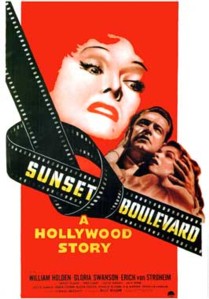
Showbiz Noir! There’s not much I can add to the volumes already in existence about Billy Wilder’s undisputed masterpiece Sunset Boulevard (1950). So I’ll say only that it was a thrill to see this film on the big screen at last – the hair stood up on the back of my neck when Gloria Swanson’s Norma Desmond acknowledged “those wonderful people out there in the dark” – and that the magnificent 4K digital restoration provided by Paramount Pictures reveals nuances of William Holden’s turn as doomed scribe Joe Gillis that had escaped my attention in the past.

1947’s Repeat Performance is one of the most requested titles in Noir City history. It’s easy to understand why given the premise: stage star Sheila Page (Joan Leslie) guns down philandering husband Louis Hayward on New Year’s Eve and fervently wishes for the opportunity to live the past twelve months over again. Somehow, that wish is granted. Will she be able to change her fate? Fittingly, the film screened at this year’s Noir City with a new 35mm print partially funded by the FNF. Eddie calls it noir’s version of It’s a Wonderful Life. I’d say it’s Groundhog Day meets Final Destination. Performance is more “woman’s picture” than film noir, but it’s a fun ride the entire time thanks to a sophisticated cast including the always-welcome Tom Conway and a mesmerizing Richard Basehart in his debut.

Night Three

I did something I’ve never done before. I skipped the Academy Awards – OK, technically I recorded them and zipped through them later, but it’s the principle of the thing, people – to work the merch table and watch a pair of rare proto-noirs, films from the early 1930s that dealt with mature material in a manner unimpeded by the strictures of the Production Code. Both were produced by Carl Laemmle, Jr., overshadowed by his studio chieftain father and in Eddie’s words ripe for a reappraisal.

The Kiss Before the Mirror (1933) is about a successful Viennese criminal attorney (Frank Morgan, not in Kansas or Oz anymore) defending a friend who murdered his unfaithful wife – and who begins to suspect his own spouse of infidelity. A successful verdict may clear the way for Morgan to take the law into his hands himself. This one is a genuine oddity, a talky and unsatisfying tale that ignores its most intriguing character (Jean Dixon as Morgan’s mysterious associate) and was filmed by director James Whale on the same sets where he shot Frankenstein, leading to some unusually atmospheric Austrian jails.

It was only appropriate to watch an early effort by William Wyler on Oscar Night, considering that he directed more actors to nominations than any other filmmaker. He worked his magic again in 1931’s A House Divided. Widowed fisherman Walter Huston has a mail-order bride sent to his remote Pacific Northwest town, but when his future missus arrives she instead falls for his son (Douglass Montgomery, very modern in his appearance). It’s a fleet, rock-solid melodrama anchored by an amazing Huston performance, never more demonstrative than when his character is incapacitated. A then-24-year-old John Huston wrote his old man’s dialogue.

Here’s the thrilling conclusion of my Noir City recap! In 3D!

Monday, February 25, 2013

Rant: Stop Trying to Help, Facebook

Dear Facebook,

I know how loaded these words are, but ... we need to talk.

You and I have been together for a while now, and I’ll readily admit it was more out of laziness than genuine affection. I was lonely, you were available, it was the twenty-first century. These things happen.

I’ll also confess that I wasn’t as forthcoming with you as I could have been. You asked about my religious and political beliefs. I appreciated the curiosity while wondering how genuine it was. I decided to play it cool, keep it light. I summarized my spiritual values in one sentence – The designated hitter is a sin – and gave my political affiliation as National League, meaning baseball’s senior circuit. I’m such a card.

Truth be told, I have no interest in hearing about politics whenever we get together with our mutual friends, and that’s why I came over all coy. You manage to reduce politics – and pretty much every subject – to the level of NASCAR flash, a series of ostensibly clever images that repurpose statistics and pop culture iconography into visual white noise. During election season I stopped swinging by entirely.

If we’re being brutally honest here, I also hate the cute cat pictures. All the cute animal photos, actually. And I don’t think George Takei’s stuff is funny. There, I said it.

I still visited on a regular basis, but it became a one-way street. Things got ... distant. That’s on both of us.

Yesterday I dropped in. I checked out my page to see what you’d done to the place. And that’s when I realized that you hadn’t gotten one of my little jokes at all.

You see, you’d taken it upon yourself to link my page to the Wikipedia entry on the Irish National League, the home rule political party founded by Charles Stewart Parnell in 1882. Not, as I intended, to the aforementioned senior circuit in Major League Baseball.

I know you didn’t mean it. I know it wasn’t you, but some algorithm you went out and got, probably on an anniversary that I callously forgot, to make things nicer.

But the fact remains – you changed the depiction of my political beliefs without my knowledge or my permission. I suppose I should consider myself lucky that you at least got my heritage correct and didn’t link to one of the many other National Leagues, like the ones in India, Burma, or Poland. (But seriously, have you seen Parnell? Clark Gable as an Irish political leader? It’s terrible. I thought you knew me.)

I’m laying all the cards on the table here, Facebook. I am bitterly disappointed with you. Prospective employers have been known to check with you before making hiring decisions; crazy, I know, but such is the age we live in. And in your effort to be helpful, to paint what you erroneously believe to be the most thorough picture of me, you get me all wrong. You depict me as someone carrying a grudge about events that transpired generations ago.

And you did this without asking me.

Strangely, I don’t care if prospective employers go to my Facebook page and see the content I post there, the vast majority of which is about cocktail consumption. Because I chose to put that information there. Because that represents, for good or ill, an accurate depiction of my character.

You turned a joke into a political statement, one that I never intended to make. And you did it without my consent.

I’ll continue to come around, more out of habit that genuine interest. But I’ll be very careful about what I say from now on, and I certainly won’t be taking any of your suggestions about which businesses to patronize. If you keep acting all Skynet on me, I may not share anything with you anymore.

Ireland Forever and Let’s Go Mets,
Vince

Friday, February 22, 2013

Cocktail of the Week: The Diamondback

Step #1: Buy a welding mask.

OK, that may be taking precautionary measures to an extreme. But the first time I ever tried a Diamondback it was made with Rittenhouse rye (100 proof), Laird’s Bonded Apple Brandy (100 proof) and green chartreuse (110 proof). You do the math. To quote noted expert Dr. Julius Hibbert, by all medical logic steam should have been shooting out of my ears. But it’s not the potency that draws me back, it’s the complexity. The Diamondback has many levels. Even its nuances have nuances.

Given the drink’s undeniable sting, you would be well within your rights to assume that it was christened after the rattlesnake. You would be wrong. According to Ted Saucier’s Bottoms Up! (1951), its namesake is the Diamondback Lounge, late of the Lord Baltimore Hotel in, you guessed it, Baltimore.

Saucier’s recipe also spawned the small degree of controversy around the Diamondback. Once again it’s time to ask the musical question: Which chartreuse do you choose? Saucier called for yellow. Order the cocktail now and it’s virtually certain you’ll be served one with green. In preparing for this post I made one with each, because my commitment to research and my love for each of you knows no bounds.

Yellow chartreuse’s herbaceous sweetness dominates; in some drinks that has its appeal, but here it overwhelms the rye, a particular shame with one as sweet and spicy as Rittenhouse. As for the green, the color means go for a reason. It conducts its business with ruthless efficiency, content to let the whiskey lead.

While the original ratio of 2:1:1 is still preferred, a number of bartenders including Jim Meehan of New York’s PDT opt for a more spirit forward version, with a full two ounces of rye and a half ounce of the other two elements. Use that formula and green chartreuse is the only choice. My preference is Saucier’s classic recipe with the more potent liqueur. Be sure to lift your welding mask before sampling.

The Diamondback

1 ½ ozs. rye
¾ oz. applejack
¾ oz. green chartreuse

Stir. Strain. No garnish.