Monday, January 17, 2022
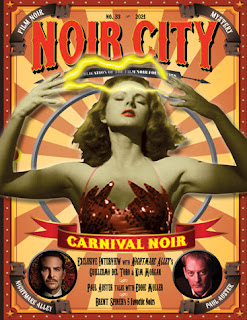
Noir City On The Midway Edition
The centerpiece of the issue is an exclusive interview with Guillermo Del Toro and Kim Morgan about their bold new reimagining of Nightmare Alley, currently in theaters. FNF honcho, TCM host, and man about town Eddie Muller weighs in on the film. And we also have a feature on the long, twisted history of carnivals in film noir.
Next up, a dazzler of a conversation between Eddie and his favorite living author, Paul Auster. Pour yourself a drink and pull up a chair to listen in as they go long on noir, art, and life.
Also in this issue—
Imogen Sara Smith considers the doppelganger in film noir, with a special focus on Joseph Losey’s harrowing masterpiece Mr. Klein (1976).
Get behind the wheel with the cabdrivers of noir, courtesy of Jake Hinkson.
Danilo Castro sizes up the “frontier trilogy” of Taylor Sheridan—Sicario, Hell or High Water, Wind River—that maps the territory where noir meets the west.
Actor Brent Spiner is best known for playing Lt. Commander Data on Star Trek: The Next Generation. His new book Fan Fiction is a wildly inventive “mem-noir” about his time on the show, blending autobiography with a crime plot. He kindly agreed to drop by and name his five favorite classic noir films.
I talk to writer/musician Willy Vlautin, whose The Night Always Comes is hands down my favorite novel of 2021. Compassionate and chilling, this noir odyssey is the book for our political moment. Read the interview, but more importantly read Willy’s book.
Plus my column, my review of what could easily end up my favorite book of 2022—Isaac Butler’s ambitious and compelling The Method: How the Twentieth Century Learned to Act—and so much more, all of it spectacularly laid out by ace designer Michael Kronenberg. I mean, just look at that cover.
You can buy the print edition at Amazon, or contribute at least twenty dollars to the FNF’s campaign to preserve and restore classic film noir to receive the bells-and-whistles digital version. You want my advice? Do both. You won’t regret it.
Monday, December 20, 2021
Keenan's Klassics: It's a Shane Black Christmas
From 2009. Needed now more than ever.
There I am at my favorite watering hole, talking with the staff, when the subject of Christmas movies is raised.
First suggestion, not made by me: the traditional double-bill of Die Hard and Die Hard II: Die Harder.
So I lobby for my own Christmas favorite, The Ref. And then observe, not for the first time, that the entire oeuvre of Shane Black – Lethal Weapon, The Last Boy Scout, The Long Kiss Goodnight, and Kiss Kiss Bang Bang – is set at the most wonderful time of the year. (Editor’s note, 2013: You can now add IRON MAN 3 to that roster. Editor’s note, 2016: And THE NICE GUYS. The Christmas trees are there if you look. Editor’s note, 2019: The streak comes to an end with Black’s 2018 film THE PREDATOR, which is set at Halloween. It was fun while it lasted.)
Therefore, as you venture out for that last round of shopping, I offer, by popular demand, what has become a VKDC tradition. (“By popular demand” meaning Rosemarie asked, “Why haven’t you posted this yet?” And she did write most of it.) Here, once again, is Shane Black’s 12 Days of Christmas. Record your church group performing this and we’ll post the video here!
Twelve cars exploding
Eleven extras running
Ten tankers skidding
Nine strippers pole-ing
Eight Uzis firing
Seven henchmen scowling
Six choppers crashing
Five silver Glocks
Four ticking bombs
Three hand grenades
Two mortar shells
And a suitcase full of C-4
God bless us, everyone. Or else.
Thursday, September 30, 2021
Noir City Fit to Print Edition
Gloria Grahame is perhaps the most popular actress in all of film noir. The details of her life have been well-documented. Offering a fascinating and fresh perspective on her legacy: Emmy Award winner Dana Delany, who candidly admits that Gloria has been her lifelong muse. Dana’s heartfelt, meticulously researched essay is a unique opportunity to venture inside the craft, “actor to actor.”
Working with Dana on this story was an absolute joy, and the result speaks for itself. I was remiss in not posting this update before Dana made her debut appearance on TCM’s Noir Alley alongside FNF honcho Eddie Muller introducing Gloria in Human Desire (1954), but if you hurry you can read Dana’s work before she returns to the show on Saturday, October 2 (with a repeat broadcast on Sunday, October 3) for more Gloria with The Glass Wall (1953).
Also in this issue—
Randy Dotinga on how classic film noir hid LGBTQ characters in plain sight;
Nora Fiore, Twitter’s Nitrate Diva, surveys astrology in crime films;
Nathalie Atkinson interviews Pornsak Pichetshote, writer of the new noir comic The Good Asian;
Eddie Muller tells the story behind the noir-stained paintings of the outsider artist known as Ely Legerdemain;
Novelist S.A. Cosby—you’ve read his books Blacktop Wasteland and Razorblade Tears, right?—explains why Point Blank (1967) is his favorite neo-noir;
And more.
I’ve got my usual column, a few book reviews, and a conversation with Silvia Moreno-Garcia, whose Velvet Was the Night is the noir novel of this summer.
The best way to get Noir City is to contribute twenty dollars or more to the FNF and its ongoing campaign to restore and preserve film noir. But now there’s a whole new wrinkle.
We’ve launched a print edition of Noir City, available via Amazon’s print on demand service. If you thought ace designer Michael Kronenberg’s graphics looked stunning in our digital mag, wait till you see his handiwork in hard copy.
While you’re at it, why not pick up our debut print edition, the Modern Noir Master issue from earlier in 2021 featuring m’colleague Ray Banks’s interview with filmmaker Mike Hodges—and exclusive testimonials from Hodges’s frequent collaborators Michael Caine (Get Carter, Pulp) and Clive Owen (Croupier, I’ll Sleep When I’m Dead)?
What the hell, I might as well beat all the drums and hip you to the latest edition of our Noir City Annual, featuring the best the magazine published in 2020. The year’s installment is a few months late—thanks, Covid—but the writing remains as fresh as ever. It’s the first book I’ve ever edited, and I’m proud of it. Stock up on your noir reading as shadows begin to lengthen.
Saturday, April 10, 2021
Noir City “With Me, It’s A Full-Time Job” Edition
Enough false modesty. Honestly, you need to check this installment out, with all credit going to our top-drawer contributors, the wizardry of ace designer Michael Kronenberg, and the guiding hand of our publisher Eddie Muller.
I will humbly admit to getting the ball rolling on the cover story. A while back, I came up with the idea of the FNF presenting an annual Modern Noir Master Award, an honor that has been bestowed on Stephen Frears, James Ellroy, and David Mamet. When I realized that 2021 marks the 50th anniversary of the landmark UK crime film Get Carter (1971), I suggested to Eddie who our next recipient should be.
Writer/director Mike Hodges also made Pulp (1972), Croupier (1998), I’ll Sleep When I’m Dead (2003), and other noir-adjacent films. In his 89th year, he has a new film in the works. All I had to do was put him together with our man on the Continent Ray Banks. The result is a free-wheeling, career-spanning interview that even covers Hodges’ own noir fiction.
I’ll also pat myself on the back for another contribution to this feature. We won’t be able to present the award live for obvious reasons, so I wanted to do something extra. Something special. Thus did I become fixated on the notion of having Sir Michael Caine and Clive Owen, the two actors who loom large in Hodges’ noir filmography, contribute to Noir City.
A longshot, I figured. But I am as tenacious an optimist as you will find, so I started making inquiries. Turned out, it couldn’t have been simpler. Both gentlemen were eager to say a few words on behalf of a valued collaborator and colleague, and you can read those words in this issue. I’ll admit I was chuffed it came together, as they say across the pond.
But that’s just for openers. In this issue, we also have—
Imogen Sara Smith with a definitive look at the work of filmmaker Christian Petzold, from his early German films never screened in the US to masterful features like Phoenix (2014) and Transit (2018);
An appreciation of a longtime noir favorite, the hard-luck actress Virginia Grey, from the Self-Styled Siren Farran Smith Nehme;
The career of self-described “Hungarian-born one-eyed cowboy from Texas” André de Toth, whose directorial credits include Pitfall (1948) and Crime Wave (1954);
An interview with Eve Plumb—yes, that Eve Plumb—about her second act as a painter whose work is inspired by classic noir films, and her turn as a villain in the neo-noir Blue Ruin (2013);
The screenwriting career of sportswriter Art Cohn, best known for the quintessential boxing film The Set-Up (1949);
Jason A. Ney’s insightful look at amnesia noir, and how this plot gimmick has evolved along with our understanding of memory;
I raise the question “Charlie Chaplin … noir filmmaker?” with an appraisal of his most confounding role, as the serial murderer Monsieur Verdoux (1947). My first draft of this article was heavy on Chaplin and Orson Welles, who came up with the idea for Verdoux, trash-talking each other for decades. I still think I should mount this as a one-man show.
And there’s still more. Trust me, you want this issue. All you have to do to get it is make a modest contribution to the Film Noir Foundation and our efforts to restore classic film.
Thursday, February 04, 2021
Reach for The Sharpest Needle
I don’t want to appear immodest and big up Needle myself. Instead, I’ll tell you that Publishers Weekly called it “a tailor-made treat for film buffs” while Historical Novel Review said “the mystery has plenty of tantalizing sidetracks … carefully stitched and neatly sewn together.”
Rosemarie and I were interviewed by Library Journal.
Everything Zoomer has the book in terrific company as one of its recommended February reads.
Over at CrimeReads, I have a piece detailing a fascinating footnote unearthed in our research: the history of Welles’s unmade adaptation of the Nicholas Blake novel The Smiler with the Knife. He’s planning the film—about a fascist coup in the United States spearheaded by a flashy playboy businessman, if you can imagine such a thing—at the time The Sharpest Needle is set. Full of surprise cameos and an explanation of how the proposed project ended up shaping Citizen Kane. Go on, give it a read.
Friday, January 01, 2021
A Bloody (Mary) Kind of Year
![]() |
| The inaugural effort |
We couldn’t ring in 2021 by going out for breakfast, obviously, but we weren’t about to abandon our only tradition. So we made adjustments. We laid in a spread for New Year’s Day. Fresh bagels, cream cheese, smoked salmon, the works. All that remained were the cocktails. I had to fix a Bloody Mary or two.
Which, astoundingly, I had never done before. My default brunch cocktail—damn near everybody’s, really, although don’t sleep on the possibilities of the Blood and Sand as an eye-opener—and at no point had I even attempted to make one. When I’m in the mood for a Bloody Mary, I’m out and about, and consequently I let the professionals handle it. Not so in 2021.
Chalk up another modification to our tradition. This year, my first act of January 1 was to step just a little bit outside of my comfort zone. May that also help set the tone for the next twelve months.
As for the drink itself, I consulted experts before getting down to work. (In the interests of full disclosure, I did stage a trial run in the waning days of 2020 so I wouldn’t stagger into this project unprepared.) Everyone has their own preferences for the Bloody Mary; I opted for a variation on Jim Meehan’s excellent recipe from his Meehan’s Bartender Manual. I also rolled the cocktail, rather than building it in the glass or shaking it, which dilutes the tomato juice. To roll the drink, you assemble the ingredients in the shaker, which you then turn over twenty or so times.
The verdict? Rosemarie liked hers. I liked mine. And the year is off to a good start.
The Bloody Mary
apologies to Jim Meehan
4 oz. tomato juice
1 ½ oz. vodka
¼ oz. lemon juice
¼ oz. lime juice
¼ oz. Worcestershire sauce
½ tsp. horseradish
¼ tsp. celery salt
¼ tsp. freshly ground black pepper
¼ tsp. hot sauce
Combine ingredients. Roll in a shaker (see above). Strain over fresh ice into a tall chilled glass. Garnish with a celery stalk.
Saturday, November 28, 2020
Noir City Noirvember Edition
Eddie Muller’s galvanizing letter from the publisher on the perils of cancel culture;
The return of Nora Fiore, Twitter’s inestimable Nitrate Diva, with a gem of a piece ranking noir’s best diners, beautifully laid out by ace designer Michael Kronenberg;
Michael dons his interviewer cap for a talk with comics writer of the moment Tom King;
My pal Christa Faust on noir’s ladies of a certain age;
Sharon Knolle’s timely reappraisal of crooked cops in noir—with an eye-opening sidebar by veteran law enforcement officer Peter Stipe;
Our man on the Continent Ray Banks considers the dark performances of beloved softie Richard Attenborough;
The troubled career of filmmaker Hubert Cornfield;
And more.
I’ve got some book reviews, my usual column complete with cocktail recipe, and a conversation with novelist Alaya Dawn Johnson (Trouble the Saints) prompted by her fascinating CrimeReads essay on racism in classic noir fiction.
Want a copy? Head over to the Film Noir Foundation website and make a modest contribution to the ongoing fight to preserve classic film noir. As accompaniment, you can listen to my colleagues hold forth on the Word Balloon podcast.
Wednesday, July 29, 2020
Noir City Coffee is for Closers Edition
What else do you get for your donation to the FNF? How’s about Imogen Sara Smith, who helped program the fantastic Western Noir series currently lighting up the Criterion Channel, on Japanese noir, paired with a salute to Japanese noir mainstay Jô Shishido by Nick Feldman?
Plus: Elsa Lanchester; the pop noir landscapes of Walter Hill; Ethan Iverson on the noir soundtracks of the late Johnny Mandel (Harper and Point Blank); Christopher Chambers looking back at the pleasures of Tony Rome; Martyn Waites on the neglected UK noir The Small World of Sammy Lee; and, yes, even more.
One feature I’m particularly excited about: actor James Urbaniak, a familiar face (and voice if, like me, you’re a fan of The Venture Bros.) takes on our 5 Favorites feature, naming the quintet of films in his personal noir pantheon.
I interview S.A. Cosby, author of the crime novel of the summer Blacktop Wasteland, and I review a pair of non-fiction titles as well as penning my usual Cocktails & Crime column.
To receive Noir City, head to the Film Noir Foundation website, kick in a few bucks to the kitty, and sign on the line that is dotted. What are you waiting for?
Saturday, April 18, 2020
Noir City Notes and Outtakes
The
content on those gorgeous pages is terrific, too, beginning with Imogen Sara
Smith’s two-part cover story on the extraordinary life and films of Jose
Giovanni. We also welcome two Twitter luminaries to the magazine: Farran Smith
Nehme (aka the Self-Styled Siren) with a look at noir’s favorite cad Zachary
Scott; and Nora Fiore—the one and only Nitrate Diva—brought us a stunning look
at the overlap of film noir and advertising aimed at women in the 1940s.One More—Actually, Two More Things
Friday, January 17, 2020
Outtakes: Robert Tasker and Ernest Booth
I’ve been reading CrimeReads since it launched, so I was happy to make my debut there yesterday with a piece that recounts the amazing true story behind Script for Scandal, the third Lillian Frost and Edith Head mystery I co-wrote with Rosemarie under our pen name Renee Patrick. Robert Tasker and Ernest Booth were two ex-cons who became screenwriters during Hollywood’s Golden Age. A fictionalized counterpart drives the plot of Script for Scandal, but we couldn’t concoct anything as remarkable as their own lives. Head over to CrimeReads and see for yourself. In the meantime, here are a few additional photographs I turned up in my research.
1932’s Hell’s Highway, co-written by Tasker, was partially filmed in an actual prison. John Cromwell directed these scenes uncredited. (Los Angeles Times, July 26, 1932)
From the February 24, 1940 San Francisco Examiner, Booth and his wife Valverda at home in Santa Cruz marking the end of Booth’s parole and what should be the start of a successful writing career with no restrictions. It wasn’t to be.
Valverda stands by her husband as he faces a murder charge. (Los Angeles Times, September 14, 1941)
Dr. George Stricker revived by smelling salts after his late wife Florence Stricker’s safe deposit box is opened. Dr. Stricker, along with Booth, was considered a suspect in his wife’s murder. (Los Angeles Times, September 18, 1941)
The most Ellroy-esque shot of them all, with headline to match. Captain Vernon Rasmussen of the LAPD searches, ultimately in vain, for the murder weapon. (Los Angeles Times, September 21, 1941)
Monday, December 23, 2019
Keenan's Klassics: It's a Shane Black Christmas
It's the tenth anniversary of this beloved yuletide classic.
There I am at my favorite watering hole, talking with the staff, when the subject of Christmas movies is raised.
First suggestion, not made by me: the traditional double-bill of Die Hard and Die Hard II: Die Harder.
So I lobby for my own Christmas favorite, The Ref. And then observe, not for the first time, that the entire oeuvre of Shane Black – Lethal Weapon, The Last Boy Scout, The Long Kiss Goodnight, and Kiss Kiss Bang Bang – is set at the most wonderful time of the year. (Editor’s note, 2013: You can now add IRON MAN 3 to that roster. Editor’s note, 2016: And THE NICE GUYS. The Christmas trees are there if you look. Editor’s note, 2019: The streak comes to an end with Black’s 2018 film THE PREDATOR, which is set at Halloween. It was fun while it lasted.)
Therefore, as you venture out for that last round of shopping, I offer, by popular demand, what has become a VKDC tradition. (“By popular demand” meaning Rosemarie asked, “Why haven’t you posted this yet?” And she did write most of it.) Here, once again, is Shane Black’s 12 Days of Christmas. Record your church group performing this and we’ll post the video here!
Twelve cars exploding
Eleven extras running
Ten tankers skidding
Nine strippers pole-ing
Eight Uzis firing
Seven henchmen scowling
Six choppers crashing
Five silver Glocks
Four ticking bombs
Three hand grenades
Two mortar shells
And a suitcase full of C-4
God bless us, everyone. Or else.
Sunday, November 10, 2019
News and Noir City Notes

Lot of ground to cover here. I should probably point out that the eBook of the third Lillian Frost and Edith Head mystery Script for Scandal—written by the missus and myself under our pen name Renee Patrick—is available everywhere, with the print edition for sale in the U.K. now and coming to the U.S. on January 7, 2020. Hey, the reviews are good.
Next, the latest issue of Noir City is on the loose. The big news is behind the scenes. It’s Eddie Muller’s last edition of the magazine as Editor-in-Chief. He’s staying on as Publisher—the Film Noir Foundation is his baby, after all—but handing over the E-i-C reins to yours truly. It was a relatively bloodless transfer of power, no matter what Eddie says.
The Czar and I are cooking up big plans for 2020. In the meantime, the current issue is a gem. Steve Kronenberg on the tragic life of Gene Tierney. Ray Banks on officers behaving badly in Ealing’s postwar crime films. Sharon Knolle surveys the cinema of Grahame Greene. Danilo Castro on Paul Schrader’s quartet of night workers. Jake Hinkson on booze and blackouts in noir.
I provide the chaser to Jake’s piece, bellying up to The Lost Weekend and asking the timeless question: Noir or Not? I also provide a pair of book reviews, contribute to Noir City’s coverage of the Seattle International Film Festival, and serve up maybe my favorite drink to date in my Cocktails & Crime column. (BONUS: my interview with author and podcaster Karina Longworth from last issue is on the FNF website.)
How much for this bounty, you damn well better be asking? A donation of twenty dollars or more to the Film Noir Foundation’s efforts to keep shadows flickering on screens everywhere is all it takes. What, you’re still here? Get donating!
Thursday, June 27, 2019
Noir City: True Crime
I should be updating this website more often—for instance, to tell you Rosemarie and I are hosting a summer film series with SIFF if you haven’t picked up the news elsewhere—but for now, here’s a late-breaking bulletin on all the news that was fit to print in the latest issue of the Film Noir Foundation’s magazine Noir City, out last week.My primary contribution this go-round is an interview with Karina Longworth, host of the acclaimed You Must Remember This podcast, which casts a gimlet eye on movie history. We had a wide-ranging conversation prompted by her new book Seduction: Sex, Lies and Stardom in Howard Hughes’s Hollywood, which in the words of FNF honcho Eddie Muller “offers a fresh and provocative slant on the eccentric billionaire and some surprising new information about some of the talented people in his life.”
Also in this issue is my look at Automata, the retro-noir web series (and possible TV series) spun off from a popular web comic. Plus my book and DVD reviews, as well as my usual Cocktails & Crime column featuring a round-up of the latest noir news.
Headlining the issue is a suite of articles about Tinseltown true crime: Alan K. Rode on how gangsters took over the studio unions (a subject that, rumor has it, may factor into the new novel from author Renee Patrick) and John Wranovics on gangster Johnny Rosselli’s short-lived stint as a moviemaking mogul. Plus my friend Brian Light’s reminiscences on collecting film noir posters, Ben Terrall’s appraisal of the career of novelist and screenwriter Jonathan Latimer, and so much more.
Interested? Of course you are. Swing on by the FNF website, make your donation, and have the issue sent to you.
Monday, November 26, 2018
Noir City Goes Global
Imogen Sara Smith on the long history of Mexican noir; Jake Hinkson on the heartbreaking crime dramas of Japan’s Yoshitarô Nomura (stream these wonders on FilmStruck before the service goes dark for good this week); the redoubtable Ray Banks takes on the villainous roles of Patrick McGoohan; Ehsan Khoshbakht on Iranian genre films; Nathalie Atkinson on the premier Canadian noir The Silent Partner; and more.On the domestic front, we’ve got a killer 5 Favorites essay from comic book legend Jim Steranko; a look at the twinned noir careers of John Huston and Orson Welles by Brian J. Robb along with a review of their last collaboration The Other Side of the Wind from FNF honcho Eddie Muller himself; and, once again, more.
As for my humble efforts, I spoke to both Lawrence Block and artist John K. Snyder III about the recent adaptation of Larry’s landmark Matt Scudder mystery Eight Million Ways to Die into a graphic novel, bringing 1980s New York to raw, vivid life in a whole new way. Plus a pair of book reviews and my Cocktails & Crime column.
You know the drill, kids: donate to the Film Noir Foundation and have all this goodness delivered direct to you. Don’t miss out. Because the next issue? That’s one gonna be even better.
Monday, July 16, 2018
Noir City: Demon Dog, Modern Master
The cover story of the latest issue of the Film Noir Foundation’s magazine is a certifiable corker. Back in April, the FNF bestowed its second Modern Master Award on novelist James Ellroy in advance of a screening of the Oscar-winning masterpiece based on his novel L.A. Confidential. Included in the magazine is a transcript of his wild, jaw-dropping conversation with FNF honcho and master of ceremonies Eddie Muller. Trust me, you’re going to want to read this one.
ASIDE: don’t sleep on the latest work from the recipient of the inaugural Modern Master Award, director Stephen Frears. A Very English Scandal, written by Doctor Who’s Russell T. Davies and boasting sterling work from Ben Whishaw and a career-best Hugh Grant, is now streaming on Amazon Prime. Frears is still throwing heat at age 77. That’s the kind of person we honor at the FNF.
Still, I know what you’re thinking. What about you, Vince? What did you do this time around?
I’ve got a feature on Baby Monkey, Private Eye, a gorgeous first reader for children written by Brian Selznick—whose previous books have been turned into films by Martin Scorsese and Todd Haynes—and David Serlin. My conversation with these two gentlemen was an absolute joy, and I hope some of the fun comes across in the article.
Plus I’ve contributed a troika of book reviews—on Thomas Doherty’s essential work of scholarship Show Trial: Hollywood, HUAC, and the Birth of the Blacklist; J. E. Smyth’s eye-opening Nobody’s Girl Friday: The Women Who Ran Hollywood (Edith Head warrants her own chapter, natch); and a newly annotated edition of Chandler’s The Big Sleep—plus hot-off-the-presses hot takes on films from the Seattle International Film Festival including one of the year’s best movies, Denmark’s The Guilty. This installment of my Cocktails & Crime column includes an interview with Abigail Gullo, who’s put her acclaimed bartending skills to work creating a drink named for Joan Crawford’s crowning achievement Mildred Pierce.
Don’t miss out. Donate to the Film Noir Foundation to have this bounty delivered to your digital doorstep. The Demon Dog says so.
Thursday, March 22, 2018
Noir City: Episode of Blonde
We didn’t plan for this to be our blonde issue. That’s just how it worked out, with a troika of fair-haired silver screen goddesses for you to (re)consider. Jake Hinkson kicks things off with our cover story on the noir films of Marilyn Monroe. Ray Banks follows up with a heartbreaker on Diana Dors. Then I (sort of) get into the act, interviewing Paul McGuigan, the filmmaker behind the BAFTA-nominated drama Film Stars Don’t Die in Liverpool about the sad final days of noir favorite Gloria Grahame.
Excuse me while I rant a moment, but I’ve got to get this off my chest: the botched release of Film Stars is the great cinematic crime of 2017. Annette Bening is transcendent as Gloria Grahame, giving hands down my favorite performance of the year. She’s perfectly paired with Jamie Bell as her much younger paramour Peter Turner, whose memoir provides the basis for the film. I loathe when movies are judged solely through the narrow lens of Academy Awards viability. But when a studio publicly declares an Oscar to be its goal and then can’t even make a worthy turn part of the conversation, well … someone screwed up. Probably multiple someones. Still, Bening’s work remains, to be discovered by audiences in due time. Years from now, people will marvel that her quicksilver brilliance paying tribute to another great actress went largely unrecognized at the time—except, of course, in the pages of Noir City.
Also in this issue: my interview with Laura Lippman, whose latest novel Sunburn is pure noir. Plus FNF founder Eddie Muller on the undiminished power of Steve De Jarnatt’s newly relevant Miracle Mile—and a bonus 5 Favorites from De Jarnatt himself. Then there’s Nathalie Atkinson on Agatha Christie for a new millennium; one legendary cartoonist (Trina Robbins) saluting another in Tarpé Mills; a look at the noir roots of Blade Runner and its sequel; profiles of filmmakers Vincent Sherman and the husband-and-wife team of Andrew and Virginia Stone; plus reviews, news, and my Cocktails & Crime column. All of it beautifully assembled by ace designer Michael Kronenberg.
Really, this issue is the son I’ll never have. Why aren’t you reading it now? Simply donate to the Film Noir Foundation and all this can be yours.


