Showing posts with label On The Web. Show all posts

Thursday, June 27, 2019

Noir City: True Crime

I should be updating this website more often—for instance, to tell you Rosemarie and I are hosting a summer film series with SIFF if you haven’t picked up the news elsewhere—but for now, here’s a late-breaking bulletin on all the news that was fit to print in the latest issue of the Film Noir Foundation’s magazine Noir City, out last week.

My primary contribution this go-round is an interview with Karina Longworth, host of the acclaimed You Must Remember This podcast, which casts a gimlet eye on movie history. We had a wide-ranging conversation prompted by her new book Seduction: Sex, Lies and Stardom in Howard Hughes’s Hollywood, which in the words of FNF honcho Eddie Muller “offers a fresh and provocative slant on the eccentric billionaire and some surprising new information about some of the talented people in his life.”

Also in this issue is my look at Automata, the retro-noir web series (and possible TV series) spun off from a popular web comic. Plus my book and DVD reviews, as well as my usual Cocktails & Crime column featuring a round-up of the latest noir news.

Headlining the issue is a suite of articles about Tinseltown true crime: Alan K. Rode on how gangsters took over the studio unions (a subject that, rumor has it, may factor into the new novel from author Renee Patrick) and John Wranovics on gangster Johnny Rosselli’s short-lived stint as a moviemaking mogul. Plus my friend Brian Light’s reminiscences on collecting film noir posters, Ben Terrall’s appraisal of the career of novelist and screenwriter Jonathan Latimer, and so much more.

Interested? Of course you are. Swing on by the FNF website, make your donation, and have the issue sent to you.


Wednesday, March 05, 2014

On The Web: Amble to Ambler

My friend Ethan Iverson, pianist in The Bad Plus and crime/thriller fiction connoisseur, has written another of his brilliant overviews of a single writer’s work, in this case the great Eric Ambler. I was lucky enough to get a sneak peek, and honored to make a meager contribution. Go read it, because I guarantee it will be the only time I ever share space with the legendary Len Deighton.

Monday, January 06, 2014

Miscellaneous: Youngman with a Horn

It’s a side effect of being obsessed with show business. Every time I meet someone who shares the same last name as somebody famous, I think, “Maybe they’re related!” Just a way to make my humdrum life more exciting. It never turns out to be true.

Until my first day in the video game business. I was introduced to the project’s lead designer Jim Youngman and thought, “Maybe he’s the grandson of Henny Youngman, the legendary comedian! The King of the One Liners! The featured attraction at the end of that spectacular tracking shot through the Copacabana in Goodfellas!” Not that I asked him about it. I knew how ridiculous the idea was.

But over the next few weeks, Jim would say things that kept me wondering. The clincher was when he mentioned that his father had edited The Horror of Party Beach, which had turned up on Mystery Science Theater 3000. I did some research and came to our next meeting flabbergasted. “You are Henny Youngman’s grandson!”

Jim happily acknowledged the connection. “Not a lot of people my age know Henny,” he said. But Jim and his father Gary, an accomplished editor and documentarian, are trying to change that.

They’ve launched a Kickstarter campaign to finish a documentary about one of the all-time great comics. Take My Life ... Please! features classic Henny Youngman performances, new interviews with contemporaries like Milton Berle, Jan Murray and Stiller & Meara, and exclusive footage of Henny shot late in the comedian’s life. I’m backing it. So is Mark Evanier, your one-stop shop for all things showbiz. And so should you.

Tuesday, December 03, 2013

Movie: The Impostors (1998)

I’m reluctant to file this post under the Tuesday’s Overlooked Movies rubric. After all, I remember The Impostors with so much affection that it was our Thanksgiving night entertainment, cinematic comfort food. The trailer’s not on YouTube – but a fan version is, which tells you something about the film’s reception.

Actor Stanley Tucci scored a succès d’estime with his maiden (co-)directorial effort, 1996’s delicate art vs. commerce fable Big Night. His follow-up left critics and audiences somewhat flummoxed. It’s an honest-to-God farce, a loving tribute to 1930s cinema featuring the best actors 1990s independent film had to offer.

Tucci and Oliver Platt play Arthur and Maurice, a pair of literally starving actors cut from Laurel and Hardy cloth. Fittingly the movie’s opening scenes play like one-reelers as the boys struggle to ply their trade. Thanks to their efforts, they run afoul of vainglorious thespian Sir Jeremy Burtom (Alfred Molina, gleefully picking scenery from between his teeth) and accidentally end up stowing away on a transatlantic cruise ship, where their troubles really start.

The characters onboard the vessel are broad types drawn from the era (Campbell Scott restores luster to a neglected favorite, the comedy German), each a faker in his or her own way. They’re played by an astonishing cast. The assemblage of talent is one of the things that keeps bringing me back to the movie: Steve Buscemi (singing!), Lili Taylor, Hope Davis, Richard Jenkins, Allison Janney, and many more. It was only on viewing the film last Thursday that I realized Burtom’s nameless dresser is played by Lost/Person of Interest star Michael Emerson. (Tucci is destined to be remembered by an entire generation as the preening M.C. of the Hunger Games Caesar Flickerman, but for me his legacy aside from his sterling work as a character actor is the trio of films he directed that show an affinity for a bygone New York: this, Big Night and Joe Gould’s Secret. I wish he’d make more of them.)

What I love about The Impostors, in addition to the players and the affection for the period, is the silliness. It celebrates a style of comedy seldom seen nowadays, wrapping up the mayhem with an end titles sequence that is one of the most joyous on film. Occasionally I’ll pop in the DVD just to watch the last shot. It never fails to make me feel like a million bucks.

On The Web: Crimes of the Century

Ethan Iverson is the hugely talented pianist in The Bad Plus, a connoisseur of crime fiction, and a man who does not shy away from monumental tasks. His latest dark undertaking is an exhaustive, highly idiosyncratic list of the genre’s must-read books. I was honored that he asked me to give feedback, along with the estimable Sarah Weinman. Clear the decks and go read his choices.

Thursday, February 02, 2012

Noir City X: San Francisco, Day 3

It wouldn’t be a festival without one controversial title. 1949’s The Great Gatsby, out of circulation for decades, split the audience down the middle. Alas, I come down squarely on the negative side. This noir-inflected adaptation of F. Scott Fitzgerald’s novel plays like it was made by people who once had the book described to them during a drunken luncheon.

Things get off to a graceless start with a clumsy “Remember the Jazz Age?” montage. Alan Ladd plays the title role and is the best thing about the film. In a sense that’s faint praise, because it’s badly cast; Betty Field brings nothing to the almost unplayable role of Daisy, and we’re saddled with Macdonald Carey, who stubbornly resisted rising into the Hollywood firmament despite having Paramount’s promotional muscle behind him, as Nick Carraway. Reliable noir faces Barry Sullivan (Tom Buchanan) and Howard Da Silva (Wilson) fare better. Ladd flaunts his physique poolside and bristles enough to set the chip on his shoulder trembling. He has some strong moments in his up-and-comer flashbacks, like when he tells his mentor Dan Cody that he plans to succeed through hard work only to have Cody cackle and say such platitudes are meant to keep the suckers in line while the wise men sweep the chips off the table. (Every film this year seemed like political commentary to me.) Ultimately, though, this Gatsby lacks both the poetry and the edge of Fitzgerald’s story. Ladd’s son David, interviewed onstage after the screening by my friend Alan K. Rode, had it right when he called the film a “simplistic take” on the novel that offered a fine part for his father.

I discovered Three Strangers (1946) in 2010 and welcomed the prospect of seeing it on the big screen. This second viewing confirmed my belief that it’s one of the best films of the 1940s. A haunting fable with an extraordinary script by John Huston and Howard Koch, it tells the interlocked stories of a trio of desperate people hoping a bizarre pact brings them fortune. Peter Lorre and Sydney Greenstreet play characters, not the caricatures they’re largely known for, and Geraldine Fitzgerald’s quicksilver presence pushes the proceedings toward the unpredictable. Director Jean Negulesco’s flair for melodrama makes every leap into the unknown believable.

Nightly Cocktail Report: A dandy Manhattan variation called the Ellis Island at Poesia. Made with bourbon, Carpano vermouth and Strega.

All this was preamble for Everybody Comes To Eddie’s: The Noir City Nightclub. The Film Noir Foundation took over a hall and turned it into the nocturnal hot spot of cinematic dreams. The place was packed, partly because of the open bar but mainly due to the tremendous roster of talent Eddie Muller assembled. Dig this bill –

Mr. Lucky and the Cocktail Party, keeping the joint jumping;

The sublime Evie Lovelle, a demure beauty whose classical approach to burlesque damn near set the town ablaze;

Laura Ellis, a silver screen chanteuse performing a repertoire of noir nocturnes;

The Latenight Callers, the pride of Kansas City, closing out the night with a killer set. Here’s their video.


The high point had to be when Muller himself took to the mic to belt out the title song from Fear Over Frisco, his recent Grand Guignol show at the Hypnodrome Theater. I described his vocal stylings as Tom Waits meets Steve Lawrence, and he seemed inordinately pleased.

At one point during the evening, it dawned on me that I felt like I’d actually stepped into a swank joint from one of the movies we’d been watching. Gorgeous dames in their finery, a hot band and a cool vibe. The party underscored the fact that Noir City isn’t simply about preserving classic films. It’s about keeping alive the social aspect of moviegoing, getting together with strangers in the dark.

One day left to go. As in all good noirs, expect a twist ending.

On The Web: Ah, Treachery!

Ethan Iverson of The Bad Plus reads every novel by one of my all-time favorites, Ross Thomas. Sharp analysis and long quotations from the master. Check it out.

Monday, September 12, 2011

Me Elsewhere: On Coldblooded

If you’ve been paying attention you know about Norma Desmond’s Monkey, the movie blog set up by novelist and recovering male model Ray Banks. All the kids are talking about it. Ray just wrapped up a terrific week of posts as part of the Nicholas Ray blogathon.

For some reason, he’s allowed me to play in his sandbox. Go read my post about the forgotten 1990s hit man comedy Coldblooded, the real remake of The Mechanic which features one of my all-time favorite supporting performances.

Monday, August 01, 2011

On The Web: Bill James

Once again I am temporarily hanging my hat at the Abbott/Gran Medicine Show, the fabulous blog co-hosted by Megan Abbott and Sara Gran. My post this time around is about Popular Crime, an obsessive and compelling overview of true crime stories from a somewhat unlikely author: baseball stats guru Bill James. I call it “one of the strangest books I’ve ever loved.” Read the post to find out why.

Tuesday, June 14, 2011

On The Web: L.A. Noire at Crimespree

One of several reasons why posting has been somewhat scarce around here lately is that I’ve gone down the rabbit hole that is L.A. Noire, the new video game from Rockstar and Team Bondi. Over at Crimespree, I offer a review.

I’d be remiss if I didn’t steer you toward this piece on the game by Extra Lives author Tom Bissell at Grantland. More than a review, it’s a consideration of how L.A. Noire prefigures massive changes in storytelling. A brilliant, must-read take.

Wednesday, May 18, 2011

On The Web: My Guilty Pleasure at Crimespree

Crimespree Magazine is your go-to source for information on crime no matter the format: in print, on TV, or at the movies. Redoubtable entertainment editor Jeremy Lynch has brought back his Guilty Pleasures series and was kind enough to ask me to participate.

I could have taken the easy way out. I could have waxed rhapsodic about Jade and been done with it, emerging with some of my dignity intact.

But no. I had to give poor Jeremy more than he bargained for. I’ll say this for myself: I am unafraid to put the guilt in guilty pleasure.

Skate on over to Crimespree to see which movie I picked.

Friday, April 22, 2011

On The Web: The Mystery of the Guest Post

It’s vintage young adult fiction week over at the Abbott Gran Medicine Show, the must-read blog co-hosted by novelists Megan Abbott and Sara Gran. This week’s sterling posts include Megan’s interview with Lois Duncan, Sara on the Sweet Valley High books, and Alison Gaylin’s singular twinning of Helter Skelter and Judy Blume.

But boys read, too. So we hear from writer/cartoonist Ed Brubaker, offering a tribute to Encyclopedia Brown and The Great Brain. And, for some reason, me. In my post, I do what few will. I stand up for the Hardy Boys.

Many thanks to Megan and Sara for letting me into their clubhouse. Go read my post and all the others. Wonderful stuff galore.

Friday, December 17, 2010

On The Web: Blatant Self Promotion

A regular feature of the Noir City Sentinel, house rag of the Film Noir Foundation, is “Noir or Not?,” in which a film’s status in that darkest of pantheons is considered. For the Sentinel’s true crime edition, the task fell to me. The title in question? On the Waterfront. It was a tough piece to write, because before I could settle the noir matter I had to address my complicated feelings toward the movie.

True confession time: WATERFRONT is one of those classics that I respect more than like. I blame the Actors Studio. The Method school of performance it touted as the apex of emotional realism now reads as stylization of a different kind. Aside from some ferocious muckraking moments, the film crowned Best Picture of 1954 doesn’t speak to me. Three years earlier, Columbia Pictures released another film about harborside corruption. THE MOB (ironically made with the working title WATERFRONT) is a sharp-elbowed racketeering exposé with a crackling script by William Bowers. If you’ll permit a little blasphemy, your correspondent prefers it to WATERFRONT. It’s faster, funnier, more suspenseful, less ... psychological. In it a young Charles Bronson slams the degrading and tainted shape-up system of hiring longshoremen, but does so amidst corkscrew plot twists and wise-guy dialogue. True noir has no agenda other than to whisper in our ears that not only are we all doomed but destined to die unfulfilled, that at best we’ll go out with swag within arm’s reach and the lover for whom we stole it pulling the trigger. Not so ON THE WATERFRONT. It has points to make. It’s an issue drama in noir threads, a sheep in wolf’s clothing.

Nothing like walking up to a revered movie and kicking it in the shins.

My Waterfront essay is one of several from the latest Sentinel currently available for free on the the FNF website. You can read it here. While you’re there, why not kick in a few bucks to the Foundation and get regular access to my genius?

Wednesday, November 17, 2010

Movies: Noir On Demand

Netflix has been bulking up its Instant Viewing service for some time now. But a recent post on the Film Noir Foundation forum brought home just how many once obscure, still unavailable on video titles are now a mouse click away.

Among the movies currently streaming on Netflix: the personal favorite Cry Danger, Ed McBain’s Cop Hater, the haunting Moonrise, John Payne in Phil Karlson’s 99 River Street, the Gold Medal adaptation Johnny Cool, Down Three Dark Streets and The Killer is Loose.

My first dip into this treasure trove was 1956’s Crime Against Joe, a film I’d never heard of before. Joe is a battle-fatigued veteran struggling to make it as a painter while being “subsidized by (his) hardworking mother.” He chooses a bad night to get hammered while seeking out a nice girl to bring home to meet Mom; a nightclub singer he flirted with is murdered, and Joe doesn’t have an alibi. At a trim 69 minutes the film is more like an episode of Alfred Hitchcock Presents, but a good one. John Bromfield’s beefy bafflement works well in the title role, and Julie London is a fetching carhop named Slacks. There’s a strong feel for small town life in the supporting characters like the local businessman with an outsized sense of propriety and Frances Morris as Joe’s mother, who dotes on her boy but still thinks him capable of dark deeds.

Next up, a chance to revisit Private Hell 36 (1954). Like most of director Don Siegel’s films, it offers extreme pressure in close quarters. Cal and Jack (Steve Cochran, the slightly-better-off man’s John Bromfield, and Howard Duff) are L.A. cops chasing down three hundred grand in cash. Their only lead is faded chanteuse Lilli Marlowe (Ida Lupino, who co-wrote the script). Cal gets the hots for Lilli and pockets some of the stolen loot, assuming no questions will be asked. Except, of course, by the partner he drags into his crime. The result is a tense, sweaty affair with recriminations galore. For added frisson seek out James Ellroy’s 1997 novella “Hollywood Shakedown,” which reimagines the film’s production in sin-sational style.

And there’s more crime coming. Next year VCI Entertainment will bring The Prowler, restored in part by the FNF, to DVD. And as of yesterday the remastered Richard Stark adaptation The Outfit, starring Robert Duvall as Parker (renamed Macklin), is available from the DVD-on-demand Warner Archive. Special thanks to John Hall for giving me the tip-off before the Archive did.

Tuesday, July 27, 2010

On The Web: Ed Gorman, The Whistler & Me

Over at his must-read blog, Ed Gorman, for reasons known only to him, interviews me about The Whistler movies. It’s inspired by the article I wrote for the current issue of the Film Noir Foundation’s magazine, the Noir City Sentinel. Go and be edified.

Friday, January 29, 2010

On The Web: Lem Dobbs

Sorry I haven’t posted this week. So much time and so little to do.

Wait a minute. Strike that. Reverse it.

One thing I have made room for in recent days is this Cosmoetica interview with screenwriter Lem Dobbs, whose credits include Dark City, The Limey, and The Limey’s commentary track, which is so good it deserves to be treated as a separate project. The interview is truly epic – 53,000 words, 90 pages – wide-ranging, and brutally honest. It’s also one of the best things I’ve read in years. Some excerpts:

Books are published now – crime novels, for example, which is a field I still follow – that are so horrible, it’s mind-boggling. Covered in laudatory review quotes and blurbs, listing all the awards they’ve won – you can’t believe it. It’s quite often impossible to find a bad review of a book, that’s how much of a racket it’s become.

I agree with him. Which kills me, because when I read a lousy crime novel – and lately I’ve read a few, all blurbed by writers I respect and touted elsewhere – I hold my tongue. Bill Crider recently summed up my feelings on the subject of reviews perfectly. I don’t see myself as a critic. I like to use my tiny corner of the internet to call attention to the good stuff. But every once in a while, when for reasons of my own I finish a book that’s a dud, I question that approach.

Dobbs on Hollywood now:

They’d much rather hear what they think is a “cool take.” But not knowing what’s old, they have no idea what’s new. So the whole phony, broken system is an exercise in futility and another reason movies are much more uniform in their awfulness. There’s absolutely no patience for, or respect or appreciation for, ideas outside the airless dome of a very limited frame of reference. If you engage in a discussion of who the “villain” is, for instance, you’d better do it in an excited and animated way (this is why it’s helpful to have a writing partner who’s also wearing big ol’ baggy shorts and a Hawaiian shirt and a turned-round baseball cap and chortling) – because to roll your eyes and sigh and question whether there even has to be a villain would be to challenge the whole current paradigm. And the “villain,” of course, once established, has to be motivated by nothing less than destroying the entire world – and so on – from cliché to cliché. If you’re unwilling to – sincerely – play this game, you might as well stay home ... Who was the “villain” in THE GREAT ESCAPE, or THE DIRTY DOZEN? Remade now – and don’t think they’re not trying – there would have to be an evil, evil, evil, evil Nazi in alternating scenes, constantly snarling, “I want them caught, I want them stopped, I want them dead!”

Bookmark it. Go back to it in stages. It’s worth the effort.

Thursday, December 10, 2009

On The Web: Crimespree Cinema

The gang over at Crimespree Cinema has asked some big names to contribute 5 favorites for 2009 – film, TV or DVD. Somehow I slipped through their defenses. My picks are up now.

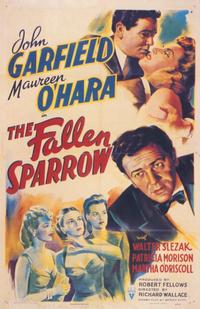
Sort Of Related: The Fallen Sparrow (1943)/Nobody Lives Forever (1946)

John Garfield may not have the same level of recognition as noir icons like Humphrey Bogart and Robert Mitchum, and the rediscovery of other names from the era like Richard Conte has allowed him to get lost in the cracks. But Garfield’s shadow may extend the furthest. The type of character he often portrayed – streetwise but fundamentally decent, a boyish tough guy who could be tamed – is a standard today. Put it this way: alone among his contemporaries, Garfield could have played either Matt Damon’s role or Leonardo DiCaprio’s in The Departed, and been brought back to read for Mark Wahlberg’s into the bargain. Watching two lesser known Garfield films with serious crime fiction pedigrees brought home the potency of that persona.

In The Fallen Sparrow, based on a novel by Dorothy B. Hughes (Ride the Pink Horse, In a Lonely Place), Garfield plays a veteran of the Spanish Civil War held prisoner by the Nazis. He’s freed in 1940 and returns to New York only to discover the Germans are still shadowing him while he delves into the murder of the childhood friend who delivered him from harm. The first third of the movie is rough sledding, a muddle with too many characters in a convoluted backstory. And may the gods of cinema take pity on you if you can’t figure out who the villain of the piece is. (Hint: The person it couldn’t be, because that’d be too obvious? Yeah, that’s who it is.)

But Sparrow fascinates for several reasons. There’s a troika of interesting women, foremost among them Maureen O’Hara as an ice princess who only begrudgingly thaws. But it’s Garfield’s work as a proto-Manchurian Candidate, still suffering the effects of torture at the hands of his captors, that compels. The film’s MacGuffin is also just right, a mixture of nobility and stubbornness that suits Garfield to a T.

By comparison, Nobody Lives Forever is light entertainment. W.R. Burnett is credited as writing the original screenplay, but it’s adapted from a story serialized in Collier’s in 1943. Garfield is Nick Blake, recovered from his WWII service and ready to resume his grifting career. He lights out for the coast and sets his sights on a rich widow, but when he falls for her for real he has to deal his partners out.

Nothing in Nobody is even remotely surprising, but the machinery is so finely assembled by Burnett and director Jean Negulesco that you’re happy to take a ride to a familiar destination if only to enjoy the scenery. George Coulouris chafes nicely as an aging con man who can’t accept that he’s no longer a pretty boy. Retro crush Faye Emerson is on hand as a bad girl, matched forehead for lovely forehead by Geraldine Fitzgerald as the pigeon who becomes a swan. But Garfield gives the enterprise life, charming as hell in rogue mode, touching when he goes soft on his mark. I’ve got some other Garfield films kicking around. It may be time to dig them out.

Friday, September 04, 2009

On the Web: More Playboy’s Penthouse

What say we kick off the holiday weekend with a little music? These clips will give you a sense of the variety show I wrote about yesterday, and spare you the indignity of looking up Playboy’s Penthouse online. Safe search, my ass. My computer may never forgive me.

First up in Hef’s pad is Frances Faye, one of the premiere nightclub entertainers of the era. Listen to her album Caught in the Act and tell me I’m wrong. With the awe-inspiring Jack Costanzo, aka “Mr. Bongo.” Part one is below, and here’s the rest.


You can also enjoy the folk duo Bud & Travis in the first of three parts. Playboy’s Penthouse booked a range of artists – jazz, cabaret, folk – and let them perform several songs in a mini-concert that provided a real flavor of their shows. Better than the band doing one number before the infomercials start.

Wednesday, August 05, 2009

On The Web: Ed Gorman

Ed says far too many fine things about the Noir City Sentinel. Such as, “I’ve never read a book on noir that was as informative and just as much as downright fun” as the latest issue.

Go read it for yourself. Then kick in a few bucks to the Film Noir Foundation and have the goodness delivered straight to your inbox.

Speaking of noir ...

DVR Alert: Glenn Ford

As part of their Summer Under the Stars festival, Turner Classic Movies is dedicating this Friday, August 7, to the films of Glenn Ford. Gilda understandably gets pride of place, with the original 3:10 to Yuma not far behind. (One of Ford’s best known noirs, The Big Heat, will air on August 13 as part of Gloria Grahame Day.) Among the lesser known Ford films are two that I can heartily recommend.

The first is Framed (1947), airing at 4:45PM EST/1:45PM PST. I saw this one at Noir City. Take advantage of this rare opportunity to enjoy Janis Carter, all legs and cheekbones and wildly darting eyes, in her I’m-gonna-say glory.

The other is 1949’s The Undercover Man (10PM EST/7PM PST). TCM ran this neglected film for the first time last month, and I’m glad they’ve got it on the schedule again already. Expert noir hand Joseph H. Lewis (Gun Crazy, The Big Combo) directs this account of Treasury agents scrambling to take down Al Capone, referred to throughout the film solely as “the Big Fellow.” Featuring a dandy performance by Barry Kelley as a Mob lawyer who’s got almost all the angles figured, a hair-raising foot chase scored to the plaintive cries of a little girl, and a scene with Esther Minciotti as an Italian immigrant whose speech about America, translated by her granddaughter, is guaranteed to put a lump in your throat. Watch it and tell me I’m wrong.

Sunday, June 07, 2009

Book: The Way Home, by George Pelecanos (2009)

When George Pelecanos is good – witness The Night Gardener – he has few peers. When he misses, he manages to do so in his own unique way. The unsuccessful Pelecanos novels seem to have been set down on paper because there were no stone tablets handy. They’re not sober but somber, ascetic to the point of being overbearing. Reading his books is occasionally like falling into conversation with a guy at a bar who becomes steadily more grave until he seizes your arm and says, “Let me tell you what it means to be a man.” Then you shake him off and point out that you only came in for a cold beer and some of the ball game, and things stay awkward until you close out your tab with the game still in progress.

That said, I prefer Pelecanos’s approach, always mindful of choice and consequence in people’s lives, to the cavalier one prevalent in other crime fiction. And I continue to pick up every book he writes.

It’s no surprise that The Way Home is one of his stronger outings, because he’s working with the genre’s elemental plot – The Bag of Money. It’s an intriguingly structured book, the first third devoted to the adolescence of Chris Flynn, a troubled kid from a good working class background. He finally goes too far and ends up doing juvenile time. Several years later he’s working as a carpet installer at the family business. Unambitious and half-heartedly trying to go straight, he’s still a worry for his father. And he continues to hang out with people he met on the inside.

Then, on a job, he discovers The Bag of Money.

The simplicity of the story and the leanness of Pelecanos’s prose complement each other here, leading up to a finale with genuine understated power. Pelecanos introduces the shrewish realtor trying to flip a house Chris is working on, apparently a minor character, then beautifully sketches in the woman’s life with a few concise paragraphs involving a waitress at the restaurant she frequents. He then goes one better by giving us the totality of the waitress’s existence in miniature. This is one of the Pelecanos books that’s like buying a round for a stranger to keep the conversation going.

On The Web: Ebony, Ivory & Jade

Meet my new favorite thing on the internet, courtesy of Jaime Weinman. It’s the titles to Ebony, Ivory & Jade, a busted 1979 TV pilot starring Bert Convy and Debbie Allen. (Convy is Jade, in case you were wondering.) As far as I can tell, the premise is Tony Orlando & Dawn as crimefighters. As far as I’m concerned, that’s pure genius. Turns out it was written by one of my heroes Jimmy Sangster, from a story by M*A*S*H’s Mike Farrell. I want this show found, and found now.

On The Web: New Blogs In Town

Hey! Joe R. Lansdale has a blog!

Hey! Scott Phillips has a blog, too!

Thursday, May 14, 2009

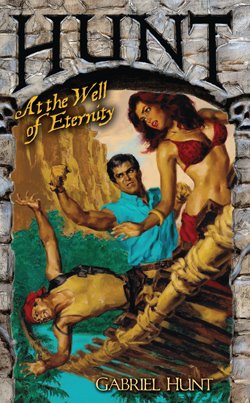
Book: Hunt at the Well of Eternity, by James Reasoner (2009)

Odds are a few of you have heard of this book by now. What with the gales of publicity, the starred review in Publishers Weekly, the raves across the blogosphere. High time, I think, for someone to be a contrarian, to throw a little cold water on this enterprise.

That someone ain’t gonna be me.

James Reasoner launches the new adventure series from the people at Hard Case Crime in high style. The tone is perfectly established from the opening pages, when an exotically beautiful woman turns up at New York’s Metropolitan Museum of Art bearing some strange artifacts for globe-trotting adventurer Gabriel Hunt, and the gala erupts in gunplay. Before long – and I mean that, because I read this book in a flash – Gabriel’s up to his ears in Civil War lore, ruthless Mexican bandits, and, of course, more exotically beautiful women. Additional books are coming from a battery of authors including Christa Faust. I’ll read ‘em all.

Random question #1: Is it me or is Gabriel Hunt in the Glen Orbik cover art above a dead ringer for Rod Taylor?

Random question #2: Does anybody remember the 1986 movie Jake Speed, another cable staple of my youth? Jake’s the hero of pulp paperbacks that turn out to be chronicles of his actual derring-do. I recall a great dyspeptic performance from John Hurt, the vague sense that the movie was crap, and nothing else. Maybe I should rent it.

On The Web: JAFO

Saints be praised, author Terrill Lee Lankford has a blog. Currently it features a long overdue critical reappraisal of Porky’s. It’ll also point you toward part one of Conflict of Interest, an original companion film to Michael Connelly’s upcoming novel The Scarecrow, written by Connelly and directed by TL. Go watch in HD.

Tuesday, April 14, 2009

Movie: Bewitched (1945)

Pop culture can be a cruel mistress. Once Arch Oboler was practically a household name, mentioned in the same breath as Orson Welles. Now he’s a neglected pioneer, remembered only by devotees of old-time radio.

I know Oboler’s name for one reason: my obsessive high school rereading of Danse Macabre, Stephen King’s overview of the horror genre. Calling Oboler radio terror’s “prime auteur,” King lovingly detailed several stories from Lights Out, the program that made Oboler’s reputation.

Like Welles, Oboler jumped from radio to the movies. He was a trailblazer there, too. In a span of three years he directed the first movie set in the aftermath of nuclear war (1951’s Five), the first commercial 3-D film (Bwana Devil), and an anti-television satire before most people had televisions (The Twonky).

Haven’t seen any of ‘em. My introduction to Oboler’s work came with Bewitched, one of the earliest screen treatments of multiple personality disorder. It’s also one of the most wildly ambitious B movies of the 1940s.

Joan (Phyllis Thaxter) is quiet and demure. When she yields to “Karen,” the voice she hears in her head (provided without credit by one of my favorite Dark City Dames, the lovely Audrey Totter), she becomes wanton. And murderous. Because let’s face it, those two go hand in hand.

Oboler cannily uses lighting effects to convey Thaxter’s transformation. Totter’s presence is a gift, especially when Joan runs down a street with Karen’s taunts ringing in her head. (“... craaaazy ... craaaazy ...”) There are sequences – a montage depicting a courtship over several weeks, a boldly photographed scene where Joan seeks refuge in a concert hall – that show Oboler relishing the opportunities of playing with a new medium.

Then there are passages that remind you that Oboler came from radio. The dialogue is stylized. Some scenes – like one with a ship captain – are interminable. There’s occasional unexplained omniscient narration. And the third act is heavy-handed, simplistic and patently unbelievable. I’d have to go back and check, but I’m pretty sure the structure makes no sense. We open with a psychiatrist (Edmund Gwenn) recounting Joan’s case to a reporter one hour before her execution, with Joan in prison. That’s not how the movie ends.

Still, the sections of Bewitched that work are striking. It’s amazing to think that Oboler was dramatizing these ideas over 65 years ago. Turner Classic Movies will be showing The Twonky tomorrow at 2PM EST/11AM PST. I’m setting the DVR.

New York’s WFMU has made Oboler’s 1962 album Drop Dead! available on line. I listened to it after watching Bewitched. The preachy final segment makes Rod Serling sound like Judd Apatow. But the rest still chills the blood. Like the two stories cited in Danse Macabre, “A Day at the Dentist’s” and Oboler’s most famous work, “Chicken Heart.” (Bill Cosby remembers it well.) And my favorite, “The Dark.”

On The Web: B Movies

AMC is now streaming B movies. I mentioned this on Twitter the other day and based on the reaction, that’s the only publicity this initiative has gotten.