Thursday, December 22, 2022

There’s Only One Hitch—Or Is There?

Just in time to plan your holiday viewing—and for the paperback release of the latest Renee Patrick novel Idle Gossip next week—comes my story at CrimeReads considering eighty years of Hitchcock movies not directed by Alfred Hitchcock. The list has fifteen entries, but I namecheck plenty more, and had to refrain from tossing in additional titles. It was plenty of fun to write, so why not check it out? (Photo from Last Embrace, the 1979 Jonathan Demme film featuring a finale at a famous landmark that Hitch himself would have admired.) 


Friday, September 16, 2022

Noir City Two Directors for the Price of One Edition

Is it unseemly for me to say that this is best issue of Noir City yet?
Very well then I am unseemly.
(I am the editor, I contain multitudes.)
(Also, sorry, Uncle Walt.)

The latest edition of the magazine published by the Film Noir Foundation is now available in your choice of digital or print—or what the hell, why not both? I guarantee you’re going to want in on this.

Let’s start with the cover story. Back when FNF honcho Eddie Muller and I cooked up the Modern Noir Master award, we drafted a list of dream recipients. One of the first names we both mentioned was John Dahl, who merits a place in the neo-noir pantheon for two movies alone: Red Rock West (1993) and The Last Seduction (1994).

(Fun fact: I attended one of the earliest screenings of Seduction, at the Seattle International Film Festival. When the movie ended, I joined the silent, dumbstruck line for the restroom. Finally, the guy in front of me blurted out, “Men are so stupid!” We unanimously agreed with him.)

Sam Moore interviews Dahl at length, about those movies, other gems like Rounders (1998) and Joy Ride (2001), and his work on noir-inflected TV shows including Breaking Bad, Justified, and Ray Donovan.

But wait, there’s another director! Nick Kolakowski talks to Michael Mann and his Heat 2 coauthor Meg Gardiner about moving the world of his 1995 magnum opus to print, and pushing the story into both the past and the future. Also in this issue—

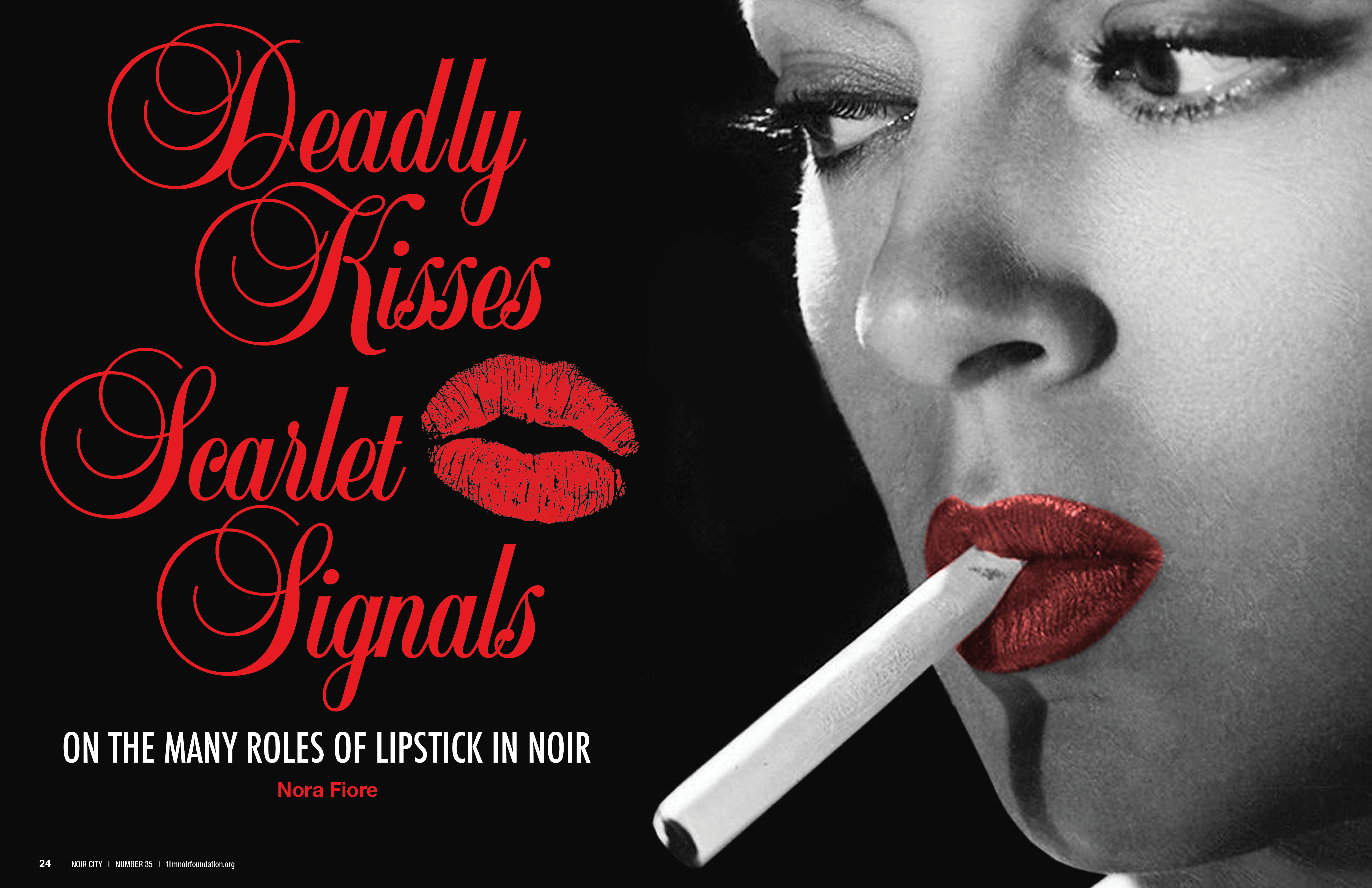
Nora Fiore, the Nitrate Diva, on the many uses of lipstick in film noir. I have to say this piece is among my favorites to appear in the magazine on my watch: a brilliant concept by Nora, written evocatively, and brought to vivid life on the page by ace designer Michael Kronenberg.


A one-of-a-kind memoir by Chris D., front man for the Flesh Eaters turned film scholar, on the surprising overlap between his two passions: punk rock and film noir.

A deep dive from John Wranovics on Harry Popkin, the onetime fight promoter who produced a series of noir titles that pulled no punches.

Noir City stalwart Jake Hinkson on noir’s dark vision of academia.

Joseph Moncure March’s epic poem The Set-Up already spawned the 1949 cinematic adaptation regarded as a classic of both noir and boxing films. Now it’s been turned into a graphic novel, and Nathalie Atkinson talks to artist Erik Kriek about it.

Plus more goodies, including my usual cocktail recipe.

Donate to the Film Noir Foundation, and in addition to supporting our restoration efforts you’ll receive a subscription to Noir City. You can also purchase the print edition exclusively at Amazon. Then settle in, because you’ll want to read this bad boy cover to cover.


Monday, May 23, 2022

Noir City “The Man That Got Away” Edition

Who’s the anguished cover boy on the latest edition of Noir City magazine, published by the Film Noir Foundation and edited by yours truly? None other than William Holden. Despite his presence in some landmark noir films, he’s not an actor synonymous with the form. I sometimes think of him as noir’s man that got away; James Ellroy once said that his dream cast for L.A. Confidential would have included “the craven, self-loathing, handsome William Holden of Sunset Boulevard” as Ed Exley, the Guy Pearce role. But as Rachel Walther points out in her terrific story, Holden brought a “brooding restlessness” to every role he played, carrying noir’s shadows forever with him. With a sidebar on Holden’s rivalry, on and offscreen, with Humphrey Bogart. Also in this issue—

Imogen Sara Smith surveys the dark world of film noir from Argentina;

Ray Banks on the heist films of Stanley Baker;

Bob Sassone considers the invaluable contributions the Saturday Evening Post made to noir;

Steve Kronenberg makes the case for character actor J.T. Walsh as neo-noir's best bad guy;

Sharon Knolle looks at horror films from noir directors;

And more.

I’ve got my column along with a review of a new book about Holden’s favorite director, Billy Wilder. My favorite contribution is a conversation with Tony Award-nominated actress and singer Melissa Errico about her new album Out of the Dark: The Film Noir Project. Melissa knows her noir, the album is a pleasure, and our chat was loads of fun.

You’re spoiled for choice when it comes to getting Noir City. You can make a contribution of twenty dollars or more to the FNF, the money going directly to our mission of preserving, restoring, and exhibiting classic noir films. That nets you a digital subscription to the magazine. Or you can purchase a print edition of our latest issue exclusively through Amazon, with our cut of the proceeds going to that same mission. Either way, pick up a copy.
 

Wednesday, May 11, 2022

Probably Should’ve Mentioned This Earlier ...

... but Idle Gossip, the latest Lillian Frost & Edith Head mystery that I wrote with Rosemarie under our house pseudonym Renee Patrick, is now out. People seem to like it. Let Renee tell you all about it.


Monday, January 17, 2022

Noir City On The Midway Edition

At the Film Noir Foundation, we couldn’t think of a better way to show 2021 the door—and welcome in 2022—than sending the latest digital issue of Noir City magazine to all FNF donors on New Year’s Eve. The print edition, available exclusively at Amazon, followed a week later. I’m only getting around to posting about it now. 2022 is already that kind of year, kids.

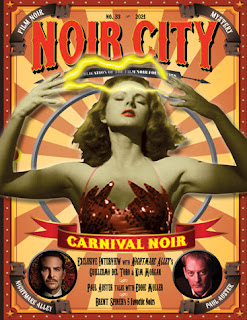
The centerpiece of the issue is an exclusive interview with Guillermo Del Toro and Kim Morgan about their bold new reimagining of Nightmare Alley, currently in theaters. FNF honcho, TCM host, and man about town Eddie Muller weighs in on the film. And we also have a feature on the long, twisted history of carnivals in film noir.

Next up, a dazzler of a conversation between Eddie and his favorite living author, Paul Auster. Pour yourself a drink and pull up a chair to listen in as they go long on noir, art, and life.

Also in this issue—

Imogen Sara Smith considers the doppelganger in film noir, with a special focus on Joseph Losey’s harrowing masterpiece Mr. Klein (1976).

Get behind the wheel with the cabdrivers of noir, courtesy of Jake Hinkson.

Danilo Castro sizes up the “frontier trilogy” of Taylor Sheridan—Sicario, Hell or High Water, Wind River—that maps the territory where noir meets the west.

Actor Brent Spiner is best known for playing Lt. Commander Data on Star Trek: The Next Generation. His new book Fan Fiction is a wildly inventive “mem-noir” about his time on the show, blending autobiography with a crime plot. He kindly agreed to drop by and name his five favorite classic noir films.

I talk to writer/musician Willy Vlautin, whose The Night Always Comes is hands down my favorite novel of 2021. Compassionate and chilling, this noir odyssey is the book for our political moment. Read the interview, but more importantly read Willy’s book.

Plus my column, my review of what could easily end up my favorite book of 2022—Isaac Butler’s ambitious and compelling The Method: How the Twentieth Century Learned to Act—and so much more, all of it spectacularly laid out by ace designer Michael Kronenberg. I mean, just look at that cover.

You can buy the print edition at Amazon, or contribute at least twenty dollars to the FNF’s campaign to preserve and restore classic film noir to receive the bells-and-whistles digital version. You want my advice? Do both. You won’t regret it.
 

Monday, December 20, 2021

Keenan's Klassics: It's a Shane Black Christmas

From 2009. Needed now more than ever.

There I am at my favorite watering hole, talking with the staff, when the subject of Christmas movies is raised.

First suggestion, not made by me: the traditional double-bill of Die Hard and Die Hard II: Die Harder.

Thus giving me the tenor of the conversation. This is not the time, perhaps, to mention Remember the Night and Holiday Affair, two overlooked films (with noir connections!) that Turner Classic Movies has labored to turn into Yuletide staples. Although a mention of Blast of Silence, full of Wenceslas wetwork, might not be out of the question.

So I lobby for my own Christmas favorite, The Ref. And then observe, not for the first time, that the entire oeuvre of Shane Black – Lethal Weapon, The Last Boy Scout, The Long Kiss Goodnight, and Kiss Kiss Bang Bang – is set at the most wonderful time of the year. (Editor’s note, 2013: You can now add IRON MAN 3 to that roster. Editor’s note, 2016: And THE NICE GUYS. The Christmas trees are there if you look. Editor’s note, 2019: The streak comes to an end with Black’s 2018 film THE PREDATOR, which is set at Halloween. It was fun while it lasted.)

Therefore, as you venture out for that last round of shopping, I offer, by popular demand, what has become a VKDC tradition. (“By popular demand” meaning Rosemarie asked, “Why haven’t you posted this yet?” And she did write most of it.) Here, once again, is Shane Black’s 12 Days of Christmas. Record your church group performing this and we’ll post the video here!

Twelve cars exploding
Eleven extras running
Ten tankers skidding
Nine strippers pole-ing
Eight Uzis firing
Seven henchmen scowling
Six choppers crashing

Five silver Glocks

Four ticking bombs
Three hand grenades
Two mortar shells
And a suitcase full of C-4


God bless us, everyone. Or else.

Thursday, September 30, 2021

Noir City Fit to Print Edition

Things have been a mite hectic around here. So much so that I neglected to trumpet from the rooftops that the latest issue of Noir City, the magazine of the Film Noir Foundation, came out this month, and it’s a particularly special one. Our one-of-a-kind cover story is the reason why.

Gloria Grahame is perhaps the most popular actress in all of film noir. The details of her life have been well-documented. Offering a fascinating and fresh perspective on her legacy: Emmy Award winner Dana Delany, who candidly admits that Gloria has been her lifelong muse. Dana’s heartfelt, meticulously researched essay is a unique opportunity to venture inside the craft, “actor to actor.”

Working with Dana on this story was an absolute joy, and the result speaks for itself. I was remiss in not posting this update before Dana made her debut appearance on TCM’s Noir Alley alongside FNF honcho Eddie Muller introducing Gloria in Human Desire (1954), but if you hurry you can read Dana’s work before she returns to the show on Saturday, October 2 (with a repeat broadcast on Sunday, October 3) for more Gloria with The Glass Wall (1953).

Also in this issue—

Randy Dotinga on how classic film noir hid LGBTQ characters in plain sight;

Nora Fiore, Twitter’s Nitrate Diva, surveys astrology in crime films;

Nathalie Atkinson interviews Pornsak Pichetshote, writer of the new noir comic The Good Asian;

Eddie Muller tells the story behind the noir-stained paintings of the outsider artist known as Ely Legerdemain;

Novelist S.A. Cosby—you’ve read his books Blacktop Wasteland and Razorblade Tears, right?—explains why Point Blank (1967) is his favorite neo-noir;

And more.

I’ve got my usual column, a few book reviews, and a conversation with Silvia Moreno-Garcia, whose Velvet Was the Night is the noir novel of this summer.

The best way to get Noir City is to contribute twenty dollars or more to the FNF and its ongoing campaign to restore and preserve film noir. But now there’s a whole new wrinkle.

We’ve launched a print edition of Noir City, available via Amazon’s print on demand service. If you thought ace designer Michael Kronenberg’s graphics looked stunning in our digital mag, wait till you see his handiwork in hard copy.

While you’re at it, why not pick up our debut print edition, the Modern Noir Master issue from earlier in 2021 featuring m’colleague Ray Banks’s interview with filmmaker Mike Hodges—and exclusive testimonials from Hodges’s frequent collaborators Michael Caine (Get Carter, Pulp) and Clive Owen (Croupier, I’ll Sleep When I’m Dead)?

What the hell, I might as well beat all the drums and hip you to the latest edition of our Noir City Annual, featuring the best the magazine published in 2020. The year’s installment is a few months late—thanks, Covid—but the writing remains as fresh as ever. It’s the first book I’ve ever edited, and I’m proud of it. Stock up on your noir reading as shadows begin to lengthen.

Saturday, April 10, 2021

Noir City “With Me, It’s A Full-Time Job” Edition

The latest issue of Noir City, the magazine of the Film Noir Foundation, reached subscribers this week. And even if I did edit it myself, I’ll say this for it: it’s pretty good.

Enough false modesty. Honestly, you need to check this installment out, with all credit going to our top-drawer contributors, the wizardry of ace designer Michael Kronenberg, and the guiding hand of our publisher Eddie Muller.

I will humbly admit to getting the ball rolling on the cover story. A while back, I came up with the idea of the FNF presenting an annual Modern Noir Master Award, an honor that has been bestowed on Stephen Frears, James Ellroy, and David Mamet. When I realized that 2021 marks the 50th anniversary of the landmark UK crime film Get Carter (1971), I suggested to Eddie who our next recipient should be.

Writer/director Mike Hodges also made Pulp (1972), Croupier (1998), I’ll Sleep When I’m Dead (2003), and other noir-adjacent films. In his 89th year, he has a new film in the works. All I had to do was put him together with our man on the Continent Ray Banks. The result is a free-wheeling, career-spanning interview that even covers Hodges’ own noir fiction.

I’ll also pat myself on the back for another contribution to this feature. We won’t be able to present the award live for obvious reasons, so I wanted to do something extra. Something special. Thus did I become fixated on the notion of having Sir Michael Caine and Clive Owen, the two actors who loom large in Hodges’ noir filmography, contribute to Noir City.

A longshot, I figured. But I am as tenacious an optimist as you will find, so I started making inquiries. Turned out, it couldn’t have been simpler. Both gentlemen were eager to say a few words on behalf of a valued collaborator and colleague, and you can read those words in this issue. I’ll admit I was chuffed it came together, as they say across the pond.

But that’s just for openers. In this issue, we also have—

Imogen Sara Smith with a definitive look at the work of filmmaker Christian Petzold, from his early German films never screened in the US to masterful features like Phoenix (2014) and Transit (2018);

An appreciation of a longtime noir favorite, the hard-luck actress Virginia Grey, from the Self-Styled Siren Farran Smith Nehme;

The career of self-described “Hungarian-born one-eyed cowboy from Texas” André de Toth, whose directorial credits include Pitfall (1948) and Crime Wave (1954);

An interview with Eve Plumb—yes, that Eve Plumb—about her second act as a painter whose work is inspired by classic noir films, and her turn as a villain in the neo-noir Blue Ruin (2013);

The screenwriting career of sportswriter Art Cohn, best known for the quintessential boxing film The Set-Up (1949);

Jason A. Ney’s insightful look at amnesia noir, and how this plot gimmick has evolved along with our understanding of memory;


I raise the question “Charlie Chaplin … noir filmmaker?” with an appraisal of his most confounding role, as the serial murderer Monsieur Verdoux (1947). My first draft of this article was heavy on Chaplin and Orson Welles, who came up with the idea for Verdoux, trash-talking each other for decades. I still think I should mount this as a one-man show.

And there’s still more. Trust me, you want this issue. All you have to do to get it is make a modest contribution to the Film Noir Foundation and our efforts to restore classic film.

Thursday, February 04, 2021

Reach for The Sharpest Needle

Tuesday was the official U.S. publication day for The Sharpest Needle, the fourth Lillian Frost and Edith Head mystery that I wrote with Rosemarie under our pen name of Renee Patrick. It’s set in 1939. The world is about to plunge into war, Orson Welles has recently arrived in Hollywood, and Lillian and Edith are asked by Marion Davies to get to the bottom of some poison pen letters she’s received. (Did you watch Mank? Then you’ll want to read this book. Did you not watch Mank? Then you’ll definitely want to read this book.)

I don’t want to appear immodest and big up Needle myself. Instead, I’ll tell you that Publishers Weekly called it “a tailor-made treat for film buffs” while Historical Novel Review said “the mystery has plenty of tantalizing sidetracks … carefully stitched and neatly sewn together.”

Rosemarie and I were interviewed by Library Journal.

Everything Zoomer has the book in terrific company as one of its recommended February reads.

Over at CrimeReads, I have a piece detailing a fascinating footnote unearthed in our research: the history of Welles’s unmade adaptation of the Nicholas Blake novel The Smiler with the Knife. He’s planning the film—about a fascist coup in the United States spearheaded by a flashy playboy businessman, if you can imagine such a thing—at the time The Sharpest Needle is set. Full of surprise cameos and an explanation of how the proposed project ended up shaping Citizen Kane. Go on, give it a read.