Can you have too much of a good thing? We’re about to find out.
The latest issue of the Noir City Sentinel, house rag of The Film Noir Foundation, streets today. And this one is truly epic. 53 – count ‘em! – 53 glorious pages of news that’s red hot and ice cold. Feature:
* An extensive overview of British noir!
* My pal Alan Rode’s exclusive interview with Eleanor Parker, Oscar-nominated star of the greatest of all women in prison movies, Caged!
* FNF kingpin Eddie Muller on Walk Softly, Stranger, crippled by “one of the worst endings of all time,” and on the career of Paul Stewart!
* The one and only Woody Haut on the one and only Elisha Cook, Jr.!
* Jake Hinkson counts the ways of voiceover!
* Yours truly on The Whistler, the only film noir series produced by Hollywood!
* And a hell of a lot more!
Donate at least ten bucks to the Film Noir Foundation and all this can be yours. Everybody’s gonna be talking about it come Monday. Don’t be left out.
Friday, July 16, 2010
Extra, Extra!: Noir City Sentinel

Monday, July 12, 2010
Book: Don’t Point That Thing At Me, by Kyril Bonfiglioli (1972)
The Keenan family motto, Eo sensim quod etiam supervenio, loosely translates from the Latin as “We’re slow, but we get there.” (Bear in mind that translation is exceedingly loose. Bear in mind also that’s not the Keenan family motto. I’m simply lobbying for it to replace the one that has served my clan in good stead for generations: “Are you going to finish that?”) I read this New Yorker article about the novels of Kyril Bonfiglioli in 2004 and bought one that very day. I finally got around to plucking it off the shelf a mere six years later. Bonfiglioli wrote a trio of tales about one Charlie Mortdecai, a shady aristocrat who toils in the art world along about the patch where it becomes a racket. Charlie’s a sweetheart whose only vices are haberdashery, alcohol and sloth. In his employ is a manservant blessed with the name Jock Strapp, the crudely effective Jeeves to Charlie’s sociopathic Wooster. Here’s our Charlie on a thuggish policeman who has come to call:
Somewhere in the trash he reads Martland has read that heavy men walk with surprising lightness and grace; as a result he trips about like a portly elf hoping to be picked up by a leprechaun. In he pranced, all silent and catlike and absurd, buttocks swaying noiselessly.
Why should I prattle on when Charlie can regale you with a description of the meal he’s served on an international flight?
... plastic smoked salmon, rubber chop in vitreous aspic, chicken turd wrapped in polystyrene bacon and weeping half-thawed strawberry on dollop of shaving soap ...
Most every chapter begins with Charlie rousing himself from slumber and closes with his return to that blissful state. (“I suppose I went to bed at some stage.”) Other that than, I’m not entirely sure what transpires in Don’t Point That Thing At Me. The plotting is, shall we say, casual, a lot of complicated business involving a stolen Goya and some nasty government types. What matters is that Charlie is forced to go to America – which he adores, especially the Cattleman’s Breakfasts – to deliver a Rolls Royce containing the purloined painting, and then kill the recipient. I never understood why.
Don’t Point That Thing At Me is hilarious – until it’s not. The story grows so dark that the savage playfulness of Bonfiglioli’s voice eventually seems out of place. I can also say, at the risk of spoiling the ending, that considering there are two more books in the series with the same characters Bonfiglioli didn’t care a whit about continuity, either. It’s a strange one, this book. It’s funny while not being that good. Or is it not good while still being funny? Yes, that’s the way to think of it.
Thursday, July 08, 2010
Book: Hunt Beyond the Frozen Fire, by Gabriel Hunt as told to Christa Faust (2010)
The latest Gabriel Hunt extravaganza begins in media res with our two-fisted adventurer eyeballing a treacherous ex-lover across “a murky, nameless Moldovan hole-in-the-wall” in pursuit of a bejeweled dagger. I tore through the action-packed opening pages expecting to catch my breath in Chapter Two, as the histories of the kindjal and Transdniestrian unrest were explained.
Nope. A furious chase on horseback. Chapter Three, then, will certainly – Huh. An assault on an ancient fortress. No time for backstory, Mr. Hunt. Exposition comes on the fly. Even more astonishing, this mayhem is merely preamble. Hunt returns to his Foundation offices in Manhattan just long enough to get sent on an another expedition. This one involves the requisite beautiful woman, her missing scientist father, and the possibility of a lost civilization beneath the South Pole. Before it’s over, there will be more derring-do and generous helpings of sex. My friend Christa Faust never lets the pace flag for an instant. As fast as it moves, you’ll read it even faster. A wild, fun ride.
Bookstores don’t have “men’s adventure” sections anymore, so I never know where to look for the Hunt novels. Asking for them only baffles clerks. “They’re written by Gabriel Hunt. Well, technically, they’re not, because he’s a fictional character. They’re credited to him, but this one is written by ...”
After two chain stores and an independent let me down, I bought Frozen Fire on my Kindle. It felt wrong; the Hunt books, with their gloriously overripe covers, demand to be read in paperback. But it worked out for the best. I wasn’t entirely certain what spavined and portcullis meant, and could look them up instantly without breaking the story’s flow. I’ve read some highbrow stuff on my Kindle, but who’d have thought a pulp adventure novel would crack the whip on the dictionary function?
Monday, July 05, 2010
Sort Of Related: Nobody’s Angel, by Jack Clark (1996)/Two O’Clock Courage (1945)
For personal reasons, I’m a fan of taxi noir. Two examples of the form recently came my way. Cabdriver Jack Clark wrote Nobody’s Baby in the 1990s. After repeated rejections he self-published the book. Until Hard Case Crime brought out a new edition last month, the only way to score a copy was to hail Clark’s rig in Chicago.
Eddie Miles has seen plenty in his years behind the wheel, but nothing prepares him for being at the center of two different murder investigations. A veteran driver is shot to death at the same time Eddie prevents a killer of prostitutes from claiming his latest victim. Eddie doesn’t exactly investigate either crime. But he sticks close, his own fate seemingly bound up in the outcome.
Both cases are ultimately solved, but neither is the point of the book. Nobody’s Angel is about broken people in a broken place. Eddie – tired, cranky, certain he’s about to be screwed by the world and whoever’s in the back of his cab – knows only he’s to blame for the sorry state of his life. He struggles to find compassion for his fares, and on the rare occasions when he does it’s powerful stuff. In pared-to-the-bone prose Clark offers a street-level view of the city, always changing and forever breaking hearts.
A cabdriver is the only thing Nobody’s Angel has in common with the frothy nonsense of Two O’Clock Courage. Amnesiac Tom Conway flags down a hack driven by Ann Rutherford. Conway realizes that he’s implicated in the murder of a theatrical producer and Rutherford, as any cab driver would, ferries him around town trying to clear his name. This overplotted B-movie hooey, complete with strained comic relief, is made bearable by Rutherford, who can only be described as adorable, and strong early work from two noir stalwarts. Jane Greer, still Bettejane in her first credited appearance, makes a great venomous party girl. And director Anthony Mann keeps the meter running with some nice business in the backgrounds of shots. For the record, even Eddie Miles would look fetching in Ann’s sporty cap.
Tuesday, June 29, 2010
Movies: Recent Release Roundup
Toy Story 3. It’s a Pixar movie. What do you think I’m going to say? I don’t know what’s more impressive, introducing a complex philosophical thought about life and death in what is ostensibly a children’s movie without a line of dialogue, or following it with a plot twist that was set up in the first movie fifteen years ago.
The Extra Man. This adaptation of Jonathan Ames’ novel was the opening night film at SIFF last month. It’s now available via on demand prior to a limited theatrical release. Paul Dano plays a disgraced prep school teacher, detached from the modern era and his own desires, who moves to New York to find himself. But first he finds Henry Harrison (Kevin Kline), asexual academic, justly forgotten playwright, and escort to moneyed women of a certain age. It’s a slight movie but an enjoyable one thanks to the two leads; Kline has his best film role in decades. The directors of American Splendor capture the real Manhattan, where abject squalor is cheek-by-jowl with wild excess and you barely notice either because you’re too focused on what’s in front of you. Winter’s Bone. Seventeen year old Ree Dolly (the astonishing Jennifer Lawrence) riles up her extended Ozark family in order to save her immediate one when her no-good daddy jumps bail and disappears. You’ll find no thriller more low-key than this one based on Daniel Woodrell’s spare novel, but bet your ass that it thrills. Its every casual act of violence has more impact than an entire summer’s worth of blockbuster explosions and fireballs. A movie packed with formidable women, and no scene of late has rocked me like Ree’s conversation with an Army recruiter.
Sunday, June 27, 2010
Movie: The Killer Inside Me (1976)
After seeing the new adaptation of Jim Thompson’s novel, I decided to check out the earlier film version. This in spite of its less-than-stellar reputation among the hardboiled cognoscenti. That’s the level of service you can expect around here.
The story, at least in terms of incident, is very much the same. Deputy sheriff Lou Ford seems like a right guy but he ain’t. Things go bad and get steadily worse. Folks die.
But this is an actual adaptation, for better or worse. The action has been shifted from Texas to a Montana mining town. The burg is nicely captured in the film, populated as it is by familiar ‘50s faces like Charles McGraw and Keenan Wynn. The biggest change is in terms of Lou Ford’s backstory, which has been simplified to the crudest Freudian terms.
That puts additional pressure on Stacy Keach, who comes through in spades. His Lou Ford is still deeply nuts, but there’s more of a sense of Lou fighting desperately to keep the lid on his psychosis. His collapse is all the more frightening because his mask of sanity never completely slips off. Susan Tyrrell, so good with Keach in Fat City, gives a great performance as Joyce, the prostitute whose desirability and greed are tinged with and intensified by laziness and anger.
Director Burt Kennedy was responsible for one of my favorite neglected noirs, The Money Trap. He deploys some elements here that have dated badly – there are too many pointless ‘70s zooms, and the soundtrack is truly lousy – but overall the film holds up. It’s less faithful to Thompson than the newer film, but more cohesive. That there are two such different approaches more than three decades apart is a testament to the power of the novel. And really, that’s where you ought to start.
Wednesday, June 23, 2010
Book: The Girl Who Kicked the Hornet’s Nest, by Stieg Larsson (2010)
In the beginning, Stieg Larsson created The Girl with the Dragon Tattoo. And it was good.
I stand by that verdict. Yes, the prose was clunky, but it worked for a story of modern characters – Mikael Blomkvist, a journalist who splits his time between crusading and preening, and Lisbeth Salander, the damaged genius of the title – in an anachronistic setting.
(ASIDE: I’m in the minority on this, but I saw the Swedish film adaptation and, aside from Noomi Rapace’s Salander, found it a dreary slog. Stripped of Larsson’s idiosyncratic style the story came across as formulaic. Rosemarie, who hadn’t read the book beforehand, summed it up thusly: “Horrible things happen to women, then and now.” An American remake, especially one directed by David Fincher, can only be an improvement.)
Next was The Girl Who Played With Fire. Actively disliked it. Comes now Hornet’s Nest, picking up mere seconds after Fire ends. Salander has been reunited with her more-than-estranged father, a Soviet defector turned gangster, and as these things usually go each tries to kill the other.
I’ve stuck with the series for one reason, and that’s Salander. So naturally she spends almost the entirety of this book incapacitated. Instead we follow a cover-up carried out by septuagenarians and their dimwitted factotums.
The granularity of Larsson’s plotting keeps the pages turning, but the writing has not improved. Here’s Salander’s doctor as she’s wheeled into the ER.
“And now the murderer herself had been shot, which was surely poetic justice of a sort. But that was not his concern. His job was to save his patient’s life, irrespective of whether she was a triple murderer or a Nobel Prize winner. Or both.”
The critical term we’re looking for is yeesh.
Once again terrible things happen to women. The book is further padded with a stalker storyline involving Blomkvist’s lover Erika Berger that Salander unravels without leaving her hospital bed. Admittedly, personal and institutional misogyny is Larsson’s true subject. He even has Blomkvist say so for those who haven’t tumbled to that fact.
“When it comes down to it, this story is not primarily about spies and secret government agencies; it’s about violence against women, and the men who enable it.”
But too often Larsson wallows in what he professes to decry. And seriously, who uses a semi-colon in dialogue?
Lisbeth Salander is such a singular creation that I read all 1,500+ pages about her. I just didn’t care for most of them. But Stieg Larsson has single-handedly saved publishing and created a tourism industry, so take my take with a grain of salt. Preferably washed down with an Akvavit.
UPDATE: Nora Ephron has some problems with the books as well.
Monday, June 21, 2010
Miscellaneous: Life in the Cheap Bastard Section
Whenever I told someone in Seattle that we were spending a few days in Las Vegas, I always got the same response. Never “When are you going?” or “Where are you staying?” but “Why?,” the assumption being that I was heading to Sin City against my will. I’ve stopped trying to explain that I actually enjoy Las Vegas. I’d simply say that my client insisted that’s where the job go down and then change the subject. On this trip we decided to honor the city’s bygone glory days by attending a Rat Pack tribute show. Trouble is there are two of them, one borne of the other, and they’re feuding, at times in true old-school fashion. We opted for The Rat Pack is Back because it’s the older show and it would allow us, at last, to visit downtown Las Vegas. That its home, the Plaza, served as Biff’s casino in Back to the Future Part II and the devil’s headquarters in The Stand was another plus, as was the fact that the Plaza’s showroom had essentially been neglected for decades prior to a renovation that preserved its Nixon-era glamour.
The show is modeled on original Rat Pack concerts but flexible enough to allow for late-career hits and Viagra jokes. The impersonations are variable, yet offered with energy and palpable affection. And the band is terrific, so a good time is had by all.
I knew that there was some audience participation in the show and sought out seats in the second tier. What happened next taught me a valuable lesson. Halfway into Frank’s set, the doors behind us burst open and “Joey Bishop” came down the aisle pretending to sell T-shirts. “I’ve got an extra large here, and looks like I’ve got another extra large right ... here.”
Guess who the spotlight hits.
I have limited recollection of the next few minutes. Rosemarie assures me that I was a good sport. I do remember Frank yelling at Joey from the stage and Joey hollering back, “I’m over here, in the cheap bastard section!” I did get a free T-shirt out of the deal, and in the men’s room after the show a guy pointed at me and said, “Hey, you’re the cheap bastard!” Recognized in a Las Vegas casino. Easily the high point of the trip.
Also crossed off our Las Vegas to-do list was an excursion to the Liberace Museum. Located in a mini-mall off the Strip, it’s more fun than it has any right to be. Liberace’s showmanship, turning his excesses into part of his act and inviting the audience to enjoy his ostentation right along with him, was ahead of its time; the museum is cannily marketing him to a new generation as “The King of Bling.” I hope it works, because the exhibits also underscore his skill as a performer. There’s no flash photography allowed – all those rhinestones are blinding enough as it is – so the pictures of each of us wearing a Liberace-style cape came out blurry. That’s my story, and I’m sticking to it.
Random Las Vegas thoughts –
* Everywhere we went, we ran into fighting couples. In restaurants, at neighboring slot machines. The worst was in the shuttle coming in from McCarran Airport. I wanted to lean forward and say, “If you two came here to rekindle something, I think it’s too late.”
* I was amazed at the floor space given over to penny slots in the high-end casinos. On previous trips I only saw them in B-list joints. Considering that Rosemarie won money on them, I’m not complaining.
* Casino themes are spoiled by staff tattoos. Historically, cowgirls and antebellum Southern belles did not have tramp stamps.
* I know it’s hot in Las Vegas. But that doesn’t mean everyone has to wear flip-flops everywhere. And if you must, at least pick up your feet. A guy scuffing along in front of us lost his sandal three times in a block and a half. I’m fairly sure he didn’t make it out of town alive, killed in some horrific moving sidewalk accident.
Monday, June 14, 2010
Movie: The Killer Inside Me (2010)
This adaptation of Jim Thompson’s chilling 1952 novel has stirred controversy since walkouts occurred during its Sundance screenings this year. Word was that it was faithful to its source. That is undoubtedly true, perhaps to a fault. The film is uncompromised, uncompromising and ultimately unsuccessful. Yet despite its flaws, I’m finding it awfully hard to shake. Lou Ford is a deputy sheriff in Central City, Texas. He’s also a high-functioning sociopath who has managed to hide his derangement for years, even from his steady girlfriend. In order to exact revenge against the town kingpin (Ned Beatty) he sets into motion a plot that starts with Lou murdering a prostitute he himself has been sleeping with. But nothing goes according to plan, and the blood continues to flow.
Thompson’s novel is not a descent into madness. It can’t be, because Lou is already there. It’s a brief ascent into lucidity. Lou Ford knows that something is wrong with him, and is intensely curious about what it might be. That sense of self-observation, of a man watching himself with great if detached interest, has no obvious cinematic correlative, putting any film version behind the eight-ball from the start.
Director Michael Winterbottom and screenwriter John Curran hew very closely to the book in what Winterbottom himself calls a “very literal film.” It’s as if they believe that because Thompson’s prose is so spare, even stark, Lou’s story is to be taken at face value. But this approach is essentially playing the notes and not the music; as Bertrand Tavernier, who made the finest Thompson adaptation with Coup de Torchon, observes, there’s a metaphysical element to all of the author’s work that’s too often ignored.
The violence is brutal, callous, and almost impossible to watch. It’s also exactly as Thompson describes it. More to the point, though, it’s exactly as Lou Ford describes it. He’s an unreliable narrator, so maybe we don’t believe him when he claims that the women involved not only refuse to defend themselves but profess their love as the blows rain down. And the film’s increased emphasis on the sadomasochistic nature of the relationships has the unpleasant side effect of suggesting that the women are complicit in their fates.
Still, this is a serious, thoughtful adaptation, and the filmmakers deserve credit for sticking to their point of view to the bitter end. Plus they get so much right. The movie looks terrific, nailing the period, the place, the desolation. Casey Affleck gives a fearless performance as Lou Ford, hiding a host of demons behind a boyish, placid mask. The offhand manner with which he delivers the most disturbing moments – his parting words to Jessica Alba’s Joyce amidst his attack on her, telling a fellow deputy not to say anything because “I haven’t given you any lines” – only heightens their effect. And the supporting performances are first rate, like Elias Koteas as a cunning union leader and especially Bill Pullman’s barnburner of a late cameo, spouting dialogue straight from Thompson’s book (“A weed is a plant out of place”). It’s not a perfect film. But it’s one I won’t soon forget.
The movie opens in theaters on June 18 but is available via IFC On Demand now. I’ll echo what was said in the last issue of the Film Noir Foundation’s Noir City Sentinel: by releasing this film and the Red Riding trilogy, IFC has proven that it’s the best hope for contemporary film noir in America.
UPDATE: I watch the 1976 film version here.
Thursday, June 10, 2010
Book: The Nearest Exit, by Olen Steinhauer (2010)
Maybe my problem is that I don’t like origin stories.
Steinhauer introduced diffident spy Milo Weaver in last year’s The Tourist. A veteran of the Department of Tourism, a CIA black-ops shop, Milo had found solace as an administrator, husband and father. Then a personal history more tortured than even Milo suspected forced him back into his old life. In Exit Milo has, to his surprise, been welcomed back to full-time Tourism, a existence both rootless and ruthless. Case in point: an assignment to kidnap and execute a 15-year-old immigrant girl living in Germany. Milo, desperate to reconnect with his own family, concocts an asymmetrical solution that fools his superiors. Having earned their trust he’s then tasked with investigating a security breach, but both matters are linked in a way that delves into Milo’s past and threatens the future of Tourism. The Tourist, alas, left me somewhat cold; it’s a big, expansive book that at times is too self-conscious about its ambition. Still, it contained enough passages on par with Steinhauer’s dazzling series of crime novels set in an unnamed Communist country for me to pick up Exit. I’m glad I did. Freed of the burdens of establishing the world it’s a completely different animal, densely plotted yet fleetly paced. You want globe-trotting derring-do, hidden agendas and suspense? They’re here, but not at the expense of character. Steinhauer never loses sight of the human costs of intelligence work. Milo is a truly good man in a genuinely bad world, always and only wanting to go home. And the ending delivers. I’m fully on board with Milo now, and await his next adventure.
Monday, June 07, 2010
Miscellaneous: Cable Box Theater
 Ondine (U.S. 2010). The latest film from Neil Jordan is in theaters and on demand. Colin Farrell, continuing his string of strong performances, plays a down-at-the-heel Irish fisherman who catches a mysterious woman in his net. Farrell’s young daughter suspects that she’s a selkie, an outlandish explanation that Farrell himself is inclined to believe even in the face of evidence suggesting a more earthbound – and dangerous – origin. It’s a lovely, delicate film, essentially a fable, helped enormously by Christopher Doyle’s cinematography that captures an Ireland where sea, sky and sod are at times indistinguishable.
Jordan is one of the few filmmakers whose work I never miss no matter the venue. In a spoiler-packed interview in Cineaste, he explains his move into television. Depressing quote of the day: “... the kind of cinema that we used to make is drying up, I’m afraid. The distribution is vanishing. The funding is vanishing.”
Related depressing story: Variety on the fate of literary adaptations in a world where “Clint Eastwood is single-handedly holding up the adult drama at the studio level.”
The Special Relationship (2010). Peter Morgan and Michael Sheen’s third collaboration about Tony Blair, now on HBO, focuses on the PM’s tricky relationship with Bill and Hillary Clinton (Dennis Quaid and Hope Davis), especially post-Lewinsky. The familiarity of the material makes it the least successful of the trio, but it deepens their joint portrait of Blair as a glib leader with sharp instincts who is all too easily starstruck, at times even by himself.
I Knew It Was You: Rediscovering John Cazale (2009). Cazale only appeared in five movies before his death at age 42, but every performance still haunts. And all five films – The Godfather, The Conversation, The Godfather: Part II, Dog Day Afternoon and The Deer Hunter – were nominated for Best Picture. Director Richard Shepard (The Matador) has assembled a lively tribute featuring those who worked with and loved the actor (Al Pacino, Sidney Lumet, Meryl Streep) and those who were inspired by him, like a very astute Sam Rockwell. My favorite observation comes from one of Cazale’s friends, who says that the secret to his technique was to find what caused his character pain and build the performance around that. On HBO.
Thursday, June 03, 2010
Movie: Hollywood Story (1951)
It turns out that I possess heretofore unsuspected powers. If I express my displeasure on the internets, the universe will make things right. All I had to do was grouse about not being able to see the rarity Hollywood Story at Noir City Los Angeles and a reader of the blog, the redoubtable John Hall, sent me a copy of the movie.
Now to use this gift judiciously. Friday should be National Donut Day. I’d like to see Armando Galarraga pitch another, official perfect game. And I wish Hollywood Story were better.
William Castle directs this B-movie riff on the previous year’s Sunset Blvd. Richard Conte is Larry O’Brien, a New York producer who finally moves to the Left Coast. When he learns that the mothballed studio he’s taking over was the scene of Tinseltown’s most famous unsolved murder, he’s found his first new project. And he’s not about to let the police or the box office stop him from tracking down the killer. Hollywood Story is loosely based on the case of silent film director William Desmond Taylor. (For a better fictionalized unraveling of that sordid affair, may I suggest Nina Revoyr’s The Age of Dreaming.) After a great opening sequence featuring early ‘50s L.A. street scenes, things go off the rails in a hurry. Jim Backus is playing an agent only peripherally involved with what’s going on. So why give him the voiceover?
Silent era stars like Francis X. Bushman appear – but as themselves, in a single scene in which they talk about how great it is to be working on a movie before they toddle off, never to be seen again. Conte gives his usual solid performance even though he’s saddled with a ridiculous character who insists on investigating the crime himself in the interest of verisimilitude. (Although, to be fair, Jerry Bruckheimer did personally demolish some space junk prior to the shooting of Armageddon.) The movie’s greatest problem is the paucity of viable suspects. Only a handful of characters were present during the events of twenty years earlier, and most of them can be eliminated by the ham-fisted way they’re introduced. The reveal of the guilty party is no big surprise, but it is cleverly staged.
On the whole Hollywood Story is a talky disappointment. I’m still glad I saw it. It has a genuine love of showbiz lore on its side. Not to mention a pretentious hack writer named Vince. For that reason alone, I’m in John’s debt.
By coincidence, I watched the 2007 documentary Spine Tingler!: The William Castle Story around the same time. It (understandably) overlooks the interesting crime dramas Castle made in the 1940s and ‘50s like my beloved Whistler series in favor of his gimmicky horror films like, well, The Tingler. But it’s a lot of fun.
Monday, May 31, 2010
Rant: A Reader’s Guide to Blurbs
Not long ago I was reading a highly-touted crime novel. I hated it. Hated the characters. Hated the plot. Especially hated the writing. The cover art was no great shakes. Even the paper it was printed on began to get on my wick.
When I finally pulled the ripcord, I turned to the ending to see if it was as bad as I had it figured. (It wasn’t. It was worse.) Then I flipped to the back cover to scan the names of the authors who had blurbed it. And put every last one of them on notice. Several had written books I’d enjoyed; seeing their names on the back of this one made me wonder what they were thinking. At least one author whose books never really appealed to me is now that much farther away from my to-be-read pile.
An outsized reaction? Maybe. It’s not every day that I loathe a book so intently that I question the judgment of anyone who expresses vaguely positive thoughts about it. Still, it got me thinking about blurbs.
I speak as a reader. A fairly serious one. I know that blurbs are a necessary evil. I am well aware that they are not always to be taken at face value, that some measure of logrolling is involved. There are equations at play here to which I am not privy. At her blog, Christa Faust has a great post about the difficulties of coming up with something appropriate to say when you genuinely love a book.
I have never bought a book because of blurbs, but they do have influence. If a favorite author likes another’s work enough to recommend it, the scales have shifted slightly in its favor. And, as I’ve recently learned, if I violently disagree with that favorite author, I will remember it.
There is a short list of writers whose name on the front of a book means I’m guaranteed to read it while their name on the back is meaningless, because they blurb everything. They even wax rhapsodic on the Chinese takeout menus left by my mailbox. (Chang’s brings a ferocious energy to the plate, serving up an experience that will linger in your mind as it does in your colon. Chow mein that is bold, rare and true.)
It has to be difficult, soliciting publishable praise from your peers. It’s no doubt equally tough to give it. Blurbing is a chance for authors to promote themselves as well as another, to build their own brands. But it’s worth bearing in mind that these opportunities can also backfire.
Monday, May 24, 2010
Book: The Big Bang, by Mickey Spillane and Max Allan Collins (2010)
Spillane began this book in the mid-1960s. Collins, a Spillane friend and collaborator, finished it. Billed as “the lost Mike Hammer sixties novel,” it’s set then. But it’s here now, and it kicks ass.
Hammer’s back in New York after a Florida sojourn to rest up from a botched Mob hit when he happens onto some punks savaging a decent kid. Hammer intervenes, so naturally a few of the punks wind up dead. (Not known for half-measures, our Mike.) He’s prepared to write it off as a good deed, but he has some questions about why the hoods chose this particular target. Answering them puts Hammer between an old enemy and a new player on the drug scene, both vying for a monumental shipment – the big bang of the title – that will sate the hunger on the streets. There are two words I was hoping to avoid when talking up this book, but I can’t think of improvements. One is seamless; the two authors tell the tale in a single cohesive voice. The other is vintage. The Big Bang recaptures Spillane at his peak. The lightning pace. The sense of New York as an open sewer. The swift, brutal violence. The women unable to resist Hammer’s Neanderthal charm, Hammer picking and choosing their company knowing he has the luscious Velda to go home to. I had a pretty good idea early on who was behind it all, but there’s a clear sense that Hammer does, too. Then the ending blindsides you and ups the ante considerably. The Big Bang is a blast.
At The Rap Sheet, J. Kingston Pierce interviews Collins on how this book came to be, as well as his many other projects.
Friday, May 21, 2010
Book: Old Dogs, by Donna Moore (2010)
I have not, as yet, been to Glasgow. I’ve got to wonder about the place now, though, having read Old Dogs. The arrival of the titular bejeweled Shih Tzu statues at a local museum is enough to turn the burg upside down.
An Italian Contessa and her sister – actually ex-hookers turned grifters – decide to boost the heavenly hounds. But first they’ll have to contend with their crooked, not-as-smart-as-he-thinks-he-is retainer. And their most recent fleecing victim, who has stalked them to Scotland in a psychotic rage. Plus there’s the competition, including two dimwit thugs and a devout Buddhist named Kyle.
Oh, yeah. And the statues might be fakes. That’s a lot of plates to keep spinning, but whenever one starts to wobble Donna finds a way to keep it aloft, all the way to the crackerjack ending. Her descriptions help enormously. A local fence has “a face like a blind cobbler’s thumb.” One of the aspiring hoodlums is so ugly that “he couldn’t get his hole in a barrel of fannies.” (That might lose something in the translation. You see, Americans ... in the UK, a fanny ... ah, to hell with it. I’ll let Keith explain.)
Busted Flush Press will be bringing out the book Stateside shortly. I won a copy of the UK edition when my name was pulled out one of Donna’s many boots in a contest at her always lively blog. Rosemarie snagged it as soon as it arrived. I’ll give her the last word: “I was laughing out loud so much that other people on the bus were staring at me. And this is the bus that goes past the methadone clinic. When you can get that crowd’s attention first thing in the morning, it means something.”
Wednesday, May 19, 2010
Movie: Le Professionel (1981)
One of Ennio Morricone’s most famous compositions is Chi Mai. I’ve listened to it for years without seeing Le Professionel, the film for which it was composed. (The same music turned up as the title theme for a BBC series about David Lloyd George, but Le Professionel used it first.) Then I learned that the film was an early writing credit for Jacques Audiard, who made this year’s brilliant A Prophet. To the top of the queue it went.
I was in love before this title sequence was over. But don’t expect vintage fromage. Something much stranger is at work here.
Jean-Paul Belmondo, of the easy, insincere smile and the face that hangs on his skull like a poorly-sized Mission: Impossible mask, plays a French secret agent sent to assassinate an African despot. But the situation on the ground is, how you say, fluid, and the French government not only calls off the hit but offers up Belmondo to stay in the dictator’s good graces. After years in captivity, Belmondo escapes and alerts his former superiors that he’s going to complete his assignment – and on French soil. Think of it as The Bourne Identity without the amnesia. Or, considering the incompetence and rampant political incorrectness on display, a po-faced OSS 117 movie. But it’s also about a disgruntled intelligence operative having fun at his agency’s expense, so maybe it’s Hopscotch with a body count.
Le Professionel is also a demented parody of star vehicles. Belmondo is not just, as they say, the guy men want to be and women want to be with. He is infallible, outthinking, outplaying and outlasting all comers. He is somehow always one step ahead and forever looking over his adversary’s shoulder.
It’s a sign of how nuts the movie is that we’re tipped to Belmondo’s unfettered awesomeness by a racist wheelchair-bound crank. There’s an edge of unpredictability throughout, along with healthy deposits of sleaze. (Exhibit A: the interrogation that wandered in from an Ilsa movie.) The Foley work is a bit heavy; when Belmondo punches a guy it sounds like a Fiat sideswiping a cow. A rough-and-tumble high-speed pursuit through the streets of Paris teases us with a car carrier that’s never a factor, in clear violation of everything Chekhov taught us about car chases.
The writing is sharp – I loved Belmondo’s manipulation of the press as a way out of a jam – and darkly comic, paying off in an ending so cynical that only the French could get away with it. And, of course, there’s Morricone’s music. The perfect thing if you’re after a different, wider-lapelled kind of spy movie.
Thursday, May 13, 2010
Movie: The Secret in Their Eyes (U.S. 2010)
Argentina’s El secreto de sus ojos was a surprise Best Foreign Film winner at the last Academy Awards. It’s only a surprise until you see the movie. Then the accolade makes perfect sense. Benjamín Espósito (Ricardo Darín), the Argentine equivalent of a D.A.’s investigator, retires and decides to write a novel about the case that has haunted him for 25 years: the rape and murder of a young newly-married woman. A culprit was identified, even apprehended, but fate and politics intervened. The story weaves back and forth in time as Espósito pursues the matter in 1974 and then follows up with the principals a quarter-century later, including his former boss (Soledad Villamil) whom he has always loved from afar.
Co-writer/director Juan José Campanella made an offbeat noir with Denis Leary called Love Walked In and has worked in U.S. television, especially the various iterations of Law & Order. Secret has been compared to an episode of the show “on steroids,” and personally I think that’s a good thing. An epic episode, spanning decades, digging into the lives of the investigators, ultimately revealing it’s more about them than the case they’re on.
The movie creates a beautifully lived-in world, filled with the sharply affectionate bickering of friends, the nuanced tyrannies among co-workers. A great scene in which Espósito’s drunken crony explains how you catch a man who has gone to ground is followed by a dazzling set piece at a soccer stadium. It helps enormously to have Darín, easily one of the world’s best and most charismatic actors, at the heart of the enterprise. (Have you seen El Aura yet? Why not?)
And then there’s the ending, which about made my own heart swell and burst. Not because of the emotional content, although there’s no denying its power. No, it was because of the way we’d gotten there.
I’ve finally realized that I respond to craft more than art. Art is a personal vision. Craft is expert workmanship. To put it in another, completely specious manner: whose needs are put first, the creator’s or the audience’s? (Blame David Mamet’s Theatre for this train of thought. Mamet writes non-fiction as if it’s meant to be carved on stone tablets, but the central thesis of his new book – the only metric that matters is getting the audience to ask “What happens next?” – is sound and true.)
I am most moved, however, when craft is elevated into art. When attention to detail is the personal statement. When all the essential work has been done but the toil is never visible, only the result. In the closing moments of Secret so many elements pay off in unexpected ways that I was touched and then absurdly grateful. It’s a beautiful film, and a deeply satisfying one.
Thursday, May 06, 2010
Book: Infamous, by Ace Atkins (2010)
Back in January, I raved about Devil’s Garden by Ace Atkins. Since then, I’ve devoured the Busted Flush Press reissue of his debut Crossroad Blues. Infamous is my third Atkins book of the year – and 2010 ain’t half over yet. Ex-bootlegger and small-time bank robber George Kelly never wanted to be known as ‘Machine Gun’ Kelly. In 1933, largely at the urging of his wife Kathryn, he kidnapped Oklahoma oilman Charles Urschel for what was then the largest ransom in U.S. history. Infamous recounts the crime and its aftermath as the Kellys go on the lam, pursued by federal agents led by former Texas Ranger Gus T. Jones and some of George’s old running buddies eager for a cut of the score.
Atkins effortlessly evokes the exhausted spirit of the Depression with telling details. Too often when I read historical fiction I’m reminded of a scene in The Simpsons sending up Alec Baldwin’s speech in Glengarry Glen Ross, when a self-help guru boasts, “You see this watch? It’s jammed with so many jewels the hands can’t move.” Authors are so determined to pack in as much of their research as possible that the story never takes off.
Not Atkins. He sets the scene beautifully, then steps back and gives his rich cast of characters run of the joint. Jones, trying to blend his old school approach to law enforcement with J. Edgar Hoover’s new methods. Kelly, a basically good-natured big ape beleaguered by his reputation. And above all Kathryn, the movie-besotted Lady Macbeth desperate to escape her hardscrabble upbringing. (“You could be anyone in a movie house and dream as big as you wanted without feeling like a sap.”) Other famous faces pop up en route, including one that’s a lovely nod to Crossroad Blues.
Late in the action a character asks, “What’s the matter with some company in this coldhearted world?” You’ll find no better no company than Infamous, the best novel I’ve read so far this year.
Here’s the highest compliment I can pay it: only every other time I picked up the book did I hear the title the way the Three Amigos say it.
Monday, May 03, 2010
Book: Cemetery Road, by Gar Anthony Haywood (2010)
 Los Angeles, 1979. Three young men torch $140,000 that they stole and go their separate ways. Decades later, one of them is murdered in an apparent drug deal gone bad. Another, now a political force, isn’t inclined to ask questions about the death. But Errol ‘Handy’ White is. Of the three, Handy ran the farthest but forgot the least. He thinks the misdeeds of the past are wreaking havoc in the present. And he won’t rest until he’s put paid to his sins and those of friends living and dead.
Haywood weaves together the tale of the young Handy, quick to offense and brimming with plans, with that of the weary contemporary one. The resulting voice is spare yet freighted with regret and hard-won wisdom. (“Right about the time he hits his middle forties, a man starts giving thought to dying well.”) Handy’s a memorable character, a tinkerer with a mission “to save imperfect but salvageable objects from a premature, and therefore wasteful, death.” Cemetery Road is a short, powerful crime novel in which the worst crimes take their time revealing themselves.
I’ve added Haywood’s blog to the roll. It’s well worth reading.
Friday, April 30, 2010
Book: Expiration Date, by Duane Swierczynski (2010)

Pick up a novel by Duane Swierczynski and you know you’re going to get two things: breakneck pacing and a wild premise. His latest, originally intended as a serial in the New York Times Sunday Magazine, is no exception.
The clock’s run out on Mickey Wade’s journalism career, and is down to the last few ticks on his relationship. Without options, he moves into his grandfather’s apartment in the dicey Philadelphia neighborhood he thought he’d left behind. Hung over after night #1, Mickey pops what he thinks are two ancient Tylenols. And abruptly finds himself in the Philly of 1972, several years before his father would be brutally murdered.
Time travel, serial killers, secret government projects. There’s inventiveness on every page, but what makes the book work – I hate using this word, but it’s appropriate – is its heart. Mickey slowly realizes that his problems are deeper than he thinks, actually going back a generation or two, and he seizes the chance to fix them. Expiration Date calls to mind those early, Night Shift-era Stephen King stories, mad science experiments that combine genres and fuse different pulp energies but keep the action human-scaled. The result is quite a ride, and my favorite Swierczynski book yet.
Wednesday, April 28, 2010
Movies: The Missing Person (2009)/44 Inch Chest (U.S. 2010)
Playing catch-up with a pair of interesting new-to-DVD crime films. One was never released theatrically in this neck of the woods. The other’s entire engagement took place while I was in the bathroom. The Missing Person is an offbeat, novella-scaled movie. Oscar nominee Michael Shannon plays an ex-NYPD cop turned Chicago shamus, hired by a slippery lawyer and his associate (fellow Oscar nominee Amy Ryan, doubling as producer) to shadow a man on a train to Los Angeles. It’s a sort of post-9/11 noir, Dashiell Hammett’s Flitcraft Parable as told by Paul Auster. Noah Buschel’s movie toys with private eye conventions rather than subverting them; Shannon is led astray by a sexy dame (Margaret Colin, whom I’ve always loved), gets knocked out cold, and finds himself criticized for making wisecracks no one understands. Shannon’s quietly forceful performance is the reason to watch this one. The awed way he says, “This kid blocks the plate like Thurman Munson” while watching a little league game slayed me. Plus the movie has the great good sense to feature Joe Lovano.
The writers and two stars of Sexy Beast reunite for 44 Inch Chest, which unspools like the foulest mouthed Harold Pinter play ever. Hard case Col (Ray Winstone), bereft when his wife (Joanne Whalley) leaves him for a younger man, kidnaps loverboy and spends the next few hours deciding what to do with him. He’s aided, abetted, and egged on in his endeavors by his querulous crew of Ian McShane, Tom Wilkinson and Stephen Dillane. Plus John Hurt, who is given dentures, the better to gnaw on the scenery. At the heart of the talk is men’s fear of love, of vulnerability, of any perceived weakness. Be forewarned that there is some truly world-class profanity on display, never more so than in the scene where the boys end up essentially spouting their sexual fantasies about Col’s missus in the idiotic belief they’re helping their mate’s cause. A scabrously funny movie with some real insight into the male psyche. Don’t skip the epilogues feature on the DVD.
Sunday, April 25, 2010
Book: Memory, by Donald E. Westlake (2010)
Disquieting is not a word likely to turn up in blurbs. But it’s an appropriate one to describe Memory, in all probability the final novel from Donald E. Westlake and the first book I’ve read in eons that literally haunted my dreams. The story behind Memory is fascinating; Westlake wrote it in the early 1960s but because it was, in the words of his friend Lawrence Block, “a lengthy serious existential novel by an unknown writer,” it failed to find a publisher. Block, one of the only people to have read the manuscript, recalled it in the wake of Westlake’s death in December 2008 and brought it to the attention of Hard Case Crime. Its appearance in print only burnishes Westlake’s reputation.
Actor Paul Cole is on the road with a play and sleeping with another man’s wife when the other man attacks him. As a result, Cole’s memory is damaged. His mind becomes a sieve, with bits and pieces of his self catching briefly before sluicing through.
Westlake’s crisply efficient writing is in evidence. X-rays of Cole’s skull are “photographs of the city in which he used to live and at the gates of which he was now camped.” Even more effective is the book’s demonically circular structure. Cole learns things only to forget them. Each toehold he finds on the long slope down only makes the next fall that much more painful. Westlake blindsides you at the start of one chapter with the blunt revelation that Cole has lost a critical item. As I read Cole’s emotions became my own: panic, despair, fatalistic acceptance.
Far more disturbing is what Memory suggests about life. Are we the sum of our experiences – or simply the product of our routines? The advice Cole receives from one man about the cumulative effect of one’s decisions has the feel of a secret never meant to be uttered.
Few novels conjure up such a state of pervasive dread, or bring a character to a place where he seems so hopelessly doomed. All without a shot being fired, without anyone being killed. This is the noir nightmare, plain and simple. I read it in a white heat for two reasons: to find out what happened next, and to put myself out of my misery.
For the record, that was intended as an endorsement.
Friday, April 23, 2010
Book: Do They Know I’m Running?, by David Corbett (2010)
Full disclosure: David Corbett is a friend. Fuller disclosure: His latest novel is terrific. Life has not been kind to the Montalvo brothers, orphaned young and living with their Salvadoran aunt in Northern California. Roque is a talented young guitarist stumbling toward manhood. Godo is a shell of himself following his tour with the Marines in Iraq. Their situation only becomes more difficult when their uncle Faustino is deported. Roque agrees to travel to El Salvador and bring Faustino back along a treacherous route controlled by criminal gangs. Godo stays behind to work with their criminal cousin Happy, who has organized Faustino’s return. Both soon discover that Happy has an agenda all his own, one that will force Roque to take others on his journey.
Do They Know I’m Running? is written with a reporter’s eye and a poet’s heart. It’s wildly ambitious, packed with richly detailed characters, showing how distant spots on the globe from Central America to the Middle East are inextricably connected. Its vast scope occasionally threatens to become sprawl, but David always narrows his focus at exactly the right time to the things that matter: the obligations we all shoulder, the burdens we choose to ignore, the unspoken commitments to our loved ones. That intense interest in the human costs of 21st century life has produced a terrific, heartbreaking book that’s one of the year’s best.
Wednesday, April 21, 2010
DVD: Over-Exposed (1956)/Women’s Prison (1955)
How do you solve a problem like Cleo Moore? The Marilyn Monroe manqué appeared as trouble in tights in a few ‘50s films. Christa Faust saw Strange Fascination at Noir City Los Angeles and noted that Cleo “had an astounding build, but she looks disturbingly like a Cabbage Patch sex doll or a female version of Arch Hall Jr.” This description is both disturbing and weirdly accurate. When Alan K. Rode, an organizer of said Noir City fest, called Janis Carter the Courtyard by Marriott of femmes fatale – “always credible, dependable and frequently underrated” – I asked him who the Hampton Inn in this metaphor was. He said Cleo. I can only assume this means Cleo is close to the highway and offers On The Run breakfast bags.
Several of Cleo’s movies appear in Columbia’s recent Bad Girls of Film Noir collection. Two of them, both directed by Lewis Seiler, appear on the same disc, and they’ve made me a Cleo fan.
In Over-Exposed, Cleo tackles the role she was born to play – and I mean tackled, because the woman had shoulders like Jason Taylor. (Speaking of which: welcome to the Jets, big man!) She’s Lily Krenshka, clip joint honey turned swimsuit model who reinvents herself as fashion photographer/blackmailer Lila Crane. Cleo is saddled with telegraphed plot twists, Richard Crenna as a wheedling boyfriend, and dialogue that indicates a pathological fear of subtext; when given her first camera, she declares, “I can use it as a jimmy. It’ll open doors for me.” It’s vigorous sleaze, and Cleo’s right at home in it.
Cleo has a minor role in Women’s Prison. Even with those shoulders she can’t muscle more screen time from this cast. You’ve got Ida Lupino as the hard-edged and possibly insane warden. Audrey Totter as a married con with a husband on the men’s side of the wall. Phyllis Thaxter as a hausfrau who can’t hack it in stir, a character the movie loses interest in as soon as we do. Future Oscar nominee Juanita Moore as an inmate named after the hospital where she was born, Polyclinic Jones. Best of all is Jan Sterling – the Ramada Inn of femmes fatale, according to Alan – as the brassy blonde who shows new fish the ropes. Even Chez K fave Gertrude Michael is along for the ride as the screw with a heart.
Women’s Prison is a cheesy issue picture, striking the balance between just good enough and just bad enough to be thoroughly entertaining. Watch it for the scene in which noble doctor Howard Duff calls Lupino a psychotic jealous of her charges because they, at least, have experienced a man’s love – and know that the two actors were married at the time.
Sunday, April 18, 2010
TV: Roku Like A Hurricane
Never let it be said that I can’t see the writing on the wall. Netflix starts signing deals with studios to delay the rental of new DVDs in exchange for more streaming content. My only problem with this arrangement is I already spend enough hours in the day staring at my computer screen. Sometimes I want to stare at my TV.
So we got a Roku. Hundreds of titles in my Netflix queue are now instantly available on my TV.
We’re tooling around the new setup and see that additional channels are available for a nominal fee. One of them, Moonlight Movies, bills itself as offering classic films from the 1930s through the ‘70s.
It’s actually the noir channel, including several hard-to-find and unavailable on video titles. We christened the Roku with a double-bill featuring an unintentional theme: mental derangement and characters named Vince.
First up, 1949’s The Crooked Way. Eddie Rice (John Payne) is a decorated WWII veteran with amnesia thanks to a chunk of shrapnel lodged in his brain. He heads back to Los Angeles to learn about his past only to discover he was both a crook and a bastard. The Crooked Way is conveniently plotted; Eddie starts running into people who know him the second he steps off the train at Union Station. And the villainous Vince is played by Sonny Tufts, living up to his billing as a lousy actor. But Payne as always is terrific, disappointed in the man he can’t remember being. And cinematographer John Alton does some of his most extraordinary work, shooting one scene in stark silhouette and later offering an astonishing close-up in which Payne’s face is completely obscured, his character’s character unknown to the audience as well as himself.
Next, Fear in the Night (1947), a low-budget Cornell Woolrich adaptation made with ingenuity. DeForest “Bones” Kelley has a vivid nightmare about killing a man – and then finds hints that perhaps it wasn’t a dream. Like Kelley’s Vince, I couldn’t shake the unnerving sense that I’d experienced all this before. I soon figured out why: writer/director Maxwell Shane remade the movie nine years later, and that one I’d seen.
Also available via Roku is an MLB.TV package that puts the coverage I get from my cable company to shame. I’d have made the switch already, but I do have to work sometime. Speaking of baseball ...
Baseball: Let’s Play Two and Then Some
Yesterday’s epic Mets/Cardinals tilt was not televised in Seattle. I ended up blowing off plans to see a movie and instead sat in my favorite bar tracking the (in)action on my phone. The battery almost died before the game finally ended after twenty innings – eighteen of them scoreless – and nearly seven hours with a 2-1 Mets victory.
It was a strange way to follow a game, both old-fashioned and modern, like receiving a telegram on an iPad. Without the commentary, some nuances took a moment to register. “Wait, Felipe López is now on the mound for St. Louis? Isn’t he a shortstop? And he’s pitching to the reliever who gave up the grand slam to him on Friday night? Who the hell is Joe Mather?” The Mets couldn’t score runs off the Cardinals position players sent to the hill while their All-Star closer failed to nail down the save. But an ugly win is still a win. At the very least there’s something to put on the team’s 2010 highlight DVD.
Meaningless Milestone: Blog Out the Candles
Six years? I’ve been blogging for six years?!?
Friday, April 16, 2010
Extra, Extra!: Noir City Sentinel
Noir City Los Angeles wraps up this weekend, so it’s only fitting that the latest issue of the Noir City Sentinel, trade rag of the Film Noir Foundation, streets today. This edition marks the Sentinel’s debut as a quarterly publication, and it’s packed with wonders including:
* FNF honcho Eddie Muller on the Foundation’s efforts to restore Too Late for Tears and The Chase
* Jake Hinkson on journeyman director Felix Feist
* The radio days of Jack Webb
* And so much more!
Among that last are two pieces by yours truly. One reviews the Red Riding trilogy, a blistering example of contemporary noir that’s a cinematic high point of 2010. The other puts the “Noir or Not?” question to a movie that has long flummoxed me, 1947’s Nora Prentiss. Where do I come down on the matter? You’ll have to contribute to the Foundation to find out.
Tuesday, April 13, 2010
Movie: Bad Lieutenant: Port of Call New Orleans (2009)
There will always be a soft spot in my heart for Abel Ferrara’s Bad Lieutenant. Along with Frequency, it’s on the very short list of movies in which the New York Mets are essential to the plot. I revisited the film last year and while Harvey Keitel’s performance is still galvanizing, it didn’t hold it up as well I’d hoped. It’s very Catholic, and I bring that to the table already. And the truth is a lot of movies from the ‘90s indie film heyday don’t date very well.
You don’t need to have seen version one to make sense of Werner Herzog’s in name only sequel. You may not make sense of it anyway. But I loved every minute of it. Nicolas Cage is the title cop. His Terrence McDonagh is no angel at the outset, but after wrenching his back rescuing a prisoner in the wake of Hurricane Katrina he becomes addicted to painkillers and that accelerates his downward spiral. McDonagh is a dogged but demented detective, determined to find out who murdered an immigrant family while juggling his own criminal endeavors and indulging various appetites.
Cage is almost the whole show here, harking back to his wild, early, Vampire’s Kiss-era performances. His enthusiasm for silent film acting comes across in his walk, which had my back aching after ten minutes. His accent devolves as the movie progresses; halfway through he sounds like Tony Clifton. But his hell-for-leather inventiveness is given a sturdy framework courtesy of the script by TV veteran William M. Finklestein (who saves a few choice lines for himself as a weary gangster).
The movie’s funny, weird, and subversive. The scene in which Cage’s many problems are resolved rat-a-tat-tat plays like some deadpan existential sitcom, as if Samuel Beckett wrote an episode of My Two Dads. Ferrara’s film may come across as more serious; every minute he’s on screen Keitel is wrestling with demons, while Cage merely seems to be playing footsie with fate. Then you get to Port Of Call’s ending, which is moving, even transcendent. I don’t know if Port of Call is a joke or a work of art. I can only say that I enjoyed it tremendously.
Sunday, April 11, 2010
Keenan’s Klassics: The Money Trap (1965)
Is that second K too much? Rosemarie thinks it’s too much.
In honor of Noir City Los Angeles and the pending release of Warner Brothers’ fifth Film Noir Classic Collection, the Warner Archive is running a sale. Thirty percent off select noir titles through April 19.
I wondered via Twitter why The Money Trap wasn’t on the list. In short order the situation was rectified. Thus did I single-handedly save consumers $5.99 and prove the utility of Twitter. No need to thank me.
Here’s a post from July 2007 explaining why this underrated film is as noir as they come.
Funny how these things work. When the question of forgotten pop culture personalities was raised at Hollywood Elsewhere earlier this month, Glenn Ford was one of the first names mentioned. And not without reason. Then the other day, author George Pelecanos wrote a heartfelt tribute to him, saying that “Ford, more than any other screen actor, is the paternal stand-in for a generation of boys whose fathers served in World War II” and praising the “quiet, confident masculinity that could only have come from someone who had nothing to prove.”
He’s ripe for reappraisal, with Russell Crowe taking over for Ford in his prime in the upcoming remake of 3:10 To Yuma. At Noir City I saw the young Ford in Framed. Time for a film from later in his career. The Money Trap is an unheralded noir with an offbeat pedigree. Director Burt Kennedy is better known for comic westerns. Walter Bernstein adapts a novel by Lionel White (The Killing). Ford plays a weary detective married to a wealthy younger woman (Elke Sommer). The missus begins having cash flow problems just as Ford is handed the case of a thief gunned down in front of an empty safe by connected physician Joseph Cotten. The thief’s dying words have Ford convinced that the safe wasn’t originally empty, and that if Ford can somehow steal the contents Cotten won’t be able to go to the police.
I’m not claiming that The Money Trap is a neglected masterpiece. The plot’s a bit lumpy, and the only thing missing from the opening sequence – Ford and partner Ricardo Montalban rocketing through the rain to a murder scene at a brothel, complete with brassy jazz soundtrack – is a narrator intoning, “A Quinn Martin Production.” But it’s a good movie. More to the point, it’s a bracingly adult one, about sex and money and the need to make a name for oneself.
It has a healthy appreciation for sleaze, always a plus in a thriller. The magnificently fleshy Sommer undressing just at the edge of the frame, loads of shots of curvy women in garter belts.
That sleaze is tied to what drives the movie: Ford’s repressed paranoia that living off his wife’s money has diminished him as a man. At one point Ford looks up the thief’s widow, a woman from the neighborhood he has a history with, played by Rita Hayworth. Ford and Hayworth appeared together several times, most memorably in Gilda. They put that history to work for them in an extraordinary scene in which they compare how their lives haven’t matched the dreams of their youth and end up sleeping together one last time. Neither actor indulges in vanity, the weathered hunk and the ravaged beauty giving each other some small bit of comfort in the long night.
Black-and-white films from the mid-to-late ‘60s seem to carry a sense of their own futility. You can feel history shrugging its shoulders and asking, “Why aren’t you in color?” In a film noir that feeling is only intensified, moreso one with leads in the twilight of their careers. Stumbling onto The Money Trap was like discovering ghosts struggle with their problems, certain in their belief that no one was watching.
Saturday, April 10, 2010
Miscellaneous: Relaunch!
Consider this post the champagne bottle. I am christening version 2.0 of this blog. I’ll tweak the design, add a few bells and whistles, but basically this is the new internet homestead.
The plan, you may recall, was to maintain the blog at the original URL. It soon became apparent that the best way to keep the old links, comments and images intact was to migrate to a subdomain with a slightly different address. Think of it as the website’s backyard. Look, I put in a deck.
I always knew there’d come a day when I moved the blog off the main page. After all, I bought the domain to build the Vince Keenan brand and promote my various products: books, films, articles, video games, my dance album, my personal fragrance (scribe ... pour homme) and my online series of motivational lectures (Take Out the Biggest Guy on the Yard: Management Lessons from Prison).
Speaking of which, I have to get back to work. Hang around all you like. Just turn off the grill when you’re done, and close the gate so the dog doesn’t get out.
Wednesday, April 07, 2010
Miscellaneous: Testing
Pay no attention to this post. This is Vince, making sure the first stage of the blog migration was successful. He has nothing interesting to say. As usual.
This blog has moved
This blog is now located at http://blog.vincekeenan.com/.
You will be automatically redirected in 30 seconds, or you may click here.
For feed subscribers, please update your feed subscriptions to
http://blog.vincekeenan.com/feeds/posts/default.
Tuesday, April 06, 2010
Miscellaneous: Changes Afoot
Some websites are redesigned, and some have redesigns thrust upon them.
Back in the technologically primitive days when I started VKDC, in the long ago year of 2004, publishing via Blogger on a non-Blogspot domain meant using file transfer protocol. Alas, Blogger has decided to stop supporting FTP at the end of this month. Meaning that I now need to do something.
The plan, if it works, will keep the blog at this URL. The migration process will take some time, more if we screw it up. In the interim, follow me on Twitter for updates.
Once the migration is done, I intend to make some visual changes around here. Believe it or not, six years ago this was a fairly slick design. Now I’m sick of looking at it.
If all goes well, there should be no interruption of the top-drawer service you have come to expect. If all doesn’t go well, which is entirely likely, remember me as a consensus builder. Except when it comes to Bigger Than Life.
Sunday, April 04, 2010
Book: Faith and Fear in Flushing, by Greg Prince (2009)
On a recent evening, Rosemarie and I were strolling around our Seattle neighborhood. A gent who’d gotten in his cups a little early stopped before us, turned to Rosemarie, and said, “What’s a good-looking woman like you doing with a Mets fan?”
(I was wearing a Mets cap. As is my wont.)
Rosemarie replied, “This man is my loving husband of almost twenty years. And I’m also a Mets fan.” Appropriately chastened, the interloper took his leave.
We walked on. “So, uh, thanks for sticking up for me,” I finally said.
“Forget it,” Rosemarie replied. “He did say I was good-looking, right?”
Random abuse is part of being a Mets fan. I don’t know how it works between Cubs and White Sox partisans, but in New York you always have to explain why you root for the orange and blue. That’s because the Yankees are the Yankees, and the Mets are the Mets.
But root for them I do. The Mets have been a part of my life for as long as I can remember. Before movies, before crime fiction, there was the Mets. Blame growing up in Queens, just a stone’s throw from Shea Stadium. They were my home team in every sense. (Rosemarie, a product of Flushing, would actually walk to games.) Being a Mets fan is an inextricable part of my identity. Ask anybody who knows me.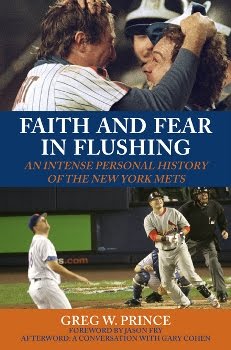 Greg Prince is one of the writers behind Faith and Fear in Flushing, a regular stop for me. He’s spun the blog into a book. Subtitled An Intense Personal History of the New York Mets, that’s exactly what it is: a look at how supporting a team, through good times and bad, becomes a constant, a way of marking the years. It’s about the twinned joy of giving yourself over to something larger, and the agony of being at the mercy of that which you can’t control. Substitute the names and it could be about your team. But if the phrase Grand Slam Single produces chills in you as it does in me, you’ll love it.
So as Opening Day dawns on Monday, I will once again don my cap in support of the most dysfunctional team in professional sports. This in spite of the fact that they’re in a division with the Phillies, the National League equivalent of the Yankees and Red Sox: a perennial contender. That everyone expects them to flirt with .500 and place no better than third this season. That sportswriters have taken to calling for regime change as if the front office is part of the Axis of Evil, or comparing Citi Field to the hell of Dante’s Inferno.
Instead, I’ll focus on the good times. Cementing my bond with my friend Mike, whose blog Metsanity is well worth reading. The 1986 world championship; game six remains one of the high points of my life. Meeting Tom Seaver, the man to this day known as The Franchise. Want to see hero worship? Look at my face.
Or simply helping out another fan. It’s late 2007. Only a few weeks after the Mets’ storied collapse, blowing a seven-game lead with seventeen to play and missing the playoffs entirely.
Whoo. Hang on. I need a minute.
I have to run to the grocery store. It’s raining, so without thinking I put on my Mets inclement weather cap – yes, I have more than one – and head out. I’m in the express line when the guy behind me taps me on the shoulder.
“I have to tell you, I’m so glad to see you,” he says to me in a quiet voice. “I haven’t been able to put on my cap since it happened.”
“You’ve got to man up,” I told him. “Next year starts right now.”
I am way, way too proud of that moment.
