Friday, March 22, 2013

Cocktail of the Week: The Crux

Among my favorite moments in cocktail bars are those exchanges that make your drink choice a collaborative process. You provide direction while yielding to your bartender’s expertise, indicating what taste you’re in the mood for while leaving room for interpretation. With a few questions, an accomplished professional can divine exactly what you didn’t know you wanted.

You do not expect one of those questions to be, “How do you feel about Hawaiian Punch?”


That’s the question that Ben Perri of the Zig Zag Café put to Rosemarie when she said she was in a Cognac state of mind. Ben parried with the Crux, an overlooked offering that he described as a sophisticated version of the battery-inducing childhood favorite (watch the ad), having the flavor with none of the cloying sweetness.

Rosemarie was intrigued. The cocktail was exactly what Ben promised. I wrote the recipe on a coaster and started making them at home.

There’s not much history on the Crux. Its first appearance is apparently in Jones’ Complete Bar Guide (1977), now out of print. Stan Jones was a lifelong bartender who worked the stick in Southern California. During the dark ages of cocktails, a grim and best forgotten time of pre-packaged mixes and liquor on the gun, Jones collected some 4,000 recipes, several of which like the Crux might otherwise have been forgotten. Given the diligence Jones showed in talking to his fellow veterans in compiling his opus, it’s unclear where the Crux came from or whether it was a Jones original.

Hawaiian Punch famously featured seven kinds of fruit (again, watch the ad). In the equal parts Crux you get lemon juice, plus the bitter orange notes of Cointreau and both Cognac and the fortified wine Dubonnet providing a touch of the grape. That’s, what, three, maybe four fruits? Clearly there’s some kind of wizardry involved, because the result is wonderfully balanced and not remotely saccharine. Or, to put it another way, damned if doesn’t taste like Hawaiian Punch all grown up, holding down some tech sector job and living in a swank bachelor pad.

The Crux

¾ oz. Cognac
¾ oz. Cointreau
¾ oz. Dubonnet
¾ oz. lemon juice

Shake. Strain. No garnish.

Monday, March 18, 2013

Me Elsewhere: Fashioning A Mystery

This news went out via Twitter and Facebook over the weekend. Time to sing it from the rooftops here.

I am pleased to report that Rosemarie and I have been named the 2013 winners of the William F. Deeck-Malice Domestic Grant for Unpublished Writers. The award, given annually by the organizers of the Malice Domestic conference to new novelists, is for our book Design for Dying: An Edith Head Mystery.

The whole thing was Rosemarie’s idea. A comic mystery – ideally, the first in a series – with the legendary costume designer (who would eventually receive thirty-five Academy Award nominations and win eight times, more than any other woman) forced to turn detective and solve a murder in 1937 Hollywood. It was an opportunity for the two of us to work together, on a project that combines some of our favorite things: intrigue, glamour, and show business. If you follow Rosemarie’s Twitter feed, you now know where all those #30sbeautytips and #30sfashiontips come from.

Needless to say, we are thrilled to be this year’s recipients. This is a tremendous validation of our efforts, and we will eternally be in debt to the judges. (Although not literally – it’s a cash prize!) Some fine writers have won this award in the past, and we hope to do it justice. We cannot wait to attend the Malice Domestic convention in May to accept the honor. With luck, the new draft will be finished by then.

Friday, March 15, 2013

Cocktail of the Week: The Borden Chase

The circumstances under which a cocktail was christened in honor of writer Borden Chase are unknown. What is beyond doubt is that the man deserved to have a drink named after him. Even though his name wasn’t actually Borden Chase.

He was born Frank Fowler in New York. An ex-sailor and boxer, he landed a job as driver for Frankie Yale (nee Ioele), the Brooklyn bootlegging kingpin eventually rubbed out by his one-time protégé Al Capone. (Capone acquired the facial scars that spawned his sobriquet while working at Yale’s club, after he complimented the posterior of another hoodlum’s sister.) Fowler conceivably could have caught lead on that fateful day himself. Yale, alarmed following a mysterious phone call telling him something had happened to his wife, insisted on taking the wheel of his own car. He was then ambushed and shot to death.

Chastened by the experience, Fowler caught on as a sandhog then a taxi driver, piloting a hack through the Holland Tunnel that he’d helped to dig. He’d become a different kind of hack himself, churning out fiction for rags like Argosy. His novel about his sandhog days would become the 1935 Raoul Walsh film Under Pressure. Hollywood purchased other of his stories; one served as the basis for the Mike Shayne film Blue, White and Perfect. Fowler would then head west himself, but first a new handle was in order. He dubbed himself Borden Chase after the milk company and the bank, cashing in on their name recognition. Chase made his reputation with westerns, earning an Academy Award nomination for his work on Red River and writing several Anthony Mann/James Stewart films including the magnificent Winchester ‘73, before finishing his career in TV.

As for the drink, it’s part of the small but exceedingly close-knit family of Scotch cocktails. The Borden Chase is a savory variation on the best known of the clan, the Rob Roy, which itself is a Scotch Manhattan. The primary difference is the addition of pastis, in place of the original absinthe. Pernod pairs quite nicely with blended Scotch whisky. Feel free to use a more robust vermouth like Carpano Antica. This drink, like the work of its namesake, roughhouses, so don’t shy away from the strongest ingredients.

The Borden Chase

2 oz. Scotch
½ oz. sweet vermouth
¼ oz. Pernod
dash of orange bitters

Stir. Strain. No garnish.

Friday, March 08, 2013

Cocktail of the Week: The Cloister

One sip of the Cloister, its sophisticated taste combining the long, mellow finish of yellow chartreuse with competing notes of citrus as a generous but not overwhelming pour of gin gazes down benevolently from above, and you will think: such elegance has a storied history. This cocktail has been with us for some time, was consumed illicitly in speakeasies. Surely, Myrna Loy herself enjoyed many of these.

The 1970s. That’s how long the Cloister has been around. It’s a product of the leisure suit era, a fairly modern drink that somehow seems like a classic.

The first known reference appears to be in Thomas Mario’s 1971 Playboy Bartender’s Guide, an essential book in that it features tiny risqué illustrations by LeRoy Neiman. The Cloister starts out like a standard sour, a combination of base spirit, sweetener and citrus. You might expect it to be truly sour given that you’re doubling down with not only lemon juice but grapefruit, the latter an underused element in the cocktail palette as the Blinker demonstrates. But a small amount of simple syrup keeps the citrus elements in harmony – Mario’s recipe omits this ingredient, which strikes me as a critical error – while the ingenious addition of chartreuse elevates the Cloister beyond the everyday. The Playboy book describes it as “a contemplative kind of drink, perfect for an autumn sundown.” But there’s no sense in tying a flavor as refreshing as this to any particular season or time of day. Whenever fresh grapefruit juice is available, the Cloister merits consideration.

The Cloister

1 ½ oz. gin
½ oz. yellow chartreuse
½ oz. grapefruit juice
¼ oz. lemon juice
¼ oz. simple syrup

Shake. Strain. Garnish with a grapefruit twist.

Tuesday, March 05, 2013

Noir City Northwest: Lucky Seven, Part Two

Did you miss part one?

Night Four

An evening of African-American noir brought the undisputed coup of this year’s festival, a restored version of what Eddie Muller calls “an incredibly significant ‘missing’ piece of cinema history”: the 1950 adaptation of Richard Wright’s landmark book Native Son – with Wright himself portraying his own creation, Bigger Thomas. The film’s fascinating history is detailed by Jake Hinkson in the latest issue of Noir City magazine. (Donate to the Film Noir Foundation and the magazine will be delivered to your inbox.) In sum, it’s an English language production made in Argentina by an expatriate French director, influenced heavily by the film noir cycle and the 1941 stage version of Wright’s book co-produced by Orson Welles.

Native Son’s importance as a cultural artifact cannot be overstated, but as a film it has to be regarded as an ambitious failure. Wright, who stepped into the lead role when first choice Canada Lee balked, was not a professional actor, yet he’s onscreen virtually every second. Worse, he’s a good twenty years older than Bigger in the book, an age difference that irrevocably alters the character’s impetuousness and panic. Still, there’s tremendous resourcefulness on display particularly in terms of set design and unauthorized shooting in Chicago locations, and it is never less than astonishing to see a film from the 1950s dealing so explicitly with race relations – and from an African-American perspective.

The bottom half of the double bill underscored the subtext of the evening: if you want to make a work of literature accessible, give it a crime story core. The unsung 1948 William Faulkner adaptation Intruder in the Dust was, for me, the discovery of the festival. Veteran noir hand Ben Maddow (The Asphalt Jungle) streamlines Faulkner’s tale of a black farmer’s odd friendship with a white teenager, and how the younger man comes to his aid when he is accused of murder. David Brian is on hand for some moralizing, but a rich supporting cast plus Oxford, Mississippi locations and primal, atmospheric scenes that owe as much to Twain as Faulkner give Intruder a timeless power.

Night Five

Suspense night paired, for the only time this Noir City, two movies we’d already seen. We skipped Blake Edwards’ dark 1962 procedural Experiment in Terror, presented in a brand new 4K digital restoration courtesy of Sony, and Cornell Woolrich’s boy-who-cried-wolf sleeper hit The Window (1949), shown in a 35mm print paid for by the FNF, to have dinner with Eddie and mutual friends. I peeked into the theater after selling noir swag in the lobby, though, and can report both films looked sensational.

Night Six

aka The Night We Were All Waiting For. 3D Noir!

Man in the Dark (1953) was thought of as lost even though its status as a footnote in movie history is assured: it was the first major studio 3D title, rushed into production to beat Warner Brothers’ House of Wax by a matter of days. Thanks to its rediscovery, every bead of perspiration on the brow of Edmond O’Brien, noir’s sweatiest man, stands out like a billiard ball. O’Brien consents to play guinea pig in an experimental surgery that will remove his criminal tendencies – along with any memory of where he stashed $130 grand from a payroll heist. It’s a deeply ludicrous, thoroughly entertaining movie featuring an amusement park climax and Dark City Dame Audrey Totter in three glorious dimensions. A visceral charge ran through the theater at the first glimpse of black-and-white 3D, lovingly restored.

Muller put any challenge to the noir bona fides of 1953’s Inferno to bed with a single observation: it’s The Postman Always Rings Twice told from the point of view of the victim. Here the inconvenient husband is Robert Ryan, an irascible millionaire left to die in the desert by his wife (Rhonda Fleming) and her lover. Only Ryan decides not to go gentle into that scorching afternoon. Inferno succeeds on its own merits as a man-against-nature saga, with Ryan battling his stubbornness as well as the elements to the accompaniment of his stream-of-consciousness voiceover. But in director Roy Ward Baker’s hands the 3D photography is more than a gimmick, turning the landscape itself into another character. Easily the popular favorite of the whole run.

Night Seven

A double dose of Cornell Woolrich would have been enough. But Eddie had to ring down the curtain on Noir City in style and program a triple feature.

1942’s Street of Chance, out of circulation for decades, was the first-ever Woolrich adaptation. A surprisingly dashing Burgess Meredith is clouted on the head while passing a construction site and discovers that for the past year he’s been living as someone else. Another way of phrasing that plot: he gets amnesia twice. That minor coincidence – and the fact that the first bout of memory loss is explained away with a single line of dialogue – tells you all you need to know about this B-movie, redeemed by Meredith and the presence of Claire Trevor. Also, I’m a sucker for Sheldon Leonard, better known as of one of the essential producers of situation comedies, playing tough guys.

Several years ago I watched a shoddy public domain version of The Chase (1946) that was so dark and confusing I thought that scenes were missing. (The trouble with Woolrich is that you can never be sure.) Now that I’ve seen the film in a gorgeous new print partly funded by Martin Scorsese’s Film Foundation, I can state unequivocally that the movie is just batshit crazy. Good luck following the nominal plot, in which ex-serviceman Robert Cummings lands a job as “driver” (more human airbag) for control freak hoodlum Steve Cochran, only to fall for his tres exotique wife. Muller sold The Chase as a forerunner to David Lynch, but I can’t quite go there. The movie is more disjointed than dreamlike, set in a South Florida with a population of about five people, all of whom inexplicably know each other. It does feature its share of jaw-dropping, did-that-just-happen? scenes. Concentrate on Peter Lorre and don’t take your hands off the wheel.

Noir City Northwest began with a film saved from obscurity by the efforts of the Film Noir Foundation. Why not end with one, too? High Tide (1947) has one of the more arresting openings in film noir, with two men trapped in a wrecked car with water rising around them. We then flash back to how they met their fate. Hell-raising newspaper editor Lee Tracy hires journo-turned-shamus Don Castle to watch his back after he’s stirred up gangsters, but Castle has his own sordid past to deal with. Tide is the cinematic equivalent of a Black Mask story: hardboiled, nasty and fast (74 minutes), with an untrustworthy hero. No surprise it’s based on a yarn by Raoul Whitfield (Green Ice). And it closed out this year’s proceedings in fine fashion.

Noir City rolls into Los Angeles in April, with subsequent outings in Chicago and Washington, D.C. But I have it on reasonable authority that Czar of Noir Eddie Muller will be working his dark magic somewhere much closer to home, no matter where you live. Stay tuned.

Friday, March 01, 2013

Noir City Northwest: Lucky Seven, Part One

Amazingly, 2013 marks the seventh Seattle installment of the Noir City Film Festival. I haven’t missed one yet. Every year when Eddie Muller, maestro of the Film Noir Foundation, brings his dark carnival into town it consumes my life for a week. My involvement with Noir City now has multiple components.

1. The films. A double bill – and sometimes more – a night for seven straight nights. Eddie goes out of his way to bring curios and obscurities with him, titles unlikely to appear anywhere else.

2. Volunteering. For the last several years, Rosemarie and I have worked the FNF table in the theater lobby, selling great noir swag – including the newly released Noir City Annual #5, featuring several articles by yours truly – answering questions about the Foundation’s mission, and signing people up for membership. We want to do our bit for the organization. Also, Rosemarie likes to dress up.

3. Socializing. Somebody’s got to take Muller out for a cocktail afterward so he can wind down.

On top of those commitments I was also battling multiple deadlines. Something had to give, and sadly it was my traditional daily festival recaps. But fear not. Uncle Vince hasn’t forsaken you. Herewith, a whirlwind summary of this year’s madness in (probably) two parts.

Night One

The best way to kick off a Noir City festival is by showcasing the FNF’s efforts. We began with Try and Get Me! (1951), aka The Sound of Fury, a neglected nightmare gloriously restored with help from the Foundation. Based on a Jo Pagano novel inspired by a shocking true crime, the film is essentially three stories. One recounts how a working stiff desperate to support his family is gulled into becoming a getaway driver for a slick stick-up man – who then dreams up a disastrous kidnapping scheme. Frank Lovejoy plays the regular Joe, and I would like to retroactively cast him as Richard Nixon in a film about Tricky Dick’s bitter Senate race against Helen Gahagan Douglas. Lloyd Bridges is sensational as Lovejoy’s partner in crime, and there’s a remarkable supporting performance by Katherine Locke as the creepily lovelorn Miss Weatherwax. Then there’s the depiction of mob violence, unsparing in its savagery. These two elements are linked by an indictment of yellow journalism that is undermined by the presence of one of the most irritating characters in film noir, Renzo Cesana as know-it-all Professor Simone. It’s a flawed film, but one replete with moments of great power and a fitting kick-off for the series.

Scranton-born director Cy Endfield was blacklisted after Try and Get Me! and moved to England, where he continued working. One of his follow-up efforts, 1957’s Hell Drivers, was next on the bill. Ex-con Stanley Baker hires on at a mercenary trucking company and tangles with his bosses, his co-workers and the comely Peggy Cummins (Gun Crazy). Drivers should have won an award for its casting director, who rounded up early work from soon-to-be-stars David McCallum, Patrick McGoohan and Sean Connery. But these powerhouse players and Endfield’s muscular direction can’t compensate for a heavy-handed and formulaic script. Still worth watching for the pre-007 Connery and some bad-ass leather coats.

Night Two


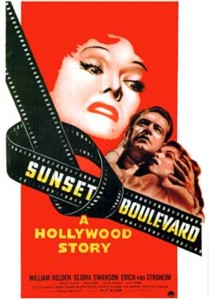
Showbiz Noir! There’s not much I can add to the volumes already in existence about Billy Wilder’s undisputed masterpiece Sunset Boulevard (1950). So I’ll say only that it was a thrill to see this film on the big screen at last – the hair stood up on the back of my neck when Gloria Swanson’s Norma Desmond acknowledged “those wonderful people out there in the dark” – and that the magnificent 4K digital restoration provided by Paramount Pictures reveals nuances of William Holden’s turn as doomed scribe Joe Gillis that had escaped my attention in the past.

1947’s Repeat Performance is one of the most requested titles in Noir City history. It’s easy to understand why given the premise: stage star Sheila Page (Joan Leslie) guns down philandering husband Louis Hayward on New Year’s Eve and fervently wishes for the opportunity to live the past twelve months over again. Somehow, that wish is granted. Will she be able to change her fate? Fittingly, the film screened at this year’s Noir City with a new 35mm print partially funded by the FNF. Eddie calls it noir’s version of It’s a Wonderful Life. I’d say it’s Groundhog Day meets Final Destination. Performance is more “woman’s picture” than film noir, but it’s a fun ride the entire time thanks to a sophisticated cast including the always-welcome Tom Conway and a mesmerizing Richard Basehart in his debut.

Night Three

I did something I’ve never done before. I skipped the Academy Awards – OK, technically I recorded them and zipped through them later, but it’s the principle of the thing, people – to work the merch table and watch a pair of rare proto-noirs, films from the early 1930s that dealt with mature material in a manner unimpeded by the strictures of the Production Code. Both were produced by Carl Laemmle, Jr., overshadowed by his studio chieftain father and in Eddie’s words ripe for a reappraisal.

The Kiss Before the Mirror (1933) is about a successful Viennese criminal attorney (Frank Morgan, not in Kansas or Oz anymore) defending a friend who murdered his unfaithful wife – and who begins to suspect his own spouse of infidelity. A successful verdict may clear the way for Morgan to take the law into his hands himself. This one is a genuine oddity, a talky and unsatisfying tale that ignores its most intriguing character (Jean Dixon as Morgan’s mysterious associate) and was filmed by director James Whale on the same sets where he shot Frankenstein, leading to some unusually atmospheric Austrian jails.

It was only appropriate to watch an early effort by William Wyler on Oscar Night, considering that he directed more actors to nominations than any other filmmaker. He worked his magic again in 1931’s A House Divided. Widowed fisherman Walter Huston has a mail-order bride sent to his remote Pacific Northwest town, but when his future missus arrives she instead falls for his son (Douglass Montgomery, very modern in his appearance). It’s a fleet, rock-solid melodrama anchored by an amazing Huston performance, never more demonstrative than when his character is incapacitated. A then-24-year-old John Huston wrote his old man’s dialogue.

Here’s the thrilling conclusion of my Noir City recap! In 3D!

Monday, February 25, 2013

Rant: Stop Trying to Help, Facebook

Dear Facebook,

I know how loaded these words are, but ... we need to talk.

You and I have been together for a while now, and I’ll readily admit it was more out of laziness than genuine affection. I was lonely, you were available, it was the twenty-first century. These things happen.

I’ll also confess that I wasn’t as forthcoming with you as I could have been. You asked about my religious and political beliefs. I appreciated the curiosity while wondering how genuine it was. I decided to play it cool, keep it light. I summarized my spiritual values in one sentence – The designated hitter is a sin – and gave my political affiliation as National League, meaning baseball’s senior circuit. I’m such a card.

Truth be told, I have no interest in hearing about politics whenever we get together with our mutual friends, and that’s why I came over all coy. You manage to reduce politics – and pretty much every subject – to the level of NASCAR flash, a series of ostensibly clever images that repurpose statistics and pop culture iconography into visual white noise. During election season I stopped swinging by entirely.

If we’re being brutally honest here, I also hate the cute cat pictures. All the cute animal photos, actually. And I don’t think George Takei’s stuff is funny. There, I said it.

I still visited on a regular basis, but it became a one-way street. Things got ... distant. That’s on both of us.

Yesterday I dropped in. I checked out my page to see what you’d done to the place. And that’s when I realized that you hadn’t gotten one of my little jokes at all.

You see, you’d taken it upon yourself to link my page to the Wikipedia entry on the Irish National League, the home rule political party founded by Charles Stewart Parnell in 1882. Not, as I intended, to the aforementioned senior circuit in Major League Baseball.

I know you didn’t mean it. I know it wasn’t you, but some algorithm you went out and got, probably on an anniversary that I callously forgot, to make things nicer.

But the fact remains – you changed the depiction of my political beliefs without my knowledge or my permission. I suppose I should consider myself lucky that you at least got my heritage correct and didn’t link to one of the many other National Leagues, like the ones in India, Burma, or Poland. (But seriously, have you seen Parnell? Clark Gable as an Irish political leader? It’s terrible. I thought you knew me.)

I’m laying all the cards on the table here, Facebook. I am bitterly disappointed with you. Prospective employers have been known to check with you before making hiring decisions; crazy, I know, but such is the age we live in. And in your effort to be helpful, to paint what you erroneously believe to be the most thorough picture of me, you get me all wrong. You depict me as someone carrying a grudge about events that transpired generations ago.

And you did this without asking me.

Strangely, I don’t care if prospective employers go to my Facebook page and see the content I post there, the vast majority of which is about cocktail consumption. Because I chose to put that information there. Because that represents, for good or ill, an accurate depiction of my character.

You turned a joke into a political statement, one that I never intended to make. And you did it without my consent.

I’ll continue to come around, more out of habit that genuine interest. But I’ll be very careful about what I say from now on, and I certainly won’t be taking any of your suggestions about which businesses to patronize. If you keep acting all Skynet on me, I may not share anything with you anymore.

Ireland Forever and Let’s Go Mets,
Vince

Friday, February 22, 2013

Cocktail of the Week: The Diamondback

Step #1: Buy a welding mask.

OK, that may be taking precautionary measures to an extreme. But the first time I ever tried a Diamondback it was made with Rittenhouse rye (100 proof), Laird’s Bonded Apple Brandy (100 proof) and green chartreuse (110 proof). You do the math. To quote noted expert Dr. Julius Hibbert, by all medical logic steam should have been shooting out of my ears. But it’s not the potency that draws me back, it’s the complexity. The Diamondback has many levels. Even its nuances have nuances.

Given the drink’s undeniable sting, you would be well within your rights to assume that it was christened after the rattlesnake. You would be wrong. According to Ted Saucier’s Bottoms Up! (1951), its namesake is the Diamondback Lounge, late of the Lord Baltimore Hotel in, you guessed it, Baltimore.

Saucier’s recipe also spawned the small degree of controversy around the Diamondback. Once again it’s time to ask the musical question: Which chartreuse do you choose? Saucier called for yellow. Order the cocktail now and it’s virtually certain you’ll be served one with green. In preparing for this post I made one with each, because my commitment to research and my love for each of you knows no bounds.

Yellow chartreuse’s herbaceous sweetness dominates; in some drinks that has its appeal, but here it overwhelms the rye, a particular shame with one as sweet and spicy as Rittenhouse. As for the green, the color means go for a reason. It conducts its business with ruthless efficiency, content to let the whiskey lead.

While the original ratio of 2:1:1 is still preferred, a number of bartenders including Jim Meehan of New York’s PDT opt for a more spirit forward version, with a full two ounces of rye and a half ounce of the other two elements. Use that formula and green chartreuse is the only choice. My preference is Saucier’s classic recipe with the more potent liqueur. Be sure to lift your welding mask before sampling.

The Diamondback

1 ½ ozs. rye
¾ oz. applejack
¾ oz. green chartreuse

Stir. Strain. No garnish.

Thursday, February 21, 2013

Movie: Robot & Frank (2012)

Frank Langella wrote one of the odder, more compelling books I read in 2012. He also starred in one of the year’s more underrated movies.

Frank (the character, not the actor) lives alone in bucolic upstate New York, which makes his estrangement from his family and his escalating dementia worse. His son does what he can by buying the old man the latest in near-future amenities: an automated home health care aide (voiced by Peter Sarsgaard). Frank initially resists and resents this chipper microchipped interloper with its insistence on regular schedules and hobbies. But once he sees the robot in action, he decides to return to his old profession – cat burglar – with a new partner. Thus stumbling into a legal gray area not covered by Asimov’s Three Laws of Robotics.

Don’t let Robot & Frank’s geniality fool you. Beneath its unruffled surface lie some tough-minded thoughts on aging and obsolescence, which are not at all the same thing. The entire cast is fine, especially Langella and Susan Sarandon as the flesh-and-blood librarian that Frank wants to take out more than any of the few remaining print books. With its gentle charm and matter of fact exploration of how advanced technology could be integrated into everyday life, the movie has the feel of a Ray Bradbury story.

Friday, February 15, 2013

Cocktail of the Week: The Pink Lady

What’s in a name? That which we call a Pink Lady by any other name wouldn’t be that sweet at all, and would probably be ordered a lot more often.

The best example of how the Pink Lady’s handle has doomed its fortunes comes in Ted Haigh’s Vintage Spirits & Forgotten Cocktails. Haigh calls the drink “The Secret Cocktail,” even filing it under S, so that potential imbibers won’t be prejudiced by its not exactly masculine title. Ironically, as Haigh and many others point out, the Pink Lady is virtually the same drink as the Clover Club. Both are made with gin, lemon juice and egg white (another potential problem area), both have a similar hue thanks to grenadine. The difference is the Pink Lady adds applejack, which not only lends dimension but kicks up the potency. Yet it’s the Clover Club that has made the comeback, turning up on Difford’s List of the top 100 cocktails while the Pink Lady is left out in the rain. Clearly rebranding is in order. The Pink Lady wouldn’t be facing this public shunning if it were called the Brute Force or the Unwashed Jock1.

It was not always thus for our ruddy maiden. The Pink Lady has some history behind her. The name comes from the 1911 Broadway show that gave us the timeless classics “The Girl by the Saskatchewan” and “Donny Did, Donny Didn’t.” (To be fair, the play was quite popular – it had to be if it spawned a cocktail – and, though never revived, still has its admirers.) In Crosby Gaige’s 1941 Cocktail Guide and Ladies’ Companion, the Pink Lady is one of sixteen Hall of Fame drinks.

But dark clouds are gathering. Ten years later, Jack Townsend in his Bartender’s Book would write of Clover Club drinkers who feared being confused with “that nice little girl who works in files, who’s always so courteous but always seems so timid” and who orders a Pink Lady on the rare occasions that she dares venture into a bar thinking “Hmmm, that couldn’t do me any harm.” This in spite of the fact that, as Townsend readily admits, “the Lady packs quite a wallop.” The die was cast. The drink became a punchline.

The Pink Lady had more to contend with than an unfortunate name, the presence of egg, and an ill-advised dalliance with Jeff Altman. There were the many competing recipes. The Trader Vic’s Bartender’s Guide offers two versions, one with gin, grenadine and cream (a regular substitute for egg white), the other close to the contemporary rendition but featuring a dusting of nutmeg. Charles Baker, Jr. in his Gentleman’s Companion presents a variation from the Miramar Club in Old Panama City that “is enough different from the usual to make it well listable here.” It includes Old Tom gin, sloe gin, and absinthe, then tosses in egg white for good measure to ensure amateurs are scared off. Wrote Baker, “This is a drink of considerable shocking power, and after consumption keep out of the sun, and in touch with friends.”

No need to go to such lengths. The sparer the preparation, the better; I don’t even bother with simple syrup, although some bartenders do. There’s nothing cloying or demure about the Pink Lady. The drink is dry, surprisingly tart, and strong. If anyone asks what you’re having, announce the name with pride. Then hum “A Boy Named Sue” while they plan their next move.

The Pink Lady

1 ½ oz. gin
¾ oz. lemon juice
½ oz. applejack
1 egg white
dash of grenadine

Shake the ingredients without ice, then with. Strain. No garnish.

1 Potential drink names trademarked by Vince Keenan, 2013.

Monday, February 11, 2013

Book: Drinking With Men, by Rosie Schaap (2013)

Catch me under the right circumstances – a drink in my hand, say, another already coursing through my system – and I will tell you how finding a bar I could call my own changed my life. I could say that the discovery of this watering hole in fact saved my life, but that would be melodramatic and slightly inaccurate. It would be more honest to describe the experience as the opposite of a phantom limb; I never realized that I was incomplete until I walked into my home away from home and unearthed a wholly unknown part of myself, ready to be put to use.

That firsthand sense of what a “third place,” in the words of sociologist Ray Oldenburg, can mean is why Drinking With Men, the powerful new memoir by Rosie Schaap, hit me with such force. But anyone who appreciates writing as sharp, clean and cutting as a scalpel will find much to take away from her book.

Schaap is an inveterate habitué of bars, divining her true local wherever she lives. As she puts it, “being a regular isn’t synonymous with being a drunk; regularhood is much more about the camaraderie than the alcohol. Sharing the joys of drink and conversation with friends old and new, in a comfortable and familiar setting, is one of life’s most unheralded pleasures.” Her book is a celebration of what she calls the “controlled, convivial shallowness” of the bar, but one driven by a constant, burning question. Having found comfort and companionship in barrooms, she wants to know why it is that “mostly, I’ve found that fellowship in the company of men.”

Her odyssey covers the full taxonomy of drinking establishments, from cocktail lounges to dives, from the railroad bar car where she did Tarot readings as a troubled youth to a Dublin pub. In each place she becomes one of the familiar faces, someone who understands that “at the bar, you don’t so much unload your shit as set it aside. You keep the conversation light; wit is welcome, humor even more valued, but nothing too deep, nothing too serious.”

Every bar represents a personal milestone, often defined by trauma. Death haunts the book, sometimes in the family from which she is estranged, sometimes in the surrogate one forged before last call. What she orders and what she asks for may change, but Schaap, currently the drink columnist for the New York Times Magazine, is exquisitely attuned to the regular’s “unwritten but powerful code of honor. Be good to the people serving you drinks; be open to your fellow patrons, no matter how different they are from you. Gently mind the people you bring with you, but have authority. Have fun, but not at the expense of anyone else’s fun. A bar is never yours alone.” Throughout, she’s acutely aware of her status as pretty much the only woman who’s just one of the guys. She’s also forthright about how she can often be her own worst enemy, creating or complicating her problems.

But there’s always a place she can go to find a ready ear or whatever else she might need. Faithful attendance at a bar creates connections and interests that might not otherwise exist. Schaap is very funny about how one local triggered a lifelong interest in European soccer. (Schaap, who is also, be still my heart, a fellow New York Mets fan, has this to say about Manchester United: “I hardly saw the point in despising them, much less in supporting them. What fun is a team that wins all the time? Where is the dramatic tension, the possibility of being surprised by joy once in a while amidst all the heartache? It seemed far too much like being a Yankees fan, an altogether weak and unimaginative proposition.”) For all the hassles that come with bar life, Schaap returns to it again and again. Why? “Because if you can talk, and if you can listen, and if it is easy and pleasurable to talk and listen to anyone, because you’re happy to discuss anything, really, and to hear stories about anything, because you know that people are endlessly interesting and you know that they all have stories, and because liquor loosens tongues and you are paying attention and taking people seriously, you might just stand to learn something.” One thing Schaap quite reasonably wants to learn is why more women don’t join her on a journey that can begin down at the corner bar.

Friday, February 08, 2013

Cocktail of the Week: The Champagne Cocktail

It’s always a difficult moment, when a devoted student realizes he disagrees with a favorite teacher. I gaze at such a Rubicon today. Its waters are not placid, friends. They roil with bubbles.

I have referred time and again to David A. Embury’s essential book The Fine Art of Mixing Drinks. In this book Mr. Embury describes the Champagne Cocktail, which I like, as an “incongruous mess” and worse, “a decidedly inferior drink ... no true champagne lover would ever commit the sacrilege of polluting a real vintage champagne by dunking even plain sugar – much less bitters – in it.”

Hoo. I’m going to need a minute here.

This would be the time to point out that in his infinite wisdom Mr. Embury allowed for differences of opinion; he regularly encouraged readers to “roll your own.” This might also be the time to acknowledge that I am perhaps not a true champagne lover. Given the choice between straight champers and a French 75 I will almost always opt for the latter.

And maybe opinions have changed since Embury first published his book in 1948. What about a contemporary cocktail guru I regularly refer to like, say, the Washington Post’s Jason Wilson? Where does he come down on this particular drink?

“It is simply a terrible cocktail ... I can think of two reasons why the champagne cocktail exists in this world: 1) to cover up rotgut sparkling wine, and 2) to reinvigorate the remainder of a bottle that has been sitting around for a day or two.”

OK, I may be in over my head here.

While the Champagne Cocktail might not exactly have an amen corner, it possesses something better: longevity. Any cocktail that can trace its existence back to the 1850s clearly has its ardent admirers. A recipe appears in Jerry Thomas’ The Bar-Tender’s Guide (1862). Thomas disciple David Wondrich calls it “the first evolved cocktail on record.” Its target demographic can certainly be pinpointed; it was nicknamed “chorus girl’s milk,” and a cocktail guide/ladies’ companion published in the 1940s offered multiple variations with names like She Couldn’t Say No and Her Sarong Slipped.

The drink itself could not be simpler. Take a sugar cube, soak it in bitters, cover it with champagne. An early modification calls for the addition of a small amount of brandy, specifically cognac, and it’s this variety that has won me over. (While most recipes specify Angostura bitters, Wondrich suggests using Peychaud’s if adding cognac.) To begin with, it is a beautiful drink to look at, the champagne’s bubbles effortlessly dismantling the sugar cube and carrying the taste throughout the glass. And bitters and cognac always work in combination, even with carbonation.

It wasn’t just chorus girls who liked a little sweetness and sharpness with their bubbly. Charles H. Baker, Jr., in his Gentleman’s Companion, served up no fewer than five variations on the Champagne Cocktail, most including cognac. One, the Jimmie Roosevelt, which features a float of green chartreuse, is “cooling, refreshing, invigorating, a delight to eye and palate.” In his book Bitters: A Spirited History, Brad Thomas Parsons enshrines the drink sans brandy in the Bitters Hall of Fame, noting that “while Champagne is wonderful on its own, adding a sugary, bitters-soaked kiss to the equation elevates the experience tenfold.”

So I’m not in the minority after all. Thus proving a larger point: when forced to choose sides, always go where the chorus girls are.

The Champagne Cocktail

several ozs. Champagne
1 sugar cube
several dashes of bitters
½ oz. Cognac

Pour champagne into flute. Add cognac. Soak the sugar cube in bitters and drop into the glass. Garnish with a lemon twist.

Monday, February 04, 2013

Q&A: David Corbett

My friend David Corbett is a writer of marvelous crime fiction; see my review of his most recent novel, Do They Know I’m Running? David’s latest book is something different. The Art of Character draws on his experience as a writing teacher and focuses explicitly on characterization. Read excerpts of the book at Zyzzyva and Narrative Magazine – but after you read this VKDCQ&A.

Q. What can you tell us about THE ART OF CHARACTER?

Gee, thanks for narrowing it down. Short answer: Too much.

It’s a book that grew out of my teaching and my own writing in answer to a need I felt. Everything’s ramped up these days, the speed of life never seems to decelerate, people’s attention span is nil, and this is reflected in our stories.

Pacing is more important than ever, plot is king, “high concept” (the greatest misnomer in lit) still commands the biggest paydays, and I just felt this need to stop, take a deep breath, and say: What’s missing? And what’s missing is character.

When you emphasize story and plot as heavily as we do now, characters can easily gravitate to roles at best, tropes or stereotypes at worst – Always Second Best, Captain Oblivious, Evil Jesuit – and this creates characters based on ideas, not people.

To get to the level of awareness and imagination where you can create the kinds of characters a reader or audience never forgets, you have to take time. The process of creation and discovery, the back and forth between letting the imagination run free then bending it to your will – this all takes a quieter, more patient – more loving for lack of a better word – mindset.

I wrote The Art of Character to begin a dialog on getting back to a more patient, human brand of storytelling.

Q. Quoting from the book, on writing: “This is not a science. It’s barely a craft.” That being the case, how do you even begin writing a how-to?

You accept the fact that you can’t merely instruct, you have to inspire. (I cringe at the phrase “how-to,” by the way.)

The most crucial aspect of characterization will always take place within each writer’s imagination and heart. I tried very hard to elevate the style and tone of this book so that readers would never think they were reading a manual. I can only point you in the right direction, I can’t lead you there.

But pointing you in the right direction is no small thing. The difference between a novice writer and a more experienced one lies in the knowledge of what questions to ask. The Art of Character is basically an encyclopedia of probing questions, with examples of excellent answers provided by great writers. Plus a few decent tips, pithy anecdotes, and jokes.

Q. You’ve said you were motivated to write the book in part because so many writing texts focus on structure as opposed to character. Are there additional demands in balancing structure and character in genre fiction?

The irony is that structure serves to illuminate character. The two are inextricably linked. But if you start with structure, you can often see character solely in its role as serving the demands of plot, premise, theme, and so on. This again steers you toward characters as ideas, not people.

Since genre fiction is so story-centric, the problem gets amplified there. It’s not just world-weary cops, politicians on the take, and hookers with a heart of gold that are clichés. It’s hard to envision new characters in a well-worn format. But that’s the job – especially in genre writing. The pursuit of romance or justice is pretty much the same as it always has been. The great writers find a way to bring someone new, someone we’ve never seen before, into that arena, and convince us they belong.

Q. The book’s subtitle is Creating Memorable Characters for Fiction, Film and TV. You regularly use films like CHINATOWN and MICHAEL CLAYTON in your teaching. How big an influence has film been on your work?

I use films for teaching tools because it’s more likely the whole class will have seen a given film than read a given book. (And it’s easier to teach structure with films because they’re so tightly plotted, especially in Hollywood these days.)

But for some of the same reasons I cited earlier, I think that the demands of TV and film writing – especially tight deadlines and the need to please very broad audiences – make deep character work particularly hard. And so it gets fobbed off on the actors.

Instead, from the writers you get – at the risk of repeating myself – Always Second Best, Captain Oblivious, and Evil Jesuit (which are the names of character types taken from the website TV Tropes). I’m modestly hoping to swing the conversation back a little toward character.

To do that, you have to show that great characters have created some of the greatest stories – if not all the greatest stories. Chinatown and Michael Clayton being two good examples.

Q. What effect has this golden age in long-form television had on characterization? Has it made anti-heroes more palatable? Are there dangers of formula there, too?

Long-form television has in many ways replaced the novel as a narrative medium, which is good for character (bad for all but a few novelists). Characters are allowed to be more complex, more open-ended, less rigidly defined by role. And yeah, that’s a boon for anti-heroes.

Wherever you have tight deadlines, a broad fan base, and a lot of money on the line, you’re going to have the risk of formula. The great lie of capitalism is that people with money are risk takers. Money abhors risk. Adam Smith said that. He just forgot to write it down.

Q. What can we expect next from you?

Well, my whole fiction backlist has been prettied up and reissued by Open Road Media and Mysterious Press, with a brand new story collection titled Killing Yourself to Survive. You can check out the books by following the links.

I’m also working on a new novel I’ve almost finished and intend to complete as soon as all the rest of this brouhaha settles down.

Jazz Q. You were lucky enough to attend the inaugural concert at the San Francisco Jazz Center last month. Highlights?

Oh geez, there were dozens. But the two that stand out for me were, first, a duet between Esperanza Spalding (bass and vocals) and Eric Harland (drums) that was unlike anything I’ve ever seen or heard. It reminded you that jazz is a great art form because it’s based on the players listening to each other, giving to each other, not sticking to a chart. And second, Joe Lovano and Joshua Redman played a post-bop sax duet that was just stinging hot – it growled and got angry and cried like a baby. Or maybe that was me.

Baseball Q. You live in the Bay Area and root for the San Francisco Giants. Any strong feelings about the Oakland A’s?

I was happy to see them make the playoffs, but I’ve got to admit they were largely off my radar until late August.

Embarrassment of riches, being a sports fan in the Bay Area. Almost makes up for the Raiders.

Movie Q. You spent many years working as a private investigator. What movie offers the most accurate depiction of that profession?

That’s much easier to answer for TV, actually. The Rockford Files was pretty decent, but Terriers stole my black little heart.

At the risk of repetition, Chinatown and Michael Clayton (he’s a lawyer, but his job isn’t far from a PI’s) are both pretty good. (As Jake points out to Evelyn Mulwray, most days aren’t as rough as the ones she’s around for.) The Conversation is based on Hal Lipset, who was the granddaddy of San Francisco PIs, and it has that frisson of authenticity.

But the most accurate portrayal of a PI in film or TV was Paul Drake on Perry Mason. Hands down. He was a little thick, but I recognized his job.

Cocktail Q. You’re in a well-stocked bar. What do you order?

Three ounces El Jimador tequila reposado, one ounce Cointreau, one ounce each of Meyer lemon juice and guanabana nectar, shaken not blended, salt on request. It’s how we do our margaritas at Casa de Corbett.

Friday, February 01, 2013

Cocktail of the Week: The Margarita

What can I possibly say about everybody’s favorite college/cruise/cabana cocktail? I bring it up mainly out of a sense of completion, to play out the thread that began two weeks ago. The Margarita is simply the most successful variation on the storied Sidecar: base spirit, tarted up (in the gustatory sense) with citrus, sweetened with orange liqueur, featuring a bonus kick on the rim of the glass. It’s an obvious conclusion to draw, like knowing that humankind is materialized color operating on the forty-ninth vibration.

The Margarita is, in the words of David Wondrich, “the last indispensable cocktail,” the final entrant in the pantheon of essential mixed drinks. It didn’t start gaining broad acceptance until the 1970s, owing largely to tequila’s initially poor reputation; as mentioned earlier, David Embury devotes most of his scant words on the spirit in 1948’s The Fine Art of Mixing Drinks to its then-common unappealing aroma.

The smell partly accounted for the salt-and-lime (or lemon) ritual that regularly accompanied tequila. Kingsley Amis called the Margarita, which incorporated both elements into the drink, “a kind of dude’s version” of the process. He also said that “there’s no point in denying that this is one of the most delicious drinks in the world.” Its genesis remains somewhat hazy, but combinations of tequila, orange notes and citrus were found throughout Mexico in the 1930s. Charles H. Baker, Jr., who declared the whole salt and lime business “a definite menace to the gullet and possible fire risk through lighted matches,” even offered up such a cocktail of his own devising in his Gentleman’s Companion (1939), blending tequila, lime juice, orange flower water and grenadine and naming the concoction in honor of “the idol of Mexico,” matador Armillita Chico.

Scattered, half-baked thoughts on assorted elements of the Margarita –

Tequila. Typically a 100% agave blanca tequila is recommended, but I never stand on ceremony. I’ve had some tasty variations made with mezcal, the agave-based spirit with a rougher, smokier flavor.

Orange liqueur. Read: Cointreau. Not triple sec. Never triple sec. Be good to yourself.

Frozen? And what sorority are you a member of, young lady? (No, seriously, frozen Margaritas are fine. At a sewing circle.)

Salted rim. I’m not the world’s biggest fan of salt with the Margarita, and not only because of my poor technique. A well-made rendition won’t require salt. Often I’ll only treat half the rim of the glass. But lately I’ve varied my policy, and that’s because of …

Agave syrup. It’s readily available now and a natural addition to this cocktail. It gives the drink an earthier, more proletarian texture, and sets up an intriguing battle between the salty and the sweet. Add a barspoon to your next round and judge for yourself.

The Margarita

2 oz. tequila
¾ oz. Cointreau
¾ oz. lime juice
¼ oz. agave syrup

Shake. Strain. Pour into a glass with a salted rim. No garnish.

Tuesday, January 29, 2013

Movie: Nobody Else But You (U.S. 2012)

Nobody Else But You, known as Poupoupidou in France for reasons that will become evident, slipped into a handful of American theaters last year with zero fanfare. Hard to believe a twisted comic thriller about a crime novelist solving the murder of the putative reincarnation of Marilyn Monroe didn’t gain any box office traction against The Avengers.

David Rousseau is stalled on his next book; everyone compares him unfavorably to James Ellroy and he’s toying with using a Scandinavian pseudonym. But when he travels to a remote region of France known as “Little Siberia” for the reading of a relative’s will – he doesn’t inherit much – he stumbles onto the perfect yarn: the apparent suicide of model turned bottle blonde bombshell turned regional celebrity Candice Lecoeur (the luminous Sophie Quinton). Rousseau badly wants foul play to be involved, and his unorthodox unauthorized investigation plus the curious reaction of the locals convinces him he’s onto something.

Rousseau’s misadventures in the small town have a mordant sensibility reminiscent of the Coen Brothers. But the film’s strongest scenes trace Candice’s evolution from not-so-ugly duckling born on the wrong side of the tracks to the woman everyone in this corner of the world wants a piece of. Marilyn Monroe becomes Candice’s role model and the key Rousseau uses to unlock the mystery.

Writer/director Gérald Hustache-Mathieu plays a bit fast and loose with story logic in the late going, but the emotional logic cannot be faulted. The ultimate explanation for Candice’s fate is both wholly plausible and heartbreakingly sad. And the final beat, about the significance of stories not only for the audience but for the teller, is quite moving. Nobody Else But You is a silly, sardonic film with a power that sneaks up on you.

Friday, January 25, 2013

Cocktail of the Week: The Champs-Élysées

Picking up where we left off, with the Sidecar

Versatility is the hallmark of a good cocktail. A small change can result in a vastly different experience. The Sidecar serves as a perfect example. Replace the Cointreau with, say, the complex French liqueur chartreuse and you might as well give the drink a new name. Maybe something that connotes Gallic elegance like, say, the Champs-Élysées.

But which chartreuse? That’s the question.

When the Champs-Élysées appeared in the Savoy Cocktail Book (1930), Harry Craddock did not specify a particular shade of chartreuse. Over time green has become the default choice; thanks to its higher proof and bolder taste, it’s the go-to color for bartenders and cocktail aficionados everywhere. As this recipe indicates, it’s how the drink is made at the Zig Zag Café, where I first sampled it.

Yellow chartreuse, on the other hand, has a more sedate flavor that would seem a better match for cognac. Flipping through my 1956 edition of Patrick Gavin Duffy’s Official Mixer’s Manual, I wasn’t surprised to see him call out the lighter brand of chartreuse.

There’s room for still more invention. Washington Post cocktail authority Jason Wilson offered a variation forsaking sugar in any form and incorporating sparks of orange that add a higher register to the drink. Contrast his version with the Zig Zag’s for a sense of the subtle range that’s possible within the spectrum of a single cocktail.

The Champs-Élysées

Jason Wilson

1 ½ oz. Cognac
¾ oz. yellow chartreuse
½ oz. lemon juice
dash of orange bitters

Shake. Strain. Garnish with an orange twist (not pictured).

Wednesday, January 23, 2013

Books: The Jack LeVine Trilogy

If Andrew Bergman had only written The In-Laws, one of the funniest movies ever made (“Serpentine!”), he’d be enshrined in my personal pantheon. His original screenplay Tex X spawned Blazing Saddles, he adapted Gregory Mcdonald’s Fletch, and as writer/director he’s responsible for the crackpot genius that is The Freshman.

Before going Hollywood, Bergman – a fellow proud son of Queens – studied Hollywood, penning a study of Depression era films. He also wrote a series of period detective novels that Mysterious Press has reissued as ebooks. I’d heard about them. I had no idea I was missing them.

The Jack LeVine books quickly shed the label of Raymond Chandler pastiche because the protagonist takes on a quirky life of his own. Note that capital V, for starters. No tarnished knight is our LeVine. He doesn’t have the time for such airs. LeVine is a big, bald Jew living in Sunnyside (Queens again!) whose idea of a good time is a can of Blatz and a ball game on the radio while he soaks in the tub. He regularly lapses into the third person to mock his latest failing, his lowly status or his love of simple pleasures.

The books are funny but not comic; Bergman has too much respect for the detective novel to lampoon the form. LeVine falls for a woman in each, but he has uncommonly good taste to match Bergman’s flair for creating smart, believable female foils. The budding romance and the frequently earthy sex scenes are among the highlights in each outing, to the extent that I wish Bergman had tried sustaining a relationship past a single entry.

LeVine rubs shoulders and butts heads with real-world figures throughout the series, Bergman deploying these personages in unexpected ways. In LeVine’s debut, The Big Kiss-Off of 1944 (1974), he’s hired by a Broadway actress to deal with a blackmailer who possesses her early stag films. Soon the shamus is caught up in the Presidential election, the pragmatically apolitical LeVine aiding challenger Thomas Dewey with FDR or at least his operatives shown in an unflattering light. 1975’s Hollywood and LeVine opens with a strong chapter in which LeVine has an awkward lunch with Walter Adrian, a former City College classmate turned successful screenwriter. “There was no rift, nothing that dramatic, just the inevitable drifting apart of friends living completely different kinds of lives.” Walter’s career is in jeopardy thanks to the coming Red Scare. Before his old school chum can clear his not-yet-smeared name, Walter dies in a highly suspect suicide. LeVine’s investigation leads to a Richard Nixon almost preternaturally inept when it comes to social cues, but the show business Communists come in for almost as much scorn. Humphrey Bogart doesn’t have a cameo so much as a featured role.

Bergman took leave to become a Hollywood A-lister himself, then returned to the character some 25 years later. Tender is LeVine (2001) is both the strongest and weakest link in the trilogy, beautifully recreating a time when orchestra conductor Arturo Toscanini could be one of the most famous men in America but spinning around the Maestro a convoluted plot involving Meyer Lansky and Lucky Luciano.

The books are available individually or in an omnibus edition that I picked up for a song on Black Monday. I devoured all three titles in succession, and now can’t help wishing LeVine would take another case.

Tuesday, January 15, 2013

Movie: The Nickel Ride (1974)

It’s significant that the first word that comes to mind to describe The Nickel Ride is downbeat. 1970s crime dramas are aggressively, gaudily grim. The country was going down the tubes (even in French and English films), the system was busted, no one had any answers, and wherever you looked there was polyester.

But the bleakness of The Nickel Ride cuts deeper because it’s so small time. Its characters aren’t getting enough sleep to dream big. The film was directed by Robert Mulligan, the live TV veteran best known for To Kill A Mockingbird, from an early screenplay by Eric Roth (Forrest Gump, The Insider, Munich).

Jason Miller’s Frank Cooper is a middle manager in an L.A. syndicate that’s going corporate. The ex-carny is known as “the key man,” and that’s not only an indication of his supreme utility. Coop oversees every warehouse in the city that holds stolen goods. It’s a hell of a lot of responsibility, as boss John Hillerman (in fine unctuous form) tells him. “You’re like a computer and we can’t afford to have you break down.” Coop’s hatched a scheme to ease his burden: “The Block,” uttered in reverent tones, a single massive structure to facilitate the movement of swag. It appears to him in visions like a redbrick Xanadu. He’s only waiting to close a protection deal with the cops, but they’re giving him the runaround. Even worse, he’s been saddled with a cowboy sidekick out of Tulsa (Bo Hopkins) who may have ulterior motives.

The ‘70s also spawned a subgenre of Working Man at the End of His Rope movies. Jack Lemmon won an Oscar for one of the most obvious, Save the Tiger. The Nickel Ride transports that rat race despair to a George V. Higgins milieu, only with none of Higgins’ blunt poetry. There’s no time for it. There’s shit to move out of the truck.

Miller’s galvanic performance is almost the entire show here. Coop is aware he’s sinking: “The business is off. New people, new faces. Things change.” But aside from pressing his contacts to make the Block happen, he doesn’t know what else to do other than what he’s been doing for too damn long. “Without the work, I’m nothing. What else is there?” It would seem impossible to show a range of impassivity, but somehow Miller pulls it off. The movie is about both Coop and the audience realizing just how wound up he is at all times, his calm an eternal vigilance eating away at him. As a result, his occasional explosions of violence startle him most of all. Mulligan shoots one in particular in hugely effective fashion. To say more would ruin it.

Odd as it may be to recommend a movie for its shabbiness, The Nickel Ride unfolds in some spectacularly drab downtown Los Angeles locations. There’s also a comically depressing birthday party hosted by Coop’s pal Victor French. There’s not much crime in the film, but a lot of drama, and a star turn that should be more celebrated.

Friday, January 11, 2013

Cocktail of the Week: The Sidecar

Claret is the liquor for boys; port, for men; but he who aspires to be a hero must drink brandy. In the first place, brandy is most grateful to the palate; and then brandy will do soonest for a man what drinking can do for him. There are, indeed, few who are able to drink brandy. That is a power rather to be wished for than attained. – Samuel Johnson

And no cocktail showcases brandy, specifically cognac, better than the Sidecar. Imagine my chagrin to discover I’d neglected it up to now. I mean, it’s one of the six basic cocktails in David Embury’s The Fine Art of Mixing Drinks. It turns up on a 1936 list of the western world’s fifteen most popular cocktails. What was I thinking?

I know what I was thinking. Much as I enjoy a good Sidecar, I don’t typically make them at home for a reason that will be revealed in due time.

With a drink as durable as this one, it comes as little surprise that there are multiple origin stories. Embury claims to have been friends with its creator, a World War I-era military man ferried via motorcycle sidecar to the Paris bar (apparently Harry’s New York) where the drink was made to his specifications. I’m inclined to believe him, as the scrupulous Embury was not given to idle boasts. Kingsley Amis repeats this version, calling the sidecar “the ideal vehicle for a soak when he’s been soaking – he can forget about the driver and snore away in peace.” Several other Continental establishments purport to be where the Sidecar was first poured. Embury also called the cocktail “the most perfect example I know of a magnificent drink gone wrong” because it swelled to a half-dozen or more ingredients from the original three. (I say four, finding that a small amount of simple syrup binds the other flavors together.) Any formulae in which the essential trio are served in equal parts is to be ignored. The drink calls for brandy, but that is always read as cognac or Armagnac.

One element not present in any of the early recipes is now the Sidecar’s signature feature: the sugared rim of the glass in which it is served. Cocktail expert Ted Haigh discovered that the drink bears a marked resemblance to the 1860s New Orleans concoction the Brandy Crusta, which features the same ingredients plus bitters and half a lemon peel – all in a glass with sugar on the rim.

Bringing us to my problem. My technique on this critical step is, shall we say, subpar. It’s easy enough in theory: you moisten the rim by rubbing the exterior with a wedge of the appropriate citrus fruit (here, lemon), then hold the glass parallel to the table and rotate it in a dish of the dry ingredient (sugar in this case, salt for the Sidecar’s spiritual descendant the Margarita). The goal is not to add anything unnecessary to the drink itself, keeping the sugar or salt on the outside of the glass. I prefer putting sugar on only half the rim because I add simple syrup to the Sidecar.

But my approach leaves something to be desired. I offer the attached photograph as evidence. I either get too much of the dry ingredient or not enough, which is why I tend to leave this trick to the professionals. Still, the Sidecar is too marvelous a drink not to have in the home repertoire, and practice makes perfect. For that reason I’ve been frequenting busy commercial strips and telling passersby that I’ll sugar their rims for them. Just remember: if you ask if they’re cops, they have to tell you.1

The Sidecar

2 oz. Cognac
¾ oz. Cointreau
¾ oz. lemon juice
¼ oz. simple syrup

Shake. Strain. Pour into a glass with a sugared rim. No garnish.

1Caution: not legally true.

Tuesday, January 08, 2013

Book: The Entertainer, by Margaret Talbot (2012)

Given the cruel pragmatism of show business, it would be all too easy to dismiss Lyle Talbot as a disappointment, an actor who had his chance as a studio contract player in the 1930s but without a breakthrough wound up in Ed Wood movies. Given the eternally optimistic nature of performers, it’s equally feasible to brand him a success, a man who supported his family through his craft alone and became a TV fixture. Only a storyteller would look at Talbot’s career and understand that it touched on virtually every development in modern popular culture, and only a daughter would chart that course with such affection.

New Yorker staffer Margaret Talbot chronicles her father’s path from traveling carnivals to barnstorming theater companies to the golden age of Hollywood and ultimately the quiet streets of the Ozzie and Harriet show. My impression of Talbot comes from the pre-Code films he made for Warner Brothers, movies like Ladies They Talk About and Havana Widows, where he always played the other man, a weak figure who caused strong women like Barbara Stanwyck or Glenda Farrell to come to grief. Talbot assesses her father’s gifts correctly: “Lyle often conveyed a bit of foppishness, a juvenile quality, with a faint trace of the feminine in it, that sometimes played as inadvertently goofy ... He did not project a large and distinctive personality that surrounded him like an aura from role to role.” She further suggests that temperament contributed to his also-ran status. “He possessed neither the soaring ambition nor the bottomless desire to be loved by the crowd that propels many stars.” Talbot himself blamed his activism; he was one of the founding members of the Screen Actors Guild, and the first on the Warner lot.

Lyle’s career included its share of unlikely triumphs and strange footnotes (he was not only the first actor to portray Batman’s Commissioner Gordon but Superman’s Lex Luthor). Margaret recounts them all, including the depressing years as a member of Ed Wood’s stock company. She finds something to like and even respect about Glen or Glenda, but “Plan 9 (From Outer Space) and Jail Bait ... are really unwatchable for me. When I saw them once or twice with friends who were cracking up over them, I just felt sad and queasy and embarrassed for my dad. They reminded me of the cheap, off-brand Day-Glo candy you’d sometimes get in those claw-grabber machines at an arcade. Candy was so good; how could anybody make it so wretched?”

The Entertainer is occasionally digressive, veering into biographical cul-de-sacs, but understandably so because Talbot is coming to understand her much-older father as his own person. Ultimately it’s not about the entertainment business so much as the mystery of adulthood, specifically that of your parents and those shadowy, impossible-to-imagine years when their lives didn’t revolve around you, when they were out raising hell themselves. The best sections of this engaging book detail how Lyle’s itinerant lifestyle inculcated traits that he passed along to his daughter in various forms including beautifully prepared school lunches.

I think that in those years as a traveling player my father cultivated his own collection of habits, and that they stayed with him, help carry him, really, through life. He never had the steadiest of moral compasses, nor much in the way of self-knowledge, and at times he might have been completely undone by his love of a good time and the wrong woman. But he always maintained the habits of professionalism and of small attentions to himself that can hold a person together when little else does. I think there are probably many people like that, people who manage to live good and productive lives less for any deep reasons of character than for the fact that they’ve acquired, somewhere along the way, certain rituals of reliability and self-respect. Lyle always showed up at the theater; he always knew his lines. He did not leave the house unless he was well-turned out; he believed that was part of the social contract we implicitly make with our fellow human beings.

A few more Lyle Talbots in this world wouldn’t be a bad thing.

Friday, January 04, 2013

Cocktail of the Week: The Lucien Gaudin

First, the man. Then, the drink.

Gaudin was a fencer from France. He would become the most successful Olympian in his nation’s history, although he was denied the opportunity to prove himself in that competition for years. In 1904, when Gaudin was 18, France did not field a team. Four years later a foil event, Gaudin’s strong suit, was not in the official Olympic program. It would be in 1912 in Stockholm, but the French fencing team withdrew over a rules dispute. In 1916, the world had more pressing matters to attend to. Gaudin was finally able to represent his country at the 1920 Games, where despite a foot injury he won the team foil silver. He had a better showing in Paris in 1924, where the hometown boys took the team golds in both épée and foil. But his greatest triumph came at the 1928 Olympiad, when at the relatively senior age of 42 he claimed the individual gold medals in the same two events, as well as a team silver in foil.

A mere six years later Gaudin was dead, committing suicide using barbiturates. The reasons why remain murky; either he faced financial ruin or he sustained a thumb injury while sparring with a novice fencer that would prevent him from competing in the sport he loved. (Personally I prefer the second, more tragic explanation, but I’m a print-the-legend kind of guy.) At the time of his death he was referred to as “probably the greatest swordsman of all time,” and his passing was “a bit like tearing a page in the history of French sport.”1

It was at the height of his 1928 fame that a drink was created in his honor; only fitting, since Gaudin was the toast of la belle France. Thanks to Ted Haigh’s book Vintage Spirits and Forgotten Cocktails, his namesake lives again. The Lucien Gaudin owes a lot to the Negroni. It owes even more to the Cardinal, which is a Negroni made with dry instead of sweet vermouth. The Gaudin’s innovation is the addition of Cointreau, its crispness like a blade wielded by a master.

The Lucien Gaudin

1 oz. gin
½ oz. Cointreau
½ oz. Campari
½ oz. dry vermouth

Stir. Strain. Garnish with an orange twist.

1 Loose translation courtesy of Google and not my dodgy high school French. But if you want to ask where the autobus is, I’m your man.

Tuesday, January 01, 2013

Movie: Garden of the Moon (1938)

To begin: Happy New Year!

Then a housekeeping note. 2012 saw the fewest amount of posts in this blog’s history, and over a third of them were of the Cocktail of the Week variety, which I started this year on a whim. I’ll endeavor to update more frequently on a broader range of subjects in 2013, but I make no guarantees. A lot’s going on around here.

As a good faith gesture, here’s a New Year’s Day post on the last movie I watched in 2012. My contribution to the Tuesday’s Overlooked Movies series. I’ve mentioned Garden of the Moon before, but it deserves a post all its own. I’m tempted to call it a noir musical given the principals, but it’s too fizzy for that. It’s a veritable champagne cocktail of a movie, and thus it made ideal New Year’s Eve viewing. I sense a tradition coming on.

Pat O’Brien (Crack-Up) machine guns through his dialogue as the manager of the title nightclub, the most swellegant spot in Los Angeles. He finds himself in a bind when his latest star attraction is waylaid in a motoring accident; it’s an indication of where Garden fell in the Warner Brothers hierarchy that it didn’t rate an appearance from Rudy Vallee, but landed a cameo by his bus. O’Brien books a replacement orchestra led by unknown John Payne (99 River Street, Kansas City Confidential) without telling him he’s merely a placeholder meant to serve two weeks. Payne teams up with the Garden’s publicist Margaret Lindsay in a battle of wits to extend his run.

The script by Jerry Wald and Richard Macaulay (They Drive By Night) brims with wisecracks, which O’Brien delivers at top volume. Vaudevillian Ray Mayer (High Wall) is one of the members of Payne’s band, along with Johnnie ‘Scat’ Davis and Bob Hope regular Jerry Colonna. Colonna may have been a one-note performer, but what a note!

Dick Powell was originally slated to take Payne’s role, and Bette Davis chose to remain on suspension rather than appear in what she dismissed as a trifle. The film is most notable for being director Busby Berkeley’s last assignment at Warner Brothers. Berkeley has no bevy of showgirls here, no breakout hits. What he does have is a clutch of sharp songs with music by Harry Warren and lyrics by Al Dubin and Johnny Mercer, the best of them two novelty numbers performed by a dozen or so guys on a bandstand. Faced with these constraints, Berkeley responds with some of the most inventive staging of his career.

Garden may be silly nonsense from start to finish, but I have tremendous affection for it. It’s one of my favorite movies of the 1930s, and you can buy it from the Warner Archive. To give you a taste, here’s the demented and inspired ‘The Girlfriend of the Whirling Dervish,’ which would become a Looney Tunes staple whenever a touch of the exotic was required.