Sports: Express Train To Mudville
Leave us journey back, if you will, to a simpler, happier time. A time when your humble correspondent was a younger, more virile figure. I’m thinking about a month ago.
The Seattle Mariners are in control of the wild card race and about to host the the Angels Angels of Anaheim (translation from the Spanish) in a crucial series. Take two out of three games and they’re in first place in the AL West. My beloved New York Mets, meanwhile, have a considerable lead on the competition. If they do well in a four-game stand against the second-place Phillies, the NL East will be decided early. I allow myself to fantasize about a Mets/Mariners World Series.
Not that my loyalties would be divided. I follow the Mariners, because I live in Seattle. I root for the Mets, because they are the team of my Queens childhood. In my fantasy World Series they don’t beat the Mariners. They crush them in four perfect games.
The Mariners get swept, never contend for the division again, and blow the wild card. They finish tied for the fifth best record in the AL. Not bad for a team that wasn’t expected to be a factor this year, but still disappointing.
The Mets? Oh, where to begin ...
They’re swept by Philadelphia, which prompts them to play their best baseball of the year. By September 12 they’d rebuilt their seven game lead, just in time for the Phillies to roll into Shea for a rematch.
They were swept again. Thus beginning what sportswriters are calling the most complete regular season collapse in modern baseball history. (Post-season collapse honors still go to the 2004 Yankees.)
The numbers are too ugly to contemplate. Still, let’s look at ‘em. The Mets closed out the year 5-12. They lost six of their last seven games at home to teams under .500.
Yet somehow, this morning their fate was in their hands. Win the final game of the year and at worst they forced a playoff against the Phillies for the division, with a shot at the wild card as well. Win and 2007 could still be the Mets’ Tom Cruise year.
You know how early in Cruise’s career he’d play cocky guys who had never been tested? Then Goose dies and Tom goes into freefall? But through adversity Tom recovers his swagger and proves that he’s every bit as good as he thought he was? Hell, better? That works for me.
The thing is, Maverick never gave up seven runs in the top of the first inning. And the Mets finish out of time, out of chances, and out of the money.
Making it worse, both the Mets and Phillies games were shown in their home markets over the air. Which meant I had to follow both games listening to the Marlins and the Nationals announcers praise their teams’ performances as spoilers. The compliments were deserved; both squads finished the season strong. But it’s not the same as hearing the joy from Philly, or the ruthless anatomization of a year gone wrong from the Mets booth crew, the best three-man team there is.
I should be heartbroken, but the truth is I never embraced this Mets team the way I did last year’s. That bunch, which was a swing of Carlos Beltran’s bat away from the World Series, could never be counted out of any game. This year’s team lacked that fire, and seemed to play with a sense of entitlement. As if they were saying, “Remember what we almost did last season? We’re gonna almost do it this year, too.”
On Thursday I told my friend Mike that I started wanting the Mets to choke because at least we’d get an epic failure out of it, something to make the season memorable. Years from now, when a team falters late, their fans will say, “Yeah, they suck, but it coulda been worse. It’s not like they were the 2007 Mets.”
I know the idea of rooting for a team is irrational. A bunch of millionaires wearing a particular uniform has nothing to do with me, with the place where I grew up, with the memories of my boyhood. But that lure is powerful. The other day I spotted a guy wearing a Pittsburgh Pirates cap and T-shirt. The Bucs logged their fifteenth consecutive losing season this year, but still he was letting his colors fly. I respect that. Even more, I understand it. I understand it all too well.
The 2007 Mets were overhyped, overconfident, underachieving assholes. But they were my overhyped, overconfident, underachieving assholes. And I’ll let my colors fly.
But not today. Today I don’t need the aggravation.
Sunday, September 30, 2007

Thursday, September 27, 2007
Books: Lit Crit
Here’s a New York story. A wealthy older woman about to embark on a cruise to Europe takes a cab to the ship. En route, she falls into easy conversation with the driver and impulsively asks him to come along. The cabbie agrees and drives his hack into the hold of the ship with the meter running. They disembark in France and the driver ferries his passenger into Paris, then to the Riviera, down deep into the boot of Italy, high into the Alps, over to Berlin, up into Scandinavia, even across the Channel to Merrie Olde England – the whole time with the meter running.
At the end of the jaunt, back into the hold goes the taxi. They return to Manhattan. The fare comes to fifteen thousand dollars, which the woman happily pays. “Now,” she tells the driver, “all you have to do is take me to my home in Brooklyn.”
“Brooklyn!,” the driver says. “Sorry, lady. You’ll have to get another cab. Every time I go to Brooklyn I come back empty.”
Somehow, I don’t think this is what the driver was talking about. Hat tip to Arts & Letters Daily.
Tuesday, September 25, 2007
Miscellaneous: Neither Here Noir There
Steve Lewis, the man behind the indispensable Mystery*File, posed a question in the comments yesterday:
(T)he guys over at (hardboiled/noir mailing list) Rara-Avis are always saying that if there’s a happy ending, it can’t be noir. Do you go along with that? If not, or even if so, what’s your take on what Noir is?
Steve’s not the only one to put this headscratcher to me. At a Seattle International Film Festival noir double-bill earlier this year, I chatted with my friend and game-show competitor, critic Tom Tangney. Tom said, “What’s with you noir guys? I thought you were all about the downer endings but in a lot of the movies I’ve seen, things work out OK.”
Solving the what-is-noir riddle accounts for a hefty slice of the traffic on R-A. It gets brutal at times. Lives have been lost. Worse, feelings have been hurt. You think I’m going to wade into that contentious debate here?
OK, I will.
The safest play would be to punt, to Potter Stewart the question and say I know noir when I see it. I’m not a purist when it comes to definition. There are some who insist that “noir” can only refer to the original canon of authors published by the Série Noire line in France, or films made between 1940 (Stranger on the Third Floor) and 1958 (Touch of Evil). I don’t want to watch a movie like The Money Trap or Memento and think, “Jesus, that’s as noir as can be. Too bad it didn’t come out in ‘52.”
The recent explosion of noir films on video clouds the matter further. Steve’s question was prompted by two titles in Warner’s Film Noir Classic Collection Volume 4. Over the weekend I caught up with another movie in the set, 1955’s Illegal. Politically ambitious D.A. Edward G. Robinson discovers he sent an innocent man to the electric chair. He resigns, hits the skids, then reinvents himself as an unscrupulous criminal lawyer allied with the crime boss he was once determined to bring down – until his former assistant is indicted for murder.
Entertaining? You bet. Noir? Not really. Sure, it has its share of noirish elements, but it’s the second remake of the 1932 melodrama The Mouthpiece. The first remake, 1940’s The Man Who Talked Too Much, is about two lawyer brothers squaring off on opposite sides of a case. I’d say every iteration of this movie belongs in your video store’s “Hambone” section – a genre to which I am also partial. So why include it in a film noir collection?
A definition I picked up at Rara-Avis is known as The Bludis Heresy, after author Jack Bludis, who coined it. It states that hardboiled fiction is about characters who go into a cold, unfeeling world with no illusions, while in noir those characters are doomed to be crushed by said world. Or, as Bludis puts it with admirable economy:
Hardboiled = Tough
Noir = Screwed
I like that a lot.
Eddie Muller, a man I always listen to on this subject, said that all noir stories are about “people who know what they’re doing is wrong, but they do it anyway.” He also said that the genre’s ethos was perfectly encapsulated by Walter Neff’s explanation of his actions in Double Indemnity: “I killed him for money and for a woman. I didn’t get the money ... and I didn’t get the woman.”
So what do I think?
I think noir, by definition, is about losers, the perpetual short-stickers of life. I think fate plays an active role. Look no further than Detour. Tom Neal, the poor bastard, never stood a chance. In the movie and in the real world.
It’s not darkness for its own sake. Too many contemporary writers branded with the noir label seem to wallow in misery, to enjoy torturing their characters. Noir is not about bad things happen to marginally good people. It’s about poor decisions boomeranging back with a vengeance.
True noir shouldn’t end on an upbeat note. But I’m willing to give the movies some leeway on that score. The powers that be in the business have always been reluctant to send the audience out feeling blue. Besides, happy endings, unlike Tolstoy’s happy families, are not all alike. At this year’s Noir City screening of Nightmare Alley, I heard some grousing that the closing scenes went too easy on Tyrone Power’s Stanton Carlisle. Sure, if hitting rock bottom is to be preferred over the long plunge down.
The French may have given the genre its name, but noir is a fundamentally American invention. Which is as it should be, because noir’s message cuts straight to the heart of the American dream. In a nation obsessed with winners, there are bound to be losers. And not only should their stories be told, they’re invariably more interesting.
Miscellaneous: Links
Steve Lewis keeps on giving. He sent me Wired’s list of unlikely movie scientists. And via BoingBoing, we have a stunningly thorough comparison of Simpsons scenes and the movies they pay homage to.
Sunday, September 23, 2007
Miscellaneous: Links
Recently at The Rap Sheet, editor J. Kingston Pierce marked the 100th anniversary of the limerick craze that swept London by calling for five-line poems with a crime fiction theme. You know me. I can never resist a challenge.
Two of my efforts are now up at the site. Be warned: they’re completely ridiculous, and I take the name of the great Ogden Nash in vain.
I knew this day was coming. My own personal greatest movie of all time, The Taking of Pelham One Two Three, is getting a big-budget, all-stops-out remake. It will mark the fourth collaboration between Denzel Washington and director Tony Scott (Crimson Tide, Man on Fire, Déjà Vu), with a script by Hollywood heavyweight David Koepp.
I honestly hope that this new version kicks ass. It’ll be damn near impossible to best the original, which is a perfect thriller, a quintessential New York movie, and one of the most entertaining films ever made. I’m curious to see how the story will be updated for the post-Giuliani era. “Screw the goddamn passengers! What the hell did they expect for their lousy MetroCard, to live forever?”
Thursday, September 20, 2007
Movies: Decoy (1946)/Crime Wave (1954)
Volume 4 of Warner Brothers’ Film Noir Classic Collection has been out for weeks, but I’m only getting into it now. It’s not my fault, y’unnerstand. I ordered it as soon as it streeted from an online retailer and somehow wound up with a boxed set of Star Trek movies. The turnaround cut into my valuable noir-watching time.
Which killed me, because the collection includes a movie I’ve wanted to see for years. Decoy has become a fabled cult item because it features what may be the most macabre plot in noir history. A woman romances a prison doctor so he’ll revive her death row boyfriend after his execution – just long enough for loverboy to reveal where he’s hidden four hundred grand in stolen loot. The movie’s production history only adds to its mystique. Producer/director Jack Bernhard met actress Jean Gillie in England, married her, and made Decoy to introduce her to American audiences. They divorced before the film was released, and Gillie died of pneumonia soon after at age 33.
Her legacy burns anew with Decoy’s appearance on DVD. She’s remarkable playing the most fatale of femmes. TV legend Sheldon Leonard is terrific as a homicide dick who believes the worst about everyone. The rest of the cast? Not so good. And the soundtrack is overbearing. But that wild premise holds your interest, and the movie is bookended by spellbinding opening and closing sequences. To quote Rosemarie: “Anybody who wants to direct needs to study that intro.”
The writer of Decoy, Nedrick Young (who would go on to pen The Defiant Ones and Inherit the Wind), appears as an actor in the other half of this disc’s double bill. Crime Wave is the kind of rock-solid, unpretentious movie director André de Toth was known for. Reformed ex-con Gene Nelson gets sucked back into the life when a trio of prison acquaintances (a young Charles Bronson among them) busts out of San Quentin and expects his help. Hard-nosed cop Sterling Hayden watches his every move. Half the cast of this movie – Hayden, Ted de Corsia, Timothy Carey – would later turn up in Stanley Kubrick’s The Killing.
I’d already seen Crime Wave, but I watched it again so I could enjoy the commentary track featuring novelist James Ellroy and the czar of noir himself, Eddie Muller. Ellroy literally pants over authentic early ‘50s Los Angeles locations and notes all the ways this movie informed his novel L.A. Confidential. (He based Bud White, played by Russell Crowe in the movie, partly on Hayden’s character, and points out a dive bar that’s the inspiration for the Nite Owl.) He also says that after rewatching Chinatown, he’s decided that it doesn’t hold up, and that Crime Wave is the better film.
I don’t think he’s kidding.
Miscellaneous: Observation
The new gig prompted me to take the plunge and buy a laptop. Renovations around Chez K have reached the noisy stage, so I’ve started taking it to coffee shops so I can work. Meaning I have, at last, become one of those people I have always despised. Such is life.
Miscellaneous: Link
A completely inconclusive study hints that women with “tramp stamps” might not be able to receive epidurals when they go into labor. Gawker’s treatment of this news warms my black heart.
Tuesday, September 18, 2007
Book: But Enough About Me, by Jancee Dunn (2006)
Meet my new favorite book. Jancee Dunn is a Jersey girl who ended up a Rolling Stone correspondent and a VJ on MTV2, back when the network used to play videos. (Hard to believe there are now two MTVs against which that charge can be leveled.)
Her memoir, which is hysterical and reads like a breeze, is studded with tips on how to interview celebrities. Examples: always chat up the drummer when talking to a band, and drivers provide the best gossip. But the most interesting sections are about Dunn’s own life. Her suburban childhood. Her close-knit family with its possibly too-strong ties to J.C. Penney. (I still remember Dunn introducing “a video from, as my dad would say, Mary J. Bilge.”) And her eventual realization that “being hip was a full-time job, and (she) was only a part-timer.” Dunn pulls off the neat trick of being more interesting than the luminaries she’s paid to write about.
The new crop of shows covering the celebrity beat seem hell-bent on taking them down. In Slate’s words, they’re either about hostile intimacy or intimate hostility. Try to steer clear of the press, as Matt Damon does, and you get taken to task by the editor of Variety. (Peter Bart should read the disturbing section of Dunn’s book in which Ben Affleck demonstrates to her how quickly a routine task like getting lunch is wrecked by paparazzi.) Which is another reason why I enjoyed But Enough About Me. It’s refreshing to read about someone regularly exposed to fame who seems so ... normal.
Miscellaneous: Link
I’m depressed that the boys in the the Bad Plus even feel they have to explain how their improvisational covers of modern songs are not ironic. Anyone who’s heard their electrifying version of “Tom Sawyer” should know better.
Sunday, September 16, 2007
Movie: Eastern Promises (2007)
Now this, ladies and gentlemen, is how it’s done.
And the audience at the Toronto Film Festival agrees. Of course, director David Cronenberg is a hometown boy. He’s long been a favorite of mine, too, never more so now that he’s become a master of the spare thriller. Terrific performances across the board. A harrowing fight scene destined to join the pantheon of greats.
But it’s really the script by Steve Knight that electrified me. It’s an absolute marvel of craftsmanship, using a simple premise – a midwife investigating the short, sad life of a teenage immigrant who died in childbirth – to dive headlong into the world of the Russian mafia and multicultural London. The elegance with which the narrative comes together makes the movie a joy to behold even as it ratchets up the tension. With this movie and Dirty Pretty Things, Knight has put himself into the top rank of screenwriters. See this one.
Miscellaneous: Link
Millard Kaufman, who wrote the great Bad Day at Black Rock and co-created Mr. Magoo, publishes his first novel at age ninety.
Friday, September 14, 2007
Movie: Shoot ‘Em Up (2007)
Clive Owen delivers a baby during a shootout, and spent shells rain down on the pregnant woman’s belly. Owen later deposits the newborn on a filthy men’s room floor and uses the baby changing station to clean his gun. Depending on your state of mind, such scenes will either strike you as:
A.) Tasteless
B.) Hilarious
I was in kind of a bad mood when I saw Shoot ‘Em Up, so I went with B. Michael Davis’ film is eighty-seven minutes of gunplay, trashy to its core and thoroughly disreputable. I cackled all the way through it. Any movie in which Clive Owen kills several dozen mercenaries literally single-handed (he is carrying that baby) scored to Motörhead’s “Ace of Spades” has a fan in me. There is a plot of sorts, but it’s so utterly ridiculous that the entire movie seems to turn toward the audience and say, “Can you believe this crap?” And Paul Giamatti goes over the top in grand style. Although personally I think it was unnecessary. I knew when he quoted Barbara Bush that he was a badass.
Miscellaneous: Link
Mike, this one is for you. And it’s even worse than you remember.
Thursday, September 13, 2007
Miscellaneous: Links
The best way to keep the new fall TV season straight? Variety’s Season Pass, a group blog by the paper’s editorial staff.
The gang at New York magazine’s Vulture is happy that Jon Stewart will be back hosting the Oscars, but they suggest that the Academy cast a wider net in future by looking to the past.
For some reason my brain coughed up this bit of childhood detritus this morning. I can’t get it out of my head, and I don’t believe in suffering alone. I’m pretty sure that’s not standard firefighting technique. Or trombone playing, for that matter.
Monday, September 10, 2007
Movie: Le Doulos (1962)
Sometimes corporations know exactly what they’re doing. By the time Giant Video Store Chain finally made it into my yuppie/hipster neighborhood about a decade ago, they had clearly done some demographic analysis. In addition to the standard miles upon miles of new releases, the store also stocked goodies that wouldn’t be in suburban outlets a few miles away. Loads of obscure art films. A healthy selection of martial arts flicks.
And, on a dusty bottom shelf, a single VHS copy of Jean-Pierre Melville’s Le Doulos.
Prior to that point, I’d never seen a Melville film. I had only read about the world that Melville had created onscreen. A world of shadows and style, where men knew how to wear hats and lived by a code that made sense to them if no one else. Where the women were impossibly ripe. Where you could never drink too much or brood enough.
I knew sight unseen that it was a world I wanted to visit if not live in. Le Doulos was the first stamp in my passport. Since then, several of Melville’s films – Bob Le Flambeur, Le Samourai, Le Cercle Rouge, and his grandest achievement Army of Shadows – have returned to theaters and been made available on DVD. Now Rialto Pictures has reissued the film that introduced me to le monde de Melville. High time I saw it again.
The title is a slang term from the French underworld meaning a police informant, and was originally translated in the U.S. as The Finger Man. Such is the reputation that Silien (Jean-Paul Belmondo) has acquired. His cohort Maurice doesn’t care; he’s putting together a heist after being released from prison, and Silien is one of the only people he trusts to help him plan it. When the cops show up in the middle of the job, Maurice begins to rethink everything he knows about his pal.
The script, based on a Série Noire by Pierre Lesou, can at times be difficult to follow, packed as it is with double-crosses and ulterior motives. It’s the kind of movie where one man will cold-bloodedly murder his close friend, another puts his life on the line for a guy he seems indifferent to, and you’re not entirely sure why. But all is made crystal clear by the gut punch of an ending. Belmondo makes no play for audience sympathy. He plays it cool and looks that way as well.
Le Doulos is showing in Seattle and Los Angeles through Thursday, and around the country for the next several months. My take on Melville’s Army of Shadows – for my money, the best movie in theaters in 2006 – is here.
Friday, September 07, 2007
Miscellaneous: Interim Report
Feels like I’m letting the team down by posting infrequently. I’m still adjusting to my new schedule. I haven’t read much other than the paper lately. And I’ve watched nothing but baseball – go Mets! – and disappointing movies on DVD that I don’t care to discuss.
I did see Superbad, which is funny. I identified quite strongly with Evan (Michael Cera), a decent, good-hearted young man who can’t understand why his female classmates don’t honor those qualities by having sex with him. He’s the character in a teen movie who comes closest to the adolescent me – after Mark Ratner in Fast Times at Ridgemont High. A movie theater usher with a crush on Jennifer Jason Leigh. Welcome to my childhood.
We’ve also been making our way through a collection of trailers from Something Weird Video, loaned to us by a friend of Rosemarie’s. When describing her tastes in exploitation fare to him, she said simply, “Knockers over gore.” And that, ladies and gentlemen, is why I married her. (I’m sure there’s also a 2000 election joke in that answer, but I’m too tired to figure out what it is.)
You need a little something extra for stopping by. Here’s a throwback throwdown from an early episode of Flight of the Conchords.
Wednesday, September 05, 2007
Miscellaneous: Links
The Wire wraps its final episode, and the Washington Post is there. I have to wait ‘til January before the last season starts airing on HBO?
Premiere considers twenty classic twist endings. Or ruins twenty movies for people who haven’t seen them, depending on your point of view.
The latest issue of the Film Noir Foundation’s newsletter – trust me, you’re missing out if you’re not getting it – brings the sad news that actress Beverly Michaels passed away in June. Some of you may recall my powerful reaction to her performance in Wicked Woman, which screened at this year’s Noir City film festival. As a tribute to Beverly, here’s the trailer to that movie once again.
Monday, September 03, 2007
Music: Classic Songs, My Way, by Paul Anka
Anka’s at it again, recording another album of comtemporary(ish) songs in his own style. I was a big fan of Rock Swings, his first such album. In my mind Anka’s rendition of “Eye of the Tiger” has now replaced Survivor’s as the definitive one, and yes, I am fully aware of just how small a boast that is.
The follow-up record isn’t as good, because of song choice. Foreigner and Bryan Adams simply aren’t as interesting as Nirvana and Soundgarden no matter how elaborate the arrangement.
There are some good tracks, like Anka’s take on Duran Duran’s “Ordinary World.” The highpoint is easily his version of “Mr. Brightside” by The Killers. That’s a song with enormous personal significance for me, and one that demands to be sung over a full orchestra. Anka does it proud.
TV: Entourage
Rosemarie, as last night’s season finale was beginning: “I hope Billy Walsh gets killed by Basque separatists while they’re in Cannes.”
Miscellaneous: Links
In preparation for the upcoming remake of 3:10 To Yuma, the AV Club rounds up 17 dark westerns.
This New York Times Magazine profile of Rick Rubin is long but, in the words of The Bad Plus guys, “essential reading for anyone with the faintest interest in the music industry.”
Friday, August 31, 2007
Miscellaneous: The August Stuff-I-Didn’t-Get-To Post
Forever Cool, Dean Martin. Enough with the albums where dead singers “duet” with contemporary artists. Dino did more than enough entertaining when he was with us. Let the man rest in peace. That said, at least this album includes some of Dean’s in-studio banter and revives the movie theme “Who’s Got The Action?,” performed here with Big Bad Voodoo Daddy. Robbie Williams again shows he knows his way around a standard. And Kevin Spacey earns points for chutzpah – or something – for singing with Dino as Dino.
Stalin’s Ghost, by Martin Cruz Smith. I never miss an Arkady Renko book. In this latest outing, the good-hearted Russian detective is assigned to investigate subway sightings of the title specter only to find himself drawn into post-Soviet politics and the repercussions of Chechnya.
Ask The Dust. Colin Farrell is terrific in Robert Towne’s adaptation of the John Fante novel. The bantam rooster strut, the self-doubt expressed as hostility; I actually believed I was watching a struggling writer in 1930s Los Angeles. The movie never fully escapes its literary origins, but that’s part of what makes it interesting. Also excellent: the letters Farrell’s character receives from his mentor H. L. Mencken, read in the vinegary rasp of film critic Richard Schickel.
This Is Tom Jones. No sooner had I picked up the first disc in this series of variety shows than Tony Kay recapped ‘em all, proving great minds really do think alike. The women’s lib sketches with Anne Bancroft alone make this worth a rental. I was struck by how much the 1969 Tom Jones looked like one of those deadly clotheshorse thugs that turn up in U.K. gangster films like Get Carter and The Long Good Friday. Time-Life should have done a better job of editing the shows. It’s not nice to promise Joey Heatherton and then not deliver. Not nice at all. So here’s Joey doing her all to sell mattresses.
Tuesday, August 28, 2007
Miscellaneous: Placeholder
Work, work, work. I’ve got one project nearing completion and last week I started an exciting new gig that I hope to be talking up big around here soon. The upshot is I haven’t had much time to post, or even to watch/read anything to post about.
A while ago, I said that under such circumstances I would hang out the video for ‘Crucified’ by Army of Lovers, which as I explained is a band consisting of my first wife, my half-brother Nils, and the guy who used to handle my landscaping. And I’m not talking about yard work.
I was all set to do that today, but instead I’ve decided to go with a solo effort from the ex featuring a bunch of fellows from the gym. Enjoy!
Saturday, August 25, 2007
Miscellaneous: Links
Ed Gorman has sent me to Cinema Retro for many a fine article. It’s only fitting, then, that the site features an interview with Ed, in which he weighs in on vintage crime films.
Several years ago, I wrote a profile of Jim Bouton, former major league pitcher and author of the landmark baseball memoir Ball Four, for a small magazine. The article was primarily about Bouton’s business career – he was one of the inventors of the bubble gum Big League Chew, for instance – but touched on all aspects of his fascinating life. He was in Altman’s The Long Goodbye, fer cryin’ out loud! After the piece ran Bouton sent me an autographed copy of Ball Four, made out to “a great writer and a nice guy.” It remains one of my most prized possessions, even though he was wrong on at least one and possibly both counts. In some respects that lovely gesture on his part set me on the path I’ve followed ever since.
Bouton’s latest project is the Vintage Base Ball Federation, dedicated to recreating the experience of our national pastime as it was played in the 1880s. Yahoo’s Steve Henson covers the league’s first world series.
Thursday, August 23, 2007
Movies: Out For Justice (1991)/Mercenary For Justice (2006)
Last week, Steven Seagal said he wants a public apology from the FBI for the damage a Bureau investigation did to his career. It’s clearly a reach; Seagal’s career was on the skids before the Feds came around. But the story reminds me that, problems aside, I like Seagal. I kind of miss the guy. And I miss the sort of movies he makes. (Yes, he’s still making them, on the cheap and primarily for video.)
I’m talking about your stripped down, basic action film. Not even meat-and-potatoes. Try meat only, bloody and still on the bone. The plot’s always the same. Bad guys do bad things. A badass who’s a good guy gets pushed too far. He settles the score by punching people in the face and snapping a few necks. Watching a bunch of one-dimensional louts get their asses kicked can satisfy on a deeply primal level.
Recently I stumbled onto Out For Justice, a big favorite around here. (Believe it or not, Rosemarie is a fan, too. You know the observation that Fred Astaire gave Ginger Rogers class while she gave him sex appeal? Rosemarie gives me class and sex appeal, while I contribute crap action movies and Dijon mustard. Surprisingly, she seems happy with this.) I left the movie on for two scenes and ended up watching the whole thing again.
One scene is what Rosemarie calls “the Uncle Pino story.” Seagal, playing a New York cop hunting down a childhood friend on a drug-fueled rampage, stops the narrative cold to recount a rambling episode about going to the movies as a kid with his Mafioso uncle. It’s got nothing to do with the rest of the action, but it’s strangely compelling, in part because Seagal wasn’t a bad actor. It’s also an example of the off-beat human moments that somehow found their way into Seagal’s early films. I’m not saying he was Robert Altman, but Seagal’s movies often wove in textures that weren’t necessary but always appreciated.
The other key scene is a bar fight. Every good action movie’s got to have at least one, with these two beats: somebody sails into a neon beer sign, and a pool cue is used for a purpose other than the one for which it was designed. Out For Justice’s is a doozy. To this day, when I can’t find something I’m looking for, I’ll wander around Chez K bellowing “Anybody seen Rich-IE?” There’s also a fine sequence in which our Steven lays waste to a pork store.
Fast forward a few days. I’m flipping around and find Mercenary For Justice, one of Seagal’s later efforts, on basic cable; the premium channels don’t touch his stuff any more. Seagal has thickened up considerably, and doesn’t move so well now. You could fit a craft services table between him and the goons he’s ostensibly thrashing.
Worst of all was a throwdown in a swank restaurant men’s room. Seagal gestures vaguely toward a thug, who goes sailing into a wall so hard that a urinal falls off. Literally, it falls off. There’s no geysering water. It’s not even connected to any pipes. It might as well have been hung there by Marcel Duchamp.
That’s the real reason for this post. I wanted to mention Steven Seagal and Marcel Duchamp in the same breath. My work is done.
Miscellaneous: Links
William Gibson talks noir and other subjects. And I’m glad I’m not the only person who notices these things: Vulture on how Michael Kamen’s score for Brazil is suddenly everywhere.
Monday, August 20, 2007
Miscellaneous: Links
Variety on all the reasons – good and bad – why Young Frankenstein is the Broadway event of the season.
From the New Yorker comes Bruce McCall’s handy illustrated guide to summer camp pests.
The AV Club names 17 dangerous cinematic computers. I respect any list that gives props to Colossus: The Forbin Project. Extra points for noticing a connection between Dark Star and Sunshine that I’d missed. Here there be spoilers.
Saturday, August 18, 2007
Stage: Young Frankenstein
It’s important in any entertainment to establish tone early. Which is why it was good to hear, in the opening scene of the new Mel Brooks musical Young Frankenstein, that the title doctor is on staff at “the Johns, Miriam and Anthony Hopkins School of Medicine.” It lets you know what you’re in for. And it signaled to me that I’d be right at home. Three fleet hours of bawdy jokes, leggy dancers and Jolson impressions is my idea of a good time.
I had my doubts about Mel Brooks tuning up the film, but I shouldn’t have. After all, YF has the strongest spine of any Brooks movie. The play’s book by Brooks and Thomas Meehan hews closely to the original script by Brooks and Gene Wilder, right down to many favorite lines. (“What knockers!” is there, “It could be raining” is not, and “He vas my boyfriend!” is its own number.) Mel had more work to do on The Producers.
The familiarity of the movie is perhaps the biggest challenge to a ridiculously talented cast, but they’re all able to put their own spins on well-established characters. The one actor who by circumstance is forced into an imitation, Christopher Fitzgerald as Marty Feldman as Igor, walks off with the show. Go figure.
Sutton Foster, a Broadway veteran I know as Coco from Flight of the Conchords, joins Shakira on the short list of women who make yodeling sexy. It’s an embarrassment of riches onstage, with Roger Bart as Frederick Frankenstein, Andrea Martin as Frau Blucher (complete with horse whinnies), Will & Grace’s Megan Mullally succeeding Madeline Kahn as Elizabeth, and Shuler Hensley as the Monster. Odd note: Hensley, a Tony winner for Oklahoma!, played Frankenstein’s Monster in Van Helsing, although to my knowledge he doesn’t have a number in that movie. I also have to mention Fred Applegate, doing double duty as Inspector Kemp (the Kenneth Mars role) and the blind hermit. In the latter scene he manages to do a perfect rendition of Gene Hackman’s distinctive chuckle, a tribute I think was intended just for me.
The caliber of the cast is so high that it’s a problem finding enough for them to do. Mullally, the best known performer, has only one song in the first act and then disappears until midway through act two. She did have a second Act One number according to the program, but it had already been cut a week into previews.
The true star of the show is director/choreographer Susan Stroman. Her staging deploys a full battery of techniques to create a palpable mood, and on top of that she fills the stage with dancers.
Brooks’s songs are the show’s weak link. (Name one song from The Producers. Go ahead, I dare you.) They’re more like ditties, excuses for bits of comic business. But they’re socked over with such gusto by the cast and so inventively presented that you don’t mind.
The one truly memorable song in the score is the only one Brooks didn’t write: Irving Berlin’s “Puttin’ on the Ritz.” The movie’s use of the song has nothing on how it plays out here. The number starts out small, then slowly and surely builds into pure joyous delirium. My sides actually ached when it was over.
Young Frankenstein runs at Seattle’s Paramount Theater through September 1, then moves to Broadway. Friends in New York already report that tickets are hard to come by. Insert monster hit joke here.
Wednesday, August 15, 2007
Miscellaneous: A Public Service Announcement
Traffic’s up at the old internet homestead lately, owing in part to an inordinate number of visitors in the last two weeks who searched the web for “Snyder” and “one day at a time.” I assume that’s because of this post about the late talk show host Tom Snyder and the website’s subhead.
I also assume that these people have arrived here in error.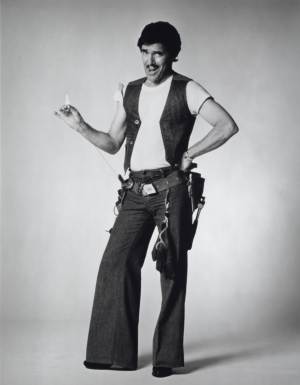 Please always remember and don’t ever forget that the lovable handyman on the CBS sitcom One Day At A Time played by Pat Harrington was named Dwayne F. Schneider. I hope this helps.
As for those who got here searching on “swinger pics” ... your guess is as good as mine.
