Book: Jack London in Paradise, by Paul Malmont (2009)
The first 2009 title I’ve read, and it’s a good one.
Paul Malmont’s debut The Chinatown Death Cloud Peril, in which several legends of pulp fiction find themselves caught up in a plot they could have devised, is one of my favorite novels of recent years. His follow-up also involves real-life figures but in a less fantastical tale.
Hobart Bosworth is largely forgotten now, but this contemporary of D. W. Griffith was a big name in the early days of Hollywood. In 1915, however, he finds himself at the end of his tether, verging on bankruptcy and about to lose his company to partner Adolph Zukor and the nascent Paramount Pictures. But Bosworth, famed for his adaptations of the hugely popular works of author Jack London, has a plan: to persuade London to write an original screenplay. Step one is to track London down. Step two is to save him from himself.
Once Bosworth locates London in Hawaii, the paradise of the title, the story meanders somewhat. But Malmont’s bracing descriptions of the landscape, physical action, London’s tumultuous marriage, and two men facing different kinds of crises more than compensate, and the various threads coalesce into a potent ending. Malmont is a name to watch.
Meaningless Milestones: Post M
This is the 1,000th post I’ve written for this site. Reaching the four figure mark in a little under five years isn’t that impressive compared to the output of the bloggers I emulate and frequently rip off, like Ed, Bill and Ivan, but it’s not bad, either.
Thursday, January 29, 2009

Monday, January 26, 2009
Noir City San Francisco: Wicked as They Come (1956)/Slightly Scarlet (1956)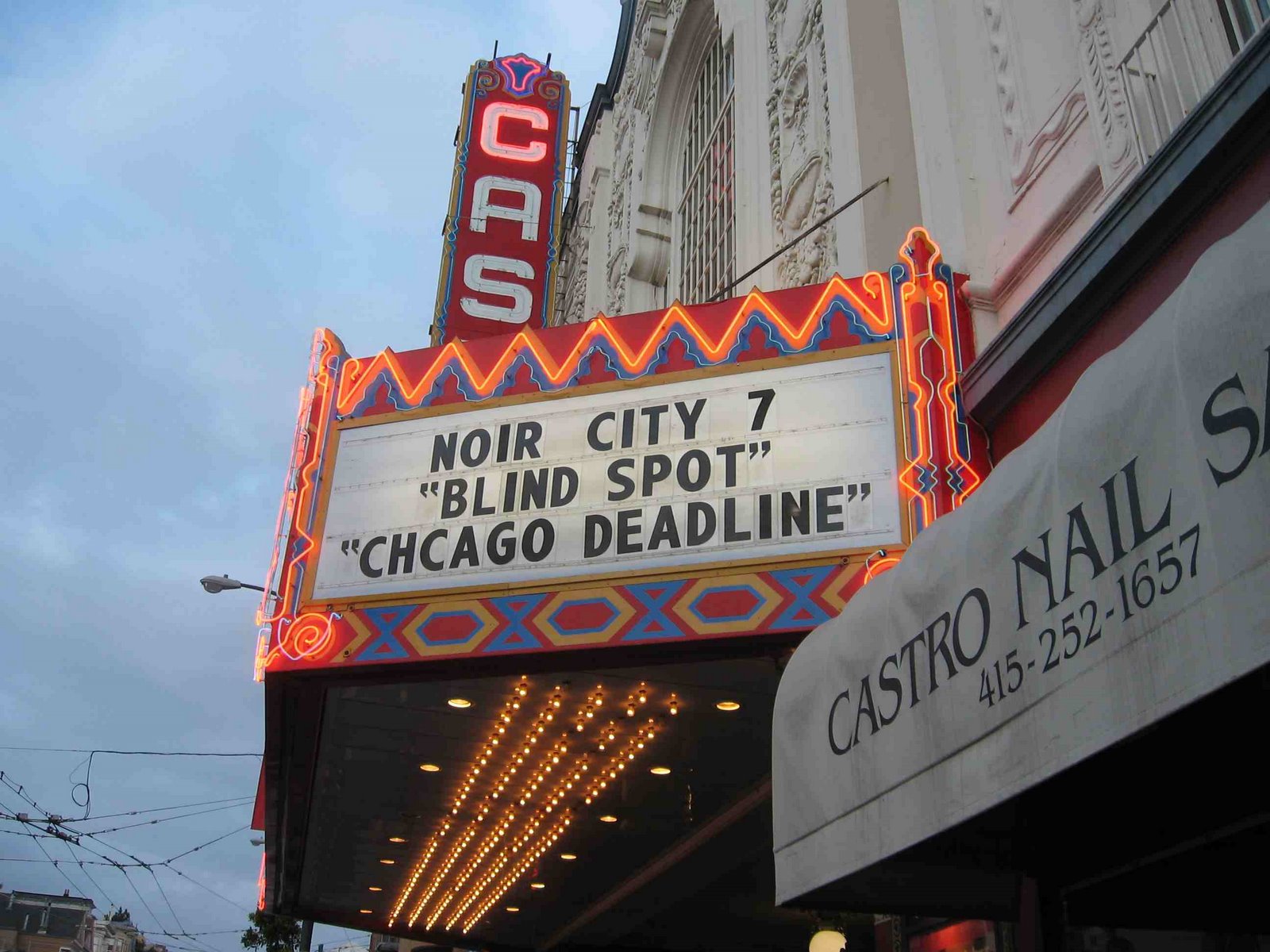 Whenever the dark carnival that is Noir City rolls into Seattle, as it will next month, Rosemarie and I are at every screening. But host and programmer Eddie Muller told us more than once that we weren’t getting the full experience until we took in a double bill at the Castro Theater in San Francisco, the place where Noir City was born. This year, we decided to rectify that.
On Saturday night, we were part of a crowd over 1400 strong, the second consecutive sell-out of the festival. Things get off to a rollicking start with David Hegarty on the Castro’s mighty Wurlitzer organ, playing a mix of favorites from the ‘20s and ‘30s. He finishes the set with a rendition of San Francisco, the crowd clapping along as the Wurlitzer sinks below stage.
The evening is a tribute to actress Arlene Dahl, so after a few welcoming words from Eddie Wicked as They Come unspools. Arlene plays a woman hell-bent on escaping her drab working class life, no matter how many seductions it takes. Wicked, based on the novel Portrait in Smoke by Bill S. Ballinger, is a familiar story complete with pat psychological explanation, but Arlene plays the bad girl with such relish that it goes down easy.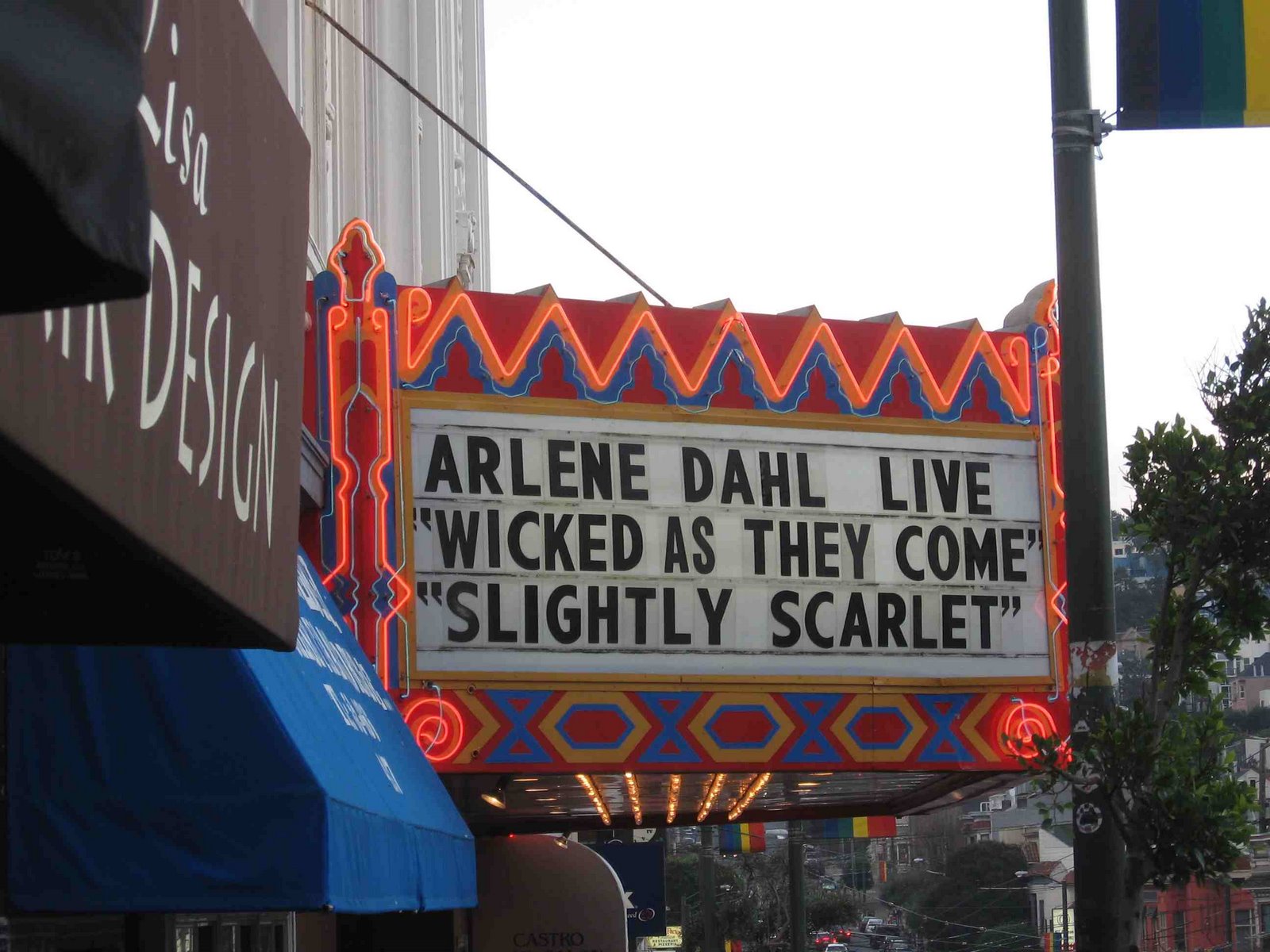 Ms. Dahl, glamorous and fiery of both spirit and mane at age 83, is in attendance along with her son, actor Lorenzo Lamas. (Dude, it’s Renegade!) Eddie interviewed her on stage over champagne. She talked about her memorable first day on the MGM lot (watch the hands, Errol Flynn!), working with the great cinematographer John Alton and director Anthony Mann on the Noir City discovery Reign of Terror, her relationship with John F. Kennedy. She won me over completely by speaking highly of Chez K favorite Dennis Morgan, her co-star in her first “official” movie My Wild Irish Rose.
A redhead, Ms. Dahl said she was often used “to bring color” to films, but what she really loved was to play the femme fatale. The twain met in our next feature, Slightly Scarlet, which teamed Arlene with fellow titian titan Rhonda Fleming. I had seen the movie before, but never in Technicolor on the big screen. Yowza. In this James M. Cain adaptation the ginger goddesses play sisters – Arlene’s the bad one – who both fall for intellectual gangster on the make John Payne. It was every bit as delirious and unhinged as I remembered. I’m still fairly certain the ending makes no sense. And the capacity crowd ate it up.
That was it for the movies, but there was more noir to come. We went to the fabulous Kayo Books, where I nearly wept at the sight of so many pulp classics up for sale. I should have brought a second empty suitcase with me. Still, I made a dandy haul that included some Fredric Brown, a copy of Joel Townsley Rogers’ The Red Right Hand to call my very own, and a Johnny Liddell thriller by Frank Kane, who wrote pretty much every episode of the old Mickey Spillane’s Mike Hammer TV series.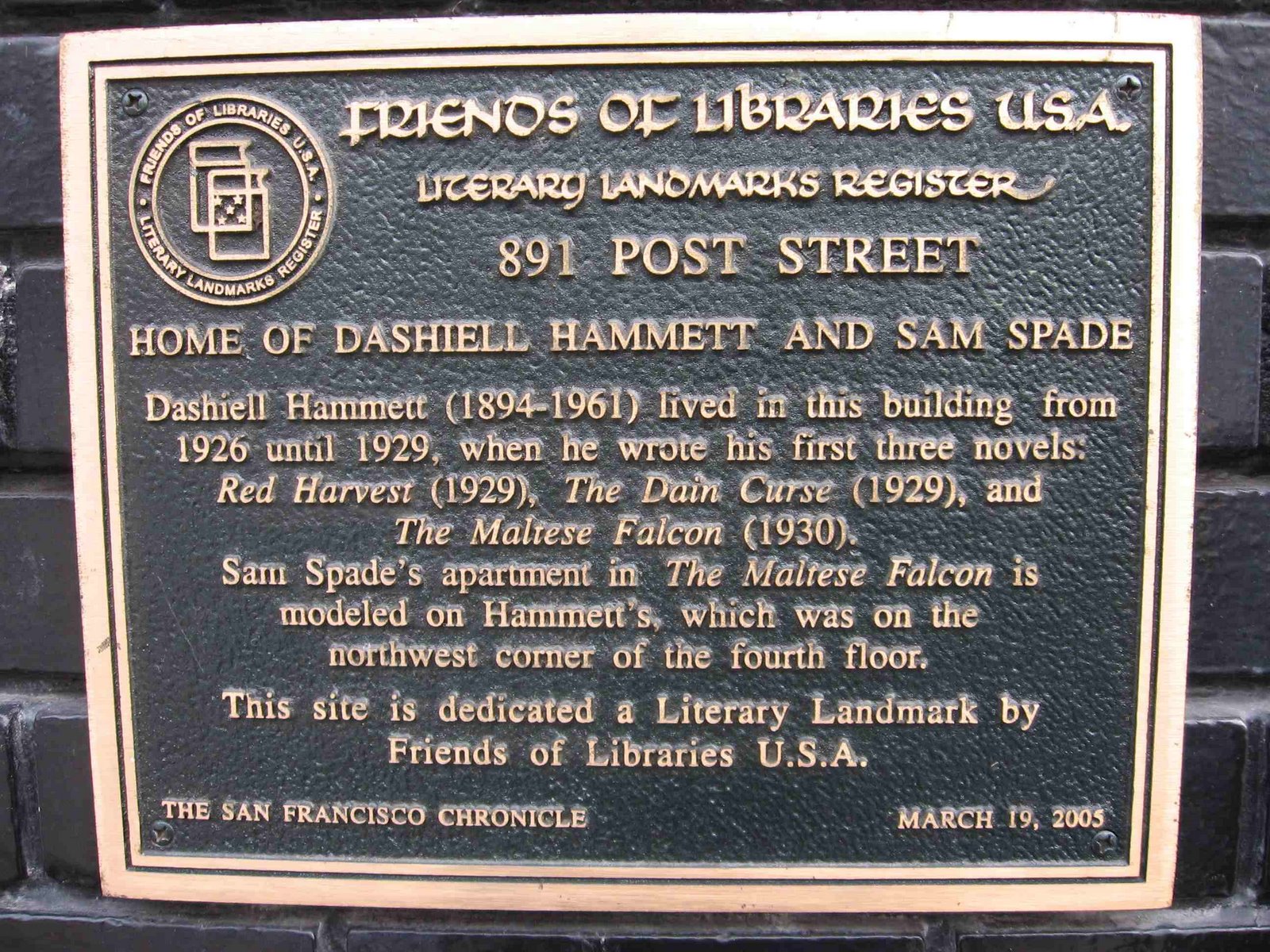 Across the street from Kayo is the apartment building where Dashiell Hammett lived while he wrote Red Harvest and The Maltese Falcon. I stopped by to pay my respects, and later went to the corner of Bush and Stockton, where Miles Archer breathed his last in Falcon.
Cocktail report: I’d long wanted to bend an elbow at Bourbon & Branch, and I’m happy to report it’s as good as advertised. The rye maple fizz on the new menu is extraordinary. I’d also heard great things about the Alembic Bar but was concerned that Haight-Ashbury would be a bit out of the way on this trip. I needn’t have worried. (Thanks, Todd and Chad!) The Alembic is worth making time for. Their Vieux Carré had me flying before I reached the airport. It was the perfect way to wrap up a fantastic weekend.
More photos are up at my Flickr page.
Tuesday, January 20, 2009
DVD: The Maltese Falcon (1931)/Satan Met a Lady (1936)
At last I have caught up with the two adaptations of Dashiell Hammett’s The Maltese Falcon that preceded John Huston’s definitive 1941 version. In the process, I received an object lesson in screenwriting.
No bones about it: 1931’s The Maltese Falcon is lousy. It’s stilted, and despite an interesting supporting cast – Thelma Todd, 42nd Street’s Una Merkel, the original Renfield Dwight Frye as Wilmer the gunsel – is hamstrung by having the one-dimensional Ricardo Cortez play Sam Spade. Mainly, though, it’s a perfect example of playing the notes but missing the music. Many of the beats and lines of dialogue that Huston took directly from Hammett’s novel are here, yet each one feels off.
Brown Holmes – now that’s a moniker! – cowrote the ’31 film and received solo credit on Satan Met a Lady, which treats the story as more of a comedy. Prevented from using Hammett’s names, Holmes threw the Falcon out as well; here the MacGuffin is a ceremonial ram’s horn stuffed with jewels. He also reinterpreted the characters. Spade’s capable secretary Effie Perine is now a ditz, but one who may not be as dizzy as she seems. The Levantine Joel Cairo becomes enormous Englishman Arthur Treacher. And “the fat man” Kasper Gutman is a woman. Who is, to be fair, still pretty big.
Spade, rechristened Ted Shayne, is played by Warren William, who had already portrayed Perry Mason and Philo Vance and would go on to be the reformed jewel thief The Lone Wolf. In Rosemarie’s words, Shayne is “whimsical to the point of derangement.”
Again key scenes survive from the book, but Holmes mixes them up, reassigning dialogue and bits of business, playing them for laughs. The thing is ... it works. The documentary on the DVD had me hating Satan in advance, only using clips that made it appear foolish. As it happens, my main dislike was Warren William’s enormous hat. It’s a testament to Hammett’s novel that it survives adaptation even when pushed into Thin Man territory.
Both movies are considerably shorter that the ’41 Falcon. One reason is that the scripts eliminate my favorite scene, where Spade blows out of his initial meeting with Gutman in order to test the fat man, only to return and learn the statue’s history. I understand why this edit was made; it’s a common note to collapse scenes so locations aren’t repeated unnecessarily. But we lose a great moment.
It’s also worth noting that the two earlier films break the first-person POV hewed to so rigorously by Huston and taken to its logical extreme by Robert Montgomery in his adaptation of Raymond Chandler’s Lady in the Lake. After Miles Archer’s murder in the ’41 film, Spade appears in every scene. The other films accelerate the action by cutting away from Spade to follow the conspirators or the police. These moments by themselves don’t hurt the films, but they do break the spell.
Satan Met a Lady will air on TCM as part of its Bette Davis tribute – Bette Davis is in it, did I mention that? – on January 26 at 11:15AM EST.
Upcoming: Noir City
This interview with my friend Eddie Muller paves the way for Noir City, kicking off in San Francisco this weekend. This year’s irresistible theme is newspaper noir. The exception is a special event this Saturday honoring actress Arlene Dahl with a Q&A and screenings of her films Slightly Scarlet and Wicked as They Come.
Yours truly will be at that event. I’ll also be at every screening when Eddie brings Noir City back to Seattle next month. And while I won’t dress vintage, I will dress appropriately.
Miscellaneous: Links
Jeff Pierce of The Rap Sheet introduces the spin-off site Killer Covers of the Week.
This ad is NSFW. It’s also the funniest thing I’ve seen in weeks.
Sunday, January 18, 2009
Movie: Vertigo (1958)
A heads up for Seattle film fans: for the next two weeks, the Cinerama is screening Alfred Hitchcock’s Vertigo in 70MM. Perfect timing for our upcoming jaunt to San Francisco. I notice something new every time I watch the movie, especially a print of this quality. I gasped audibly at the sight of the lush red flocked wallpaper in Ernie’s Restaurant, and never before appreciated the way the light bleeds out of the scene in the Argosy book store as Scottie Ferguson first hears the tale of mad Carlotta – and how it returns once he and Midge step out onto the sidewalk. Few lines in film history wound as much as Scottie’s desperate plea to Judy, “It can’t matter to you.”
It occurred to me as the film ended this afternoon that every time I’ve seen Vertigo it’s been on the big screen. I’ve never watched it on television. I think I’ll keep it that way. If you’re in this neck of the woods, check the schedule and make your plans.
Books: The Edgar Awards
Whoops. These nominations have been out for days. Special congratulations to VKDC favorite Christa Faust, getting a nod in the always-tough Best Paperback Original category for Money Shot.
Thursday, January 15, 2009
Friday’s Forgotten Books: When Gravity Fails, by George Alec Effinger (1987)
Patti Abbott was kind enough to ask me to participate in her Friday’s Forgotten Books series again. You could make the argument that choosing a novel nominated for both the Hugo and the Nebula Awards and handsomely reissued in 2005 means I have a loose definition of the word “forgotten.” But as far as I’m concerned, nowhere near enough people know about George Alec Effinger – and that includes crime fiction readers.
When Gravity Fails is the first of Effinger’s novels set in the Budayeen, the shady quarter of an unidentified Middle Eastern city in the late 22nd century. It’s the place Marîd Audran calls home. A street-level operator always willing to do a favor provided you meet his price, Marîd is the Budayeen’s answer to both Jim Rockford and Matt Scudder. He finds himself drawn into a string of brutal murders that target Friedlander Bey, the quasi-benevolent 200 year old kingpin of the Budayeen. Bey in turn drafts Marîd into becoming his personal private investigator.
Effinger’s world, rich in detail, is one where the West has long been in decline and life has taken on a decidedly Islamic cast. Into it Effinger injects an array of societal and technological evolutions. Abuse of sophisticated neurological drugs. Elaborate transgender surgeries. And that most desired of upgrades, cranial modification. Once you’ve been wired, you can chip in personality modules (“moddies”) that allow you to become anyone you wish, or “daddies” that temporarily give you whatever skills you require. In the first chapter, a man wearing a James Bond moddy commits a cold-blooded execution. Later, after being forced by Bey to undergo modification, Marîd becomes Nero Wolfe to solve the case. Effinger’s deft depiction of how devout believers deal with these advances is one of the book’s joys.
Effinger followed up Gravity with A Fire in the Sun and The Exile Kiss. Additionally, several short pieces are collected in Budayeen Nights. They’re all worth reading for fans of mystery and SF alike. Effinger’s Budayeen tales are the rare works of speculative fiction that function as a crystal ball. More and more it seems that the world he created in these pages is the one we’re rushing toward headlong.
Wednesday, January 14, 2009
Ricardo Montalban (1920-2009)
In the late actor’s long career, there were several distinct phases. Stardom in Mexico. Making waves with Esther Williams. “I am Mr. Rourke, your host.” Soft Corinthian leather. Star Trek II: The Wrath of Khan. An entire generation of kids now knows him as the grandfather from the Spy Kids movies. Not many performers stay relevant for so long.
But you know the Montalban who will be celebrated here: the hard-boiled one. The undercover federale working hand in hand with an American agent to bust an immigrant smuggling ring in Border Incident. The small-town cop faced with big city murder and willing to take a chance on the boys in the lab in the proto-CSI Mystery Street. The detective itching for some of his crooked partner’s action in The Money Trap. All good movies made better by Montalban’s charismatic presence.
Mark Evanier has a story about working with Ricardo Montalban that’s a good one.
Monday, January 12, 2009
DVD: Moontide (1942)
What a singularly odd movie. Where to begin? Let’s get the plot out of the way. Itinerant wharf rat Bobo (Jean Gabin) saves the life of suicidal “hash wrangler” Ida Lupino. Their budding romance is enough to keep him working at a bait barge in a California harbor. But Bobo may have committed a murder during an alcoholic blackout. And his only friend, played by Thomas Mitchell, may be willing to trade on that fact to secure his own future.
The story of the movie, full of almosts and near-misses, is far more interesting than the one in it. Moontide was meant to serve as the great Gabin’s introduction to a wide American audience; the film’s mixed reception contributed to his return to France. The source novel, by character actor Willard Robertson, is by all accounts a catalog of depravity that was greatly watered down for the screen. Original director Fritz Lang walked off the production – apparently due to a clash with Gabin over mutual paramour Marlene Dietrich – and was replaced by Archie Mayo. Salvador Dali contributed to the blackout sequence, only to have other hands complete the actual design.
I’d love to say that Moontide transcends such turbulent origins, but I can’t. Every compromise shows. The movie is a jumbled, fascinating mess.
At first, novelty carries the day. Nothing in Moontide feels remotely real. That otherworldly mood is partly a result of logistics; plans to shoot in San Pedro, California were scrapped after Pearl Harbor, so filming took place on a huge soundstage. But mainly it’s the forced marriage of American and European sensibilities that anesthetizes the proceedings. After a while longueurs set in, to use le mot juste.
The thin, obvious story doesn’t help much. Neither does the self-conscious approach to the lives of “little people.” I wouldn’t have been surprised to read the credit “Written by Barton Fink.” The actual script is by novelist John O’Hara.
Gabin lobbied to cut out stereotypical French behavior, but he still manages to carve exquisite jambon in his performance. He does have several fine moments, like one on the restorative powers of breakfast. Mitchell’s jovial stage Irishness has rarely been put to better use. Lupino and Claude Rains work their customary magic.
All for a movie that remains inert. I never thought about turning Moontide off, but I couldn’t wait for it to be over. Primarily so I could start talking about it. Three last thoughts:
I don’t care what Fox says, Moontide is not noir. It’s melodrama. Pure, uncut, prison-grade melodrama.
The movie uses an instrumental version of Irving Berlin’s “Remember” as its theme of undying romantic love. Which is fine unless you know the lyrics. (“You promised that you’d forget me not/But you forgot to remember.”)
If you are compelled to call a character Bobo, do not compound the error by having everyone repeat his name.
Miscellaneous: A Critical Question
It’s posed by Bill Crider. UPDATE: The link is now fixed.
Sunday, January 11, 2009
On The Web: More Westlake
The Rap Sheet collects memories of and tributes to Donald E. Westlake from dozens of crime writers in two posts. Also, a reminiscence by director Stephen Frears, Westlake’s collaborator on The Grifters, and Westlake talks to Ed Gorman about the return of Parker.
Thursday, January 08, 2009
Miscellaneous: No Time For Blog, Doctor Jones
The first week of the year is always a mess, isn’t it? I’m on a new schedule, which is actually an old schedule, and as a result I haven’t had time to update the site these last few days. I tried, though. I took a whack at that sixteen random things meme making the rounds and realized that there are only eleven salient facts about me. And only six of them are interesting.
So until equilibrium is restored, check out some other blogs of note. Like author Tom Piccirilli’s The Cold Spot. Or JohnAugust.com. This recent post outlining his involvement with the Captain Marvel movie is as good a primer on how Hollywood works as you’ll find.
I know, that’s not enough. Tell you what. Here’s a song that Cary Grant used to perform at parties. It’s sung to the tune of “My Bonnie Lies Over the Ocean.” I learned it from the book I’m currently reading, Roger Moore’s memoir My Word Is My Bond.
I once had a box of tin soldiers
I knocked off the general’s head
I broke all the sergeants and corporals
Now I play with my privates instead
Go on, try to do it in Cary’s voice.
Oh, all right. I know what you really want.
Sunday, January 04, 2009
Book: The Hunter, by Richard Stark (1962) & More Westlake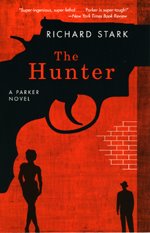 On some scores, I am as good as my word. I said that I would reread the new University of Chicago reissue of The Hunter that I picked up the day before Donald E. Westlake died, and I did. It’s not like it was difficult; everything Donald Westlake wrote goes down smooth. Some random thoughts.
The book is meaner and even darker than I remember. It’s plain that Mr. Westlake didn’t intend to start a series that would last 40 years with this novel, but the intervention of an editor changed that.
A passage that leapt out on this reading:
He could look out at the street, and let his fifteen-cent cup of coffee cool. It was a Park Avenue coffee shop, and expensive. Pastrami on rye, eighty-five cents, no butter. Like that.
Like that. That phrase is an example of how, as Lee Goldberg noted, Mr. Westlake “wrote books that inspired people to become authors.” He made it look effortless.
The Hunter, like many Westlake books, is so attuned to the city of New York that it can be plotted on a subway map. So far it’s been filmed twice, as a definitive Los Angeles movie and then in Chicago.
Point Blank was acclaimed for its Nouvelle Vague-influenced storytelling, but the structure deployed in the Parker novels – four sections, with three from Parker’s POV and the fourth from other characters related to the job at hand – is every bit as impressive, with a formal rigor of its own. The Hunter features one of its more dazzling uses. Parker attempts to gain entry to a building, and things go wrong. Horribly so. Westlake generates tremendous suspense from this sequence even though we already know that Parker’s target is no longer in the building.
Over the weekend I also reread “Fugue For Felons,” a short story from the 2004 collection Thieves’ Dozen (eleven stories, natch) that showcases Mr. Westlake at his most inventive. Fearing that he might lose the rights to the name of his character John Dortmunder to Hollywood, he wrote a tale featuring a “parallel universe” version of the hangdog thief. The only problem is John Rumsey didn’t behave in quite the same way. It’s a treat. And it features one of Mr. Westlake’s trademark observations that strikes particularly close to home, about the New York subway:
... and the poor G, the Brooklyn-Queens crosstown, which never gets into Manhattan at all but just shuttles back and forth between Brooklyn and Queens, full of people wearing hats.
Tributes to Donald Westlake are all over the web, many of them collected at Sarah Weinman’s Confessions of an Idiosyncratic Mind. I’d recommend the ones by Duane Swierczynski and Max Allan Collins. But the most astonishing is by Ethan Iverson of The Bad Plus, who carried on a longtime email correspondence with Mr. Westlake. If you’re a fan, it’s a must-read.
And I’ll echo Jeffrey Wells and say that now more than ever, we need a quality DVD of 1973’s The Outfit. Not only does it feature a cast of noir legends like Robert Ryan, Marie Windsor, Timothy Carey, Jane Greer and Elisha Cook, Jr., it’s also the Parker movie that Donald Westlake himself said was his favorite.
Cocktails: Insert Absinthe Pun Here
The New York Times Sunday Style section has done more than its share to propagate idiotic trends. So it’s nice to see them Rochambeau one before it gets out of hand. From Eric Konigsberg’s article on the absinthe craze:
If absinthe were a band, it would be Interpol, third-hand piffle masquerading as transgressive pop culture. If absinthe were sneakers, it would be a pair of laceless Chuck Taylors designed by John Varvatos for Converse. If it were facial hair, it would be the soul patch. If absinthe were a finish on kitchen and bath fixtures, it would be brushed nickel.
Saturday, January 03, 2009
DVD: The Maltese Falcon (1941)
Falcon was my first movie of 2009. I always watch a classic on January 1 to set the tone for the rest of the year. And it’s preparation for a jaunt to San Francisco later this month to take in some of Noir City.
One of my favorite scenes is the initial encounter between Sam Spade (Humphrey Bogart, but you knew that) and “the fat man” Kasper Gutman (Sydney Greenstreet). They take each other’s measure with that sparkling Dashiell Hammett dialogue left largely untouched by John Huston. (“Here’s to plain speaking and clear understanding ... I’ll tell you right out I’m a man who likes talking to a man who likes to talk.”) Spade tries to leverage what he’s learned into more information, but Gutman refuses to play along. So Spade erupts, hurling his glass down, threatening Gutman’s gunsel Wilmer, and storming out of the room. It’s a startling moment.
Cut to the corridor. As Adolph Deutsch’s music takes a turn, a smile spreads across Spade’s face. Losing his temper was an act, a way of stirring the pot. What makes the scene is that as Spade presses the button for the elevator, he notices that his hand is shaking. And he smiles at that, too.
As I watched it for the umpteenth time, I thought: no way this scene would play out like this today.
Spade would still pitch a fit, of course. Only we’d be told about it in advance. The hero of the movie appearing not to be in control? That note would be fast in coming. We’d get a simple dialogue fix, Spade telling loyal secretary Effie Perine that he’ll raise a ruckus if the fat man won’t play ball. And something ineffable would be lost.
I’ve had this deluxe edition of Falcon for ages, but I’ve yet to watch either the 1931 adaptation or the ’36 version Satan Met A Lady. That situation will shortly be rectified. I did, however, watch the 1941 Warner Brothers blooper reel included on the DVD. Profanity in black and white? Jimmy Stewart cursing? Unbelievable.
On The Web: Movie News on the Move
Brush up your web links. Aaron Hillis takes over GreenCine Daily, while outgoing editor David Hudson begins working his magic at IFC.com’s The Daily. David does a superhuman job collecting all the net’s film news at a single location. It’s worth bookmarking his site and reading it every day.
Thursday, January 01, 2009
Donald E. Westlake (1933-2008)
A sad start to the new year. Donald E. Westlake died late yesterday.
Mr. Westlake was one of my all-time favorite authors. More than that, he was one of the best. Named a Grand Master by the Mystery Writers of America, and considered one of the greatest writers of the 20th century by some critics.
But their opinion doesn’t matter when the novels make their own case. His older ones are forever being reprinted and finding new audiences. I just picked up the University of Chicago reissue of The Hunter on Tuesday.
I admired him for so many reasons. His versatility. Writing wry comic capers under his own name, then offering the genre’s photo negative as Richard Stark, books that live up to the pen name. His longevity. Starting in the pulps and ending his career with some of his strongest work, like 1997’s The Ax, a book I’ve been thinking of a lot these last few months. His ability to work in different mediums. He cowrote the script for the marvelous thriller The Stepfather and was nominated for an Academy Award for his adaptation of Jim Thompson’s The Grifters. His matchless skill at capturing the rhythm and flavor of life in New York City. A Westlake coinage – “Harya” – is still my greeting of choice.
I never met Donald E. Westlake, but I felt like I knew him. I’m certain that I’m going to miss him. I’m going to start rereading The Hunter right now.
When a fresh-faced guy in a Chevy offered him a lift, Parker told him to go to hell. The guy said, “Screw you, buddy,” yanked his Chevy back into the stream of traffic, and roared on down to the tollbooths. Parker spat into the right-hand lane, lit his last cigarette, and walked across the George Washington Bridge.
Wednesday, December 31, 2008
TV: At Long Last, Morton & Hayes
What say we mix it up a little for the last post of 2008? I want to keep things interesting for my readers, especially as I now know, having run the year-end stats, how many of you there are. (I’ll just say “record setting numbers” and leave it at that. But my thanks to all of you, and the regulars in particular.)
I’ve mentioned before the TV series Morton & Hayes, which surfaced during the summer of 1991 and sank without a trace. The brainchild of Rob Reiner and Spinal Tap cohort Christopher Guest, it purported to be a showcase for the films of the forgotten 1930s comedy team of Chick Morton (Kevin Pollak in the role he was born to play) and Eddie Hayes (Bob Amaral). Each week the boys would appear in a “newly rediscovered” two-reel short, meticulously recreated right down to the jump cuts and shoddy effects.
I watched every episode. And ever since, I have waited in vain for the show to appear somewhere, anywhere else.
The other day I searched the online outlets for older TV series. AOL Video, Hulu, Fancast, Fanlu. Nothing.
But Youtube? Youtube had one episode, in three pieces.
It’s actually one I remembered vividly. Guest himself appears as a bandleader doing the novelty dance “The Cold Potato.” Even better, a then-unknown Allison Janney absolutely nails the period style. The way she says “Pago Pago” kills me. It’s not the best recording – for one thing, you won’t be able to appreciate the show’s look – but it’s better than nothing.
So end ’08 or start ’09 with “Society Saps.” Part one is below, and here are parts two and three. Here’s wishing everyone a happy new year.
Monday, December 29, 2008
The Good Stuff: Favorite Movies of 2008
Ask people to name the best of anything and they’ll dither, and think about the weight of history, and draft a lengthy list of possibilities to winnow down. I don’t have that kind of time. But ask for favorites and the answers come quick and can be counted on the fingers of one hand. These are movies that spoke to me personally. The marketing workups for these movies identify their target audiences in terms of oddly specific categories (“Copy Shop Employees Who Eat Sack Lunches and Have Never Seen Seinfeld”) and my name. This year, there are five of them, listed in the order seen.
In Bruges. Martin McDonagh’s scabrous and soulful comedy about a pair of hit men awaiting further instructions.
The Bank Job. A heist movie like they used to make.
Man on Wire. The documentary about Philippe Petit’s “coup” of walking a tightrope between the towers of the World Trade Center. It’s structured like a caper, and is a poem to possibility and to New York.
The Fall. Tarsem’s fantasia on the power of storytelling.
OSS 117: Cairo, Nest of Spies. Sublime silliness, with many of the laughs coming from the flawless recreation of ‘60s spy movies.
Here’s how far out of the Oscar loop I am: not only are none of these films year-end prestige releases, all five are already on video. You could watch ‘em tonight if you wanted. In fact, you should.
This is where I’m supposed to name all the movies that came thisclose to making the cut. Instead, here’s A Half Dozen Thrillers That More People Should Have Seen, again in the order I saw them.
Married Life. Calling this a thriller is stretching the definition a bit. Consider it a small, arch marital noir, and proof that Pierce Brosnan should narrate every movie he’s in.
Jar City. A spare, haunting adaptation of Arnaldur Indridason’s Icelandic crime novel.
Tell No One. Some plot contrivances from the book remain, but you won’t notice thanks to Guillaume Canet’s breathless pacing and focus on the emotional underpinnings of the story. That this became a summer arthouse hit is one of 2008’s nicest surprises.
Transsiberian. Brad Anderson’s train-set drama takes its time getting started, but never goes where you’d expect. Emily Mortimer delivers one of my favorite performances of the year.
Body of Lies. And here I thought it had everything: two big stars operating at their peak, exotic locales, a smart script, and energy to burn.
JCVD. I described this to my video game colleagues as “a Charlie Kaufman movie with kickboxing.” I stand by that summation.
Sunday, December 28, 2008
Movies: Holiday Affair (1949)/Remember the Night (1940)
At Thrilling Days of Yesteryear, which you should be reading regularly anyway, Ivan has a post on holiday movies that mentions the VKDC Christmas Film Festival. In some sense this is appropriate, because Ivan programmed my yuletide viewing. I made a point of recording two movies he championed and watched them as the last of the snow fell on Seattle. With the Shreve Seal of Approval, you’re seldom disappointed.
Although I am confused, because watching Holiday Affair so soon after The Killer is Loose raises a perplexing question: do I like Wendell Corey now? Let’s say I’m open to reappraisal and leave it at that. Corey is the Bellamy in this romantic comedy, set in New York City in the waning weeks of December. Janet Leigh plays a war widow with a young son. Accepting lawyer Corey’s longstanding marriage proposal would allow her to leave her job as a comparison shopper for a department store. But that job is how she meets Robert Mitchum, a vagabond clerk who challenges Corey for her affections.
Canned performances by child actors sink many films from the ‘40s and ‘50s, but Gordon Gebert feels almost contemporary as the lonely little boy who holds the action together. Isobel Lennert’s script is nicely balanced between the characters. Corey has a lovely moment late in the action when he lays out the facts of the case with legal precision. Some might be surprised by how easily Mitchum takes to the genre, but I’m not; the man always knew how to handle sardonic dialogue, and I will forever insist that His Kind of Woman is a comedy. Amidst the gossamer, Affair is quite tough-minded. Mitchum buys Gebert an extravagant gift because he wants the boy to know that good things are possible in life. Leigh protests only to have Mitchum remark, “Not every surprise is a telegram from the War Department,” a line that brought her and me up short.
Another sweet confection with a tart center followed in Remember the Night. The last script Preston Sturges wrote before moving to the director’s chair teamed Fred MacMurray and Barbara Stanwyck four years before Double Indemnity. He’s a New York D.A. charged with prosecuting her for shoplifting. He cagily has the trial postponed until after the holidays, only to discover that fellow Hoosier Stanwyck will be alone in the city for Christmas. The road trip that follows has its share of screwball antics, but mainly it affords Stanwyck’s character the chance to see that a hardscrabble start in life doesn’t have to dictate one’s fate. Sturges fills the screen with his typically vivid supporting characters – Elizabeth Patterson’s Aunt Emma lives an entire life in a single reaction shot – and wraps up the story with an unsentimental but potent ending.
TCM airs both films every December in the hopes of making them seasonal staples. I’ll certainly watch them again, after my screenings of The Ref and Kiss Kiss Bang Bang. I still prefer my Christmas movies naughty, not nice.
Thursday, December 25, 2008
Miscellaneous: Ho Ho Huh?
From Alan Feuer’s New York Times article:
There is a theory of journalism that holds that Christmas Day is relatively news-free, a day spent peacefully at home opening presents, entertaining Grandma, watching “Klute” on DVD or simply mulling over what to order — the shrimp or the chicken lo mein — at the Empire Grand later that night.
Klute? Really? Who watches Klute on Christmas Day?
Ah, well. To each his own. Happy holidays, everybody.
Monday, December 22, 2008
The Good Stuff: Favorite Novels of 2008
Some years I don’t feel like making lists. This year I do. Blame the weather. These aren’t “bests,” just my favorites.
To begin, the Grand Master slots. It’s not fair to cite these authors here, because my saying I like them is akin to opining, “I endorse breathing” or “You know what’s good? Bourbon.” So I again salute Donald E. Westlake in his Richard Stark guise for Dirty Money, the last of his triptych about a very hectic month in the life of his thief Parker. And Lawrence Block for Hit and Run, in which philatelist assassin Keller goes to ground in a gratifyingly old school way.
Now, ten books listed in the order I read them with minimal commentary, as I’ve already bragged ‘em up good.
Money Shot, by Christa Faust. Hardboiled stuff served up straight. I want more Angel Dare. I’d say please, but how hardboiled would that be?
Saturday’s Child, by Ray Banks. Banks! Get that website back up! You’ve got more books coming out.
Gas City by Loren D. Estleman. An almost clinical look at corruption in a fading Midwestern burg. Beautiful prose on every page.
Matala, by Craig Holden. A slim volume full of menace.
Frames, by Loren D. Estleman. Estleman’s second book on the list is a complete change in tone, an almost lighthearted story of a “film detective” caught up in a decades-old Tinseltown murder.
Hollywood Crows, by Joseph Wambaugh. Another peerless picaresque about day to day life in the LAPD.
Vampyres of Hollywood, by Adrienne Barbeau and Michael Scott. The most fun I’ve had reading all year.
Small Crimes, by Dave Zeltserman. Lean and dark with a chest punch of an ending.
The Girl with the Dragon Tattoo, by Stieg Larsson. A haunting tale made all the more so by the author’s death.
Toros & Torsos, by Craig McDonald. The only book on this list I haven’t mentioned before because I just finished it, so allow me to sing its praises now. Hector Lassiter, the two-fisted pulp writer who featured in the Edgar-nominated Head Games, is embroiled in a series of murders inspired by Surrealist art. Spanning many years and locations with cameos ranging from Ernest Hemingway to Orson Welles, it’s a ferocious, wildly ambitious novel and a grand way to close out a year’s worth of reading.
And yes, I am aware that half of these titles involve the nexus of crime and movies. You should know to expect that when you come here.
Sunday, December 21, 2008
Book: Hey There (You with the Gun in Your Hand), by Robert J. Randisi (2008)
In the third of Randisi’s Rat Pack novels, Eddie Gianelli is once again called on to perform a service above and beyond his duties as a pit boss at the Sands. Someone is blackmailing Sammy Davis, Jr., and only Eddie is fit to be go-between. But this caper could extend beyond show business; after all, it’s 1961, and Rat Pack crony JFK is in the White House. The book is Randisi’s usual mix of clean prose and sharp period detail. If he writes a dozen of these books I’ll read them all, because the Rat Pack are my version of superheroes. Sure, Tony Stark can build a pocket fusion reactor in a cave with a box of scraps. But could he do a number with Allan Sherman and Vic Damone like Dean Martin?
Eddie did a favor for Dino in the first novel, then helped Frank in #2. I doubt that Peter Lawford will be next, based on how he’s treated in the books. I’ve always felt some degree of affection for Brother-in-Lawford, who had to know he was in over his head. (Lawford, well played by Angus Macfadyen, is the focus of HBO’s The Rat Pack.) He was a mere mortal who found himself amongst gods, and that’s as close as you’re going to get to tragedy in the world of ring-a-ding-ding.
Movie: The Killer is Loose (1956)
I owe Randisi. His book kept me up late the night I was recording this movie on TCM and the DVR stopped six minutes early. Because I was awake to notice it, I was able to grab the fraught closing scenes, which play out like ur-DePalma.
Killer marks a foray into crime drama by Budd Boetticher, a director whose lean psychological westerns are winning deserved acclaim on DVD. While attempting to arrest mousy bank clerk Wendell Corey for robbery, detective Joseph Cotten accidentally kills Corey’s wife. Several years later, Corey escapes from prison hell-bent on responding in kind, targeting Cotten’s spouse Rhonda Fleming.
Boetticher’s economy and stark compositions ratchet up the tension brilliantly. Corey is an actor I haven’t particularly cared for in the past but he’s phenomenal here, his face rendered a void by Clark Kent eyeglasses, his psyche scarred by his perceived failures during the war. There are terrific supporting performances by veterans of the Jack Webb Players John Larch as Corey’s former sergeant and Virginia Christine as a cop’s wife who knocks Fleming off her pedestal. A genuine B-movie gem.
Friday, December 19, 2008
Movie: It Happened In Hollywood (1937)
Since making my way through most of The Whistler movies, I’ve become a fan of the stolid charms of actor Richard Dix. So when TCM aired this obscure movie, aka Once A Hero, a few weeks ago, I recorded it. Little did I realize that bonuses were in store.
Bonus #1: It’s the second writing credit for the great Samuel Fuller.
Bonus #2: It features an extended sequence that earns it a small place in Hollywood history.
Bonus #3: It’s awful, but in a way that fascinates.
Dix, in an echo of his own career, plays a star of silent movie westerns devoted to his young fans. Then talkies come in. After one session with a diction coach (Franklin Pangborn in the Franklin Pangborn role), it’s clear that Dix ain’t cut out for Coward. As his best girl Fay Wray moves on to success, he loses his money. He gets a second chance when he’s offered a role as a tough guy in a gangster film, but Dix refuses to be a bad example to the kids by gunning down a cop in cold blood. He decides to leave Tinseltown and return to life on the range, where based on his duds he was a midnight cowboy. That’s when Billy, one of the kids he doesn’t want to disappoint, turns up on his doorstep. He won’t go back to the welfare home until Dix introduces him to some movie stars, a plot development that makes zero sense considering Billy’s stated contempt for every film that isn’t a western.
Bringing us to bonus #2 above. Dix throws a party for Billy at the ranch he’s already lost to the bank, and invites the stand-ins for the biggest names in the business. All of whom are played by the actual studio doubles for those stars, in the only on-screen appearances many of them had. You see facsimiles of Clark Gable, Mae West, James Cagney, Charlie Chaplin and Harold Lloyd. Arthur McLaglen turns up as his brother Victor. Sisters Betty and Carol Dietrich appear as Greta Garbo and Marlene (no relation) Dietrich. Bing Crosby’s doppelganger lip syncs to one of Bing’s records. It’s an amazing bit of movie history.
Normally I don’t give away endings, but It Happened in Hollywood goes so off the rails in the closing minutes that I have no choice. Consider yourselves warned.
Billy has one of those movie accidents. Dix needs money to save the kid’s life. So he returns to the bank he was supposed to rob in the gangster film, this time to knock it over for real. Only before he can do so, it’s held up by actual thieves. After one of them shoots a cop, Dix draws his six-gun and saves the day. By this point the studios have figured out how to record sound outdoors, so westerns are back in vogue. And Dix returns to the silver screen, a bigger star than ever. The end.
It Happened in Hollywood is four different movies jammed together, often in the same scene, and none of them good. I’d call it a comedy because it’s impossible to take seriously, not because it’s funny. But in holding up a funhouse mirror to show business, it was years ahead of its time. And in my book, you get points for being early.
