Friday, April 30, 2010

Book: Expiration Date, by Duane Swierczynski (2010)

Pick up a novel by Duane Swierczynski and you know you’re going to get two things: breakneck pacing and a wild premise. His latest, originally intended as a serial in the New York Times Sunday Magazine, is no exception.

The clock’s run out on Mickey Wade’s journalism career, and is down to the last few ticks on his relationship. Without options, he moves into his grandfather’s apartment in the dicey Philadelphia neighborhood he thought he’d left behind. Hung over after night #1, Mickey pops what he thinks are two ancient Tylenols. And abruptly finds himself in the Philly of 1972, several years before his father would be brutally murdered.

Time travel, serial killers, secret government projects. There’s inventiveness on every page, but what makes the book work – I hate using this word, but it’s appropriate – is its heart. Mickey slowly realizes that his problems are deeper than he thinks, actually going back a generation or two, and he seizes the chance to fix them. Expiration Date calls to mind those early, Night Shift-era Stephen King stories, mad science experiments that combine genres and fuse different pulp energies but keep the action human-scaled. The result is quite a ride, and my favorite Swierczynski book yet.

Wednesday, April 28, 2010

Movies: The Missing Person (2009)/44 Inch Chest (U.S. 2010)

Playing catch-up with a pair of interesting new-to-DVD crime films. One was never released theatrically in this neck of the woods. The other’s entire engagement took place while I was in the bathroom.

The Missing Person is an offbeat, novella-scaled movie. Oscar nominee Michael Shannon plays an ex-NYPD cop turned Chicago shamus, hired by a slippery lawyer and his associate (fellow Oscar nominee Amy Ryan, doubling as producer) to shadow a man on a train to Los Angeles. It’s a sort of post-9/11 noir, Dashiell Hammett’s Flitcraft Parable as told by Paul Auster. Noah Buschel’s movie toys with private eye conventions rather than subverting them; Shannon is led astray by a sexy dame (Margaret Colin, whom I’ve always loved), gets knocked out cold, and finds himself criticized for making wisecracks no one understands. Shannon’s quietly forceful performance is the reason to watch this one. The awed way he says, “This kid blocks the plate like Thurman Munson” while watching a little league game slayed me. Plus the movie has the great good sense to feature Joe Lovano.

The writers and two stars of Sexy Beast reunite for 44 Inch Chest, which unspools like the foulest mouthed Harold Pinter play ever. Hard case Col (Ray Winstone), bereft when his wife (Joanne Whalley) leaves him for a younger man, kidnaps loverboy and spends the next few hours deciding what to do with him. He’s aided, abetted, and egged on in his endeavors by his querulous crew of Ian McShane, Tom Wilkinson and Stephen Dillane. Plus John Hurt, who is given dentures, the better to gnaw on the scenery. At the heart of the talk is men’s fear of love, of vulnerability, of any perceived weakness. Be forewarned that there is some truly world-class profanity on display, never more so than in the scene where the boys end up essentially spouting their sexual fantasies about Col’s missus in the idiotic belief they’re helping their mate’s cause. A scabrously funny movie with some real insight into the male psyche. Don’t skip the epilogues feature on the DVD.

Sunday, April 25, 2010

Book: Memory, by Donald E. Westlake (2010)

Disquieting is not a word likely to turn up in blurbs. But it’s an appropriate one to describe Memory, in all probability the final novel from Donald E. Westlake and the first book I’ve read in eons that literally haunted my dreams.

The story behind Memory is fascinating; Westlake wrote it in the early 1960s but because it was, in the words of his friend Lawrence Block, “a lengthy serious existential novel by an unknown writer,” it failed to find a publisher. Block, one of the only people to have read the manuscript, recalled it in the wake of Westlake’s death in December 2008 and brought it to the attention of Hard Case Crime. Its appearance in print only burnishes Westlake’s reputation.

Actor Paul Cole is on the road with a play and sleeping with another man’s wife when the other man attacks him. As a result, Cole’s memory is damaged. His mind becomes a sieve, with bits and pieces of his self catching briefly before sluicing through.

Westlake’s crisply efficient writing is in evidence. X-rays of Cole’s skull are “photographs of the city in which he used to live and at the gates of which he was now camped.” Even more effective is the book’s demonically circular structure. Cole learns things only to forget them. Each toehold he finds on the long slope down only makes the next fall that much more painful. Westlake blindsides you at the start of one chapter with the blunt revelation that Cole has lost a critical item. As I read Cole’s emotions became my own: panic, despair, fatalistic acceptance.

Far more disturbing is what Memory suggests about life. Are we the sum of our experiences – or simply the product of our routines? The advice Cole receives from one man about the cumulative effect of one’s decisions has the feel of a secret never meant to be uttered.

Few novels conjure up such a state of pervasive dread, or bring a character to a place where he seems so hopelessly doomed. All without a shot being fired, without anyone being killed. This is the noir nightmare, plain and simple. I read it in a white heat for two reasons: to find out what happened next, and to put myself out of my misery.

For the record, that was intended as an endorsement.

Friday, April 23, 2010

Book: Do They Know I’m Running?, by David Corbett (2010)

Full disclosure: David Corbett is a friend. Fuller disclosure: His latest novel is terrific.

Life has not been kind to the Montalvo brothers, orphaned young and living with their Salvadoran aunt in Northern California. Roque is a talented young guitarist stumbling toward manhood. Godo is a shell of himself following his tour with the Marines in Iraq. Their situation only becomes more difficult when their uncle Faustino is deported. Roque agrees to travel to El Salvador and bring Faustino back along a treacherous route controlled by criminal gangs. Godo stays behind to work with their criminal cousin Happy, who has organized Faustino’s return. Both soon discover that Happy has an agenda all his own, one that will force Roque to take others on his journey.

Do They Know I’m Running? is written with a reporter’s eye and a poet’s heart. It’s wildly ambitious, packed with richly detailed characters, showing how distant spots on the globe from Central America to the Middle East are inextricably connected. Its vast scope occasionally threatens to become sprawl, but David always narrows his focus at exactly the right time to the things that matter: the obligations we all shoulder, the burdens we choose to ignore, the unspoken commitments to our loved ones. That intense interest in the human costs of 21st century life has produced a terrific, heartbreaking book that’s one of the year’s best.

Wednesday, April 21, 2010

DVD: Over-Exposed (1956)/Women’s Prison (1955)

How do you solve a problem like Cleo Moore?

The Marilyn Monroe manqué appeared as trouble in tights in a few ‘50s films. Christa Faust saw Strange Fascination at Noir City Los Angeles and noted that Cleo “had an astounding build, but she looks disturbingly like a Cabbage Patch sex doll or a female version of Arch Hall Jr.” This description is both disturbing and weirdly accurate. When Alan K. Rode, an organizer of said Noir City fest, called Janis Carter the Courtyard by Marriott of femmes fatale – “always credible, dependable and frequently underrated” – I asked him who the Hampton Inn in this metaphor was. He said Cleo. I can only assume this means Cleo is close to the highway and offers On The Run breakfast bags.

Several of Cleo’s movies appear in Columbia’s recent Bad Girls of Film Noir collection. Two of them, both directed by Lewis Seiler, appear on the same disc, and they’ve made me a Cleo fan.

In Over-Exposed, Cleo tackles the role she was born to play – and I mean tackled, because the woman had shoulders like Jason Taylor. (Speaking of which: welcome to the Jets, big man!) She’s Lily Krenshka, clip joint honey turned swimsuit model who reinvents herself as fashion photographer/blackmailer Lila Crane. Cleo is saddled with telegraphed plot twists, Richard Crenna as a wheedling boyfriend, and dialogue that indicates a pathological fear of subtext; when given her first camera, she declares, “I can use it as a jimmy. It’ll open doors for me.” It’s vigorous sleaze, and Cleo’s right at home in it.

Cleo has a minor role in Women’s Prison. Even with those shoulders she can’t muscle more screen time from this cast. You’ve got Ida Lupino as the hard-edged and possibly insane warden. Audrey Totter as a married con with a husband on the men’s side of the wall. Phyllis Thaxter as a hausfrau who can’t hack it in stir, a character the movie loses interest in as soon as we do. Future Oscar nominee Juanita Moore as an inmate named after the hospital where she was born, Polyclinic Jones. Best of all is Jan Sterling – the Ramada Inn of femmes fatale, according to Alan – as the brassy blonde who shows new fish the ropes. Even Chez K fave Gertrude Michael is along for the ride as the screw with a heart.

Women’s Prison is a cheesy issue picture, striking the balance between just good enough and just bad enough to be thoroughly entertaining. Watch it for the scene in which noble doctor Howard Duff calls Lupino a psychotic jealous of her charges because they, at least, have experienced a man’s love – and know that the two actors were married at the time.

Sunday, April 18, 2010

TV: Roku Like A Hurricane

Never let it be said that I can’t see the writing on the wall. Netflix starts signing deals with studios to delay the rental of new DVDs in exchange for more streaming content. My only problem with this arrangement is I already spend enough hours in the day staring at my computer screen. Sometimes I want to stare at my TV.

So we got a Roku. Hundreds of titles in my Netflix queue are now instantly available on my TV.

We’re tooling around the new setup and see that additional channels are available for a nominal fee. One of them, Moonlight Movies, bills itself as offering classic films from the 1930s through the ‘70s.

It’s actually the noir channel, including several hard-to-find and unavailable on video titles. We christened the Roku with a double-bill featuring an unintentional theme: mental derangement and characters named Vince.

First up, 1949’s The Crooked Way. Eddie Rice (John Payne) is a decorated WWII veteran with amnesia thanks to a chunk of shrapnel lodged in his brain. He heads back to Los Angeles to learn about his past only to discover he was both a crook and a bastard.

The Crooked Way is conveniently plotted; Eddie starts running into people who know him the second he steps off the train at Union Station. And the villainous Vince is played by Sonny Tufts, living up to his billing as a lousy actor. But Payne as always is terrific, disappointed in the man he can’t remember being. And cinematographer John Alton does some of his most extraordinary work, shooting one scene in stark silhouette and later offering an astonishing close-up in which Payne’s face is completely obscured, his character’s character unknown to the audience as well as himself.

Next, Fear in the Night (1947), a low-budget Cornell Woolrich adaptation made with ingenuity. DeForest “Bones” Kelley has a vivid nightmare about killing a man – and then finds hints that perhaps it wasn’t a dream. Like Kelley’s Vince, I couldn’t shake the unnerving sense that I’d experienced all this before. I soon figured out why: writer/director Maxwell Shane remade the movie nine years later, and that one I’d seen.

Also available via Roku is an MLB.TV package that puts the coverage I get from my cable company to shame. I’d have made the switch already, but I do have to work sometime. Speaking of baseball ...

Baseball: Let’s Play Two and Then Some

Yesterday’s epic Mets/Cardinals tilt was not televised in Seattle. I ended up blowing off plans to see a movie and instead sat in my favorite bar tracking the (in)action on my phone. The battery almost died before the game finally ended after twenty innings – eighteen of them scoreless – and nearly seven hours with a 2-1 Mets victory.

It was a strange way to follow a game, both old-fashioned and modern, like receiving a telegram on an iPad. Without the commentary, some nuances took a moment to register. “Wait, Felipe López is now on the mound for St. Louis? Isn’t he a shortstop? And he’s pitching to the reliever who gave up the grand slam to him on Friday night? Who the hell is Joe Mather?” The Mets couldn’t score runs off the Cardinals position players sent to the hill while their All-Star closer failed to nail down the save. But an ugly win is still a win. At the very least there’s something to put on the team’s 2010 highlight DVD.

Meaningless Milestone: Blog Out the Candles

Six years? I’ve been blogging for six years?!?

Friday, April 16, 2010

Extra, Extra!: Noir City Sentinel

Noir City Los Angeles wraps up this weekend, so it’s only fitting that the latest issue of the Noir City Sentinel, trade rag of the Film Noir Foundation, streets today. This edition marks the Sentinel’s debut as a quarterly publication, and it’s packed with wonders including:

* FNF honcho Eddie Muller on the Foundation’s efforts to restore Too Late for Tears and The Chase

* Jake Hinkson on journeyman director Felix Feist

* The radio days of Jack Webb

* And so much more!

Among that last are two pieces by yours truly. One reviews the Red Riding trilogy, a blistering example of contemporary noir that’s a cinematic high point of 2010. The other puts the “Noir or Not?” question to a movie that has long flummoxed me, 1947’s Nora Prentiss. Where do I come down on the matter? You’ll have to contribute to the Foundation to find out.

Tuesday, April 13, 2010

Movie: Bad Lieutenant: Port of Call New Orleans (2009)

There will always be a soft spot in my heart for Abel Ferrara’s Bad Lieutenant. Along with Frequency, it’s on the very short list of movies in which the New York Mets are essential to the plot. I revisited the film last year and while Harvey Keitel’s performance is still galvanizing, it didn’t hold it up as well I’d hoped. It’s very Catholic, and I bring that to the table already. And the truth is a lot of movies from the ‘90s indie film heyday don’t date very well.

You don’t need to have seen version one to make sense of Werner Herzog’s in name only sequel. You may not make sense of it anyway. But I loved every minute of it.

Nicolas Cage is the title cop. His Terrence McDonagh is no angel at the outset, but after wrenching his back rescuing a prisoner in the wake of Hurricane Katrina he becomes addicted to painkillers and that accelerates his downward spiral. McDonagh is a dogged but demented detective, determined to find out who murdered an immigrant family while juggling his own criminal endeavors and indulging various appetites.

Cage is almost the whole show here, harking back to his wild, early, Vampire’s Kiss-era performances. His enthusiasm for silent film acting comes across in his walk, which had my back aching after ten minutes. His accent devolves as the movie progresses; halfway through he sounds like Tony Clifton. But his hell-for-leather inventiveness is given a sturdy framework courtesy of the script by TV veteran William M. Finklestein (who saves a few choice lines for himself as a weary gangster).

The movie’s funny, weird, and subversive. The scene in which Cage’s many problems are resolved rat-a-tat-tat plays like some deadpan existential sitcom, as if Samuel Beckett wrote an episode of My Two Dads. Ferrara’s film may come across as more serious; every minute he’s on screen Keitel is wrestling with demons, while Cage merely seems to be playing footsie with fate. Then you get to Port Of Call’s ending, which is moving, even transcendent. I don’t know if Port of Call is a joke or a work of art. I can only say that I enjoyed it tremendously.

Sunday, April 11, 2010

Keenan’s Klassics: The Money Trap (1965)

Is that second K too much? Rosemarie thinks it’s too much.

In honor of Noir City Los Angeles and the pending release of Warner Brothers’ fifth Film Noir Classic Collection, the Warner Archive is running a sale. Thirty percent off select noir titles through April 19.

I wondered via Twitter why The Money Trap wasn’t on the list. In short order the situation was rectified. Thus did I single-handedly save consumers $5.99 and prove the utility of Twitter. No need to thank me.

Here’s a post from July 2007 explaining why this underrated film is as noir as they come.

Funny how these things work. When the question of forgotten pop culture personalities was raised at Hollywood Elsewhere earlier this month, Glenn Ford was one of the first names mentioned. And not without reason. Then the other day, author George Pelecanos wrote a heartfelt tribute to him, saying that “Ford, more than any other screen actor, is the paternal stand-in for a generation of boys whose fathers served in World War II” and praising the “quiet, confident masculinity that could only have come from someone who had nothing to prove.”

He’s ripe for reappraisal, with Russell Crowe taking over for Ford in his prime in the upcoming remake of 3:10 To Yuma. At Noir City I saw the young Ford in Framed. Time for a film from later in his career.

The Money Trap is an unheralded noir with an offbeat pedigree. Director Burt Kennedy is better known for comic westerns. Walter Bernstein adapts a novel by Lionel White (The Killing). Ford plays a weary detective married to a wealthy younger woman (Elke Sommer). The missus begins having cash flow problems just as Ford is handed the case of a thief gunned down in front of an empty safe by connected physician Joseph Cotten. The thief’s dying words have Ford convinced that the safe wasn’t originally empty, and that if Ford can somehow steal the contents Cotten won’t be able to go to the police.

I’m not claiming that The Money Trap is a neglected masterpiece. The plot’s a bit lumpy, and the only thing missing from the opening sequence – Ford and partner Ricardo Montalban rocketing through the rain to a murder scene at a brothel, complete with brassy jazz soundtrack – is a narrator intoning, “A Quinn Martin Production.” But it’s a good movie. More to the point, it’s a bracingly adult one, about sex and money and the need to make a name for oneself.

It has a healthy appreciation for sleaze, always a plus in a thriller. The magnificently fleshy Sommer undressing just at the edge of the frame, loads of shots of curvy women in garter belts.

That sleaze is tied to what drives the movie: Ford’s repressed paranoia that living off his wife’s money has diminished him as a man. At one point Ford looks up the thief’s widow, a woman from the neighborhood he has a history with, played by Rita Hayworth. Ford and Hayworth appeared together several times, most memorably in Gilda. They put that history to work for them in an extraordinary scene in which they compare how their lives haven’t matched the dreams of their youth and end up sleeping together one last time. Neither actor indulges in vanity, the weathered hunk and the ravaged beauty giving each other some small bit of comfort in the long night.

Black-and-white films from the mid-to-late ‘60s seem to carry a sense of their own futility. You can feel history shrugging its shoulders and asking, “Why aren’t you in color?” In a film noir that feeling is only intensified, moreso one with leads in the twilight of their careers. Stumbling onto The Money Trap was like discovering ghosts struggle with their problems, certain in their belief that no one was watching.

Saturday, April 10, 2010

Miscellaneous: Relaunch!

Consider this post the champagne bottle. I am christening version 2.0 of this blog. I’ll tweak the design, add a few bells and whistles, but basically this is the new internet homestead.

The plan, you may recall, was to maintain the blog at the original URL. It soon became apparent that the best way to keep the old links, comments and images intact was to migrate to a subdomain with a slightly different address. Think of it as the website’s backyard. Look, I put in a deck.

I always knew there’d come a day when I moved the blog off the main page. After all, I bought the domain to build the Vince Keenan brand and promote my various products: books, films, articles, video games, my dance album, my personal fragrance (scribe ... pour homme) and my online series of motivational lectures (Take Out the Biggest Guy on the Yard: Management Lessons from Prison).

Speaking of which, I have to get back to work. Hang around all you like. Just turn off the grill when you’re done, and close the gate so the dog doesn’t get out.

Wednesday, April 07, 2010

Miscellaneous: Testing

Pay no attention to this post. This is Vince, making sure the first stage of the blog migration was successful. He has nothing interesting to say. As usual.

This blog has moved


This blog is now located at http://blog.vincekeenan.com/.
You will be automatically redirected in 30 seconds, or you may click here.

For feed subscribers, please update your feed subscriptions to
http://blog.vincekeenan.com/feeds/posts/default.

Tuesday, April 06, 2010

Miscellaneous: Changes Afoot

Some websites are redesigned, and some have redesigns thrust upon them.

Back in the technologically primitive days when I started VKDC, in the long ago year of 2004, publishing via Blogger on a non-Blogspot domain meant using file transfer protocol. Alas, Blogger has decided to stop supporting FTP at the end of this month. Meaning that I now need to do something.

The plan, if it works, will keep the blog at this URL. The migration process will take some time, more if we screw it up. In the interim, follow me on Twitter for updates.

Once the migration is done, I intend to make some visual changes around here. Believe it or not, six years ago this was a fairly slick design. Now I’m sick of looking at it.

If all goes well, there should be no interruption of the top-drawer service you have come to expect. If all doesn’t go well, which is entirely likely, remember me as a consensus builder. Except when it comes to Bigger Than Life.

Sunday, April 04, 2010

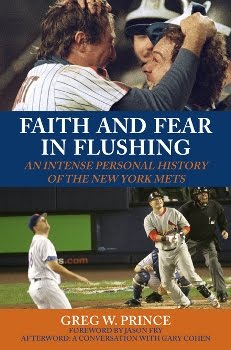
Book: Faith and Fear in Flushing, by Greg Prince (2009)

On a recent evening, Rosemarie and I were strolling around our Seattle neighborhood. A gent who’d gotten in his cups a little early stopped before us, turned to Rosemarie, and said, “What’s a good-looking woman like you doing with a Mets fan?”

(I was wearing a Mets cap. As is my wont.)

Rosemarie replied, “This man is my loving husband of almost twenty years. And I’m also a Mets fan.” Appropriately chastened, the interloper took his leave.

We walked on. “So, uh, thanks for sticking up for me,” I finally said.

“Forget it,” Rosemarie replied. “He did say I was good-looking, right?”

Random abuse is part of being a Mets fan. I don’t know how it works between Cubs and White Sox partisans, but in New York you always have to explain why you root for the orange and blue. That’s because the Yankees are the Yankees, and the Mets are the Mets.

But root for them I do. The Mets have been a part of my life for as long as I can remember. Before movies, before crime fiction, there was the Mets. Blame growing up in Queens, just a stone’s throw from Shea Stadium. They were my home team in every sense. (Rosemarie, a product of Flushing, would actually walk to games.) Being a Mets fan is an inextricable part of my identity. Ask anybody who knows me.

Greg Prince is one of the writers behind Faith and Fear in Flushing, a regular stop for me. He’s spun the blog into a book. Subtitled An Intense Personal History of the New York Mets, that’s exactly what it is: a look at how supporting a team, through good times and bad, becomes a constant, a way of marking the years. It’s about the twinned joy of giving yourself over to something larger, and the agony of being at the mercy of that which you can’t control. Substitute the names and it could be about your team. But if the phrase Grand Slam Single produces chills in you as it does in me, you’ll love it.

So as Opening Day dawns on Monday, I will once again don my cap in support of the most dysfunctional team in professional sports. This in spite of the fact that they’re in a division with the Phillies, the National League equivalent of the Yankees and Red Sox: a perennial contender. That everyone expects them to flirt with .500 and place no better than third this season. That sportswriters have taken to calling for regime change as if the front office is part of the Axis of Evil, or comparing Citi Field to the hell of Dante’s Inferno.

Instead, I’ll focus on the good times. Cementing my bond with my friend Mike, whose blog Metsanity is well worth reading. The 1986 world championship; game six remains one of the high points of my life. Meeting Tom Seaver, the man to this day known as The Franchise. Want to see hero worship? Look at my face.

Or simply helping out another fan. It’s late 2007. Only a few weeks after the Mets’ storied collapse, blowing a seven-game lead with seventeen to play and missing the playoffs entirely.

Whoo. Hang on. I need a minute.

I have to run to the grocery store. It’s raining, so without thinking I put on my Mets inclement weather cap – yes, I have more than one – and head out. I’m in the express line when the guy behind me taps me on the shoulder.

“I have to tell you, I’m so glad to see you,” he says to me in a quiet voice. “I haven’t been able to put on my cap since it happened.”

“You’ve got to man up,” I told him. “Next year starts right now.”

I am way, way too proud of that moment.

Tuesday, March 30, 2010

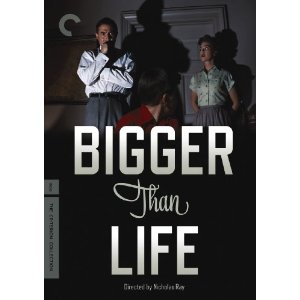
Movie: Bigger Than Life (1956)

Talking about the latest Criterion DVD release has already landed me in a dustup, so I tread with caution. On Facebook I said the movie was a curio, not a lost classic. That prompted a critic whose work I regularly read to call me a ... well, the exact name was left vague but I’ll go with the most positive option and say philistine. The critic ultimately kicked me to the digital curb. Maybe Errol Morris is right when he suggests that social media is as bad as high school.

Bigger Than Life generated an uncommon amount of publicity when it debuted on video last week. The majority of reviews were laudatory; the word “masterpiece” crops up repeatedly. It was hailed as a neglected landmark, an incisive social critique, a scathing exposé of the American Dream.

All of which should have raised red flags. I don’t have many rules when it comes to movies, but here’s one: when every hosanna fawns over what a movie says but not what actually happens onscreen, odds are you’re in for a tough sit.

Nicholas Ray directs. The movie is based on a New Yorker article and feels like it. James Mason plays a mild-mannered schoolteacher who moonlights as a taxi dispatcher. He suffers from increasingly frequent bouts of pain which are diagnosed as a symptom of a fatal arterial disease. But there’s a new treatment, the miracle drug cortisone. It saves Mason’s life, but also triggers manic episodes that crescendo into full-blown psychosis with his abuse of the drug. He becomes a suburban Nietzsche, a household tyrant terrorizing his family.

The lopsided script is so focused on Mason and his largely one note fugues that the behavior of the other characters is rendered incomprehensible. His doctors aren’t held to account. As for Mason’s wife (Barbara Rush), I had to keep stepping out of the movie to backtrack her motivations. “I suppose if she thinks X, it makes sense she’d do Y.” Many critics claim Bigger Than Life is fundamentally about issues of class – novelist Jonathan Lethem, a great admirer of the film, offers 27 minutes of cultural background on the DVD – but the movie treats money obliquely. In a key scene, Mason holds up medical bills shot in such a way that I couldn’t tell what they were until he’d already put them down. Here’s another of my rules: if your characters’ actions are essentially prompted by subtext, you’ve failed as a dramatist.

I was interested enough in the story to track down the original article in the New Yorker’s archives. Berton Roueché’s “Ten Feet Tall,” published in September 1955, is an astonishing piece of reportage that answered every question raised by Bigger Than Life’s flawed script. To begin with, the schoolteacher’s wife has a far more substantial presence. During the period in question, she herself was incapacitated by sickness. Her husband’s adverse reaction to cortisone was compounded by his doctor’s refusal to discuss why he was altering the dosage. Here’s the teacher on his physician: “He believes in a minimum of explanation and a maximum of results. And, of course, I said nothing to my wife.” The bath scene that gives the movie its signature image – Mason’s reflection in a shattered mirror – comes from out of left field in the film. The incident in context is smaller and far more devastating.

Roueché’s article is a case study. So is Bigger Than Life, in how not to adapt material.

UPDATE: Jaime Weinman offers a terrific counterpoint to this post.

Thursday, March 25, 2010

Movie: A Prophet (U.S. 2010)

Lots going on, so I’ll keep this brief: you need to see this movie.

It’s a brilliant, hard-hitting epic. Malik, a young French Arab, is thrown into prison for a six-year bid. Without family or friends on the outside, he’s prepared to face his fellow inmates alone – until he comes to the attention of the Corsican gangsters who run the joint ... and need another Arabic prisoner killed. The preparation for the hit and the job itself are ferociously intense. Soon Malik finds himself in a strange no man’s land, protected by men who don’t respect him and reviled by his own kind. So he does what any smart kid would do: he begins exploiting his benefactors, his enemies and the system, and slowly amasses power.

Tahar Rahim manages to chart the transformation of Malik’s character while nailing down the true hard case’s complete lack of affect; he becomes a new man without it ever registering in his face. Rahim is matched by Niels Arestrup as the aging kingpin who didn’t expect the world inside the prison’s walls to change, too. Jacques Audiard’s direction is supple without stinting on detail. Seek this brutal, relentless and powerful movie out.

Sunday, March 21, 2010

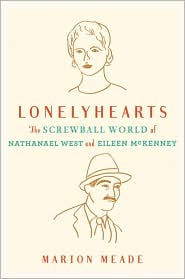
Related: Lonelyhearts, by Marion Meade (2010)/Five Came Back (1939)

They make an unlikely couple. Nathanael West, an author whose comic sensibility is so dark it can be difficult to find. And Eileen McKenney, a Midwestern girl whose big city adventures spawned a miniature empire.

Theirs may not have been a “screwball world,” as author Meade subtitles her joint biography; West and McKenney both died too young in a car accident caused by West’s notoriously bad driving mere days before the debut of the play that would make Eileen’s exploits even more famous. But Meade’s telling has that tone. She writes with an informal, almost jaunty voice that suits what is ultimately a tale of kindred spirits finding each other, and prior to that a recounting of literary circles in 1920’s New York and ‘30s Hollywood. The most interesting material is about those orbiting the star-crossed twosome, like West’s overbearing mother and Ruth McKenney, the staunch Communist who gained her greatest fame chronicling her superficial sibling’s antics in My Sister Eileen (filmed twice, adapted into a play and later the musical Wonderful Town).

It’s the rare biography that makes you think less of its subject – well, one of them – but it happens here with West, who comes across as pretentious and scheming. Amazingly, a stint in the Poverty Row salt mines matured him. The Day of the Locust, with its parade of grotesques and apocalyptic sense of alienation, is a book I respect without actually liking. Give me the realistically grim but more humane work of West’s Republic Pictures stablemate Horace McCoy.

West’s greatest success as a screenwriter is, ironically, one of the first disaster movies. In Five Came Back he mixed disparate types – among them a gangster’s young son, his pistol-packing “uncle,” an anarchist and the lawman escorting him to his execution, plus Lucille Ball as a woman who’s been around the block with an EZ Pass – on a doomed airplane. Spoiler alert: five come back.

The film plods in its early stages, serving as a better showcase for director John Farrow than West. But tropes become tropes for a reason. Once the plane crashes and the action moves to the jungle, the stock characters become more involving. West, expecting to receive sole credit, was dismayed to find himself sharing space with, among others, Dalton Trumbo, who transformed the anarchist villain into the voice of reason.

Five Came Back was the sleeper hit of 1939, launching Farrow to the A-list. (ASIDE: Want to read about Farrow’s glory days? I wrote an article about them that’s in this book.) He would remake the film nearly 20 years later as Back From Eternity. Guess what else is on my DVR?

Tuesday, March 16, 2010

Book: The Detective in Hollywood, by Jon Tuska (1978)

If I’ve learned one thing from the big dogs of the noir circuit, it’s the importance, nay, the necessity of documentation. Talk directly to the people who made the movies, get them on the record, create a body of knowledge. (Exhibit A, as I’ve said before: Eddie Muller’s one-of-a-kind Dark City Dames.)

That’s what makes Jon Tuska’s overview of the private eye genre so vital. He did the legwork when there were still plenty of people around to interview, like Billy Wilder, Alfred Hitchcock, Robert Montgomery.

Even more impressive is that he committed to this undertaking in those dimly remember’d days before video and the internet, when research of this kind meant hard work. Tuska sat down with Lloyd Nolan, who played Michael Shayne, and Nolan brought along something a fan sent that might be helpful: a typewritten list of all of Nolan’s films. An asterisk by the title meant the fan owned a print of the movie.

Tuska’s work is exhaustive but never tiring, guiding you through now-neglected series like the Crime Doctor and Mr. Wong, telling you which Charlie Chan films are worth your while. The chapter on The Thin Man movies also includes their many imitators. Tuska writes with wit and affection, but also a sharp critical eye. Some of his positions I agree with (dismissing all of Boston Blackie), some I don’t (no way is The Drowning Pool better than Harper). And the few stances he cheerily admits are heretical – such as claiming that Montgomery’s subjective camera Lady in the Lake is superior to both Murder, My Sweet and The Big Sleep – are so persuasively argued that I’m willing to give the movies in question another look. The book ends with an affectionate appraisal of the ‘70s troika of The Long Goodbye, Chinatown and The Late Show.

I first learned about the book from Ed Gorman, who wonders why it never got its due. Having read it, I’m now asking the same question. Tuska updated it in 1988 as In Manors and Alleys: A Casebook on the American Detective Film. I’m going to need a copy of one version or the other to call my own. Any fan of The Whistler is welcome around here.

Thursday, March 11, 2010

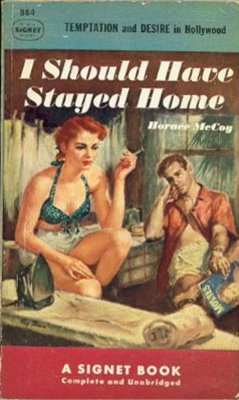
Book: I Should Have Stayed Home, by Horace McCoy (1938)

One of the knocks on e-readers that baffles me is, “You lose that new book smell!” To which I say, “What about that old book smell?” A few years ago I picked up a paperback in an antique store containing two novels by Elisabeth Sanxay Holding. It was only when I got the book home that I realized it reeked, as if it had been used to prop up a leaky boiler in a basement that doubled as a hobo graveyard. Rosemarie, her eyes watering in the next room, announced, “Either you read that one outside or you don’t read it at all.” As I consigned the leathery pages to the flames, I heard them cry out in torment. (Actually, I just tossed the book in the trash. Several blocks away.)

Since buying my Kindle, I’ve been primarily filling it up with older, somewhat hard to find books. Solomon’s Vineyard and Fast One did not disappoint. Nor did Horace McCoy’s brief and brutal I Should Have Stayed Home.

McCoy, a journalist and Black Mask writer, moved to Los Angeles in 1930 with hopes of becoming an actor. He would instead become a screenwriter. But the cattle call experience marked his work, especially his best known novel, They Shoot Horses, Don’t They?, about Hollywood aspirants participating in a grueling dance marathon, and I Should Have Stayed Home.

Georgia-born Ralph Carston headed west with dreams of stardom, but he finds himself short of cash, scuffling for extra work, and sharing a seedy bungalow with his Platonic roommate Mona Matthews. A friend of Mona’s is arrested for shoplifting. A chain of circumstance follows that brings Ralph in contact with an older woman who has designs on him, a disillusioned flack, and a host of other Tinseltown types.

It’s a grim, powerful book. Ralph seethes with desperation and rage. He’s implied in his letters to his mother that he’s already made it in Hollywood, but he soon learns that his accent and his attitude may keep him from success. Scarier is the resentment boiling over into hatred that he feels toward those who have managed to grab the brass ring. (“It made me sore, sitting here looking at Robert Taylor, the biggest star in the pictures, trying to figure out what he had that put him where he was and that, goddam it, one of these days ...”) It’s an unsparing look at the dark reality of show business that deserves to be mentioned alongside Nathanael West’s The Day of the Locust.

Saturday, March 06, 2010

Miscellaneous: Your Weekend Recommendations

Now that Noir City has wrapped, it’s high time for me to get my head back in the twenty-first century. Here are some more contemporary picks.

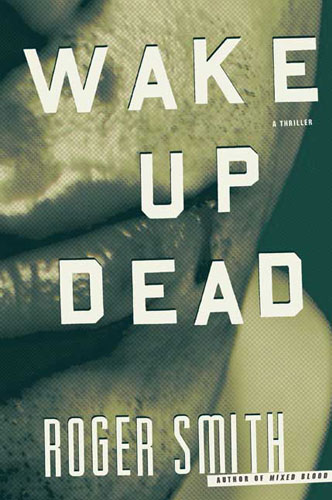
Wake Up Dead, by Roger Smith (2010). Roxy Palmer used to be an American model. Now she’s living in Cape Town, South Africa, trophy wife to an arms trafficker. When two street punks jack their car, Roxy takes advantage of the situation. Thus setting into motion a tortured Elmore-Leonard-meets-Robert-Altman chain of events embroiling Roxy, the carjackers, a mercenary known as Billy Afrika, a psychotic gang boss hell-bent on a reunion with his prison “wife,” and an honest bastard of a cop named Maggott forced to investigate with his son in tow.

The bleakness of this book is, at times, suffocating; each character’s history is so grim that the miasma of misery threatens to become blackly comic. But there’s no denying that every one of Smith’s players pops off the page, and his pacing is relentless. It’s a prison shank of a novel: brutal and hard, driving in deep and leaving a hell of a mess.

The Ghost Writer (2010). A review described Roman Polanski’s adaptation of Robert Harris’ novel as a “town car thriller.” That how it seems for much of its running time, a well-appointed and smooth ride.

Ewan McGregor is the title character, hired to punch up the memoirs of former British Prime Minister Tony Blair Adam Lang (Pierce Brosnan). As Lang is brought up on charges in The Hague for his role in abetting America’s rendition program, the ghost begins to wonder about the mysterious suicide of his predecessor.

There are terrific performances throughout, including one from 94-year-old Eli Wallach. The movie’s final revelation is a doozy, delivered in an extended, largely wordless set piece that is a joy to behold. Sly, meticulously constructed, with a perfect visual capper. Days later, I’m still cackling at it.