Sports: Express Train To Mudville
Leave us journey back, if you will, to a simpler, happier time. A time when your humble correspondent was a younger, more virile figure. I’m thinking about a month ago.
The Seattle Mariners are in control of the wild card race and about to host the the Angels Angels of Anaheim (translation from the Spanish) in a crucial series. Take two out of three games and they’re in first place in the AL West. My beloved New York Mets, meanwhile, have a considerable lead on the competition. If they do well in a four-game stand against the second-place Phillies, the NL East will be decided early. I allow myself to fantasize about a Mets/Mariners World Series.
Not that my loyalties would be divided. I follow the Mariners, because I live in Seattle. I root for the Mets, because they are the team of my Queens childhood. In my fantasy World Series they don’t beat the Mariners. They crush them in four perfect games.
The Mariners get swept, never contend for the division again, and blow the wild card. They finish tied for the fifth best record in the AL. Not bad for a team that wasn’t expected to be a factor this year, but still disappointing.
The Mets? Oh, where to begin ...
They’re swept by Philadelphia, which prompts them to play their best baseball of the year. By September 12 they’d rebuilt their seven game lead, just in time for the Phillies to roll into Shea for a rematch.
They were swept again. Thus beginning what sportswriters are calling the most complete regular season collapse in modern baseball history. (Post-season collapse honors still go to the 2004 Yankees.)
The numbers are too ugly to contemplate. Still, let’s look at ‘em. The Mets closed out the year 5-12. They lost six of their last seven games at home to teams under .500.
Yet somehow, this morning their fate was in their hands. Win the final game of the year and at worst they forced a playoff against the Phillies for the division, with a shot at the wild card as well. Win and 2007 could still be the Mets’ Tom Cruise year.
You know how early in Cruise’s career he’d play cocky guys who had never been tested? Then Goose dies and Tom goes into freefall? But through adversity Tom recovers his swagger and proves that he’s every bit as good as he thought he was? Hell, better? That works for me.
The thing is, Maverick never gave up seven runs in the top of the first inning. And the Mets finish out of time, out of chances, and out of the money.
Making it worse, both the Mets and Phillies games were shown in their home markets over the air. Which meant I had to follow both games listening to the Marlins and the Nationals announcers praise their teams’ performances as spoilers. The compliments were deserved; both squads finished the season strong. But it’s not the same as hearing the joy from Philly, or the ruthless anatomization of a year gone wrong from the Mets booth crew, the best three-man team there is.
I should be heartbroken, but the truth is I never embraced this Mets team the way I did last year’s. That bunch, which was a swing of Carlos Beltran’s bat away from the World Series, could never be counted out of any game. This year’s team lacked that fire, and seemed to play with a sense of entitlement. As if they were saying, “Remember what we almost did last season? We’re gonna almost do it this year, too.”
On Thursday I told my friend Mike that I started wanting the Mets to choke because at least we’d get an epic failure out of it, something to make the season memorable. Years from now, when a team falters late, their fans will say, “Yeah, they suck, but it coulda been worse. It’s not like they were the 2007 Mets.”
I know the idea of rooting for a team is irrational. A bunch of millionaires wearing a particular uniform has nothing to do with me, with the place where I grew up, with the memories of my boyhood. But that lure is powerful. The other day I spotted a guy wearing a Pittsburgh Pirates cap and T-shirt. The Bucs logged their fifteenth consecutive losing season this year, but still he was letting his colors fly. I respect that. Even more, I understand it. I understand it all too well.
The 2007 Mets were overhyped, overconfident, underachieving assholes. But they were my overhyped, overconfident, underachieving assholes. And I’ll let my colors fly.
But not today. Today I don’t need the aggravation.
Sunday, September 30, 2007

Thursday, September 27, 2007
Books: Lit Crit
Here’s a New York story. A wealthy older woman about to embark on a cruise to Europe takes a cab to the ship. En route, she falls into easy conversation with the driver and impulsively asks him to come along. The cabbie agrees and drives his hack into the hold of the ship with the meter running. They disembark in France and the driver ferries his passenger into Paris, then to the Riviera, down deep into the boot of Italy, high into the Alps, over to Berlin, up into Scandinavia, even across the Channel to Merrie Olde England – the whole time with the meter running.
At the end of the jaunt, back into the hold goes the taxi. They return to Manhattan. The fare comes to fifteen thousand dollars, which the woman happily pays. “Now,” she tells the driver, “all you have to do is take me to my home in Brooklyn.”
“Brooklyn!,” the driver says. “Sorry, lady. You’ll have to get another cab. Every time I go to Brooklyn I come back empty.”
Somehow, I don’t think this is what the driver was talking about. Hat tip to Arts & Letters Daily.
Tuesday, September 25, 2007
Miscellaneous: Neither Here Noir There
Steve Lewis, the man behind the indispensable Mystery*File, posed a question in the comments yesterday:
(T)he guys over at (hardboiled/noir mailing list) Rara-Avis are always saying that if there’s a happy ending, it can’t be noir. Do you go along with that? If not, or even if so, what’s your take on what Noir is?
Steve’s not the only one to put this headscratcher to me. At a Seattle International Film Festival noir double-bill earlier this year, I chatted with my friend and game-show competitor, critic Tom Tangney. Tom said, “What’s with you noir guys? I thought you were all about the downer endings but in a lot of the movies I’ve seen, things work out OK.”
Solving the what-is-noir riddle accounts for a hefty slice of the traffic on R-A. It gets brutal at times. Lives have been lost. Worse, feelings have been hurt. You think I’m going to wade into that contentious debate here?
OK, I will.
The safest play would be to punt, to Potter Stewart the question and say I know noir when I see it. I’m not a purist when it comes to definition. There are some who insist that “noir” can only refer to the original canon of authors published by the Série Noire line in France, or films made between 1940 (Stranger on the Third Floor) and 1958 (Touch of Evil). I don’t want to watch a movie like The Money Trap or Memento and think, “Jesus, that’s as noir as can be. Too bad it didn’t come out in ‘52.”
The recent explosion of noir films on video clouds the matter further. Steve’s question was prompted by two titles in Warner’s Film Noir Classic Collection Volume 4. Over the weekend I caught up with another movie in the set, 1955’s Illegal. Politically ambitious D.A. Edward G. Robinson discovers he sent an innocent man to the electric chair. He resigns, hits the skids, then reinvents himself as an unscrupulous criminal lawyer allied with the crime boss he was once determined to bring down – until his former assistant is indicted for murder.
Entertaining? You bet. Noir? Not really. Sure, it has its share of noirish elements, but it’s the second remake of the 1932 melodrama The Mouthpiece. The first remake, 1940’s The Man Who Talked Too Much, is about two lawyer brothers squaring off on opposite sides of a case. I’d say every iteration of this movie belongs in your video store’s “Hambone” section – a genre to which I am also partial. So why include it in a film noir collection?
A definition I picked up at Rara-Avis is known as The Bludis Heresy, after author Jack Bludis, who coined it. It states that hardboiled fiction is about characters who go into a cold, unfeeling world with no illusions, while in noir those characters are doomed to be crushed by said world. Or, as Bludis puts it with admirable economy:
Hardboiled = Tough
Noir = Screwed
I like that a lot.
Eddie Muller, a man I always listen to on this subject, said that all noir stories are about “people who know what they’re doing is wrong, but they do it anyway.” He also said that the genre’s ethos was perfectly encapsulated by Walter Neff’s explanation of his actions in Double Indemnity: “I killed him for money and for a woman. I didn’t get the money ... and I didn’t get the woman.”
So what do I think?
I think noir, by definition, is about losers, the perpetual short-stickers of life. I think fate plays an active role. Look no further than Detour. Tom Neal, the poor bastard, never stood a chance. In the movie and in the real world.
It’s not darkness for its own sake. Too many contemporary writers branded with the noir label seem to wallow in misery, to enjoy torturing their characters. Noir is not about bad things happen to marginally good people. It’s about poor decisions boomeranging back with a vengeance.
True noir shouldn’t end on an upbeat note. But I’m willing to give the movies some leeway on that score. The powers that be in the business have always been reluctant to send the audience out feeling blue. Besides, happy endings, unlike Tolstoy’s happy families, are not all alike. At this year’s Noir City screening of Nightmare Alley, I heard some grousing that the closing scenes went too easy on Tyrone Power’s Stanton Carlisle. Sure, if hitting rock bottom is to be preferred over the long plunge down.
The French may have given the genre its name, but noir is a fundamentally American invention. Which is as it should be, because noir’s message cuts straight to the heart of the American dream. In a nation obsessed with winners, there are bound to be losers. And not only should their stories be told, they’re invariably more interesting.
Miscellaneous: Links
Steve Lewis keeps on giving. He sent me Wired’s list of unlikely movie scientists. And via BoingBoing, we have a stunningly thorough comparison of Simpsons scenes and the movies they pay homage to.
Sunday, September 23, 2007
Miscellaneous: Links
Recently at The Rap Sheet, editor J. Kingston Pierce marked the 100th anniversary of the limerick craze that swept London by calling for five-line poems with a crime fiction theme. You know me. I can never resist a challenge.
Two of my efforts are now up at the site. Be warned: they’re completely ridiculous, and I take the name of the great Ogden Nash in vain.
I knew this day was coming. My own personal greatest movie of all time, The Taking of Pelham One Two Three, is getting a big-budget, all-stops-out remake. It will mark the fourth collaboration between Denzel Washington and director Tony Scott (Crimson Tide, Man on Fire, Déjà Vu), with a script by Hollywood heavyweight David Koepp.
I honestly hope that this new version kicks ass. It’ll be damn near impossible to best the original, which is a perfect thriller, a quintessential New York movie, and one of the most entertaining films ever made. I’m curious to see how the story will be updated for the post-Giuliani era. “Screw the goddamn passengers! What the hell did they expect for their lousy MetroCard, to live forever?”
Thursday, September 20, 2007
Movies: Decoy (1946)/Crime Wave (1954)
Volume 4 of Warner Brothers’ Film Noir Classic Collection has been out for weeks, but I’m only getting into it now. It’s not my fault, y’unnerstand. I ordered it as soon as it streeted from an online retailer and somehow wound up with a boxed set of Star Trek movies. The turnaround cut into my valuable noir-watching time.
Which killed me, because the collection includes a movie I’ve wanted to see for years. Decoy has become a fabled cult item because it features what may be the most macabre plot in noir history. A woman romances a prison doctor so he’ll revive her death row boyfriend after his execution – just long enough for loverboy to reveal where he’s hidden four hundred grand in stolen loot. The movie’s production history only adds to its mystique. Producer/director Jack Bernhard met actress Jean Gillie in England, married her, and made Decoy to introduce her to American audiences. They divorced before the film was released, and Gillie died of pneumonia soon after at age 33.
Her legacy burns anew with Decoy’s appearance on DVD. She’s remarkable playing the most fatale of femmes. TV legend Sheldon Leonard is terrific as a homicide dick who believes the worst about everyone. The rest of the cast? Not so good. And the soundtrack is overbearing. But that wild premise holds your interest, and the movie is bookended by spellbinding opening and closing sequences. To quote Rosemarie: “Anybody who wants to direct needs to study that intro.”
The writer of Decoy, Nedrick Young (who would go on to pen The Defiant Ones and Inherit the Wind), appears as an actor in the other half of this disc’s double bill. Crime Wave is the kind of rock-solid, unpretentious movie director André de Toth was known for. Reformed ex-con Gene Nelson gets sucked back into the life when a trio of prison acquaintances (a young Charles Bronson among them) busts out of San Quentin and expects his help. Hard-nosed cop Sterling Hayden watches his every move. Half the cast of this movie – Hayden, Ted de Corsia, Timothy Carey – would later turn up in Stanley Kubrick’s The Killing.
I’d already seen Crime Wave, but I watched it again so I could enjoy the commentary track featuring novelist James Ellroy and the czar of noir himself, Eddie Muller. Ellroy literally pants over authentic early ‘50s Los Angeles locations and notes all the ways this movie informed his novel L.A. Confidential. (He based Bud White, played by Russell Crowe in the movie, partly on Hayden’s character, and points out a dive bar that’s the inspiration for the Nite Owl.) He also says that after rewatching Chinatown, he’s decided that it doesn’t hold up, and that Crime Wave is the better film.
I don’t think he’s kidding.
Miscellaneous: Observation
The new gig prompted me to take the plunge and buy a laptop. Renovations around Chez K have reached the noisy stage, so I’ve started taking it to coffee shops so I can work. Meaning I have, at last, become one of those people I have always despised. Such is life.
Miscellaneous: Link
A completely inconclusive study hints that women with “tramp stamps” might not be able to receive epidurals when they go into labor. Gawker’s treatment of this news warms my black heart.
Tuesday, September 18, 2007
Book: But Enough About Me, by Jancee Dunn (2006)
Meet my new favorite book. Jancee Dunn is a Jersey girl who ended up a Rolling Stone correspondent and a VJ on MTV2, back when the network used to play videos. (Hard to believe there are now two MTVs against which that charge can be leveled.)
Her memoir, which is hysterical and reads like a breeze, is studded with tips on how to interview celebrities. Examples: always chat up the drummer when talking to a band, and drivers provide the best gossip. But the most interesting sections are about Dunn’s own life. Her suburban childhood. Her close-knit family with its possibly too-strong ties to J.C. Penney. (I still remember Dunn introducing “a video from, as my dad would say, Mary J. Bilge.”) And her eventual realization that “being hip was a full-time job, and (she) was only a part-timer.” Dunn pulls off the neat trick of being more interesting than the luminaries she’s paid to write about.
The new crop of shows covering the celebrity beat seem hell-bent on taking them down. In Slate’s words, they’re either about hostile intimacy or intimate hostility. Try to steer clear of the press, as Matt Damon does, and you get taken to task by the editor of Variety. (Peter Bart should read the disturbing section of Dunn’s book in which Ben Affleck demonstrates to her how quickly a routine task like getting lunch is wrecked by paparazzi.) Which is another reason why I enjoyed But Enough About Me. It’s refreshing to read about someone regularly exposed to fame who seems so ... normal.
Miscellaneous: Link
I’m depressed that the boys in the the Bad Plus even feel they have to explain how their improvisational covers of modern songs are not ironic. Anyone who’s heard their electrifying version of “Tom Sawyer” should know better.
Sunday, September 16, 2007
Movie: Eastern Promises (2007)
Now this, ladies and gentlemen, is how it’s done.
And the audience at the Toronto Film Festival agrees. Of course, director David Cronenberg is a hometown boy. He’s long been a favorite of mine, too, never more so now that he’s become a master of the spare thriller. Terrific performances across the board. A harrowing fight scene destined to join the pantheon of greats.
But it’s really the script by Steve Knight that electrified me. It’s an absolute marvel of craftsmanship, using a simple premise – a midwife investigating the short, sad life of a teenage immigrant who died in childbirth – to dive headlong into the world of the Russian mafia and multicultural London. The elegance with which the narrative comes together makes the movie a joy to behold even as it ratchets up the tension. With this movie and Dirty Pretty Things, Knight has put himself into the top rank of screenwriters. See this one.
Miscellaneous: Link
Millard Kaufman, who wrote the great Bad Day at Black Rock and co-created Mr. Magoo, publishes his first novel at age ninety.
Friday, September 14, 2007
Movie: Shoot ‘Em Up (2007)
Clive Owen delivers a baby during a shootout, and spent shells rain down on the pregnant woman’s belly. Owen later deposits the newborn on a filthy men’s room floor and uses the baby changing station to clean his gun. Depending on your state of mind, such scenes will either strike you as:
A.) Tasteless
B.) Hilarious
I was in kind of a bad mood when I saw Shoot ‘Em Up, so I went with B. Michael Davis’ film is eighty-seven minutes of gunplay, trashy to its core and thoroughly disreputable. I cackled all the way through it. Any movie in which Clive Owen kills several dozen mercenaries literally single-handed (he is carrying that baby) scored to Motörhead’s “Ace of Spades” has a fan in me. There is a plot of sorts, but it’s so utterly ridiculous that the entire movie seems to turn toward the audience and say, “Can you believe this crap?” And Paul Giamatti goes over the top in grand style. Although personally I think it was unnecessary. I knew when he quoted Barbara Bush that he was a badass.
Miscellaneous: Link
Mike, this one is for you. And it’s even worse than you remember.
Thursday, September 13, 2007
Miscellaneous: Links
The best way to keep the new fall TV season straight? Variety’s Season Pass, a group blog by the paper’s editorial staff.
The gang at New York magazine’s Vulture is happy that Jon Stewart will be back hosting the Oscars, but they suggest that the Academy cast a wider net in future by looking to the past.
For some reason my brain coughed up this bit of childhood detritus this morning. I can’t get it out of my head, and I don’t believe in suffering alone. I’m pretty sure that’s not standard firefighting technique. Or trombone playing, for that matter.
Monday, September 10, 2007
Movie: Le Doulos (1962)
Sometimes corporations know exactly what they’re doing. By the time Giant Video Store Chain finally made it into my yuppie/hipster neighborhood about a decade ago, they had clearly done some demographic analysis. In addition to the standard miles upon miles of new releases, the store also stocked goodies that wouldn’t be in suburban outlets a few miles away. Loads of obscure art films. A healthy selection of martial arts flicks.
And, on a dusty bottom shelf, a single VHS copy of Jean-Pierre Melville’s Le Doulos.
Prior to that point, I’d never seen a Melville film. I had only read about the world that Melville had created onscreen. A world of shadows and style, where men knew how to wear hats and lived by a code that made sense to them if no one else. Where the women were impossibly ripe. Where you could never drink too much or brood enough.
I knew sight unseen that it was a world I wanted to visit if not live in. Le Doulos was the first stamp in my passport. Since then, several of Melville’s films – Bob Le Flambeur, Le Samourai, Le Cercle Rouge, and his grandest achievement Army of Shadows – have returned to theaters and been made available on DVD. Now Rialto Pictures has reissued the film that introduced me to le monde de Melville. High time I saw it again.
The title is a slang term from the French underworld meaning a police informant, and was originally translated in the U.S. as The Finger Man. Such is the reputation that Silien (Jean-Paul Belmondo) has acquired. His cohort Maurice doesn’t care; he’s putting together a heist after being released from prison, and Silien is one of the only people he trusts to help him plan it. When the cops show up in the middle of the job, Maurice begins to rethink everything he knows about his pal.
The script, based on a Série Noire by Pierre Lesou, can at times be difficult to follow, packed as it is with double-crosses and ulterior motives. It’s the kind of movie where one man will cold-bloodedly murder his close friend, another puts his life on the line for a guy he seems indifferent to, and you’re not entirely sure why. But all is made crystal clear by the gut punch of an ending. Belmondo makes no play for audience sympathy. He plays it cool and looks that way as well.
Le Doulos is showing in Seattle and Los Angeles through Thursday, and around the country for the next several months. My take on Melville’s Army of Shadows – for my money, the best movie in theaters in 2006 – is here.
Friday, September 07, 2007
Miscellaneous: Interim Report
Feels like I’m letting the team down by posting infrequently. I’m still adjusting to my new schedule. I haven’t read much other than the paper lately. And I’ve watched nothing but baseball – go Mets! – and disappointing movies on DVD that I don’t care to discuss.
I did see Superbad, which is funny. I identified quite strongly with Evan (Michael Cera), a decent, good-hearted young man who can’t understand why his female classmates don’t honor those qualities by having sex with him. He’s the character in a teen movie who comes closest to the adolescent me – after Mark Ratner in Fast Times at Ridgemont High. A movie theater usher with a crush on Jennifer Jason Leigh. Welcome to my childhood.
We’ve also been making our way through a collection of trailers from Something Weird Video, loaned to us by a friend of Rosemarie’s. When describing her tastes in exploitation fare to him, she said simply, “Knockers over gore.” And that, ladies and gentlemen, is why I married her. (I’m sure there’s also a 2000 election joke in that answer, but I’m too tired to figure out what it is.)
You need a little something extra for stopping by. Here’s a throwback throwdown from an early episode of Flight of the Conchords.
Wednesday, September 05, 2007
Miscellaneous: Links
The Wire wraps its final episode, and the Washington Post is there. I have to wait ‘til January before the last season starts airing on HBO?
Premiere considers twenty classic twist endings. Or ruins twenty movies for people who haven’t seen them, depending on your point of view.
The latest issue of the Film Noir Foundation’s newsletter – trust me, you’re missing out if you’re not getting it – brings the sad news that actress Beverly Michaels passed away in June. Some of you may recall my powerful reaction to her performance in Wicked Woman, which screened at this year’s Noir City film festival. As a tribute to Beverly, here’s the trailer to that movie once again.
Monday, September 03, 2007
Music: Classic Songs, My Way, by Paul Anka
Anka’s at it again, recording another album of comtemporary(ish) songs in his own style. I was a big fan of Rock Swings, his first such album. In my mind Anka’s rendition of “Eye of the Tiger” has now replaced Survivor’s as the definitive one, and yes, I am fully aware of just how small a boast that is.
The follow-up record isn’t as good, because of song choice. Foreigner and Bryan Adams simply aren’t as interesting as Nirvana and Soundgarden no matter how elaborate the arrangement.
There are some good tracks, like Anka’s take on Duran Duran’s “Ordinary World.” The highpoint is easily his version of “Mr. Brightside” by The Killers. That’s a song with enormous personal significance for me, and one that demands to be sung over a full orchestra. Anka does it proud.
TV: Entourage
Rosemarie, as last night’s season finale was beginning: “I hope Billy Walsh gets killed by Basque separatists while they’re in Cannes.”
Miscellaneous: Links
In preparation for the upcoming remake of 3:10 To Yuma, the AV Club rounds up 17 dark westerns.
This New York Times Magazine profile of Rick Rubin is long but, in the words of The Bad Plus guys, “essential reading for anyone with the faintest interest in the music industry.”
Friday, August 31, 2007
Miscellaneous: The August Stuff-I-Didn’t-Get-To Post
Forever Cool, Dean Martin. Enough with the albums where dead singers “duet” with contemporary artists. Dino did more than enough entertaining when he was with us. Let the man rest in peace. That said, at least this album includes some of Dean’s in-studio banter and revives the movie theme “Who’s Got The Action?,” performed here with Big Bad Voodoo Daddy. Robbie Williams again shows he knows his way around a standard. And Kevin Spacey earns points for chutzpah – or something – for singing with Dino as Dino.
Stalin’s Ghost, by Martin Cruz Smith. I never miss an Arkady Renko book. In this latest outing, the good-hearted Russian detective is assigned to investigate subway sightings of the title specter only to find himself drawn into post-Soviet politics and the repercussions of Chechnya.
Ask The Dust. Colin Farrell is terrific in Robert Towne’s adaptation of the John Fante novel. The bantam rooster strut, the self-doubt expressed as hostility; I actually believed I was watching a struggling writer in 1930s Los Angeles. The movie never fully escapes its literary origins, but that’s part of what makes it interesting. Also excellent: the letters Farrell’s character receives from his mentor H. L. Mencken, read in the vinegary rasp of film critic Richard Schickel.
This Is Tom Jones. No sooner had I picked up the first disc in this series of variety shows than Tony Kay recapped ‘em all, proving great minds really do think alike. The women’s lib sketches with Anne Bancroft alone make this worth a rental. I was struck by how much the 1969 Tom Jones looked like one of those deadly clotheshorse thugs that turn up in U.K. gangster films like Get Carter and The Long Good Friday. Time-Life should have done a better job of editing the shows. It’s not nice to promise Joey Heatherton and then not deliver. Not nice at all. So here’s Joey doing her all to sell mattresses.
Tuesday, August 28, 2007
Miscellaneous: Placeholder
Work, work, work. I’ve got one project nearing completion and last week I started an exciting new gig that I hope to be talking up big around here soon. The upshot is I haven’t had much time to post, or even to watch/read anything to post about.
A while ago, I said that under such circumstances I would hang out the video for ‘Crucified’ by Army of Lovers, which as I explained is a band consisting of my first wife, my half-brother Nils, and the guy who used to handle my landscaping. And I’m not talking about yard work.
I was all set to do that today, but instead I’ve decided to go with a solo effort from the ex featuring a bunch of fellows from the gym. Enjoy!
Saturday, August 25, 2007
Miscellaneous: Links
Ed Gorman has sent me to Cinema Retro for many a fine article. It’s only fitting, then, that the site features an interview with Ed, in which he weighs in on vintage crime films.
Several years ago, I wrote a profile of Jim Bouton, former major league pitcher and author of the landmark baseball memoir Ball Four, for a small magazine. The article was primarily about Bouton’s business career – he was one of the inventors of the bubble gum Big League Chew, for instance – but touched on all aspects of his fascinating life. He was in Altman’s The Long Goodbye, fer cryin’ out loud! After the piece ran Bouton sent me an autographed copy of Ball Four, made out to “a great writer and a nice guy.” It remains one of my most prized possessions, even though he was wrong on at least one and possibly both counts. In some respects that lovely gesture on his part set me on the path I’ve followed ever since.
Bouton’s latest project is the Vintage Base Ball Federation, dedicated to recreating the experience of our national pastime as it was played in the 1880s. Yahoo’s Steve Henson covers the league’s first world series.
Thursday, August 23, 2007
Movies: Out For Justice (1991)/Mercenary For Justice (2006)
Last week, Steven Seagal said he wants a public apology from the FBI for the damage a Bureau investigation did to his career. It’s clearly a reach; Seagal’s career was on the skids before the Feds came around. But the story reminds me that, problems aside, I like Seagal. I kind of miss the guy. And I miss the sort of movies he makes. (Yes, he’s still making them, on the cheap and primarily for video.)
I’m talking about your stripped down, basic action film. Not even meat-and-potatoes. Try meat only, bloody and still on the bone. The plot’s always the same. Bad guys do bad things. A badass who’s a good guy gets pushed too far. He settles the score by punching people in the face and snapping a few necks. Watching a bunch of one-dimensional louts get their asses kicked can satisfy on a deeply primal level.
Recently I stumbled onto Out For Justice, a big favorite around here. (Believe it or not, Rosemarie is a fan, too. You know the observation that Fred Astaire gave Ginger Rogers class while she gave him sex appeal? Rosemarie gives me class and sex appeal, while I contribute crap action movies and Dijon mustard. Surprisingly, she seems happy with this.) I left the movie on for two scenes and ended up watching the whole thing again.
One scene is what Rosemarie calls “the Uncle Pino story.” Seagal, playing a New York cop hunting down a childhood friend on a drug-fueled rampage, stops the narrative cold to recount a rambling episode about going to the movies as a kid with his Mafioso uncle. It’s got nothing to do with the rest of the action, but it’s strangely compelling, in part because Seagal wasn’t a bad actor. It’s also an example of the off-beat human moments that somehow found their way into Seagal’s early films. I’m not saying he was Robert Altman, but Seagal’s movies often wove in textures that weren’t necessary but always appreciated.
The other key scene is a bar fight. Every good action movie’s got to have at least one, with these two beats: somebody sails into a neon beer sign, and a pool cue is used for a purpose other than the one for which it was designed. Out For Justice’s is a doozy. To this day, when I can’t find something I’m looking for, I’ll wander around Chez K bellowing “Anybody seen Rich-IE?” There’s also a fine sequence in which our Steven lays waste to a pork store.
Fast forward a few days. I’m flipping around and find Mercenary For Justice, one of Seagal’s later efforts, on basic cable; the premium channels don’t touch his stuff any more. Seagal has thickened up considerably, and doesn’t move so well now. You could fit a craft services table between him and the goons he’s ostensibly thrashing.
Worst of all was a throwdown in a swank restaurant men’s room. Seagal gestures vaguely toward a thug, who goes sailing into a wall so hard that a urinal falls off. Literally, it falls off. There’s no geysering water. It’s not even connected to any pipes. It might as well have been hung there by Marcel Duchamp.
That’s the real reason for this post. I wanted to mention Steven Seagal and Marcel Duchamp in the same breath. My work is done.
Miscellaneous: Links
William Gibson talks noir and other subjects. And I’m glad I’m not the only person who notices these things: Vulture on how Michael Kamen’s score for Brazil is suddenly everywhere.
Monday, August 20, 2007
Miscellaneous: Links
Variety on all the reasons – good and bad – why Young Frankenstein is the Broadway event of the season.
From the New Yorker comes Bruce McCall’s handy illustrated guide to summer camp pests.
The AV Club names 17 dangerous cinematic computers. I respect any list that gives props to Colossus: The Forbin Project. Extra points for noticing a connection between Dark Star and Sunshine that I’d missed. Here there be spoilers.
Saturday, August 18, 2007
Stage: Young Frankenstein
It’s important in any entertainment to establish tone early. Which is why it was good to hear, in the opening scene of the new Mel Brooks musical Young Frankenstein, that the title doctor is on staff at “the Johns, Miriam and Anthony Hopkins School of Medicine.” It lets you know what you’re in for. And it signaled to me that I’d be right at home. Three fleet hours of bawdy jokes, leggy dancers and Jolson impressions is my idea of a good time.
I had my doubts about Mel Brooks tuning up the film, but I shouldn’t have. After all, YF has the strongest spine of any Brooks movie. The play’s book by Brooks and Thomas Meehan hews closely to the original script by Brooks and Gene Wilder, right down to many favorite lines. (“What knockers!” is there, “It could be raining” is not, and “He vas my boyfriend!” is its own number.) Mel had more work to do on The Producers.
The familiarity of the movie is perhaps the biggest challenge to a ridiculously talented cast, but they’re all able to put their own spins on well-established characters. The one actor who by circumstance is forced into an imitation, Christopher Fitzgerald as Marty Feldman as Igor, walks off with the show. Go figure.
Sutton Foster, a Broadway veteran I know as Coco from Flight of the Conchords, joins Shakira on the short list of women who make yodeling sexy. It’s an embarrassment of riches onstage, with Roger Bart as Frederick Frankenstein, Andrea Martin as Frau Blucher (complete with horse whinnies), Will & Grace’s Megan Mullally succeeding Madeline Kahn as Elizabeth, and Shuler Hensley as the Monster. Odd note: Hensley, a Tony winner for Oklahoma!, played Frankenstein’s Monster in Van Helsing, although to my knowledge he doesn’t have a number in that movie. I also have to mention Fred Applegate, doing double duty as Inspector Kemp (the Kenneth Mars role) and the blind hermit. In the latter scene he manages to do a perfect rendition of Gene Hackman’s distinctive chuckle, a tribute I think was intended just for me.
The caliber of the cast is so high that it’s a problem finding enough for them to do. Mullally, the best known performer, has only one song in the first act and then disappears until midway through act two. She did have a second Act One number according to the program, but it had already been cut a week into previews.
The true star of the show is director/choreographer Susan Stroman. Her staging deploys a full battery of techniques to create a palpable mood, and on top of that she fills the stage with dancers.
Brooks’s songs are the show’s weak link. (Name one song from The Producers. Go ahead, I dare you.) They’re more like ditties, excuses for bits of comic business. But they’re socked over with such gusto by the cast and so inventively presented that you don’t mind.
The one truly memorable song in the score is the only one Brooks didn’t write: Irving Berlin’s “Puttin’ on the Ritz.” The movie’s use of the song has nothing on how it plays out here. The number starts out small, then slowly and surely builds into pure joyous delirium. My sides actually ached when it was over.
Young Frankenstein runs at Seattle’s Paramount Theater through September 1, then moves to Broadway. Friends in New York already report that tickets are hard to come by. Insert monster hit joke here.
Wednesday, August 15, 2007
Miscellaneous: A Public Service Announcement
Traffic’s up at the old internet homestead lately, owing in part to an inordinate number of visitors in the last two weeks who searched the web for “Snyder” and “one day at a time.” I assume that’s because of this post about the late talk show host Tom Snyder and the website’s subhead.
I also assume that these people have arrived here in error.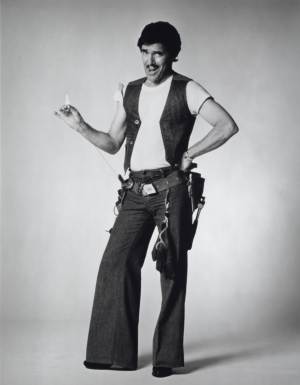 Please always remember and don’t ever forget that the lovable handyman on the CBS sitcom One Day At A Time played by Pat Harrington was named Dwayne F. Schneider. I hope this helps.
As for those who got here searching on “swinger pics” ... your guess is as good as mine.
Monday, August 13, 2007
Miscellaneous: Links
Ethan Iverson of The Bad Plus – go buy Prog, it’s terrific – takes a break from the trio’s tour to talk noir with Allan Guthrie. Do The Math keeps on giving: Ethan links to a new blog by critic Fred Kaplan, whose reviews are what helped me start climbing that jazz learning curve. Kaplan attended every night of the recent 70th birthday tribute to the great bassist Charlie Haden at New York’s Blue Note. Haden performed with a stellar line-up of pianists: Brad Mehldau, Paul Bley, Kenny Barron ... and Ethan Iverson. Would that I could have been there. I’ll have to fire up my copy of Always Say Goodbye, the Haden/Quartet West album that’s like a soundtrack to a brilliant film noir that never existed. See what I did there, bringing it back to noir? God, I’m good.
Fellow E.L.O. and Xanadu fan Matt at scrubbles.net digs up some great video featuring the band’s music – including one anime clip from a 1983 Japanese science fiction convention that must be seen to be believed. It’s four minutes that will change your life.
Miscellaneous: Meaningless Milestone
This is my 750th post. Do I win a prize?
Sunday, August 12, 2007
Stage: Eddie Izzard
I’ll be blunt. Actor and comedian Eddie Izzard is a fucking genius. If you haven’t seen his concert special Dress To Kill, queue it up right now to see a performer at his absolute peak. When we heard that Eddie was doing two shows in Seattle to try out new material, we snapped up tickets at once.
The general theme of the set could, I suppose, be described as the evolution of human belief systems. A rubric broad enough to include the following digressions:
- What aliens with acid blood would really be like
- The inner monologue of the human appendix
- The reasons why cows would make great secret agents
- The difficulty faced by Roman soldiers in describing Hannibal’s elephants in Latin
All of it done Eddie’s singular style – rambling, discursive, yet circling back on itself in surprising ways.
That spontaneity led to the show’s high point, namely Eddie being hit in the face by a kamikaze fly that had gotten into the theater. It prompted a ten-minute riff that won’t be repeated anywhere else. Sometimes, you really do just have to be there.
When Eddie blanked on the name of “that dancer who died because her scarf was so long it got caught in the wheels of the car,” Rosemarie shouted out Isadora Duncan first and loudest. And here I thought she was so circumspect.
Seattle’s stint as the new New Haven continues. Mel Brooks’s Young Frankenstein musical is in tryouts here before opening on Broadway. We’ve got tickets for that, too, and will be seeing it later this week.
Thursday, August 09, 2007
Movie: Slayground (1983)
I watched this movie because I am a Donald E. Westlake/Richard Stark completist. And so you won’t have to, because it’s not good.
Stark’s Parker character, here named Stone and played by Peter Coyote, is forced to go ahead with an armored car robbery without his getaway driver of choice. The reckless replacement ends up killing a young girl. Her wealthy father hires a professional killer to track down the men responsible. And Stone hies off into England to hide out in a creepy amusement park.
Slayground errs in making the hit man a full-blown psychotic out of a horror movie. As a result, plenty of potentially engaging material – how does the assassin locate three loosely-connected thieves? – is skipped over entirely. There’s some interest in seeing the British comic actor Mel Smith in a straight role, but the amusement park stuff wears thin in a hurry.
Still, for the first twenty minutes or so I thought I’d lucked into something special. There’s a great, ice-cold opening scene (featuring Kelli Maroney of Night of the Comet and Chopping Maul) explaining what happened to Stone’s original driver. And the heist itself is the closest representation of Stark I’ve yet to see on film, a quick and brutal piece of work carried out in one of those isolated shades-of-brown towns where cash remains king.
But once Parker – sorry, Stone – tells the rookie driver to pull over after the accident to see if anyone’s hurt, I knew the good times were over. The Parker I know wouldn’t do that.
TV: My On Demand Demands
Hey, basic cable networks. You’d be having an even better summer if you took full advantage of On Demand. I missed Sunday night’s debut of TNT’s The Company, based on the novel by Robert Littell and starring VKDC favorite Michael Keaton as legendarily brilliant-but-batshit CIA officer James Jesus Angleton. No problem, I figure. I’ll just catch up with it during the week.
No dice. Part one hasn’t aired again, and there’s no sign of the miniseries at TNT On Demand. Yet all their other summer shows, like The Closer and Saving Grace, are there. The USA Network will allow you to catch up on Monk whenever you want, but not their spy caper Burn Notice. I know I have a DVR, but seriously, do I have to do everything myself?
Miscellaneous: Links
The unbelievable feel-good story of the day: the inspiration for Omar in The Wire and the main character of The Corner are getting married.
You don’t have to be a Catholic from Queens to find this Onion story hilarious. But it helps.
Tuesday, August 07, 2007
Rant: All The News That’s Print To Fit
It’s day two of the incredible shrunken newspaper. Yesterday, the New York Times cut one-and-a-half inches from the width of its pages. This hard on the heels of another increase in price. The Times has managed to convince some fools to pay more for less.
Meet one of those fools.
I have a more romanticized notion of the daily paper than most people my age. Blame my father. Not that he was an ink-stained wretch. He worked at the airport, and every day he’d salvage whatever newspapers were left behind on planes and spend the night paging through them. He’d walk through the door with a stack so thick a cop in a James Ellroy novel could beat a guy with it. Not just the New York rags, but papers from around the globe. Occasionally a copy of the Sun would be in the mix, and I’d ogle the page 3 girl while pretending to broaden my horizons. The idea was fixed in my head from a young age: reading the paper is what grown-ups do.
I’ve been subscribing to the New York Times for years. Not too long ago, I was about to break the relationship off. The size change and the rate hike were factors, but the main reason was much simpler. I was tired of reading the paper. If I didn’t tackle it early enough in the day it became a burden, like a troll dwelling under a bridge I had to cross on my way home.
Me: I can’t believe enough shit happens in the world to fill this damn thing every day.
Rosemarie: You don’t have to read it if you don’t want to. You’re allowed to take a day off.
Me: I can’t. It’ll know.
The Times’s checkered recent history didn’t help. The excesses in the Wen Ho Lee case. The Jayson Blair scandal. Judith Miller’s flawed reporting on WMDs in the run-up to the Iraq invasion. I’d gone from thinking of the paper of record as an institution, like marriage, to thinking of it as an institution, like the Department of Motor Vehicles.
Whole sections of the paper I never even look at. I could not describe under pain of death the contents of Thursday Styles or House & Home. The magazine irks me, largely because of Deborah Solomon’s odious feature in which she puts condescending questions to accomplished people. I hate the sports coverage because it slights the Mets in favor of the Yankees.
Then we have the op-ed pages. I skip the editorials. Maureen Dowd’s poisonous coquette act has been tiresome for 12 years. Every Nicholas Kristof piece on Africa is the same. (There, I said it.) One out of every seven David Brooks columns is interesting; the others are unhinged because of Brooks’s desperation to cling to his conservative bona fides while appealing to the paper’s liberal readership. And if Thomas Friedman explains how “going green” makes sound business and political sense one more time, I will track him down and tear out his transit cop mustache with my bare hands.
When the letter announcing the increased rates arrived, I snapped. That’s it, I said. I’m not standing for it. I can read the damn thing online, the way I read the local Seattle papers, and for free.
I logged onto the Times website to cancel my subscription. What followed was a curious exercise in number crunching.
Do I get $6.40 worth of value out of weekday delivery of the Times? Obviously not.
Do I get $6.50 out of Sunday delivery of the Times? Hell, no. The national edition doesn’t even include much of the good stuff. Rosemarie likes the crossword puzzle, but not that much.
Do I get $12.80 out of seven-day delivery?
Hang on a minute.
Yes. Yes, I do.
I need to read the paper. I have to get my news from somewhere, and I haven’t watched it on TV since Lynne Russell left CNN. The Times is to newspapers what democracy is to systems of government according to Churchill: the worst we have, except for all the others.
And I don’t want to read the Times online. I spend too much time staring at my computer screen as it is. I never finish anything beyond a certain length anyway. (This post is getting dangerously close to that limit.)
Online, I’d only read articles that interest me, about culture and politics. I wouldn’t see striking photographs or pullquotes that might draw me in. I might miss the bylines of Times staffers like Jack Hitt and C. J. Chivers whose reporting is always worth a look.
Also, it’s difficult to drag a laptop into the bathroom. I admit it, I read in there. It’s the only place where I multitask. The rest of the time, baby, I’m focused like a laser. (Incidentally, the new smaller size makes restroom reading even easier.)
Portability has an added benefit. One of the great pleasures in life is reading the Times in coffee shops. While everyone else huddles over their laptops or has inane conversations on their cell phones, I pore over the vital issues of the day. It’s one of the rare times in life when I truly feel like an adult. Like a grown man. And I’m willing to pay close to thirteen bucks a week for that privilege.
But three bucks for the coffee? That’s another story.
Miscellaneous: Links
Behold the awesome power of animation! From the great comedian Louis CK.
Salon (yes, you’ll have to sit through an ad) interviews blogger Paul Clarke of The Cocktail Chronicles, who sings the praises of a local watering hole I may have mentioned once or twice.
New York magazine discovers that winning a competition reality show like Project Runway or Top Chef is no guarantee of success. And this comes as a surprise to whom, exactly?
Sunday, August 05, 2007
Movie: The Simpsons Movie (2007)
“Irreverent humor throughout” is right. Why, the credits alone are packed with sassback!
The Simpsons big screen debut is loads of fun, with a suitably grand sense of scale and a spirit the harks back to the early seasons of the show. I could have used more Krusty, but at least he gets one great sight gag. The breakout star in the supporting cast: Chief Wiggum. Maybe he’ll get that spin-off after all. Does this mean President Arnold Schwarzenegger will meet Rainier Wolfcastle, as the movie shows they’re clearly not one and the same?
I am firmly a part of Generation Simpsons. Literally every day for the past fifteen years, I have made at least one reference to the show in conversation. One of Moe Szyslak’s pearls of wisdom comes up frequently (“I’m a well-wisher, in that I don’t wish you any specific harm”). More often than not it’s a throwaway line of Homer’s. Favorites include:
“Well, if we agree, then why are we arguing?”
“It teaches them while they learn.”
“You can’t go this far and not go further.”
“Everyone is stupid except for me.”
“It’s because they’re stupid. That’s why everyone does everything.”
To be fair, I had those last two thoughts before Homer put them into words, so I feel I deserve partial credit.
The Simpsons line I cite most often isn’t spoken by any of the regulars, but a guest player. Perhaps the show’s supreme guest player, who also turns up in the movie, one A. Brooks. It’s from his appearance as self-help guru Brad Goodman:
“There’s no trick to it! It’s just a simple trick!”
Something about that sentiment is as American as apple pie.
Friday, August 03, 2007
On The Web: Siskel & Ebert
More than ten years’ worth of reviews from Siskel & Ebert, beginning in 1985, are now available online. Looking at a few clips reminded me how much of an impact the show had on me during my budding movie buff years. Sometimes the only thing I’d know about an independent or foreign film that wouldn’t play the hinterlands of South Florida would be what Gene and Roger said about it.
Too bad you can’t watch entire episodes. I have vivid recollections of one from June 1987, when Gene’s annoyance that Roger gave a thumbs down to Stanley Kubrick’s Full Metal Jacket while praising Benji, The Hunted ate away at him throughout the telecast. He kept circling back to it, goading Roger. When they appeared on talk shows that summer, Gene continued to bring it up.
The Full Metal Jacket clip shows both critics at their best. (For the record, I’m with Gene.) Gene Siskel is a classic example of someone who shouldn’t work on television – a vinegary, balding, middle-aged man – taking to it with aplomb.
I stopped watching the show regularly after Gene’s death in 1999. I have tremendous respect for Roger Ebert as a critic and a human being, but it was his tetchy chemistry with Gene that made the program worth watching. For proof, check out the look of disbelief on Gene’s face as Roger famously gives a thumbs up to the Burt Reynolds kiddie comedy Cop and a Half. “Where’s your red suit and beard, Santa, ‘cause you just gave them a gift.”
Miscellaneous: Blow Out the Candles
When I was a kid, my least favorite days of the year were December 25 and August 3. Christmas and my birthday. Because for at least part of those days, I was the center of attention. And believe it or not, I hated being the center of attention.
But that was then, this is now, and I’m starting to warm up to the spotlight. So, for the good of my own mental health: today is my birthday. Hooray for me.
Wednesday, August 01, 2007
Miscellaneous: The July Stuff-I-Didn’t-Get-To Post
Sunshine. The production team behind 28 Days Later turns their attention to science fiction. An impossibly beautiful team of astronauts heads into space to jumpstart the sun before it dies. I liked it quite a bit. And the science is accurate. Kinda.
The Bullet Trick, by Louise Welsh. An interesting structure and seedy atmosphere to burn in this novel about a cut-rate burlesque magician who gets in over his head with dirty cops and shady dames.
Mad Men. Two episodes in and I’m loving AMC’s first dramatic series, about advertising execs in 1960 New York. It illustrates in many subtle ways how the world has changed in 45 years – and how it hasn’t.
Miscellaneous: Quote of the Day
From the New York Times article on the success of Skinny Bitch, a chick-lit-style diet book that, to the surprise of some purchasers, includes several chapters of animal rights information. Says co-author Rory Freedman:
“They’re mad that they spent $14 on a book that was not what they thought, but they’re not mad that chickens are having beaks chopped off their faces? How is that possible? I can’t even wrap my mind around that.”
Oh, come on. I’ll bet some of the people who bought this book paid good money to have part of their own beaks chopped off their faces.
Miscellaneous: Raise A Glass
Tales of the Cocktail, the international culinary and cocktail event, held their annual shindig in New Orleans last month. There my usual hangout The Zig Zag Café took home prizes for Best Drinks Selection and Best Classic Cocktail Bar. That’s in the world, folks, and decided by people who know. Congratulations to Ben, Kacy, Murray (also a finalist for Bartender of the Year), and company. Drop by if you’re in Seattle and mention my name. Maybe it’ll help. Me, I mean, not you.
Tuesday, July 31, 2007
Passings: Ingmar Bergman, Tom Snyder
One was a signature cinematic artist of the twentieth century. The other hosted some TV. Guess which one I’m going to talk about.
Far more intelligent people than me have eulogized Bergman’s passing. A thorough overview can be found at GreenCine Daily. More importantly, Bergman’s legacy will last as long as humanity does. You could sit down with any number of his films this evening in the comfort of your own home.
But Tom Snyder’s legacy is already fading. Here’s how I know: I’m completely unfamiliar with what Tom Snyder is most famous for. I never saw a minute of The Tomorrow Show. It was before my time. When I finally caught up with Dan Aykroyd’s send-ups of Snyder years later, I had no idea who he was mocking.
I got to know Snyder from his mid-‘90s CNBC show, which I became weirdly obsessed with. Specifically the opening segment, when Tom would talk about his day. Spending the afternoon with his mother, griping about some ad he’d seen on TV. It was a fleeting moment of humanity on television, the equivalent of chatting with your neighbor over the fence. At times he could be self-involved or overbearing, but so can we all. What came through was Snyder’s desire to use the medium to connect.
He was saddled with a lot of second- and third-tier guests on that show, but evinced a genuine curiosity about them that made the interviews more interesting than whatever was on the late night line-up. He maintained the same standard when he took over the slot after David Letterman.
That show is now ably hosted by Craig Ferguson. After author Ken Bruen’s recent appearance on the program, Peter Rozovsky at Detectives Beyond Borders bemoaned that there was no venue on television for serious conversation with writers. I came to Ferguson’s defense, but Peter’s point is well-taken. A Tom Snyder interview with Ken Bruen would have been something to see.
I did encounter Tom Snyder once before his CNBC stint. He wrote the foreword to An Edge in My Voice, a collection of essays by frequent Tomorrow Show guest Harlan Ellison. It’s a book I read repeatedly in high school and college. Snyder writes:
“For years, I have written for television news programs. I think much of it has been pretty good, but if I set it down right here in front of you, few would remember a word of it. That’s because television news writing disappears rapidly. It comes on, it goes off, and it disappears. It doesn’t lie around gathering shelf dust for years and then one rainy night beckon your curiosity from the booktable ... The good pieces I wrote for television would always be a private satisfaction to me. The dumb ones – the really horrid crap I had dashed out with no thought and less preparation – those were gone and forgotten and nobody would ever know of them and thank God for that.”
There you go. A bit of Tom Snyder’s writing that wasn’t forgotten, at least not by me.
Edward Champion wrote a post about Snyder last week that features several Tomorrow Show clips. Other tributes come from Mark Evanier, Ken Levine, and Ed Gorman. And watch a Bergman film at your convenience.
Sunday, July 29, 2007
Book: I Love You, Beth Cooper, by Larry Doyle (2007)
Doyle is the veteran Simpsons scribe who also has the sorely underrated Looney Tunes: Back in Action to his credit. (You can read that script and several others at his website.) His first comic novel triggered high school flashbacks so intense that my voice changed.
Denis Cooverman, star debater and valedictorian, blurts out the title line in his graduation speech. What he doesn’t expect is that Beth Cooper, head cheerleader and secret hellion, will find his professions of love cute. What he doesn’t know is that Beth has a new boyfriend, Kevin, who is massive, on leave from the Army, and lacking a sense of humor. As Denis, Beth and their friends spend a long graduation night shuttling from parties to make-out spots trying to avoid Kevin, Denis finds out the adolescent social whirl he’s long fantasized about isn’t quite as he imagined it.
It’s a funny book, with bright turns of phrase throughout. It’s also a rich one, with Denis and particularly Beth bursting out of the Breakfast Club pigeonholes into which high school has forced them in some surprising ways. By the end the book achieves a grace, even a wisdom, that caught me off-guard.
Seldom have I identified with a character as strongly as I did with Rich Munsch, Denis’s best (and only) bud. Rich is completely obsessed with movies and views every mortifying event as grist for the film someone must be making of his life. Rich, in other words, is the adolescent me, only with more flair. By which I mean any flair.
Reading the book has me thinking about high school and my graduation night in particular, when I had my own Denis Cooverman moment. For the full four years I attended Dunedin High School in Dunedin, Florida – go, Falcons! – I harbored an intense crush on a girl named Ellen.* I don’t know why. I knew nothing about her. I doubt we said more than fifty words to each other, mainly because I was tongue-tied in her presence. She sat next to me in several classes, and occasionally when the teacher made a joke that fell flat she’d turn to me and roll her eyes. At such moments I would come perilously close to passing out.
After the graduation ceremony we all filed back into the high school one final time. Emotions were running high; people were already exchanging goodbyes. And a single thought took possession of me: I have to mark this moment. I stalked the halls until I found Ellen, standing with a group of her friends. She smiled at me. I seized my chance.
“Congratulations,” I said, and kissed her. And I mean a full Adrien-Brody-on-Halle-Berry special, with a dip and everything. I may have banged her head into a locker. The whole thing’s kind of a blur. I am not usually given to acts of unprovoked affection.
When the kiss ended, I said, “I’m sorry, but I’ve wanted to do that for four years.”
Ellen laughed. “I’m glad you did it, then.”
I never saw her again. I’m sure she doesn’t even remember the incident. But that night alone almost made high school bearable. It was a lesson I’d learned from all the movies I’d been watching. If you get the ending right, all the disappointment that came before doesn’t matter.
* - Name changed to protect the innocent
Friday, July 27, 2007
Movies: Run Swinger Run/Sex Club International (1967)
Oh, like you wouldn’t rent movies with those titles. I didn’t come here to be judged.
Actually, I don’t know why I rented them. Sexploitation movies bore me to tears. I prefer thrillers with a generous dollop of sleaze, not titillation with a half-assed plot grafted on. That’s what we get a double dose of here, courtesy of director Barry Mahon.
Sex Club International is the marginally better of the two. The club president can’t complete the simplest task without disrobing and looks just enough like Ann Coulter to give the enterprise some contemporary resonance. The movie is narrated by a regional man of mystery named, I kid you not, Lucky Bang Bang, who reads his lines off cue cards scattered on the floor.
But the good people at Something Weird Video know how to load up a disc with extras. There are several Mahon shorts as well as a collection of trailers for other classics of his oeuvre like Crazy, Wild and Crazy and Good Time With a Bad Girl. Sadly, there is no coming attraction for 1968’s immortal The Diary of Knockers McCalla.
Mahon eventually made the natural transition into children’s films. The disc includes the preview for his micro-budgeted production The Wonderful Land of Oz. Since watching it, I have not been able to sleep. It is that horrifying. I can’t find it online, but these photos will give you a taste of the horror that awaits you.
The best extra is a slideshow of adult film magazine covers accompanied by radio spots from the era. One ad trumpets a movie featuring footage of the birth of a baby. That’s soon trumped by one showing the birth of twins. All for educational purposes only, of course. It makes for quite a time capsule.
Amazing fact: Barry Mahon was the inspiration for Steve McQueen’s character in The Great Escape. Ed Wood gets a biopic and Barry doesn’t? Act I: War Hero! Act two is buck naked and bucking conventions. And in act three Barry gains redemption by reaching out to America’s youth. I’m telling you, this thing writes itself.
Miscellaneous: Links
Yesterday I mentioned The President’s Analyst. Today’s Variety Army Archerd flashback is all about it.
Via Kung Fu Monkey, it’s A World Without Us.
Maybe Bill O’Reilly is right about San Francisco values, because the demon cab is still rolling.
Top Ten Things You Didn’t Know About the New York Mets. Watch the video, it’s better that way.
Thursday, July 26, 2007
Movie: Waterhole Number Three (1967)
Here’s actor Bruce Dern on Waterhole Number Three, from his memoir Things I’ve Said But Probably Shouldn’t Have. A book which, you may remember, I enjoyed.
I do a movie with as funny a script as I’ve ever read, called WATERHOLE NUMBER THREE. The writer and director, Joe Steck, a funny wunderkind, had written a movie called THE PRESIDENT’S ANALYST, which Jim Coburn was also in. WATERHOLE NUMBER THREE, a western, starts out with Coburn in a card game where he loses everything he’s got ... He walks outside, pulls his gun out, and kills his horse. Now he’s got nothing. He looks into the lens and says, “So blame me. So what? I want to start from scratch, okay? Is that okay with you? Can we go on now?” He’s saying this to the audience. I thought, shit, this works. It’s funny. He goes into another saloon, and an old miner’s there having a drink. The old miner has an attack. As he dies, he gives Coburn a napkin containing a map to waterhole number three, where there sits a fortune. He spends the rest of the movie trying to find it. Unbeknownst to him, there’s a bunch of people also looking for waterhole number three: Timothy Carey; Strother Martin, Maggie Blye ... Jack Elam, and the guy who James Arness kills at the beginning of GUNSMOKE every week, Bob Welke. Tim Carey, the guy in Kubrick’s movie THE KILLING who kills the horse, is in it. Carroll O’Connor is the sheriff, and I’m the sheriff’s deputy. We’re looking for the guys who are looking for waterhole number three. L. Q. Jones is another one. Warren Oates. They all found waterhole number three one after the other, except for Coburn, who has the real map. It’s a MAD, MAD, MAD, MAD WORLD with horses instead of cars. And it works.
Sounds like a hoot, no? I rented it for the horse gag alone, even though I knew that Joe Steck isn’t credited as the writer of The President’s Analyst – a funny movie – and my Leonard Maltin guide lists William Graham as Waterhole Number Three’s director.
Guess what? The horse gag isn’t there. Neither is Coburn addressing the camera. Or the miner. The map is in the possession of another gambler Coburn guns down in the street.
Also not in the movie: Strother Martin, Jack Elam, Bob Welke (actually Wilke), L. Q. Jones, and Warren Oates. Roger Miller narrates the whole thing in song, but Dern doesn’t mention him.
In the interests of completion, I should point out another error. The movie doesn’t work. At all. I gave up on it after half an hour. (So yes, technically, all those actors could turn up in the portion I skipped. Maybe in disguise, a la The List of Adrian Messenger. If that’s the case, no one in recorded history has spilled the secret.)
Certainly there’s some poor copy editing here. Someone should have caught the misspelling of Wilke’s name. And cut one of the Timothy Carey references. And maybe even, you know, watched the movie. Or at least verified the cast list.
And perhaps Dern isn’t wrong. The opening he describes could easily have been in an early draft of the script, while the missing actors’ scenes wound up on the cutting room floor. It seems more likely, though, that this is a concrete example of the treachery of memory. What’s in your head isn’t necessarily what actually happened.
I just wish I could see the movie Bruce Dern remembers. It has to be better than the one that exists.
Tuesday, July 24, 2007
Book: Blackmailer, by George Axelrod (1952)
Ed Gorman has the brief on George Axelrod – “hip but accessible.” For me, he’ll always be the man who wrote one of the greatest screenplays in the history of motion pictures, the original adaptation of Richard Condon’s The Manchurian Candidate. A cult following has sprung up around his directorial debut, the savage black comedy Lord Love A Duck. I’m not in that number; the movie’s too bilious and scattershot for my taste. But it’s the rare comedy that left me feeling uneasy at the end, which is a point in its favor.
Axelrod’s interview in Patrick McGilligan’s Backstory 3 is a freewheeling marvel. He dishes on working with Marilyn Monroe and Frank Sinatra, analyzes why the movie version of his play The Seven Year Itch failed (thanks to changes dictated by the Breen Office, “the goddamn premise didn’t make any sense”), and tells how he briefly convinced Truman Capote that the film of Breakfast at Tiffany’s was going to be called Follow That Blond.
Somewhere in that illustrious career, Axelrod found time to pen a Gold Medal paperback, which Hard Case Crime has brought back into his print. Blackmailer is kind of a Gold Medal Lite, about a Manhattan editor caught up in a daft plot involving a Hollywood bombshell, a tough-guy talent agent, and a manuscript that might be the last book from a Hemingwayesque author. It’s lighter and more urbane than standard Gold Medal fare, and it works surprisingly well. Only someone truly on the inside of show business could have concocted that ending.
Blackmailer includes a passage that perfectly captures the joys to be found in B-movies, especially when compared to big-budget films that are “completely sterile from the very beginning.” Sure, B’s may be “slapped together by someone who thought if he could make a movie fast enough and cheap enough he could probably make a few dollars.” But they’re not sterile. If you’re lucky, they’ll include talented performers “acting for their own enjoyment – for personal kicks,” who might convince you that they’re actually fighting for their lives. It’s a great scene for movie buffs.
TV: Entourage
I’ve complained about the show’s greatest implausibility before – that a group of four guys from Queens doesn’t include a single Mets fan. Then, in Sunday night’s episode, Johnny Drama (Emmy nominee Kevin Dillon) turned up wearing a 1986 Lenny Dykstra throwback jersey. I have chosen to interpret this as proof that the show’s writers have acknowledged their error, and that they read this blog.
Miscellaneous: Links
Hell hath no fury like a comic whose material has been stolen.
Today’s bounty at The Obscure Store includes demonic taxicabs and prison riots over Woody Allen.
Sunday, July 22, 2007
Movie: The Money Trap (1966)
Funny how these things work. When the question of forgotten pop culture personalities was raised at Hollywood Elsewhere earlier this month, Glenn Ford was one of the first names mentioned. And not without reason. Then the other day, author George Pelecanos wrote a heartfelt tribute to him, saying that “Ford, more than any other screen actor, is the paternal stand-in for a generation of boys whose fathers served in World War II” and praising the “quiet, confident masculinity that could only have come from someone who had nothing to prove.”
He’s ripe for reappraisal, with Russell Crowe taking over for Ford in his prime in the upcoming remake of 3:10 To Yuma. At Noir City I saw the young Ford in Framed. Time for a film from later in his career.
The Money Trap is an unheralded noir with an offbeat pedigree. Director Burt Kennedy is better known for comic westerns. Walter Bernstein adapts a novel by Lionel White (The Killing). Ford plays a weary detective married to a wealthy younger woman (Elke Sommer). The missus begins having cash flow problems just as Ford is handed the case of a thief gunned down in front of an empty safe by connected physician Joseph Cotten. The thief’s dying words have Ford convinced that the safe wasn’t originally empty, and that if Ford can somehow steal the contents Cotten won’t be able to go to the police.
I’m not claiming that The Money Trap is a neglected masterpiece. The plot’s a bit lumpy, and the only thing missing from the opening sequence – Ford and partner Ricardo Montalban rocketing through the rain to a murder scene at a brothel, complete with brassy jazz soundtrack – is a narrator intoning, “A Quinn Martin Production.” But it’s a good movie. More to the point, it’s a bracingly adult one, about sex and money and the need to make a name for oneself.
It has a healthy appreciation for sleaze, always a plus in a thriller. The magnificently fleshy Sommer undressing just at the edge of the frame, loads of shots of curvy women in garter belts.
That sleaze is tied to what drives the movie: Ford’s repressed paranoia that living off his wife’s money has diminished him as a man. At one point Ford looks up the thief’s widow, a woman from the neighborhood he has a history with, played by Rita Hayworth. Ford and Hayworth appeared together several times, most memorably in Gilda. They put that history to work for them in an extraordinary scene in which they compare how their lives haven’t matched the dreams of their youth and end up sleeping together one last time. Neither actor indulges in vanity, the weathered hunk and the ravaged beauty giving each other some small bit of comfort in the long night.
Black-and-white films from the mid-to-late ‘60s seem to carry a sense of their own futility. You can feel history shrugging its shoulders and asking, “Why aren’t you in color?” In a film noir that feeling is only intensified, moreso one with leads in the twilight of their careers. Stumbling onto The Money Trap was like discovering ghosts struggle with their problems, certain in their belief that no one was watching.
Friday, July 20, 2007
Book: Solea, by Jean-Claude Izzo (U.S. 2007)
Total Chaos, the first book in Izzo’s Marseilles Trilogy, dazzled me. Chourmo made a brilliant follow-up. Solea brings the series to a close in dizzying, almost punishing style.
The love of ex-cop Fabio Montale’s life has left him. But there are still pleasures to be found on the streets of his beloved city. Glasses of pastis with his small but loyal circle of friends. The Mediterranean itself. A night in the arms of a woman with gray-blue eyes.
But when another woman in Fabio’s life is forced into hiding by Mafia killers, those killers turn up at his doorstep. They want him to track down his one-time paramour, and will butcher those close to him until he succeeds.
Solea isn’t perfect; there are some aspects of the plot that I found implausible. But the book is driven relentlessly forward by Izzo’s cold fury at “how organized crime is poisoning the world economy.” Globalization has thrown ministers, millionaires and mobsters together, all of them putting their interests ahead of the common good. Montale says he feels as if the shadow of death has fallen across his life. That apocalyptic mood infects the entire novel. Montale doesn’t have to descend into hell. Hell is coming for him, for the south of France, for all of united Europe.
Yet as is always the case, Izzo’s prose – again beautifully translated by Howard Curtis – is charged with a hunger for life. It’s an intoxicating blend of passion and fatalism, spiced with literary and musical references that carry real weight. What amazes me is how casually Izzo interrupts his reveries with nuggets of hard-won wisdom. (“Just because you’re used to life doesn’t mean you have to carry on living.”)
The Marseilles Trilogy is, simply put, the pinnacle of crime fiction in this decade. Do yourself a favor and read it now.
Wednesday, July 18, 2007
Trailer Trash: Wicked Woman
It’s been almost a week now, and I can’t get Wicked Woman out of my head. Beverly Michaels’ jaw-dropping performance. The haunting theme song. The overall shoddiness of the production. And oh, how the ghost of that Brylcreem clings.
I don’t know when or if I’ll get to see this movie again, so the trailer is going to have to tide me over. Luckily, it has a little of everything that makes Wicked Woman unique. Including the song.
That’s diminutive Percy Helton smooching on Beverly. Walter Satterthwait, a longtime Wicked Woman fan, says Percy was never more slimy than he is here, and I agree with him. Eddie Muller introduced the film by saying that Percy kept the one-sheet for the movie, which featured Percy cowering before a giant Beverly, in a place of honor in his home for the rest of his life – despite his wife’s instructions to take it down. Nice to know Beverly had that effect in real life, too.
Tuesday, July 17, 2007
Book: Things I’ve Said But Probably Shouldn’t Have, by Bruce Dern (2007)
Dern subtitled his book “An Unrepentant Memoir,” and he’s as good as his word. His co-writers Christopher Fryer and Robert Crane are wise enough to organize the material and then stay out of Dern’s way as he walks through a long career “playing people that live just beyond where the buses run.”
The result reads like a long, rambling conversation with the actor while he’s waiting to be called to the set. Dern’s voice can be courtly one minute, referring to actresses he admires as Miss (Miss Bening, Miss Sally Field), and juvenile the next. Dern is refreshingly frank about sex but discusses it like the Midwestern teenager he once was, talking about “humpers” and getting into some puss. He isn’t shy about airing his grudges and his dislikes. (He calls Al Franken “a poor man’s Art Metrano,” for me the high point of the book.)
Dern also expounds at length about what excites him to this day about acting, namely capturing actual human behavior onscreen. He cites several of these living moments, called “Dernsers,” with many coming from my favorite Dern movies, Smile and Diggstown. His comparison of Matt Damon’s performance in Good Will Hunting and Ryan O’Neal’s in Love Story has me ready to watch both movies again. And he makes it plain how his devotion to long-distance running has brought discipline to his life and work. This warts-and-all book goes on the (very) short list of acting memoirs worth reading.
Newsstand: The New Yorker, July 9
I just caught up with Alex Ross’s article on the Finnish composer Jean Sibelius, who became a popular favorite during his life but never received the respect of the critical establishment. He died without completing what was expected to be his masterwork. There’s a lot of music theory in the article that’s beyond me, but a great deal that seems applicable to the arts in general. Two quotes in particular struck me. The first, from Danish composer Carl Nielsen’s 1925 book Living Music:
“The simplest is the hardest, the universal the most lasting, the straightest the strongest, like the pillars that support the dome.”
And American avant-garde composer Morton Feldman, from 1984:
“The people who you think are radicals might really be conservatives. The people who you think are conservative might really be radical.”
Of course, that one ain’t just true of the arts.
Sunday, July 15, 2007
Movie: You Kill Me (2007)
After a solid week of old school noir, it’s tough to get back into the cinematic swim. You’ve got to choose your next feature carefully. The wrong movie could induce toxic shock. I’d have to be revived by an usher waving a picture of Edmond O’Brien under my nose. And you don’t find that level of service at a lot of the big theater chains anymore.
Fortunately, an intermediate step was available. You Kill Me is a comic spin on noir directed by one of the contemporary masters of the form, John Dahl.
Ben Kingsley stars as a Buffalo hit man whose alcoholism leads him to screw up a job involving rising Irish gangster Dennis Farina. Kingsley’s Polish mob boss patron (Philip Baker Hall) sends him to San Francisco to dry out. There, he’s watched over by a pit bull real estate salesman (Bill Pullman), helped by a gay AA sponsor (Luke Wilson) and smitten with the divine Teá Leoni, who is not in nearly enough movies.
That’s a fine cast, and Dahl gets great work out of them. Pullman and Dahl, who go way back, bring out the best in each other. You Kill Me is blithe and light on its feet, but with some savvy things to say about the recovery process, being your own man, and the way ethnic rivalries stubbornly cling to life in the east but fade as you move west. Plus it’s funny into the bargain.
OK. I’m ready now. Bring on the giant robots.
Friday, July 13, 2007
Noir City Northwest: Scarlet Street (1945)/Wicked Woman (1953)
On the last night of Noir City, bad girls ruled.
I was wowed by Scarlet Street when I first watched it on a lousy public domain DVD. Seeing a pristine print from the Library of Congress brings the full force of its fatalism to bear. Is there a better ensemble in noir? Edward G. Robinson as the middle-aged man making a final bid at living his dream. Joan Bennett as the aptly named Kitty March, the essence of lazy feline entitlement. And Dan Duryea using the insinuating instrument of his voice to great effect. (Disturbing observation: dye Duryea’s blond hair dark and he’s a ringer for Stephen Colbert.) Add an airtight script by Dudley Nichols and direction by Fritz Lang, and the result is hellish perfection.
And then – oh, then – we have Wicked Woman.
Amazon Beverly Michaels rolls into town, lands a job as a waitress, and proceeds to lay waste to the place. She’s a proto-Nomi Malone from Showgirls, drifting from city to city, getting into trouble, and flying into spontaneous rages.
Michaels is something, blonde and six feet tall. She can’t act, but she doesn’t have to. She’s a six foot blonde. Director Russell Rouse loves her even if the camera doesn’t. He’s happy to show her shaving her endless legs, slapping around in her dirty bare feet, and tying her robe on. Three times. In seventy-seven minutes.
Michaels has her fans, though. I think we were sitting behind one. An older gent, reeking of cigarettes and Brylcreem, who began singing “Theme from Wicked Woman” as soon as it started. Clearly he’s been carrying a torch for some time. I’m happy they were briefly reunited.
The movie goes beyond awful, achieving a kind of Zen purity. The bad acting suddenly becomes naturalistic, as if you’re watching a low-budget, fly-on-the-wall documentary on when good girls stray. It’s trash. Sleazy trash. Sleazy, utterly transporting trash. (Update: Behold the trailer in all its glory!)
Michaels eventually quit acting and married her director, who went on to win an Academy Award for his work on Pillow Talk. Thus providing one of noir’s rare happy endings.
And that brought down the curtain on the debut outing of Noir City Seattle. I’m fairly sure I contracted emphysema from watching so many people smoke. My thanks to Eddie Muller for programming this extraordinary festival, and to SIFF Cinema and curator Anita Monga for hosting it.
Why did so many people hie themselves to the theater in a summer swelter for seven consecutive days to see two movies a night? Perhaps because they appreciate craftsmanship. As Eddie noted after one screening, it’s unlikely that similar numbers will turn out fifty years hence for a revival of movies being made today, when everything is twenty minutes too long and the ability to tell a story efficiently seems to have been lost.
But noir owes its fascination to more than just narrative economy. Here’s a quote from Jules Buck, who worked with the pioneering producer Mark Hellinger. It’s from the latest issue of the Noir City Sentinel, the newsletter of the Film Noir Foundation. Do yourself a favor and join.
“We didn’t know from noir in those days. Hellinger just wanted to make tough stories, filled with the passion of life vs. death. What people call noir was simply movies that grabbed life vs. death by the throat and hung on no matter what.”
The essential question of existence, stripped to its sinew and answered with dames and wisecracks. Fifty years from now, people will still be looking for that. And these movies will still deliver the goods.
