Miscellaneous: New York State of Mind
Two days after my vacation in NYC and I’m already back in the maelstrom, so I’ll keep this recap brief.
“Music doesn’t come from us. It comes through us. But we’ve got to keep ourselves clean on the inside so it can come through us. And most of us don’t. So that’s on us.”
- Barry Harris, whom we saw in performance with his trio at the Jazz Standard
Dear Citi Field:
I like you. I do. You’re a little impersonal and not at all Mets-centric, but you’ve got charm and the pulled pork sandwiches from Blue Smoke are to die for. I think you’ll grow on me. I wasn’t sold on Caesars Club, though. You know, that private section for the wealthier fans that feels like an international departure lounge and features its own bar and carving station? I was in there when Francoeur hit the two-run shot that gave the Mets the lead over Houston, a lead they’d never give up, and I almost felt like it didn’t happen because I saw it on a big screen TV. We left immediately and were back freezing out tuchuses off in the bleachers when Murphy went yard. At least we got to the see the Apple come up. I’d complain further but I figure if the team’s good those seats will be impossible for me to afford, so I’m just going to hope for a great season next year. That way, it won’t be a problem.
Best,
Vince
PS. Thanks for keeping Carvel.
Additional recommendations include Coco Before Chanel, the brilliant new Coen Brothers film A Serious Man – if at all possible, see it with a packed house on the Upper West Side on a Saturday after temple, when it plays like Blazing Saddles – and Mike’s NYC tour of the Fashion District.
You would not think that a cocktail called the New Jersey Turnpike would be good. You would be wrong. Thanks to the bartenders at Little Branch for introducing me to this rye and applejack sour. Also recommended: anything poured at the Flatiron Lounge.
Three days after we saw and enjoyed the Manhattan Theatre Club’s revival of the George S. Kaufman/Edna Ferber play The Royal Family, actor Tony Roberts took ill onstage. We’re glad to hear he’s doing better, and we wish him a swift recovery.
My Flickr page includes additional photos from our walk along the High Line as well as our visit to various locations from Flight of the Conchords.
Tuesday, October 06, 2009

Friday, September 25, 2009
Movies: Programming Reminders
An alert to all noir fans. Turner Classic Movies is turning over its primetime line-up this evening to the work of director Phil Karlson. After kicking around Hollywood for years in a variety of roles including gag writer for Buster Keaton, Karlson made his reputation in the 1950s with a series of hard-hitting crime dramas.
TCM leads off with Scandal Sheet, based on a novel by Sam Fuller. It’s a wild one. I saw it earlier this year at Noir City. Next up is The Phenix City Story, a brutal small-town exposé that pulls no punches. The night wraps up with the gangster drama The Brothers Rico and the burlesque musical Ladies of the Chorus, featuring an early performance by Marilyn Monroe. Karlson Fest begins at 8PM Eastern, 5PM Pacific.
While I’m at it, I’ll also point out that on Monday, October 5 TCM has scheduled a mini-marathon of films from The Whistler series starting at 6AM Eastern, 3AM Pacific. Sadly, only six of the eight titles will air, with two of the better entries – Mark of The Whistler and The 13th Hour – going missing. Still, it’s a rare chance to see these odd, haunting movies on TV. Set those DVRs.
For more on the Whistler films, read my pointlessly exhaustive coverage.
Wednesday, September 23, 2009
Movies: Shadows of The Thin Man
Quick – who kills who in The Thin Man?
Yeah, I never remember either. That’s not Dashiell Hammett’s fault. As two recent Mystery*File pieces observe, the plot is certainly solid enough. But it’s the barrage of booze-fueled badinage between Nick and Nora Charles, played in the 1934 film and its five sequels by William Powell and Myrna Loy, that gives the story its kick.
The blend of comedy, mystery and romance developed by Hammett proved so successful that plenty of similar movies were made. Without planning to – I don’t really plan anything – I recently watched three of them.
The Ex-Mrs. Bradford (1936) tries to recapture the Thin Man magic in the most obvious way by casting Powell as a society doctor who has split from mystery writer spouse Jean Arthur. There’s still clearly a spark between them, and it’s fanned when Powell is implicated in a race track murder.
Bradford, alas, is a dud; in the interests of full disclosure, I confess to liberal use of the fast-forward button, mainly to get to a wrap-up that makes up in ingenuity what it lacks in plausibility. Part of my problem is that I’m not really a Jean Arthur fan. When I see her I think she’s Gracie Allen, and when I realize my mistake I am invariably disappointed. The movie does feature Eric Blore in one of his 77 performances as a butler. Only 49 more to go.
1938’s The Mad Miss Manton teamed up Barbara Stanwyck and Henry Fonda three years before their legendary pairing in The Lady Eve. Stanwyck plays the proto-Paris Hilton, a socialite and leader of the “Park Avenue Pranksters” regularly derided as frivolous in the press. When she claims to have discovered a dead body that then disappears, newspaper editor Fonda makes it his mission to discredit her. The plot barely hangs together, but at least amateur sleuth Stanwyck makes her share of mistakes. The sight of seven women in furs blundering around crime scenes has its own rewards. For a frothy movie it has a dark palette, no surprise considering that it was filmed by future noir master Nicholas Musuraca. His photography adds some genuine menace to a subway-set climax.
The Princess Comes Across (1936) strikes the perfect balance of elements. Carole Lombard plays the title role, a member of Swedish royalty bound on a cruise ship for her Hollywood debut. Also on board is womanizing bandleader Fred MacMurray (he sings!), a blackmailer, an escaped murderer, and a quintet of internationally renowned detectives (including Sig Ruman and Mischa Auer). Lombard sends up Greta Garbo beautifully, particularly once it’s revealed early on that Princess Olga is actually Brooklyn’s own Wanda Nash, desperate for a break.
I’m kicking myself for missing another example of the form, 1938’s There’s Always A Woman, with Melvyn Douglas and Chez K favorite Joan Blondell from a story by Manton’s Wilson Collison. Ed Gorman and Ivan at Thrilling Days of Yesteryear recommend it, which means I’ll scour the TCM listings for the next airing.
Sunday, September 20, 2009
Miscellaneous: All Thumbs Up
Making up for the paucity of recent posts with a slew of recommendations.
Noir City Sentinel. The latest issue of the house rag of the Film Noir Foundation is now available. This edition has several articles on director André de Toth, a roundup of some recent noir films, an appraisal of actor/wild man Timothy Carey, and more. Go. Give. Get.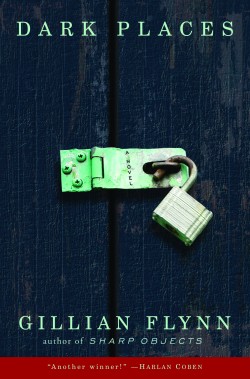 Dark Places, by Gillian Flynn (2009). Libby Day is the sole survivor of the “Satan Sacrifice of Kinnakee, Kansas,” and it’s her testimony that sent her metal-obsessed brother Ben to prison for butchering their mother and two sisters. More than twenty years later, Libby has milked the tragedy dry. Desperate for cash, she agrees to investigate the murder on behalf of the Kill Club, a group of obsessives certain she got everything wrong.
Some of the final plot turns strain credulity, and Flynn has a thing for coining hyphenated words. On a single page, Libby trance-drives past dusk-black elevators that she views with kitten-round eyes. This koala-cute authorial tic can be cough-syrup-cloying, but it’s a small price to pay for a supple voice that bounces between past, present and three distinctly different viewpoints to tell a haunting story of lives teetering on the precipice of disaster long before any blood is shed.
The Ancient Rain, by Domenic Stansberry (2008). An elegiac Shamus Award nominee. Ex-cop and ex-spook Dante Mancuso is drawn into an investigation of a 1970s bank robbery staged by political activists, reawakened by and filtered through the paranoia of the months after September 11. Stansberry nails the mood of 2002 perfectly, as well as Dante’s sense of bearing witness to the slow-motion demise of San Francisco’s Italian community. The Jerusalem File, by Joel Stone (2009). Europa Editions delivers again, with this posthumous novel by Pulitzer Prize nominee Stone. Retired Israeli state security agent Levin finds himself working as a private investigator when a sort-of friend asks him to shadow the wife he’s sure is being unfaithful. Again, the voice is the draw here, combining the world-weariness of Le Carré with the vinegar of Simenon. Or, to put it another way, it’s a tale told by God if He were in fact George Sanders. (For the record, that’s a universe I want to live in.) This brief novel is one of the best of the year.
The Informant!, (2009). Proof that Hollywood does sometimes get it right. When I read Kurt Eichenwald’s book, I felt that he didn’t grasp how truly bizarre – and funny – the material was. But Steven Soderbergh, writer Scott Z. Burns and company certainly do, nailing a tricky tone from the outset. Burns’ adaptation is a marvel, deploying voiceover to great effect and paying it off at the end. Extra points for the score by Marvin Hamlisch, the pride of Queens College.
Tuesday, September 15, 2009
Movie: Shield for Murder (1954)
The best film criticism compels the reader, through idiosyncratic perspective and felicitous turns of phrase, to seek out a movie destined to disappoint. To wit, from Dark City: The Lost World of Film Noir by my friend Eddie Muller:
While THE PROWLER is subtle and complex, unwinding with a seductive rhythm, SHIELD FOR MURDER is a drum solo by a club-footed spastic.
Brother, I am in.
And I’m not even that big a fan of The Prowler, a movie more interesting to think about than to watch. But the comparison made Shield for Murder a must-see.
Edmond O’Brien (who co-directed) is Detective Barney Nolan. Not bent but broken, cracking under the strain of too many hard hours for too little pay, Barney’s decided to make his move. He’s going to off a bookie, pinch his roll, and light out for suburbia with his girl. All he’s got to do is hoodwink his protégé. And handle a deaf-mute witness. And deal with his own lousy luck.
Not exactly new ground, that story (from a novel by William P. McGivern). Still, it’s fertile B-movie terrain. Yet Shield limps out of the gate, inert from the first frame and devoid of suspense. It was clearly shot on the cheap; the opening sequence features the most egregious traveling boom shadow I’ve ever seen, and I’ve seen plenty.
Marla English as Nolan’s girl is easy on the eyes but hard on everything else. John Agar is, well, John Agar-like playing Nolan’s partner. The usually reliable O’Brien must have read all those press clippings singling out his ability to convey sweaty desperation. Nothing else would explain the directorial choice to include multiple close ups of O’Brien looking sweaty and desperate. The grace notes come courtesy of a well-filmed shootout at a crowded high school pool and a few familiar faces in the supporting roles, most notably a blonde Carolyn Jones in the movie’s best scenes as a brave-face barfly.
Verdict: I’m with Eddie. At least now I can cross "experience drum solo by club-footed spastic" off my bucket list.
Sunday, September 13, 2009
Miscellaneous: Vamping
Sorry, kids. Multiple deadlines and big plans have me jumping. Standard operating procedure would be to post the video for “Crucifed” by Army of Lovers – you know, the band featuring my first wife, my half brother Nils, and the guy who handles my landscaping, and I ain’t talking about yard work. But the geniuses at MTV Music have taken their copy down, and once you go digital you never go back. (For you completists, here’s the considerably less crisp YouTube version.)
These days the last refuge of a scoundrel is his Twitter feed. So why not read this excellent interview with Walter Hill, one of my filmmaking heroes? Or play Little Wheel, a beautiful (and short) Flash game featuring a great soundtrack? Real posts coming soon.
Monday, September 07, 2009
Sort Of Related: Richard Stark Edition Effective may not sound like the highest compliment. But it is in the world of Parker, the professional thief created by Donald E. Westlake under the pen name of Richard Stark.
And the new graphic novel adaptation of The Hunter by Darwyn Cooke is brilliantly effective. Cooke’s clean, dynamic art, rendered with a sharp eye for early ‘60s detail, suits Stark’s stripped-down prose perfectly. The result is the best interpretation of the character to date, and that includes the two cinematic versions of this book. It’s a potent moment when Parker finally raises his face to a mirror and we see his grim Jack Palance mug. But it’s the blank eyes of the wife who betrayed Parker and left him for dead that fully reveal the power of Cooke’s style.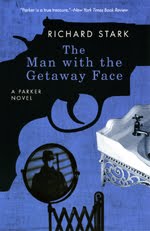 Reading the comic triggered a hunger for Stark in pure form so I read the second entry in the series, 1963’s The Man with the Getaway Face. (Cooke’s take on this book will be published next summer.) Parker’s gotten plastic surgery after the events of The Hunter. Desperate for cash, he signs on for a heist that he already knows comes with a double-cross. His only hope is to beat his supposed partner to the punch. But there are unexpected complications, including one involving Parker’s new look. Do I even have to tell you it’s good?
Elsewhere, critic Paul Matwychuk goes on a Parker roll, watching three movies about the character in a row.
Saturday, September 05, 2009
Movie: Manhandled (1949)
In the annals of film noir, surely no actress has made a greater impression than ... Dorothy Lamour?!?
Hope and Crosby would be shocked to find Dottie on The Road to Ruin in this not-on-video rarity. Alan Napier, Alfred the Butler on TV’s Batman, looms Easter Island-like over the rest of the cast as a writer – the right kind, he thinks, not one of those blasted pulpsters – plagued by recurring dreams in which he murders his jewelry-bedecked unfaithful wife. He visits the office of a psychiatrist, where Dottie works, to figure out what these dreams might mean. Guess what happens next.
Manhandled is the Patient Zero in an epidemic that has infected many contemporary thrillers. It suffers from ELS: Everybody’s Lying Syndrome. No one in this movie is on the level with the exception of Sterling Hayden, who turns up half an hour in as an insurance investigator (and is the only person who comes close to Napier in the height department). Even our Dottie stretches the truth to the breaking point. Once you realize you can’t trust any aspect of the story, the whole enterprise starts to feel insubstantial.
In another ahead-of-its-time trope, each supporting player is given a specific bit of business to define his character, which is promptly run into the ground. This does, however, set up one of the lamest comic closing scenes in film history. Oh, and the cops behave like idiots throughout.
So why did I like this movie? Two words: Dan Duryea. Sporting an unholy combination of loud bowtie, dark shirt and sweater vest, he’s at his sleazy best playing a shady-cop-turned-shamus. (And yes, he slaps Dorothy Lamour.) Duryea topped off his tank of ingratiating smarm for this one, and his engine keeps running long after the rest of Manhandled has gone into a ditch.
Friday, September 04, 2009
On the Web: More Playboy’s Penthouse
What say we kick off the holiday weekend with a little music? These clips will give you a sense of the variety show I wrote about yesterday, and spare you the indignity of looking up Playboy’s Penthouse online. Safe search, my ass. My computer may never forgive me.
First up in Hef’s pad is Frances Faye, one of the premiere nightclub entertainers of the era. Listen to her album Caught in the Act and tell me I’m wrong. With the awe-inspiring Jack Costanzo, aka “Mr. Bongo.” Part one is below, and here’s the rest.
You can also enjoy the folk duo Bud & Travis in the first of three parts. Playboy’s Penthouse booked a range of artists – jazz, cabaret, folk – and let them perform several songs in a mini-concert that provided a real flavor of their shows. Better than the band doing one number before the infomercials start.
Thursday, September 03, 2009
DVD: Playboy’s Penthouse
The first lesson learned from watching two episodes of Hugh Hefner’s 1959-60 variety show while waiting for the next Mad Men to air: hipsters actually talked like, you know, hipsters, man. Lenny Bruce even snaps his fingers during his patter, like he’s covering for the bongo player who’s busy chatting up some broad.
Playboy’s Penthouse is one strange program. The idea is we’re attending a party at Hef’s title pad. There are camera glitches galore – get that girl outta there! – compounded by the fact that the guests are downing actual cocktails. Hef tackles the dual roles of interviewer and master of ceremonies when he’s not qualified for either one. He clings to his pipe for dear life throughout. The pilot has the feel of a shakedown run, the show structured along the lines of an issue of the magazine. A truncated segment on a newfangled kitchen-in-a-cabinet comes off like a lifestyle piece that you’d page past.
I appreciate Lenny Bruce’s role in the history of comedy, but I’ve never found him funny. His appearance as the first guest did make the show feel like a party, in that I wanted to wander off, refill my glass and inspect the host’s medicine cabinet.
But the oddness of the conceit only adds to the fascination of these shows. Nat King Cole drops by and doesn’t sing. He just ... hangs out. Rona Jaffe talks about writing The Best of Everything and it manages to sound like a genuine conversation.
The musical segments are where the shows really lift off. Cy Coleman, who composed the now-famous “Playboy’s Theme,” performs “You Fascinate Me” with a centerfold at his side and it turns into a spry, sexy, little horn-rimmed number. Sammy Davis Junior does an electrifying set.
There’s talk about the Playboy philosophy, which apparently revolves around having a good hi-fi. To be fair, Hef does a fine job of explaining it in an accompanying 2006 interview. It boils down to figuring out who you want to be, then pretending to be that person until you are that person. Turns out I’ve been following Hef’s lead for years without knowing it. I’m here to say his approach works surprisingly well.
These shows are a time capsule of a moment when popular culture was broader. Jazz and theater were common currency, proven in a Teddi King novelty song that assumes a familiarity with Tennessee Williams and William Inge. I’m happy to meet someone who knows Brandon Inge. They also capture the last instants before hip became cool. Hip was adult. Cool is adolescent. Hip, as exclusionary as it was, at least rewarded effort. You had to work to find the cutting edge stuff, and then act as if you hadn’t tried. Cool only focuses on that last part.
The rest of the shows in this collection are from Playboy After Dark, Hef’s 1969 variety series. Only ten years had passed, but it was a completely different era. I’ll watch the later shows, but I doubt I’ll find them as interesting.
UPDATE: I dig up some clips from the show here.
Sunday, August 30, 2009
DVD: The Last Lullaby (2008)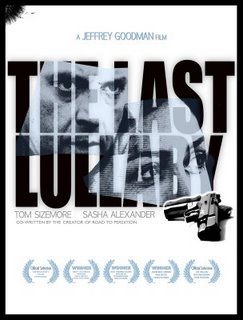 The Last Lullaby is a throwback, deliberately so. It’s a taut, low-key crime drama, more interested in character than chaos, with the feel of a Gold Medal paperback. That may be to its financial detriment; the filmmakers ultimately distributed the movie themselves after a long run on the festival circuit. An upcoming DVD release should allow Lullaby to find its audience.
Max Allan Collins co-wrote the movie, based on his short story “A Matter of Principal.” Tom Sizemore plays a hit man settled into uneasy retirement who finds himself drawn back into the life, only to experience complicated feelings for the woman he’s meant to kill.
Lullaby benefits from its deliberate pace. That’s not to say that it’s slow, but that it’s set in a world where actions have consequences and the movie has the confidence to allow them to play out. Sizemore gives a revelatory performance as a genuine tough guy who knows he doesn’t need to shout in order to make himself heard, and there’s a delicacy to his scenes with his target (Sasha Alexander). Lullaby could also be eligible as the Best Foreign Film entry from America, a nation of highways and chain restaurants, of small towns with their own rhythms. There’s a scene where Sizemore’s character meets the man who hires him at his lake house. It’s not Hollywood’s idea of a big spread, but in plenty of places it’s exactly what a rich man’s digs look like.
Lullaby’s director Jeffrey Goodman has been chronicling the film’s release at Moviemaker magazine.
Monday, August 24, 2009
Miscellaneous: San Francisco Treats
Back from a long weekend in San Francisco, my home away from home (Seattle) away from home (New York). Good friends, good conversation and good cocktails abounded. Among the highlights was a visit to Mission Dolores, part of an ongoing pilgrimage to the locations used in Alfred Hitchcock’s Vertigo. Alas, it wasn’t open. But I have it on good authority that Carlotta Valdes isn’t buried there anyway.
We spent an entire day at SFMOMA, which currently has some extraordinary exhibits. Georgia O’Keeffe and Ansel Adams: Natural Affinities does what every museum show should, which is make you see an artist or in this case two of them in a new way. Running concurrently is an extensive display of photographs by Richard Avedon. Plus there’s SFMOMA’s impressive permanent collection and the new rooftop sculpture garden. It’s one of my favorite museums. Also stopped in at the Museum of Performance and Design’s tribute to Noël Coward. Personal papers and photographs galore, not to mention dressing gown after dressing gown after dressing gown. I’ve always admired Coward, but after seeing this exhibit he’s now one of my heroes. He came from nothing and transformed himself into the epitome of international style and sophistication by cultivating that image. He lived the life he wanted by living the life he wanted. There’s a lesson there. Some choices quotations from the man: “I can’t sing, but I know how to, which is quite different.” And, “The only way to enjoy life is to work. Work is much more fun than fun.” Speaking of which, I’d better get back to it.
Thursday, August 20, 2009
Sort Of Related: The Amateurs, by Marcus Sakey (2009)/Julia (U.S. 2009)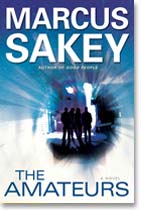 The latest novel by Marcus Sakey nails that stage in life when potential begins to curdle into disappointment. Four Chicago friends meet regularly for drinks every week. All of them unattached, in their 30s, and wondering what happened to the fabulous lives they were going to lead. When one of them is pulled by his boss against his will into a drug deal, they decide to steal the money for themselves. But the job doesn’t go as planned. The foursome may not be as close as they thought. And what they’ve stumbled into is no ordinary drug deal.
The lead characters are drawn with plenty of shading and rough edges. There are sharp observations about friendship and aging. A passage early on sets the tone, when the sole female member of the group talks about how going out on Saturday night once meant feelings of lightness and possibility. Now she fills days and waits to turn into her mother. The Amateurs also captures the mood of those months in 2008 when Americans felt impotent collective rage at the collapse of the financial system and the associated lack of accountability. A strong piece of work.
Speaking of people who should not undertake lives of crime ...
(You see? There are themes to these entries.)
Julia played the festival circuit, received an abbreviated theatrical release, and is out this week on a bare bones DVD. It’s a two-and-a-half-hour character study-cum-crime drama. And it demands your immediate attention.
Tilda Swinton plays the title role, a self-destructive L.A. alcoholic blazing her own path to hell. At an AA meeting she meets a fellow sufferer who presents her with a deranged plan: kidnap my son from his wealthy grandfather. Julia, at the end of her long, unraveling rope, goes along with it.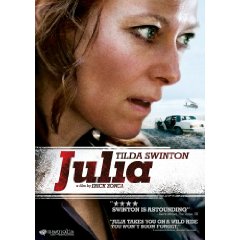 The crime in this movie is not that of big-budget thrillers or gritty noir novels that tout their realism. This madness is right out of a police blotter, caprice and coincidence colliding with bad planning and poor impulse control. Harrowing.
Julia is also one of the great depictions of a hardcore drunk. The character is always ready with blame and an excuse. Her highs are believably high, her lows degrading. Swinton is simply astonishing, serving up the addict’s quicksilver shifts from confidence to rage to petulance. It’s a titanic performance.
The movie is a messy ramble, at times maddening but always fascinating. That’s only fitting for a film inspired by John Cassavetes and specifically Gloria. How odd is it that for all Cassavetes’ influence it’s a movie he tossed off as a lark that has spawned remakes official and unofficial?
Sunday, August 16, 2009
Miscellaneous: Whip Round #1
Many projects moving forward at once, so expect more posts like this. Alighting on multiple topics with no diminution of my customary acuity.
The Girl Who Played With Fire, by Stieg Larsson (2009). I was not the only one who fell hard for Larsson’s debut, last year’s The Girl With The Dragon Tattoo. Which makes this follow-up so disappointing. Larsson’s old-fashioned style suited the first book, essentially a locked-room mystery set on an island. Without that setting, Larsson’s voice simply seems plodding. (Bad news is delivered by the cops. “Berger’s mouth dropped open. Blomkvist looked as if he had been struck by lightning.”) I read all 500 pages, shopping lists and trips to Ikea included, for one reason: Larsson’s beguiling creation Lisbeth Salander, a sort of real-world version of William Gibson’s Molly forged by cruelty and institutional neglect. I’ll tackle the last entry in the series for that reason, too.
The Shimmer, by David Morrell (2009). Morrell uses the mysterious Marfa lights as the basis for a conspiracy thriller. He shrewdly reinvents Marfa as Rostov, Texas, even fictionalizing the filming of Giant in the town. The only thing missing is an alternate reality Donald Judd. But for all Morrell’s skill at creating tension, it’s the human moments that register most strongly. When New Mexico cop Dan Page discovers the reason why his wife fled their home to visit the lights, there’s no supernatural explanation. Just pure heartbreak.
Julie & Julia (2009). Somebody has to admit it, so I will: I enjoyed the Amy Adams scenes. I enjoyed the whole thing.
College Swing (1938)/Back to School (1986). I read an interview with David Letterman years ago in which he cited Bob Hope as an example of someone who, perhaps, stayed too long at the fair. Watching his early film College Swing, I understood what Dave meant. Hope’s hustling coward character still feels unbelievably fresh and modern. The script, an excuse to link together songs and novelty acts, gets some zing from an uncredited Preston Sturges. Gracie Allen has some great moments, and there’s a Jerry Colonna bit that’s priceless. Also with a fully-haired Jackie Coogan cutting a rug with then-wife Betty Grable. A few days later I stumbled onto Back To School, which uses several of the same plot elements. Featuring New Wave Robert Downey, Junior and his future director Keith Gordon. God, I miss Rodney Dangerfield.
Tuesday, August 11, 2009
Movie: The Carey Treatment (1972)
Michael Crichton wrote novels to put himself through Harvard Med. Because really, what else did he have to do? I’m sure he also had a paper route. This not-on-DVD adaptation of Crichton’s Edgar Award winner A Case of Need, published under the pseudonym Jeffery Hudson, aired on TCM. The draw for me was the fact that it was directed by Peter Gunn guru Blake Edwards.
James Coburn plays a rock star pathologist recently arrived in Boston. When his friend (character actor James Hong in what may be the most solid part he’s ever had) is charged with killing the daughter of the chief of surgery during an abortion, Coburn launches his own investigation. It’s CSI: House in the swinging ‘70s, with a jazz score by Roy Budd (Get Carter). Director Edwards was not happy with the final version; neither were the screenwriters who took their names off the movie. Crichton’s plot still works when the movie remembers it, but there are too many suede jacketed “let’s just be, baby” scenes. Which, to be fair, do add to the overall entertainment value. For that matter, so does a kinky massage interrogation between Coburn and former Beyond The Valley of the Dolls star/future Turner & Hooch screenwriter Michael Blodgett.
Coburn can be a strange presence, as Steve Lewis observed last week. I wouldn’t go as far as Steve, but I do see his point. Coburn often manages to come across as simultaneously cool yet insubstantial. When I watch one of his movies I’m reminded of the line from The Limey when Peter Fonda is told he’s not so much a person as a vibe. That’s true in spades here. But sometimes a vibe is all you need.
Sunday, August 09, 2009
Passings: Budd Schulberg and John Hughes
It’s facile to compare the lives of two people who die within days of each other. Individuals whose names would ordinarily never be spoken in the same sentence are irrevocably joined. They’re linked only through quirks of fate and the calendar, yet the mind can’t help making connections, drawing parallels.
Budd Schulberg died on Wednesday after a full life at the age of 95. His legacy includes What Makes Sammy Run, one of the essential Hollywood novels. On the Waterfront, which he wrote, remains both a gripping drama and a maddening artifact of a troubled American era. (Schulberg testified voluntarily before HUAC and named others working in Hollywood who had been members of the Communist party in the 1930s.) A Face in the Crowd, with its homespun media demagogue, has lost none of its prophetic power. Schulberg’s long tenure as a boxing correspondent yielded the novel (and eventually the film) The Harder They Fall.
John Hughes died on Thursday, too young at age 59. He had largely retreated from filmmaking. Every few years there would be a swirl of rumors that he’d return to directing, and I always hoped he would.
I was a teenager during Hughes’s glory years in the 1980s, so you’d think that his movies meant the world to me. You’d be wrong. I still haven’t seen Sixteen Candles in its entirety. My first exposure to The Breakfast Club was on VHS at a friend’s “movie party.” I didn’t succumb to Ferris Bueller’s Day Off until late in its run. I actively resisted the Hughes oeuvre at the time. I didn’t need movies about adolescent misery by some pandering adult; I was living it. (I was a pretentious little ass in those days. I’m a pretentious big ass now.) It’s a tribute to Hughes’ particular genius that my blind impulse for self-preservation is one he would have readily understood.
The Breakfast Club may be glib, but its depiction of high school is unerring. We cling to our labels even as we long to shed them. Bueller is Hughes’ greatest achievement, a daft charmer about the porous boundary between youth and adulthood. You can worry to excess as a kid – it will surprise no one to learn that Alan Ruck’s Cameron was the first movie character I ever truly identified with – and you can forget as a grown-up that taking time for yourself is easy and vital. The Vacation movies, or the first and third ones at any rate, expose the truth that parents are slaves to expectation as much as their offspring are. They’re also funny as hell.
It’s unfair to knock Hughes for the narrow focus of his films. Life got small before the pictures did. Schulberg wrote about the wider world, about the complex systems of institutions and the demands they make on individuals, because he could. Hughes took as his subject the everyday woes of white suburban teenagers and the white suburban parents they became, because by the 1980s that was all audiences cared about. (I warned you upfront that these comparisons would be facile.) Each man engaged with the issues of his day and thus helped to define his era. I bow my head to mourn them, as well as a time when movies were more interesting.
Read Schulberg’s essay on his experience of working with F. Scott Fitzgerald. Thanks to Ed Gorman. Also read about Hughes’ uncommon generosity to a young fan.
Wednesday, August 05, 2009
On The Web: Ed Gorman
Ed says far too many fine things about the Noir City Sentinel. Such as, “I’ve never read a book on noir that was as informative and just as much as downright fun” as the latest issue.
Go read it for yourself. Then kick in a few bucks to the Film Noir Foundation and have the goodness delivered straight to your inbox.
Speaking of noir ...
DVR Alert: Glenn Ford
As part of their Summer Under the Stars festival, Turner Classic Movies is dedicating this Friday, August 7, to the films of Glenn Ford. Gilda understandably gets pride of place, with the original 3:10 to Yuma not far behind. (One of Ford’s best known noirs, The Big Heat, will air on August 13 as part of Gloria Grahame Day.) Among the lesser known Ford films are two that I can heartily recommend.
The first is Framed (1947), airing at 4:45PM EST/1:45PM PST. I saw this one at Noir City. Take advantage of this rare opportunity to enjoy Janis Carter, all legs and cheekbones and wildly darting eyes, in her I’m-gonna-say glory.
The other is 1949’s The Undercover Man (10PM EST/7PM PST). TCM ran this neglected film for the first time last month, and I’m glad they’ve got it on the schedule again already. Expert noir hand Joseph H. Lewis (Gun Crazy, The Big Combo) directs this account of Treasury agents scrambling to take down Al Capone, referred to throughout the film solely as “the Big Fellow.” Featuring a dandy performance by Barry Kelley as a Mob lawyer who’s got almost all the angles figured, a hair-raising foot chase scored to the plaintive cries of a little girl, and a scene with Esther Minciotti as an Italian immigrant whose speech about America, translated by her granddaughter, is guaranteed to put a lump in your throat. Watch it and tell me I’m wrong.
Monday, August 03, 2009
Sort-Of Related: Get Real, by Donald E. Westlake (2009)/Made in U.S.A. (1966)
That there’s not a pall hanging over Get Real, the last novel completed by Donald E. Westlake before his death last year, is a testament to how funny the book is, how sharp Westlake’s eye was. Only when it ended did it truly sink in that we won’t get another John Dortmunder book.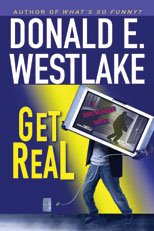 The sad-sack criminal mastermind and his gang of misfits are between heists when the strangest of all opportunities comes along – their own TV show. A company that produces reality television has the brilliant idea of following the crew while they plan and execute a job. Dortmunder agrees to play along as cover for an actual caper. There are a few snags, naturally. Like, how do you put professional thieves on salary? How do you steal something and get away with it while cameras are rolling? But the biggest problem is one that Dortmunder doesn’t see coming: Andy, Tiny, even Dortmunder himself kinda like being on TV.
The reality genre – which shapes the truth, into entertainment – takes plenty of well-deserved hits. There are some sly observations about the acting life, which crops up often in Westlake’s books, plus a few bits of business that will only be funny to New Yorkers. Things don’t exactly work out – that wouldn’t be Dortmunder – but they go less wrong than usual, and our last glimpse of the hangdog burglar is him rounding a corner with something that’s almost but not quite a spring in his step. It’s a nice sendoff for the character.
Coinciding with Get Real’s release was the debut of Made in U.S.A. on DVD. Jean-Luc Godard’s film was based, theoretically, on The Jugger, one of the Parker novels that Westlake wrote as Richard Stark.
I knew going in that the film bears no resemblance to the source novel, that it was made hastily under bizarre circumstances, that Westlake himself hated it. Here, I’ll quote him: “it’s such a rotten movie.” Godard films, even ones I like, leave me a little cold. But I’m a Westlake completist, so I had to check it out.
Or at least I had to try. I tapped out after forty minutes, and only lasted that long because of Anna Karina. I did watch the entire 20 minute short film on the new Criterion disc cataloging Godard’s many political and cultural references. A writer in the movie is named David Goodis. Daisy Kenyon is paged at a health club. It’s eighty-five minutes of meta-rib-ticklers and preening self-regard.
Rosemarie’s review: “Movies like this make me appreciate the Jonas Brothers.”
Say what you will about Kevin, Joe and Nick – and if you talk trash about Joe, I will so NEVER SPEAK to you AGAIN – you can at least understand how some people find them entertaining. Made in U.S.A., on the other hand, exists simply to make those who “get it” feel superior. That’s not true to the serie noire spirit Godard claims to be honoring. It’s certainly not true to the ethos Donald E. Westlake embodied. I’m fairly sure I know whose works will stand the test of time better.
Westlake is having quite a few weeks. Also out now is Darwyn Cooke’s graphic novel adaptation of the first Parker novel The Hunter. I ordered myself a copy as a birthday present. Speaking of my birthday ...
Miscellaneous: Meaningless Milestones
... it’s today. I’m not picky. Making the check out to cash is fine.
Friday, July 31, 2009
Book: Bury Me Deep, by Megan Abbott (2009)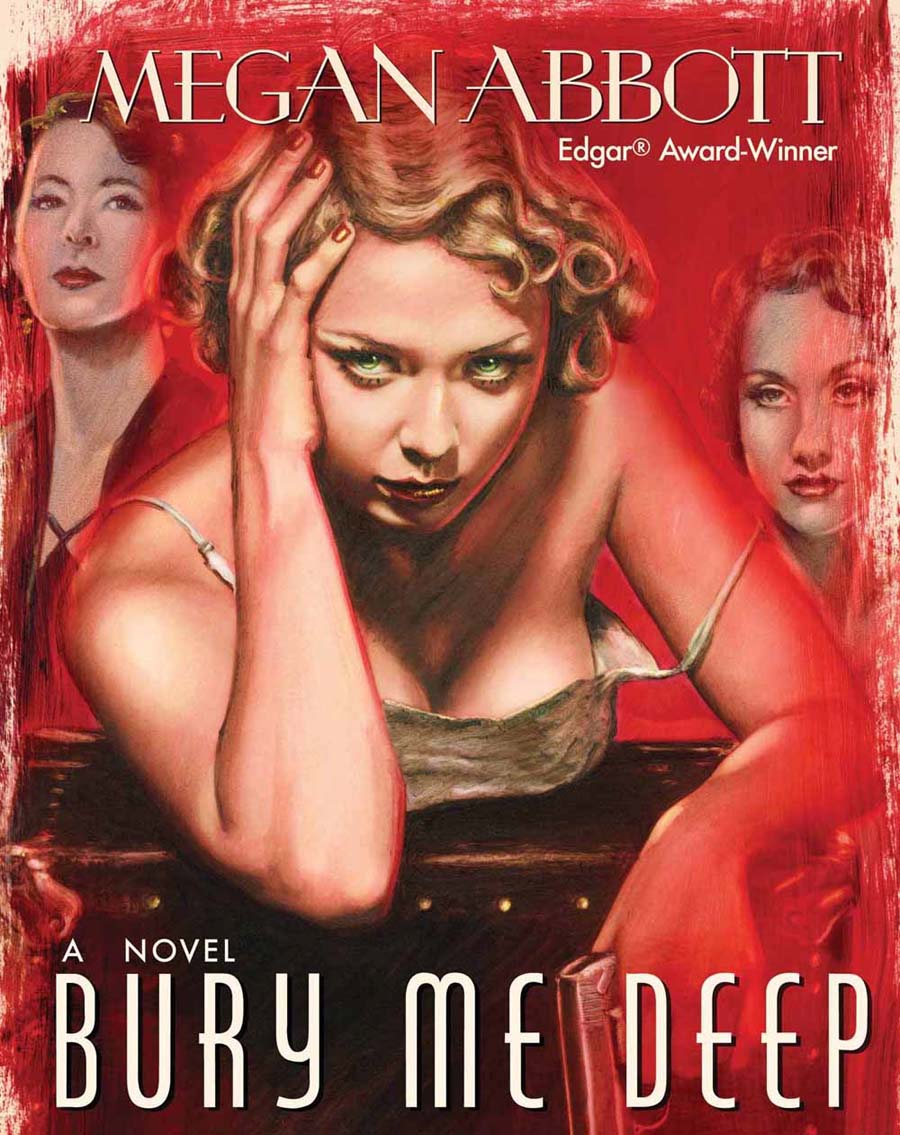 It’s been so hot in Seattle that I can barely string two ... dammit, it’s on the tip of my tongue. You know, a unit of language that acts as the principal carrier of meaning. Anyway, I can barely string two of those things together, but I can’t let any more time pass without singing this book’s praises. It’s that good.
Abbott’s follow-up to the Edgar Award-winning Queenpin is inspired by “Trunk Murderess” Winnie Ruth Judd. Normally, I’d link to some background on the case, but you won’t find a better summary than the one Abbott provides at the end of her novel. Besides, you don’t want to know too much about how actual events played out, especially when Abbott deviates from the facts to unearth a larger story.
In 1931, Marion Seeley is alone in the strange city of Phoenix after her drug addict husband takes the only job he can get south of the border. Innocent young Marion becomes friends with both a nurse at the clinic where she works and the nurse’s tubercular roommate. She also becomes fascinated by their lifestyle, entertaining wealthy businessmen. Marion falls for one of these men, learning some disturbing truths about her own needs and desires. Abbott describes this intimate struggle for control in evocative language that can blindside you with its force.
Then things get worse, and Abbott lays that out in a relentless manner that would do Cornell Woolrich proud.
Hell, just look at the cover. You know you want to read it. Go ahead.
Monday, July 27, 2009
DVD: Golden Age Noir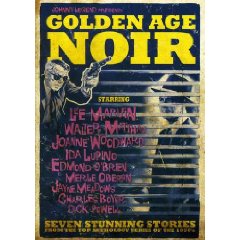 The role of television is an under-reported chapter in the evolution of film noir. The small screen supplemented and eventually supplanted the B movie, attracting talent from both sides of the camera. Many of these shows, episodes of various anthology series of the 1950s, no longer exist.
Cultural impresario and freelance wild man Johnny Legend is doing his best to rectify the situation. His Raunchy Tonk Video label has released Golden Age Noir, a DVD containing seven blasts from the past. They’re from a variety of series, with an emphasis on name actors.
Sound Off, My Love (Four Star Playhouse, 1953). Merle Oberon stars as a woman too vain to admit she requires a hearing aid. She relents only to discover that she hasn’t been fooling anyone – but several people have been fooling her. Starts slow but picks up thanks to direction by old noir hand Robert Florey (Danger Signal).
Dark Stranger (the premiere of The Star and The Story, 1955). Edmond O’Brien is a pulp writer who falls in love with a woman (Joanne Woodward) who may be his own creation. It bears a resemblance to Stranger Than Fiction.
The Squeeze (Four Star Playhouse, 1953). Gambling house owner Willie Dante (Dick Powell, who played the role several times) gets pressured by the ne’er-do-well son of a crusading D.A. Sharp script by Blake Edwards – have I mentioned I’m still on a Peter Gunn kick? – and direction by Robert Aldrich.
F.O.B. Vienna (Suspense, 1953). Hooey about an American engineer caught up in European espionage. Director Robert Mulligan strains against the limitations of live TV. It’s a dud, but it stars Walter Matthau, so what are you gonna do?
House For Sale (Four Star Playhouse, 1953). A house-hunting Ida Lupino encounters escaped lunatic George Macready. Minor fun.
Counterpoint: The Witness (1952). A true rarity, the sole episode of a cop series starring Lee Marvin several years before M Squad. It’s about a botched robbery and the resulting murder of a burlesque clown. With some great gritty locations and a few odd David Lynch-style moments, but it’s easily the worst of the bunch. The show is set over three city blocks but features more walking than the Lord of the Rings trilogy.
A Place of His Own (Four Star Playhouse, 1953). A mentally damaged WWII veteran is coerced by his family into taking the blame for a murder he didn’t commit. The winner, hands down, with a fine performance by Charles Boyer.
The disc is a fascinating peak into a neglected era of film noir. Johnny’s already got a second volume set for release next month, along with a sex-and-drugs Dragnet compilation that I should order right now.
Sunday, July 26, 2009
Movie: Bunco Squad (1950)
It’s been a strange week. Several new projects cropped up, and I ceded control of the television to Rosemarie for five nights so she could watch Torchwood: Children of Earth.
I was able to squeeze in a few short items, like this movie recorded off TCM in the wee hours. How could I resist a title like Bunco Squad? Plus it’s about phony psychics, and you know how I feel about them.
Robert Sterling is the wooden detective in the titular unit. His aspiring actress girlfriend is played by Howard Hughes discovery Joan Dixon. Hughes certainly had a type: skittish brunettes who couldn’t convey fear if their hair was on fire. Sterling, at the request of a lieutenant who has never missed a meal, engages in some baffling police work to track down a ring of sham spiritualists. They’re led by Ricardo Cortez, more animated here than he was playing the first Sam Spade. Their target is a kindly rich woman mourning her dead son. Sterling’s brilliant plan is to set Dixon up as another fake fortuneteller, preying on the poor grieving mother’s emotions for the greater good. I’m sure the idea made sense to Lieutenant Are-You-Going-To-Finish-That on paper.
Bunco Squad is crap, but it’s fast-moving crap. Director Herbert Leeds churned out entries in the Cisco Kid, Charlie Chan, Mr. Moto and Mike Shayne series, so he knew how to move things along. There are some interesting tidbits explaining how mendacious mediums work. Dante, once known as “king of magicians,” appears as himself, aiding the police in their inquiries. You also get a ridiculous fight scene a la Mummenschanz. And Cortez and his cronies can only kill people by tampering with their brake lines. It happens not once, not twice, but three times in 67 minutes. Not that that establishes a pattern or anything.
DVD: The Paul Lynde Halloween Special
Why did I watch this now? Good luck trying to rent it in October. You can’t get near the thing. The Lynde special aired exactly once in 1976, and was then thought lost. They haven’t found the full eight-hour cut of von Stroheim’s Greed, but they did dig this one up.
It features every All Hallows’ Eve staple: witches, CB radio, and sketches spoofing Valentino. There’s also Kiss making their TV debut, but none of their numbers is anywhere near as scary as Florence Henderson’s rendition of “That Old Black Magic.”
Also on the show is Roz (Pinky Tuscadero) Kelly. Pinky is the character she played on three episodes of Happy Days. That’s how she’s billed. Lynde even announces her name that way in the wrap-up. It’s like putting an expiration date on her fame. “You’ll get fifteen minutes if you’re lucky, sweetheart.”
Here, for your viewing pleasure, is the closing disco number. Don’t let the three-minutes-plus running time fool you. It seems much longer.
Tuesday, July 21, 2009
Cocktails: Words of Wisdom
"A proper drink at the right time – one mixed with care and skill and served in a true spirit of hospitality – is better than any other made thing at giving us the illusion, at least, that we’re getting what we want from life. A cat can gaze upon a king, as the proverb goes, and after a Dry Martini or a Sazerac Cocktail or two, we’re all cats."
- From Imbibe!: From Absinthe Cocktail to Whiskey Smash, a Salute in Stories and Drinks to “Professor” Jerry Thomas, Pioneer of the American Bar, by David Wondrich
Truer words never written, and ones that came back to me last night in my favorite bar while enjoying a variation on the Battle of New Orleans.
Sunday, July 19, 2009
Books: Bulletin From Hard Case Crime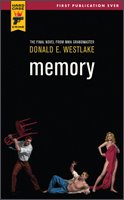 An extraordinary piece of news from Hard Case Crime this weekend. In April 2010 they will release Memory, a never-before-published novel by the late, great Donald E. Westlake. Westlake’s friend Lawrence Block provided them with the manuscript. Barring any additional discoveries, it will be the last novel we get from one of the greats. The opening chapter already has me clamoring for more.
DVD: On Guard (1997, U.S. 2001)
This sumptuous swashbuckler was recommended by author and fellow OSS 117 enthusiast Walter Satterthwait. It’s truly the kind of film they don’t make any more. Considering that it took four years to find an American distributor, they seldom release them, either. An acrobat and child of the road who falls in with a nobleman during Louis XIV’s reign must raise his friend’s young daughter in secret to protect her from a scheming relative. This movie has it all: hissable villains, hidden identities, real estate swindles, and hunchbacks aplenty. Plus too many swordfights to count. Technically, it should be called En Garde.
Or Le Bossu, as it was known in France. (The novel by Paul Féval, a contemporary of Alexandre Dumas, has been filmed six times.) There’s so much story that the third act felt a touch frantic; it’s the rare movie that would be benefit from being a few minutes longer. The conclusion initially gave me pause, but it’s all of a piece with the film’s swooning tone. Grand, old-fashioned entertainment. Thanks for the tip, Walter.
Movie: The Hurt Locker (2009)
I’ve been meaning to say this for a week. You won’t see a better action movie, suspense film, or drama this summer. Get out there and support this one.
Friday, July 17, 2009
Miscellaneous: Dick Tracy Meets The Phantom
In November 2008, the Los Angeles Times website featured this article on Warren Beatty’s federal lawsuit over control of the character Dick Tracy. Beatty bought the rights to the detective two decades ago and made the Oscar-winning 1990 film. According to the article:
The sale allowed Tribune, the original publishers of the classic strip, to take back the rights if Beatty didn’t film another project.
Tribune, which owns the Los Angeles Times, recently sent Beatty a letter saying time is up and it is reasserting control of the character. But the actor claims he should retain the rights because he started filming a Dick Tracy TV special earlier this month.
Imagine my joy upon opening the July issue of Now Playing, the Turner Classic Movies program guide, and seeing the following listed as airing as part of their salute to the character on July 18 at 7PM EST:
Dick Tracy Special (2009). Leonard Maltin interviews Warren Beatty as Dick Tracy, while film clips trace the history of the comic strip detective. BW&C30m.
I circled it in the schedule, and had the DVR ready to go.
Check the schedule now. Airing at 7PM EST on July 18 is Role Model: Gene Wilder, an interview with the comic actor by Alec Baldwin. I saw it when it first aired. It’s a fine show, as Mark Evanier will tell you. But it lacks the zest that only contractual obligation can bring.
In a March 25, 2009 Chicago Tribune article, Beatty’s attorney says, “He sold [the special], even though the contract doesn’t require him to do that. The contract doesn’t even require him to finish it. He just has to start it.” The article also notes that in promotional materials, “the half-hour movie chat between film critic Leonard Maltin and Tracy (played by Beatty), is simply called ‘innovative.’”
The special is listed as being in post-production in the IMDb. I honestly hope that Beatty completes it, and that it turns up on TV eventually. Something tells me it’ll be a hoot.
Monday, July 13, 2009
Book: Preston Sturges by Preston Sturges (1990)
Yes, I’m feeling much better now. Thank you for asking, and for the many cards and letters. It’s your strength that keeps me going.
My convalescence was sped along by reading Preston Sturges’ memoir, adapted and edited by the filmmaker’s widow Sandy from material Sturges was writing at the time of his death. I was hoping to glean some insight into that five year stretch, unparalleled in movie history, when Sturges made one dazzling comedy after another. The Lady Eve, The Palm Beach Story, Hail The Conquering Hero, so many more.
On that score, I was disappointed. Sturges doesn’t head for Hollywood until the last quarter of the book, and most of those pages chronicle frustration and financial woes. His advice is worth taking, though.
Money is not star material. One should never have enough of it, or enough lack of it, to allow of its playing a principal role.
If I’d had Sturges’ childhood, I’d have lavished attention on it, too. His mother Mary was a peripatetic Auntie Mame type. Whatever her flaws, she showed her son that the world was a place of great possibility. Through her, Preston met countless interesting people. He briefly shared a room with silent screen siren Theda Bara. Occultist Aleister Crowley called him a “brat.” His mother gave Isadora Duncan the scarf that led to her death.
Glamorous ocean voyages, romance with heiresses, disaster avoided with the help of wealthy benefactors. Sturges’ early years were out of a Sturges movie. Only someone who led a charmed life could make films so blithe. Yet another reason to be disappointed.
The Sturges family has set up a terrific website dedicated to the man and his work. Pay special attention to his eleven rules for box office appeal.
Maybe it’s better not to know too much about people whose work you admire. I thought that after reading Lawrence Block’s recent memoir, in which he evinced little interest in the questions I would have asked him. Maintaining a touch of mystery is a good thing, maybe a necessary one. Albert Brooks often talks about his odd friendship with Stanley Kubrick, who called him full of praise after seeing Modern Romance. (Kubrick told him he’d wanted to make his own film about jealousy, which became Eyes Wide Shut.) They spoke on the phone often, but when Brooks suggested meeting in person Kubrick said it would be a bad idea. After Francois Truffaut raved about James Toback’s Fingers, Toback wanted to get together. Truffaut declined, saying, “Let’s continue to communicate with each other through our films.” And then there’s the time Mel Brooks ... why don’t I let Mel tell the story?
Tuesday, July 07, 2009
Miscellaneous: Missive From My Deathbed
The title is pure hyperbole. A particularly intractable sinus infection has held me in its grippe for over two weeks. I feel like I can only muster a few hours of concentration per day, and those are needed for the paying gigs.
Example: Just now I was unable to think of the word hyperbole. I wandered into the other room and asked Rosemarie, “Isn’t there a term that means the use of exaggeration as a literary device?” I really ought to go back to watching baseball highlights, but with the Mets’ season going the way it is and my delicate condition, I could trigger something.
Still, I want to give. So I’ll say that I devoted my Independence Day ration of cogent hours to Michael Mann’s Public Enemies and was glad I did. I’ll also say that I’ve added Donna Moore’s Big Beat from Badsville to the links page, and you should be checking it out regularly.
Here’s how addlebrained I am. I almost tied together three articles I read today – Cass Sunstein’s exploration of how association with like-minded individuals breeds extremism; Roger Ebert’s levelheaded response to those who disagreed with his review of the Transformers sequel; and an analysis of how porn is abandoning plot and going fuck scenes only – with the Bing advertising campaign that gives me night sweats in an epic post about our mile-wide, inch-deep, instant-gratification culture. Then I remembered I was me and said to hell with it.
So instead, here’s Slate’s article on stuntmen’s favorite stunt movies. Along with one in its entirety, Claude Lelouch’s blistering Rendezvous. Watch to the end. It’s tres French.
Friday, July 03, 2009
Too Soon Gone: The Noir Legacy of Fabián Bielinsky
An edited version of this article appeared in the May/June 2009 issue of the Noir City Sentinel. To subscribe, become a member of The Film Noir Foundation.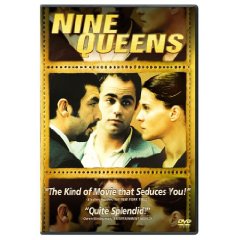 Two movies. That’s not much of a legacy. But the brief filmography of Argentina’s Fabián Bielinsky is enough to prove that, with his death in 2006, world cinema lost more than a gifted storyteller. After watching Nueve Reinas (2000) and the darkly glittering jewel El Aura (2005), Film Noir Foundation founder Eddie Muller said he was “so miserably sure that Bielinsky would have been the greatest writer-director of contemporary noir.”
Born in Buenos Aires in 1959, Bielinsky earned his stripes as an assistant director on over 400 commercials and numerous feature films. During this fifteen-year apprenticeship he worked on projects as varied as an ad directed by German auteur Wim Wenders and Eversmile, New Jersey (1989), an oddity about an itinerant dentist fated to be remembered as the other movie Daniel Day-Lewis made the year of his Academy Award-winning triumph in My Left Foot. In 1998, Bielinsky received his first above-the-line credit as one of three writers of the allegorical science fiction film La Sonámbula (Sleepwalker). He longed to make his own movies but felt hamstrung by an industry dominated by established names and prejudiced against genre fare. He ultimately made the transition to the director’s chair the way so many of the greats did – by winning a contest. The Patagonik Film Group selected his screenplay out of 350 entries in a 1998 competition, giving Bielinsky a green light and a modest $1.3 million budget. The resulting movie revolutionized Argentinean filmmaking.
Nueve Reinas (Nine Queens) is a con man caper with a distinctive Latin flavor, seasoned by the corruption endemic during Argentina’s fiscal crisis of the 1990s. Veteran grifter Marcos (Ricardo Darín) bails novice Juan (Gastón Pauls) out of trouble for his own selfish reasons; he needs a partner for the day, and his usual sidekick is unavailable. Marcos gives Juan a crash course in the art of the short con. Among his pearls is knowing when to act aggrieved. “The more offended you are, the less suspicious you look,” he advises his protégé. But plans change quickly when an aging confederate presents Marcos with a “once in a lifetime” opportunity – unloading a forgery of the title sheet of Weimar Republic stamps on a shady financier poised to flee the country. To make the score Marcos reaches out to his estranged sister, Juan risks his own nest egg, and each man will have to trust the other.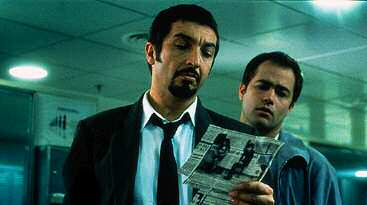 Bielinsky’s film is ferociously entertaining. Breezy yet tense, packed with reversals and plot complications but never difficult to follow, culminating in a note-perfect ending. Much of the film’s impact can be traced to the bravura sequence when Marcos points out to Juan the countless “mustard chuckers ... operators, swindlers” hiding in plain sight on the streets of Buenos Aires, watching for any hint of vulnerability on which to pounce. Bielinsky’s on-the-fly technique, which Darín described as “almost as if we were carrying out a raid or pulling off a heist,” only adds credibility. Nueve Reinas posits a world of tricksters and thieves, leavened by the wounded insistence of all involved that they are not crooks. Even the acquaintance offering Marcos a motorcycle with minor damage, namely a “small caliber” perforation in the gas tank, bristles at the accusation. It’s all just business.
Hollywood took note of Nueve Reinas’s international success, but Bielinsky resisted the call. An Americanized version happened without him. As remakes go, Criminal (2004) is not at all bad. It has a nice sense of scale, a game cast featuring John C. Reilly and Maggie Gyllenhaal, and a feel for the multicultural vibe of Los Angeles, beautifully shot by cinematographer Chris Menges. Producers Steven Soderbergh and George Clooney turn it into a scruffy, low-key cousin of their Ocean’s Eleven films. (Soderbergh cowrote the adaptation with director Gregory Jacobs under the name Sam Lowry, the Brazil-inspired pseudonym he used on The Underneath, his 1995 retooling of the classic noir Criss Cross.) Criminal’s primary problem is that it simply cannot compare with the movie that spawned it. It lacks the danger and unpredictability of Nueve Reinas. Some of the best beats and lines from Bielinsky’s film had to be cut because they were unique to the original’s setting. Take the ending. There’s no way it could be used in an American film. Actually, scratch that. It might work now.
Nueve Reinas has a jaundiced view of human relations, but Bielinsky’s noir sensibility would not reach full pungent bloom until his follow-up effort. El Aura, known as Dawn in Argentina, is a singular achievement, a truly existential film that comes across as an unholy combination of Richard Stark and Oliver Sacks. Its cunning use of traditional genre elements – fate, choice and chronic blackouts – makes it one of the finest cinematic noirs of this decade.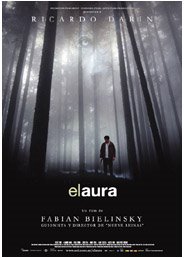 We meet the film’s nameless protagonist (Ricardo Darín again) lying amidst a swirl of ATM receipts, seemingly rehearsing for his own chalk outline. He’s not dead, just suffering from an epileptic fit. The character works as a taxidermist, bloodlessly applying logic to recreate the savagery of animals. As a colleague notes, he has “a weird fantasy for a taxidermist who’s never gotten in a fight with anyone,” and that’s plotting perfect heists he lacks the nerve to carry out. “It can be done neatly. It can be done well ... There’s no reason why anyone should die,” Darín insists. “Yes, there’s a reason,” his skeptical colleague replies. “There’s a load of guys with guns.”
Darín gets an unlikely chance to put his theories to the test. While on a hunting trip he accidentally kills a man, only to discover that his victim was an underworld figure whose plan to rob the local casino is already in motion. The taxidermist can step into the dead man’s role and live the fantasy he has long imagined.
Bielinsky’s growth as a filmmaker, from the effervescent charm of Nueve Reinas to the command on display in El Aura, is hugely impressive. Much of the latter movie plays with minimal dialogue, communicating information purely through images. Consider the sheer elegance of the way Bielinsky uses details in the background of shots to convey that the taxidermist’s wife has left him. He immediately follows this revelation with an extraordinary series of edits moving Darín from his apartment to the lush greenery of the Patagonian countryside. Darín suffers a seizure when he’s alone in the woods about to bring down a deer, and thanks to Bielinsky’s kinetic treatment of the incident we experience it right along with him.
But it’s the robbery scenes that showcase Bielinsky’s mastery. Early in the film, Darín waits with a fellow taxidermist to cash his check. As Darín explains how he’d loot the place, his scheme comes to life. It’s beautifully choreographed mayhem, the sad sacks in line behind them abruptly transformed into icy professionals, Darín and his associate blithely commenting on the action. Contrast this with the botched factory job that occurs halfway through the movie. Darín is no longer conductor but bystander. The sequence deftly illustrates the power and the impotence of bearing witness as Darín reacts to every gunshot and cry of agony, trying to piece together what went wrong.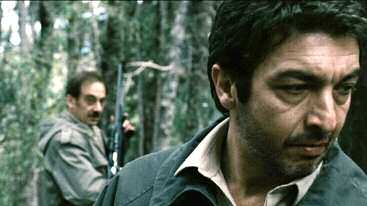 El Aura has style to burn, but Bielinsky knew that true noir is about character. He has an able collaborator in Ricardo Darín. The actor shines playing a man who takes refuge in his intellect as he finds his masculinity constantly questioned. He’s at his best during a halting speech to the dead man’s wife in which he explains the not-altogether-unpleasant sensation (the aura of the title) that precedes one of his neurological episodes: “There’s a moment, a shift ... things suddenly change ... The fit is coming, and there’s nothing you can do to stop it. Nothing. It’s horrible ... and it’s perfect. Because during those few seconds, you’re free. There’s no choice. No alternative. Nothing for you to decide.”
That sense of inevitability pervades the movie, ratcheting up the tension and coloring the taxidermist’s actions. Darín has ample opportunity to walk away from the situation, but his refusal to do so – or even to recognize those moments of opportunity – adds force to the ending, which is as bleak as can be. For the taxidermist everything has changed, but nothing is different. Chilling stuff.
Special mention must be made of the dead man’s dog, who alone knows that Darín has disposed of his master. Easily noir’s greatest canine since Pard in High Sierra. And both of Bielinsky’s movies make reference to a shadowy figure known as “El Turco,” integral to each plot but never appearing onscreen. One can’t help but speculate that future Bielinsky films would have drawn us deeper into the Turk’s demimonde.
El Aura did not achieve Nueve Reinas’s level of exposure in the United States. It was distributed via the Independent Film Channel’s First Take series, released on demand and in theaters simultaneously. This approach makes films available to a wider audience – your correspondent saw El Aura on TV on “opening night,” a full three months before its truncated big-screen run in Seattle – but at the expense of publicity. Even being named one of 2006’s best films by The New York Times’s A.O. Scott didn’t garner El Aura additional attention.
Hollywood again made overtures to Bielinsky, but he continued to spurn them. He said it would take a different type of movie to tempt him to America. For crime dramas he would remain in his native Argentina, where he could “keep full control.” Bielinsky undoubtedly had the right idea. It’s unlikely that a studio would give him free rein to make a thriller as spare and unsettling as El Aura. On June 26, 2006, El Aura swept Argentina’s film awards, taking home prizes for best picture, Bielinsky’s script and direction, and Darín’s performance among others. Two days later, in a hotel room in São Paulo, Brazil where he was casting a TV commercial, Fabián Bielinsky died of a heart attack at age 47, leaving behind a wife and a young son.
Two movies. That’s all we’re going to get. Considering the innate understanding of noir that Fabián Bielinsky showed, it’s nowhere near enough.
Wednesday, July 01, 2009
Extra, Extra!: Noir City Sentinel
The July/August issue of the house organ (keep your snickers to yourselves) of the Film Noir Foundation hit in-boxes around the globe this morning. At an epic 33 pages, it’s no longer a newsletter but a magazine.
Including for your reading pleasure:
* An extensive interview with writer/director Arnold Laven!
* Eddie Muller’s profile of Belita, the figure skating Ice Queen of film noir!
* Philippe Garnier’s astonishing article on a pair of jailbirds who found success as screenwriters in 1930s Hollywood!
Plus, this issue of the Sentinel features the byline of yours truly not once but twice, on a survey of the Catholic noir of John Farrow and a book-versus-film comparison of Nightmare Alley.
You know you want to read it. Kick in a few bucks to the Film Noir Foundation and enjoy.
Tuesday, June 30, 2009
Book: No More Heroes, by Ray Banks (UK 2008, US 2010?)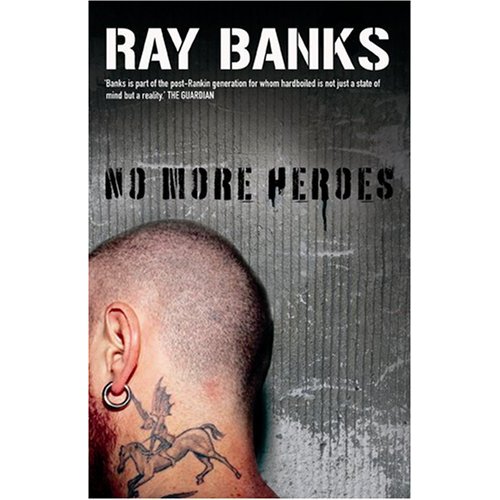 This is the third Ray Banks book I’ve touted in 2009, and the second this month. Why? Because Banks is just that good. And because the photographs that he has of me could be so easily misinterpreted by a judgmental public, various animal rights groups, and the good people at Comfort Inn and Suites.
Ex-con Cal Innes, through with the California dreamin’ of Donkey Punch (aka Sucker Punch Stateside), is back home with a new job serving evictions for Mancunian slumlord Don Plummer. When a publicity storm arises after Cal saves a young boy from a fire in one of Plummer’s deathtraps, he takes advantage by restarting his P.I. business. His first client: Plummer, desperate to know who torched his property and is threatening to do so again.
The sharply-turned, deceptively simple plot ranges the political spectrum from neo-Nazis to crunchy student protestors. But it’s the development of Cal as a character that shines. The Innes books are so closely linked that they’re practically one novel, and Banks capitalizes on the scarce daylight between them. Cal’s every decision has consequences. Many are physical; in a genre where other protagonists shake off a lead-pipe beating like a head cold, Banks makes every bruise count.
And, of course, Heroes is funny. Cal’s voice – profane, grumpy, hopeful – is one of the sharpest in crime fiction.
Beast of Burden, the last of the Innes books, is by all accounts something to look forward to. I’ve got a copy on hand, but I’m not going to dive into it. I want to pace myself.
I give it two weeks. Three at the outside.
Sunday, June 28, 2009
Sort-Of Related: McQ (1974)/Harry In Your Pocket (1973)
At The Rap Sheet recently, J. Kingston Pierce linked to this clip, an annotated car chase from the shot-in-Seattle cop movie McQ.
I found it fascinating, particularly because the sequence ends on the exact spot where Rosemarie’s office now stands. It got me thinking how infrequently the Emerald City turns up in movies. Sure, there’s Sleepless in Seattle, which depicts a romantic comedy burg I don’t recognize. And Singles, capturing the city during the decade it would define. But the truth is Seattle, especially the downtown core that I seldom stray from, has an innate seediness due to its hardscrabble roots and the weather. And if you want seediness on film, you’ve got to turn back the clock to the 1970s.
McQ seems to have been spawned in a fit of municipal jealousy. It’s as if Seattle’s city fathers said, “San Francisco had Bullitt and Dirty Harry. We need a movie that showcases us a crime-infested West Coast hellhole made for tough guys, too!” John Wayne is in Eastwood mode as SPD lieutenant Lon McQ. We never learn what that’s short for, but I’m guessing McQuestionable Police Practices.
You’ve seen McQ even if you haven’t seen McQ, and I don’t mean that as a knock. You’ve got a heroic cop kicking against the suits, police corruption, lots of talk about drugs as “junk,” a flashy pimp informant. It’s the ur-cop movie, the collective unconscious as Quinn Martin Production. Director John Sturges allows us one fleeting glimpse of the Space Needle as the Duke wakes up on his boat – of course he lives on a boat – determined not to show Seattle as a forward thinking bastion but a working-class town dealing with real-world problems. Colleen Dewhurst is great as an aging junkie waitress, managing a regal grandeur as she observes that she doesn’t do skag.
Rosemarie’s Review: “This movie has some of the worst small talk I’ve ever heard.”
McQ whetted my appetite for ‘70s Seattle sleaze. Harry in Your Pocket filmed here the previous year. By all accounts the production was a big deal locally; then-mayor Wes Uhlman has a cameo as one of the many people whose wallets are lifted by ace cannon James Coburn. Coburn and his partner Walter Pidgeon, dapper and addicted to cocaine, train a pair of kids (Michael Sarrazin and Trish van Devere) to become stalls, providing the distraction that allows Coburn’s Harry to work his magic. The youngsters have an extended practice session in King Street Station, currently being restored to the let’s say glory seen in the film.
Harry is the sole feature directed by Mission: Impossible creator Bruce Geller, and it’s essentially a photo negative of that series: a team of perfectly trained individuals functions in perfect sync, not to hoodwink a Latin American dictator but relieve innocent folks of their cash. The movie presents its characters as criminals in their native habitat, and that lack of judgment is its greatest asset. Harry ultimately feels a bit insubstantial, but it possesses a breezy charm. It’s not available on DVD, but you can watch the entire film on Fancast.
Rosemarie’s Review: “This movie also stars a woman who was married to George C. Scott?”
I’ve lived in Seattle more than fifteen years, and my personal jury is still out about the place. Several reasons why are enumerated in this article, particularly #3.
