So about Sunday ... the double feature was devoted to John Garfield. I’ve seen The Postman Always Rings Twice a time or three, and I watched He Ran All the Way not all that long ago – and didn’t particularly care for it. (Great opening 20 minutes, but it gets very stagy very quickly.) Consequently, I chose to forego them both and dine with the czar instead. But I was on hand to sell merch and hear Eddie’s introduction, which touched on how the former Julius Garfinkle spearheaded the Group Theater-born school of naturalistic acting that prefigured Clift, Brando and Newman; Postman’s transformation from the definitive work of noir fiction to high-class women’s picture; and the blacklist’s effect on the careers of everyone involved with He Ran All the Way. When Eddie wrapped up by noting that he’s in regular contact with Garfield’s daughter and she asked him to tell the audience, “Julie sends his love,” I almost regretted my decision. I’ll revisit Postman again soon.
Monday’s movies? Both brand new to me.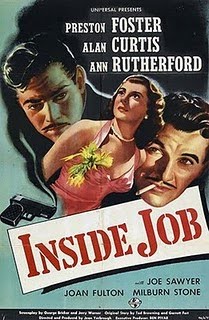 The authentic B picture Inside Job was aptly described by Eddie as “67 minutes of craziness.” Ex-con Alan Curtis, coerced by his old boss into robbing the department store where he’s working a straight gig, opts to hit the joint himself with wife Ann Rutherford. Sounds noir, right? Well, it ain’t. I don’t know what to call Inside Job other than baffling. Featuring a photo of a Robert Benchley lookalike in a bathing suit and the most annoying child actor in screen history. Curtis is the target of a police dragnet, but when he goes out in broad daylight – to buy a radio, yet – he doesn’t bother to shave off his distinctive mustache. Which I can understand; without the ‘stache, even the camera wouldn’t notice him. The truly downbeat ending makes it the weirdest Christmas movie ever. Tod Browning is credited with the story, the last time the legendary horror director’s name appeared on a film.
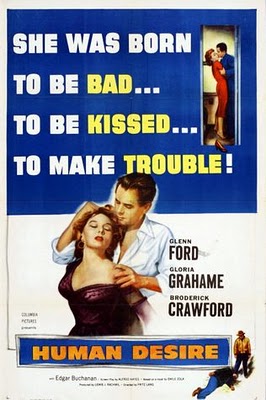 It was unfair of Eddie to show a Fritz Lang movie next. The opening sequence of Human Desire, showing train engineers at work, is more suspenseful than all of Inside Job ... and nothing is happening. The film is based on Émile Zola’s 1890 novel La Bête Humaine, previously filmed by Jean Renoir in 1938. Glenn Ford, an actor Noir City has taught me to appreciate, is a Korean war vet returning to his railway job. He falls for the wife of colleague Broderick Crawford, unaware that her interest in him is spurred by the need to cover up a murder Crawford has committed.
Human Desire is another showcase for Gloria Grahame and her stiletto vulnerability. The psychology of her character is so dark that the movie itself seems frightened of it. The beautiful quality of the print only emphasized the truncated scenes and abrupt ending. For its occasional skittishness, however, Human Desire has intensity and atmosphere to spare. From Fritz Lang, I would expect no less.
Tuesday, February 23, 2010
Noir City Northwest: Inside Job (1946)/Human Desire (1954)

Sunday, February 21, 2010
Noir City Northwest: Cry Danger (1951)/The Mob (1951)
It’s good to see your money at work.
The Film Noir Foundation takes its mission seriously, funding restorations of movies that would otherwise be lost. Organization capo Eddie Muller explained the many hurdles in the process before the Northwest premiere of the Foundation’s latest effort, done in conjunction with the UCLA Film & Television Archive. Because Cry Danger was produced independently by star Dick Powell, it was at genuine risk of disappearing. The FNF’s intervention has given this underrated film – and VKDC favorite – a new lease on life.
Powell’s Rocky Mulloy is released from prison after serving five years on a robbery charge when a witness resurfaces to back up Rocky’s claim of innocence. That the witness has never seen Mulloy before and alibis him only in the hope of making a few bucks is the first indication that Cry Danger isn’t going where you expect. Rocky looks up Rhonda Fleming, his ex-flame/current wife of his still-in-stir pal, and sets his sights on the man behind the frame, the “now 60% legit” Louie Castro (William Conrad). William Bowers’ script is a marvel of construction, especially as it was written with producer Powell looming over his shoulder. (“We just lost another fifty grand from the budget. Cut something.”) Cry Danger’s greatest asset is the character of Powell’s unlikely savior DeLong, a bibulous one-legged Marine and thinly-veiled self-portrait of Bowers. Richard Erdman gives what I rank as one of the greatest supporting performances of all time, abetted by classic dialogue. (“Occasionally, I always drink too much.”) Erdman is not only still acting, he has a recurring role on NBC’s Community as one of Greendale CC’s more mature students. Amazing considering his career began with Mr. Skeffington in 1944. Cry Danger is a terrific film well worth saving.
Bowers and director Robert Parrish next collaborated on The Mob. I saw this film for the first time last year and was floored by it. Eddie explained why it’s not better known: when Columbia’s On The Waterfront became a hit, their earlier, lower-budgeted effort about corruption on the docks was forgotten.
Time for some blasphemy: The Mob is better than On The Waterfront. It’s faster, funnier, more suspenseful and less ... psychological.
Broderick Crawford is a cop sent undercover to investigate the rackets. (“I gotta go underground. You know, like gophers and Communists.”) On his way to identifying mysterious kingpin Blackie Clegg he’ll tussle with an authentic rogue’s gallery: Neville Brand, Ernest Borgnine, John Marley. A young Charles Bronson turns up for a scene. And Bowers’ treatment of Richard Kiley’s character, a too-friendly longshoreman, is an object lesson in screenwriting. A sensational double-bill.
Saturday, February 20, 2010
Noir City Northwest: Pitfall (1948)/Larceny (1948)
A capacity crowd was on hand for the opening night of the fourth Noir City Northwest. Master of ceremonies Eddie Muller gave the new converts the full spiel on the mission of the Film Noir Foundation, dedicated to “preserving America’s noir heritage” and rescuing films from the “poor stewardship” of the conglomerates that own them.
This year’s theme is Lust & Larceny, and the kick-off double bill summed it up nicely. The first four films are also a mini-tribute to screenwriter William Bowers, a longtime VKDC favorite whom Eddie described as the Robert Towne of his day, brought in regularly to punch up scripts.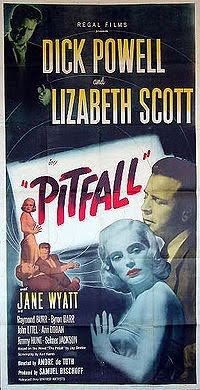 Bowers’ work isn’t credited on Pitfall, but his fingerprints are all over it. Crackling dialogue, sharply-etched supporting players, tight plotting. Married insurance executive Dick Powell is no longer settled with being settled, chafing at his perfect life. A claim brings him in contact with Lizabeth Scott, a good-hearted girl who’s a magnet for men of poor character. Like shady shamus Raymond Burr, who found her for Powell and wants to make his connection with her permanent.
I first saw Pitfall at Noir City several years ago and had a reservation or two about it. That’s because I went in with certain expectations. Revisiting it, I could appreciate Pitfall for the gem that it is. Burr’s character is a stalker plain and simple, played with a modern edge. Lizabeth Scott’s Mona, who does the right thing at every opportunity to no avail, breaks your heart. And Jane Wyatt as Powell’s pragmatic wife may be the hardest nut of them all.
The more light-hearted Larceny is the movie Rosemarie was most interested in because it pairs up two of her favorite actors, John Payne and Dan Duryea. The twosome are part of a ring of con men who set out to fleece grieving war widow Joan Caulfield. There are only two problems: inside man Payne starts falling for Caulfield, and Duryea’s girl, who carries a torch for Payne, arrives to gum up the works. She’s played by Shelley Winters at her brassy best, delivering one Bowers zinger after another. Throw in noir favorite Percy Helton and a slew of lookers pining after Payne, and a good time is had by all.
All that plus the FNF’s beautifully produced 2009 memorial reel and Serena Bramble’s extraordinary The Endless Night: A Valentine to Film Noir. For an amazing price of ten bucks, people. How can you go wrong?
Rosemarie and I are selling FNF merch in the lobby before each show. (She’s the eye candy, I’m the numbers man.) We did land-office business yesterday. Our most popular item is the second edition of the Noir City Sentinel Annual, collecting the best of the pieces that appeared in the FNF’s subscriber newsletter. Eddie’s in there, as is Edgar Award winner Megan Abbott and other luminaries – plus several pieces by yours truly.
Last night, I was asked to sign a copy of the book. That is a personal first that I won’t soon forget.
Friday, February 19, 2010
Noir City Northwest: Your Reminder

This post is basically an excuse to run that banner.
It starts tonight. Here’s the program. You know where I’ll be. If you’re in Seattle, come on out and see two movies for ten bucks. Movies that in many cases aren’t available on video and rarely if ever air on television. Movies presented by the Czar of Noir himself, Eddie Muller. Movies brought to you courtesy of the Film Noir Foundation. Movies the way they were meant to be seen.
And if you’re not in Seattle, I will, in spite of multiple deadlines and an abnormally high tree pollen count, endeavor to bring you the coverage that this website is known for.
Into the shadows we go.
Tuesday, February 16, 2010
Movies: The Red Riding Trilogy (U.S. 2010)
For several reasons, I will keep what had been planned as a lengthy post brief.
See these movies.
OK, not that brief.
David Peace wrote a quartet of novels weaving together a decade’s worth of true crime in the north of England with his own fevered imaginings of corruption, guilt, and the merest glimmers of redemption. Those four books have been condensed into a remarkable trio of films. Each one scripted by Tony Grisoni but helmed by a different director. Characters drift between them, their roles transforming. Loose ends ravel. Mysteries resolve.
You really should see these movies. 1974 (Julian Jarrold) focuses on a hotshot young reporter who didn’t cut it in London and is back on his old stomping grounds. He’s convinced he’s onto the case of a serial murderer of young girls, and equally certain that this story will return him to the top. The poor sod has no idea he’s stumbled into a nest of tangled motives and vice that has pulled better men down.
1980 (James Marsh) sees an outsider arrive, a straight arrow cop (the brilliant Paddy Considine) called on to determine why the local police haven’t apprehended the Yorkshire Ripper. He thinks his history in this neck of the woods will aid him in his endeavors. He is wrong.
1983 (Anand Tucker) finds chickens coming home to roost, sinners struggling to the light, and Shakespeare being proven right: at the length, truth will out.
The series, which aired on U.K. television last year, has been compared to Twin Peaks, The Wire, the collected works of James Ellroy, and Zodiac. All somewhat valid, none truly accurate.
What Grisoni and company have crafted here is an epic vision of evil. Of the domestic variety, petty and insidious, dwelling in institutions, the hearts of men, the landscape itself. It’s a haunting, harrowing piece of work. It’s noir for the 21st century. Yes, you’ll like one film more than the others (I’d opt for 1980 myself). Granted, it’s not perfect. What is? But in its ambition, its execution, its belief in the power of the accretion of detail, its faith in the audience, its sheer fucking adultness, it’s the most thrilling thing I’ve watched in ages.
The movies are being screened around the country, including at Seattle’s Northwest Film Forum, in the coming weeks, often back-to-back-to-back. I pity those who absorb them that way; priests and publicans should be on call. Right now the entire trilogy is available via IFC On Demand, which is how I watched them over the course of three days. It made it easier to weep for my fellow man and rage at an indifferent God. Plus, no parking problems!
Clear your schedule. See these movies. Thank me later.
Monday, February 15, 2010
Movies: Race Street (1948)/Scene of the Crime (1949)
Noir City Northwest kicks off this coming Friday – if you’re in Seattle, come on out and say hello to yours truly at the Film Noir Foundation table in the lobby – and the time has come to get into shape. I’ve been on a vigorous training regimen, running wind sprints, downing extra cocktails. I’ve also got to keep those blogging muscles limber, so here’s a practice post on a pair of films noir.
You know you’re in trouble when William Bendix is the most charismatic member of your cast. That’s where we find ourselves in Race Street. The stolid George Raft is a bookie aiming to go legit in the nightclub business. But close pal Harry-then-Henry Morgan is bumped off when he refuses to pay protection money, and Raft decides to track down the killers himself. Bendix is his childhood friend turned police detective. The story’s no great shakes, and there are some odd directorial choices. Morgan’s potent death scene – a tumble down a brutally long flight of stairs – is ruined by a slow push-in at the end, and there’s a bizarre musical number featuring Raft’s torch singer sis filmed Spike Jonze style without explanation. I have higher hopes for another Raft noir, Red Light, scheduled for the festival.
Sometimes actors can surprise you. Van Johnson gained fame as MGM’s all-American boy, but in Scene of the Crime he’s surprisingly plausible as big city cop Mike Conovan. When his former partner is gunned down under suspicious circumstances Mike sets out to clear his name, even if it means cozying up to former gangster’s moll Gloria DeHaven. All while long-suffering wife Arlene Dahl lobbies him to quit the force altogether, even conspiring with an old beau to land him a cushy private sector job.
Charles Schnee’s script features pungent dialogue (DeHaven is described thusly: “Figure like champagne, heart like the cork”), still-shocking violence, and a nice mix of authentically shady characters, like Norman Lloyd’s stoolie Sleeper. Plus there’s a richness of detail at the margins. The killers are knocking over Syndicate joints, so the Outfit starts staging its own lineups. Moments like that lift Scene of the Crime a rung or two above the ordinary.
Thursday, February 11, 2010
Movie: The Red Shoes (1948)
Patience, ladies and gentlemen, is rewarded.
I had deliberately avoided the landmark Michael Powell/Emeric Pressburger film The Red Shoes on TV because I knew it demanded to be seen on the big screen. Last night I not only watched a gloriously restored new print, but it was introduced by Thelma Schoonmaker, the widow of director Michael Powell and Martin Scorsese’s longtime (and multiple Academy Award-winning) editor. She cut Goodfellas, people.
The film, about a ballet company and the dancer who becomes muse to two men, overwhelmed me. It’s unmatched in its depiction of a collaborative art form and the ways one individual can unite others in service of a vision. The boldness of its filmmaking still astounds. The CGI in, say, Avatar is about making a physical world seem real. The effects deployed in The Red Shoes are used to bring an emotional universe to life. They’re far riskier, and the rewards that much greater when they succeed.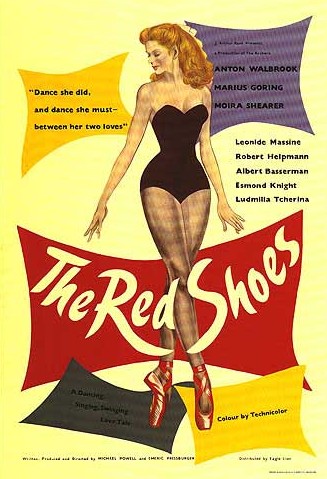 The evening began with a brief before-and-after comparison highlighting the work of the UCLA Film & Television Archive with the support of The Film Foundation. The restoration was an extraordinarily difficult one; The Red Shoes was shot in three-strip Technicolor on a camera so enormous Powell nicknamed it “the cottage.” Over the decades the individual strips shrank at different rates and were damaged by mold. The result is astonishing. Jack Cardiff’s photography contains colors I’d only previously seen on the insides of my eyelids. A single shot of several pairs of the title shoes presented for the approval of the company’s impresario features so many discernable shades of scarlet that it’s almost unseemly.
Ms. Schoonmaker walked us through the film’s history. Powell’s determination to cast a ballet dancer (Moira Shearer) in the lead role, his willingness to replace technical personnel when they told him he was going too far. Producer J. Arthur Rank loathed the movie, finding it too “artistic,” and did everything he could to bury it. Only the efforts of a pair of New York exhibitors changed its fortunes. They converted a legitimate theater to screen it, and it wound up running for two straight years.
Gene Kelly dragged studio executives to showings in order to make his case for the ballet at the end of An American in Paris. Ms. Schoonmaker talked about the many others who had been inspired to commit their lives to the arts after seeing The Red Shoes, including writer Nicholas Pileggi and painter Ron Kitaj. To say nothing of the legion of girls driven to join the ballet.
She said that The Red Shoes was the one constant on Scorsese’s list of desert island films. “Every movie Marty has made was influenced by this one,” she said, going so far as to point out a specific homage that appears in the upcoming Shutter Island.
The Red Shoes screens at the Northwest Film Forum beginning Friday, and next week it returns to New York’s Film Forum by popular demand. A DVD is due out later this year, but see it in a theater if you can. As Ms. Schoonmaker observed, Michael Powell didn’t make his movies to be watched by one person on a small screen. He meant for them to be shared by strangers in the dark.
Wednesday, February 10, 2010
Book: Fast One, by Paul Cain (1933)
Clearly the universe is urging me forward in my quest to read the novelistic equivalents of the twenty-minute egg. Fast One had been on my radar for some time. I finally acquire a copy only weeks after finishing Richard Rayner’s A Bright and Guilty Place, which lays bare the miasma of Los Angeles vice that inspired Paul Cain; all Cain did was change the names. Then I pick up Max Décharné’s book to learn that Raymond Chandler called Fast One “some kind of a high point in the ultra hardboiled manner.” Décharné, naming Ted Lewis’ Jack’s Return Home (filmed as Get Carter) a spiritual descendant, dubs Fast One a “masterpiece ... another nihilistic train-wreck of a book where virtually every character comes to a bad end.” Believe me, those two are not kidding.
Fast One is the story of Gerry Kells, an East Coast gambler ensconced in L.A. Local kingpin Jack Rose, seeing a gang war coming, wants Kells on his side. Kells is content to stay neutral, so Rose frames him for murder. Kells then decides to seize control of the city’s rackets himself. The only problems are Rose, L.A.’s other crooks, some interested out-of-town players, the deeply bent police department, the equally suspect power structure, a woman he can’t trust, and his own appetites. And he still damn near pulls it off.
Originally serialized in Black Mask, Fast One is terse almost to the point of incomprehensibility; Cain not only omits needless words, he skimps on a few of the useful ones as well. I had to turn back a few pages on a regular basis. That didn’t diminish the blazing speed with which the book moved, and the fever dream of corruption that it creates. Fast One may not be a good book, but it is a singular one, and it deserves its reputation.
Cain was born George Carrol Sims but called himself Peter Ruric when he worked as a screenwriter. He had an affair with actress Gertrude Michael, a Chez K favorite, basing the character of the duplicitous and dipsomaniacal Miss Granquist on her. Knowing that only enhanced my enjoyment of the book.
Update: The Rap Sheet paired this post in its Friday’s Forgotten Books round-up along with another take on Fast One from Evan Lewis at Davy Crockett’s Almanack. More good information over there.
Sunday, February 07, 2010
Book: Hardboiled Hollywood, by Max Décharné (U.S. 2010)
My first problem? This new reprint of a 2003 No Exit book is called Hardboiled Hollywood, yet two of the eleven movies in it – Hell is a City and Get Carter – are as English as Bobby Charlton eating crisps at a snooker match.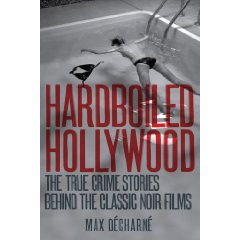 The bigger problem? It’s subtitled The True Crime Stories Behind the Classic Noir Films. Which led me to believe that it would be about the true crime stories behind the classic noir films. Silly Vince. In truth not even half the movies covered have specific historical antecedents, and those are dispensed with in cursory fashion. Some prime candidates are overlooked; despite numerous references to James M. Cain there are no chapters on Double Indemnity or The Postman Always Rings Twice, both inspired by an actual murder. Instead the focus is on the well-trod ground of the making of the films themselves.
(ASIDE: In the interests of completeness I’ll also say that it’s appalling publisher W.W. Norton would release a book with jacket copy citing “Anthony Perkin’s” performance in Psycho. Here’s the rule: if you’re not sure where the apostrophe goes, leave it out. Better we think you forgot it.)
That said ... misleading title aside I enjoyed Hardboiled Hollywood. Décharné knows the terrain, writes with passion, and consistently turns up overlooked perspectives. Here’s a great quote from the Spectator on Nicholas Ray and They Live By Night: “If the director had taken the trouble to be French, we would be licking his boots in ecstasy.” The Get Carter material is particularly strong, with Décharné rightly taking director Mike Hodges to task for his misinterpretation of the word “nails” in Ted Lewis’ source novel Jack’s Return Home. Décharné correctly points out that the Parker in Richard Stark’s The Hunter is smarter and more ruthless than Lee Marvin’s incarnation in Point Blank. And it’s good to be reminded that Bonnie and Clyde were not folk heroes but venal small-time killers.
There’s some bait and switch involved, but Hardboiled Hollywood is worth reading.
Miscellaneous: Golden Boot Link
Author and noir historian Alan K. Rode attends the Golden Boot Award ceremony for legendary stuntman Bob Hoy.
Wednesday, February 03, 2010
Books: Kith and Kindle
During the week that Amazon got into a feud with Macmillan (fragging Macmillan’s authors in the process) and Apple introduced the iPad, I finally received my Kindle. Once again demonstrating the flawless timing that has made Keenans valued participants in ballroom dances, cavalry raids and open mic nights throughout history.
(ASIDE #1: Want cogent commentary on Amazon v. Macmillan? Read John Scalzi. Everyone else is. As for the iPad, I’ve lived to the biblical age of however old I am without buying a single Apple product. I’m not about to start now.)
I dithered about the decision to purchase a Kindle for months. By rights I should have been an early adopter; I’m e-reading’s ideal customer. I love books but am rigorously unsentimental about them as physical objects. I want the stories, not the pages.
Money kept me on the fence. Not only the cost of the device but the fact that many of the books I read come courtesy of Seattle’s excellent public library. I can work their hold system like a pinball machine. Graze it with my hip and new releases tumble my way.
But the SPL, feeling the economic pinch, has been forced to make changes. They’ve capped the number of titles you can reserve. And they’ve added a fee to an essential service for researching: interlibrary loans. I could request titles the SPL didn’t carry and a few weeks later a copy would turn up, marked with an orange band. The book, borrowed from the Cerritos, California library or a small college in Minnesota, would be my responsibility for two weeks, a charge I took seriously.
A few weeks ago I had my nose pressed to the Kindle store’s window when I noticed that a research book I wanted for a project, unavailable at the library and retailing for forty dollars, could be mine for only five bucks over the ILL fee. Wheels started turning.
(ASIDE #2: Yes, naysayers, I know that I don’t technically own a book on my Kindle, that I only license it and have therefore allowed the serpent of copyright into my intellectual garden. Or something. For good or ill, this doesn’t bother me.)
Then another discovery. Years ago I’d had a conversation with a book store owner who told me that the three most hardboiled novels were Green Ice by Raoul Whitfield, Fast One by Paul Cain, and Jonathan Latimer’s legendary, censored Solomon’s Vineyard. (I give you no less an authority than James Reasoner on that last title’s history and worth.) I’d found a copy of Green Ice – truth be told, I didn’t care for it – but not the others, aside from imperfect online and POD editions.
The Kindle store had both. Total cost: $4.98.
And so, I placed my order.
It was strange to fire up the Kindle and see the text of John Buntin’s L.A. Noir, which I’d read in hard copy, without page numbers. The interface was simple and intuitive. The e-ink display was astonishingly easy on the eyes. I opened Solomon’s Vineyard, read the introductory note promising “everything but an abortion and a tornado,” and scrolled to Chapter One.
From the way her buttocks looked under the black silk dress, I knew she’d be good in bed. The silk was tight and under it the muscles worked slow and easy. I saw weight there, and control, and, brother, those are things I like in a woman. I put down my bags and went after her along the station platform.
I don’t know about you, but if I found that smeared on shopping bags I’d keep reading. Which is what I did, devouring half of the book in a single sitting, never aware that I was looking at a screen, letting words written 70 years ago work their magic.
And having the text-to-speech voice read that Latimer paragraph aloud? Priceless.
Miscellaneous: Links
My friend award-winning sportswriter Mike Gasparino has launched Metsanity, a new blog about our mutual favorite team. Go. Read. Enjoy.
My friend award-winning author Christa Faust inked her new deal, then inked her new deal.
Get your genres confused? Donna Moore sorts it all out.
Monday, February 01, 2010
Miscellaneous: Weekend Roundup
Wallander. Don’t ask me to compare these BBC adaptations to Henning Mankell’s novels about Swedish detective Kurt Wallander. I’m woefully unschooled in Scandinavian crime fiction, a failing I will soon remedy thanks in part to these films. They have a striking look, the Swedish locales shot in part by last year’s Academy Award winning cinematographer Anthony Dod Mantle. Kenneth Branagh is sensational as Wallander, a compassionate investigator who is never fully present in his own life. The ninety-minute running times allow the personal scenes room to breathe. Sometimes they overwhelm the mystery; I was more involved in Wallander’s reconciliation with his troubled artist father (David Warner in Old Testament prophet mode) than the main story in Sidetracked. The films improve as they go; the last, One Step Behind, is as good as television gets. All three are suffused with a weary, bone-deep sadness that’s haunting.
Whatever Works (2009). Minor Woody Allen, but still entertaining. The movie’s notion that living in New York makes you a better person is naïve, but I happen to agree with it. Larry David’s inability to be anyone other than Larry David actually helps to put it over. A pleasant surprise.
Girls on the Loose (1958). The lovely Mara Corday leads a distaff team of heisters in a payroll job. I don’t know why she turns to crime. She says something about needing to live on the edge, but I think it’s because she’s going broke booking her gamine sister’s Bohemian burlesque act in her nightclub. Mara assembles some crew: a nervous wreck, an alcoholic French beautician, and a truck-stop tough blonde (Joyce Barker, a true Gold Medal gorgon who only appeared in this movie). The whole enterprise is nicely sleazy – Joyce is a masseuse! – and not all that badly plotted. Amazingly it’s directed by Casablanca’s Victor Laszlo, Paul Henreid. That this movie is not on DVD is a travesty. Here’s the trailer.
Friday, January 29, 2010
On The Web: Lem Dobbs
Sorry I haven’t posted this week. So much time and so little to do.
Wait a minute. Strike that. Reverse it.
One thing I have made room for in recent days is this Cosmoetica interview with screenwriter Lem Dobbs, whose credits include Dark City, The Limey, and The Limey’s commentary track, which is so good it deserves to be treated as a separate project. The interview is truly epic – 53,000 words, 90 pages – wide-ranging, and brutally honest. It’s also one of the best things I’ve read in years. Some excerpts:
Books are published now – crime novels, for example, which is a field I still follow – that are so horrible, it’s mind-boggling. Covered in laudatory review quotes and blurbs, listing all the awards they’ve won – you can’t believe it. It’s quite often impossible to find a bad review of a book, that’s how much of a racket it’s become.
I agree with him. Which kills me, because when I read a lousy crime novel – and lately I’ve read a few, all blurbed by writers I respect and touted elsewhere – I hold my tongue. Bill Crider recently summed up my feelings on the subject of reviews perfectly. I don’t see myself as a critic. I like to use my tiny corner of the internet to call attention to the good stuff. But every once in a while, when for reasons of my own I finish a book that’s a dud, I question that approach.
Dobbs on Hollywood now:
They’d much rather hear what they think is a “cool take.” But not knowing what’s old, they have no idea what’s new. So the whole phony, broken system is an exercise in futility and another reason movies are much more uniform in their awfulness. There’s absolutely no patience for, or respect or appreciation for, ideas outside the airless dome of a very limited frame of reference. If you engage in a discussion of who the “villain” is, for instance, you’d better do it in an excited and animated way (this is why it’s helpful to have a writing partner who’s also wearing big ol’ baggy shorts and a Hawaiian shirt and a turned-round baseball cap and chortling) – because to roll your eyes and sigh and question whether there even has to be a villain would be to challenge the whole current paradigm. And the “villain,” of course, once established, has to be motivated by nothing less than destroying the entire world – and so on – from cliché to cliché. If you’re unwilling to – sincerely – play this game, you might as well stay home ... Who was the “villain” in THE GREAT ESCAPE, or THE DIRTY DOZEN? Remade now – and don’t think they’re not trying – there would have to be an evil, evil, evil, evil Nazi in alternating scenes, constantly snarling, “I want them caught, I want them stopped, I want them dead!”
Bookmark it. Go back to it in stages. It’s worth the effort.
Monday, January 25, 2010
Book: The Writing Class, by Jincy Willett (2008)
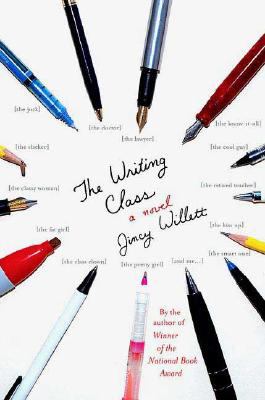 Amy Gallup is a middle-aged loner who hates being alone, a once-promising novelist who now teaches adult extension creative writing courses. She’s been at it for so long she can instantly size up each new group during the first session, knowing at once which students are wasting their time and hers. Then someone in the class begins sending odd notes. Biting parodies, obscene drawings, critiques that cut too close to the bone. The notes turn into pranks, then the pranks become deadly. And nobody really wants to the read the surgeon’s medical thriller.
Jincy Willett’s darkly funny novel is ruthless when it comes to the teaching of fiction. The samples of each student’s work are priceless. But every barb contains useful writing advice. The book is also an affectionate portrait of a prickly character in Amy, and a sly treatise about what motives people to read, to write, to connect. I missed this book when it was published initially. Thanks to my friend Chad Jones for the recommendation.
Miscellaneous: Elsewhere
What I Learned on Twitter. I’ve spoken before about The Three Investigators books, which got me hooked on crime fiction as a tyke. Turns out the boys are so popular in Germany that there’s a movie. Here’s the trailer.
I’d Link If I Could. The article on the cryonics movement in the January 25 issue of the New Yorker (not online unless you’re a subscriber) is fascinating reading. Jill Lepore analyzes several of the Amazing Stories yarns that inspired Robert Ettinger to start freezing people. Ettinger is the kind of crackpot utopian visionary – briefly famous in the 1960s and 70s, interviewed by Johnny Carson, David Frost and others – that we don’t see enough of any more. A taste of Lepore’s article:
In ‘Man Into Superman,’ Ettinger throws around a lot of Nietzsche and George Bernard Shaw, but shows more evidence of having whiled away the hours reading Penthouse, which began publication in 1965. The world of tomorrow will be unimaginably better than the world of today. How? There will be transsex and supersex! Scientists will invent “a sexual superwoman ... with cleverly designed orifices of various kinds, something like a wriggly Swiss cheese, but shapelier and more fragrant.” Animals will be bred as sex slaves; even incest might be allowed. Also, scientists will likely equip men with wings, built-in biological weapons, body armor made of hair, and “telescoping, fully adjustable” sexual organs. (Hold on. That last one. Doesn’t the existing model already come with that?)
Thursday, January 21, 2010
TV: The Greatest Broadcast in the History of the Medium
Five years ago today, a landmark broadcast went out over the airwaves ... of digital cable. An episode of the Independent Film Channel’s Ultimate Film Fanatic, featuring yours truly as a contestant.
The strangest thing about the show is that a few weeks after it taped, Rosemarie was selected to be on Jeopardy! Making 2005 our year of game shows.
UFF’s entire run lives on via YouTube. So I might as well mark the occasion by embedding it here. Again.
Two vital points before watching –
1. I now have the sense to wear contact lenses.
2. Also, my hair looks much, much better.
First, intros and round one: trivia. We were asked to come up with our own opening lines, which the producers then “improved.” Still, I sell the moment and cap it off by staring down the camera Lee Van Cleef-style.
I had a strategy in this round. My competitor is Tom Tangney, critic for several Seattle radio stations, and I knew from our pre-show conversation that he was an erudite gentleman of taste. I therefore decided to force him to answer questions about crappy thrillers, which I regard as my forte. Watch as careful planning almost blows up in my face.
Round two: debate. (Spoiler alert: I make it through round one. To this day, I can’t believe I remembered the name of that damn doll.) Your celebrity judges are Academy Award winner Tatum O’Neal and certified badasses Keith David and Henry Rollins.
The producers stopped tape before this round to ask for topic suggestions. I confess that Kevin Costner was my idea. Again I had a strategy, namely degree of difficulty. If I could ably defend an unpopular position, maybe I’d earn the judges’ respect. For the record, I stand by the argument I made and would add the additional exhibits of The Upside of Anger and Mr. Brooks. As for Rumor Has It ...
Round three: obsession. Or as I thought of it, collections.
In a rare moment of prescience, I announced to Rosemarie after my audition, “If I get on the show I’ll make it all the way to the third round, then crash and burn.” Which is exactly what happened. See for yourself. Any of the other contestants would have fared better than me in this section.
Problem #1: I don’t collect things. Scrounging up three items was a reach. (BTW, the key broke on the flight home.)
Problem #2: I’m up against Tony Kay, now host of Seattle’s Bizarro Movie Night. I didn’t stand a chance.
Note the raw sexual chemistry between Tatum and myself. What Rollins says about me is still one of the high points of my life. It was almost worth losing the five grand in prize money to be spared his scorn. Almost. And my popcorn line was used in TV spots throughout the season, so I won the battle for airtime.
In closing, my hair really does look better now. Honestly. I can’t stress that enough.
Monday, January 18, 2010
Movie: Big Fan (2009)
The directorial debut by former Onion editor and screenwriter of The Wrestler Robert Siegel received only a token theatrical release. Now on DVD and streaming via Netflix, this unsettling, darkly hilarious film can find the audience it deserves. Paul Aufiero (Patton Oswalt) is a 36-year-old parking garage attendant who still lives with his mother. Two things get him out of bed every day: the New York football Giants and the few minutes each week when he gets to be “Paul from Staten Island” on a sports radio call-in show. One night he has a chance encounter with his favorite member of the team’s starting line. Only his dream moment ends up going wrong. Badly wrong. Several days in the hospital wrong. What do you do when your one true passion in life literally and figuratively kicks your ass?
Big Fan is either the funniest drama of the year or the grimmest comedy. Siegel readily acknowledges the film’s debt to Scorsese movies like Taxi Driver and The King of Comedy (not to mention Billy Wilder’s The Fortune Cookie), but he makes the terrain his own and has a genuine feel for life in the outer boroughs. The movie is even better if you’re familiar with the charnel house that is NFC East football.
Co-star Kevin Corrigan tells a great story in the DVD extras about his own Big Fan-style meeting with Robert DeNiro. In a Q&A on the disc, Siegel says Paul had to be a Giants fan because he couldn’t imagine people being unable to get Jets tickets. Not after yesterday’s San Diego game. For the record, Siegel is right about Philadelphia Eagles fans.
Here’s Patton Oswalt deconstructing the hellish song ‘Christmas Shoes’ – now animated! And Roger Ebert on how Netflix streaming video may change the Academy Awards.
Thursday, January 14, 2010
Book: Devil’s Garden, by Ace Atkins (2009)
Why, oh why, have I not read Ace Atkins until now?
Devil’s Garden retells the saga of Roscoe ‘Fatty’ Arbuckle, one of the first and arguably still the greatest of show business scandals. What’s known is that Arbuckle threw an epic party at a San Francisco hotel in 1921. During the bash, would-be actress Virginia Rappe took ill, dying several days later. Accusations flew, abetted by William Randolph Hearst’s newspapers. Arbuckle stood trial for manslaughter three times. He was never convicted, but his career was destroyed. With vivid, economical prose, Atkins weaves together multiple viewpoints including those of Hearst and Arbuckle himself. Most impressive is the perspective of young Pinkerton operative Dashiell Hammett, then known as Sam. Atkins incorporates many clues about the writer Hammett would become without detracting from the story at hand. And he finds ways of surprising you even if you’re already familiar with the sad facts of the case.
Nothing is better than discovering an established author who is new to you. I now have Atkins’ Nick Travers series as well as his other historical novels including Infamous, the upcoming one about “Machine Gun” Kelly, to look forward to. Here’s his blog.
Tuesday, January 12, 2010
Movie: Best Seller (1987)
Time again for a question that’s a hobbyhorse around here: whatever happened to sleaze? Where’s a guy gotta go to get served up a cocktail of sex, violence and cynicism? Oh, right. Videogames. If I want the cinematic variety, I have to return to the cable staples of my youth.
In Best Seller, Brian Dennehy plays Joseph Wambaugh Dennis Meechum, L.A. cop and successful author. He’s suffering from writer’s block when the perfect story saunters into his life in the form of Cleve (James Woods). Cleve claims to be the in-house assassin for a huge conglomerate and its pillar of the community founder. (“Corporations deal in two things, assets and liabilities. I eliminated the liabilities, and I provided some of the assets.”) As aggrieved as a top salesman passed over for promotion, Cleve has decided to bring the entire enterprise down by collaborating with Meechum on a book – whether Meechum wants to or not.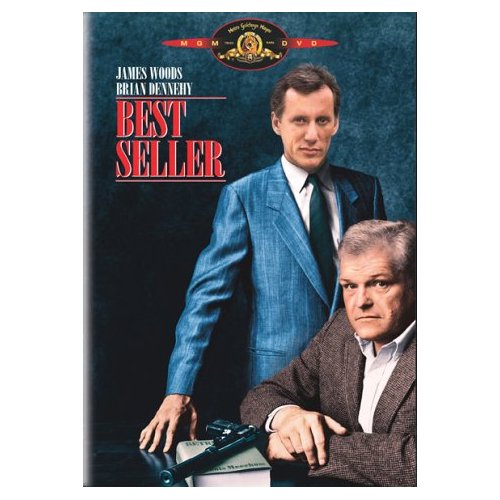 Best Seller was directed by John Flynn, who brought astonishing fidelity to Richard Stark’s Parker in the tragically still-not-on-video The Outfit. The script is by personal hero Larry Cohen, which means it moves with ferocious energy while still having time for crackpot diversions. Like Woods singing in French and a visit to the hit man’s parents. Cohen wrote the film for Kirk Douglas and Burt Lancaster but Larry, bless his B-movie heart, can only work in fast-and-cheap mode. The result is the most underpopulated conspiracy movie ever. It’s basically just two guys.
But what guys. Dennehy and Woods are the Hope and Crosby of mayhem. Woods has never been better, playing a true sociopath who is utterly ruthless yet has kind words for the little people and praise for the American dream. Watch his reaction, both deeply hurt and enraged, when Dennehy refuses a gift. This strange hybrid of thriller and jet-black buddy comedy also ventures into meta terrain thanks to Cleve’s obsession with coming across as a sympathetic character.
There are movies with more sleaze, but what’s here – like Cleve’s pickup of a woman in a bar – is cherce. And for a jaundiced view of how the world works, it can’t be beat.
Dennehy is still going strong at age 71, currently onstage in Chicago doing O’Neill and Beckett. I’d like to see him return as the head of the show-within-the-show’s Teamster crew on 30 Rock. Here’s a recent interview in which he demonstrates that good ol’ Irish Catholic fatalism that’s like mother’s milk to me.
Sunday, January 10, 2010
Upcoming: Noir City 8
San Francisco at the end of this month, Seattle in February. First warning: yours truly will be working the SIFF Cinema lobby. Also, I’ll be selling FNF goodies.
Here’s the promo, featuring 2009’s Miss Noir City Alycia Tumlin and the man himself, Eddie Muller.
Saturday, January 09, 2010
Book: A Bright and Guilty Place, by Richard Rayner (2009)
Rayner’s history of 1920s and ‘30s Los Angeles is wrapped, naturally, around corruption and reinvention. Leslie White is an investigator for the D.A.’s office who becomes a pulp author. (When he needs help breaking into the racket, he gets in touch with his old lawyer friend Erle Stanley Gardner.) Dave Clark is a golden boy war hero turned prosecutor who ends up charged with the murder of L.A.’s criminal kingpin.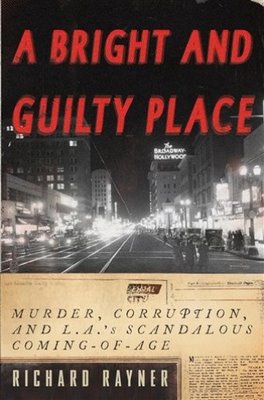 The book brims with fascinating information, but it’s also disjointed. There are a few scandals too many. The lives of the two central figures don’t have that much overlap. Clark’s trial is anticlimactic while the bizarre events in its wake are treated as an afterthought. Raymond Chandler is frequently cited even though his relation to the proceedings is tangential.
Ultimately it’s Chandler’s vision of Los Angeles, seductive and treacherous, that Rayner understands intuitively and captures very well. For all its flaws as a history of a time, the book succeeds as a chronicle of a mood. Many people have contrasted Rayner’s book with L.A. Noir by John Buntin, which picks up the City of Angels’ story where Rayner leaves off. Rayner’s book is better written, Buntin’s more cohesive. Together they offer a compelling account of Los Angeles as it was not only inventing itself, but 20th century America.
Some of White’s stories are collected in The Black Lizard Big Book of Pulps. I’ll say this for them: they have a certain energy. Here’s the opening line from “The City of Hell!,” published in the October 1935 issue of Black Mask and influenced by L.A.’s endemic graft.
The piercing screams of a woman filled the awed hollow of silence left void by the chatter of a sub-machine-gun and acted as a magnet of sound to suck the big squad car to the scene.
Rayner recently led the Guardian on a tour of locations from the book. And here he is on Ben Hecht.
Monday, January 04, 2010
Movie: District 13: Ultimatum (U.S. 2010)
Typically it’s several weeks into January before I see my first film released in that calendar year. 2008: Cloverfield, January 26. 2009: Taken, January 31.
But we are out of the dark ages, brothers and sisters. Let it be known that, through the miracle of On Demand, in 2010 I saw a 2010 release on January 1. I know it’s not exactly a flying car or a sassy robot maid. But I’m still kind of impressed.
In Luc Besson’s District 13: Ultimatum, there’s another conspiracy to annihilate one of Paris’s lesser, more polyglot precincts. Once again supercop Damien must team up with neighborhood hero Leito to save the day. There’s not as much parkour as in the original, I missed the grittiness of the first film, and the third act – in which District 13’s many ethnic gangs unite to raid a French seat of power guarded by soldiers who don’t use their guns – is completely ridiculous. Not bad, mind you, just ridiculous. On the plus side there’s a fight using a Van Gogh, and I am now in love with Elodie Yung of the razors in her ponytail. I have also been informed by a party who shall remain Rosemarie nameless that the sight of Cyril Raffaelli in go-go dancer drag not only justified the expense but may warrant a second look on the big screen.
At one point Raffaelli mentions that he’s about to be thrown into “a local Guantanamo,” and the bad guys are crooked cops allied with a military contractor called, I kid you not, Harriburton. America, the new global shorthand for movie villainy. Technology’s not the only thing that’s changed.
Thursday, December 31, 2009
The Good Stuff: Films of 2009
No, I haven’t seen Avatar yet. I haven’t seen Alvin and the Chipmunks: The Squeakquel, either, so this whole endeavor could be a fool’s errand. Still, onward. Favorite films of the year, listed in order seen.
Up
The Hurt Locker
In the Loop
Julia
Inglourious Basterds
District 9
The Informant!
A Serious Man
Anvil!: The Story of Anvil
The Damned United
Two exclamation points. That’s a record.
Cinematic highlight of the year: same as always, baby. Noir City. 2010’s installment is coming up fast.
And a holdover from last year’s list, Thrillers More People Should Have Seen. All currently available on video.
Just Another Love Story. Classic noir elements repurposed and updated in a twisty film from Denmark.
The Limits of Control. Calling Jim Jarmusch’s movie a thriller may be something of a stretch. I’m not sure what happens in it. I’m not sure anything happens in it. Simply allow its beauty to wash over you, though, and you’ll be alright.
The Merry Gentleman. I’m a fan of Michael Keaton’s directorial debut. But it will now always have a special place in my heart. Why? Because it made me big in Canada.
A Perfect Getaway. David Twohy is the last of the old-school genre storytellers (Pitch Black, Below). The slow build-up and the lead character being a screenwriter only add to the meta-fun. If this movie were French, it would be a cult classic praised to the rafters by hipster critics. But because it was filmed in Hawaii and stars recognizable actors like Steve Zahn and Timothy Olyphant, it’s fated to be the best movie nobody saw this year.
Tuesday, December 29, 2009
The Good Stuff: Books of 2009
I’ll keep the preamble to a minimum. The books are listed in the order I read them. More detailed posts can be found here.
Favorite crime fiction:
Beat the Reaper, Josh Bazell
Safer, Sean Doolittle
American Rust, Philipp Meyer
No More Heroes, Ray Banks
Bury Me Deep, Megan Abbott
Dark Places, Gillian Flynn
The Jerusalem File, Joel Stone
The Ghosts of Belfast, Stuart Neville
Pariah, Dave Zeltserman
Losers Live Longer, Russell Atwood
Favorite not-crime fiction:
How I Became a Famous Novelist, Steve Hely
Hummingbirds, Joshua Gaylord
The Financial Lives of the Poets, Jess Walter
Bonus Categories:
2008 novel that would have been on this year’s list and could have been on last year’s had I read it in time: The Age of Dreaming, Nina Revoyr
2010 novel that would have been on this year’s list and will probably be on next year’s: Print the Legend, Craig McDonald
Favorite novels that were new to me in 2009: The Red Right Hand, Joel Townsley Rogers (1945) and Adios, Scheherazade, Donald E. Westlake (1970). Again, a thousand thanks to Duane Swierczynski for introducing me to the latter.
Favorite non-fiction:
The Complete Game, Ron Darling
Methland, Nick Reding
L.A. Noir, John Buntin
And finally, the best book I read in 2009 regardless of genre or year of publication is Moneyball: The Art of Winning an Unfair Game, by Michael Lewis (2003). I’ll go you one better. This book – about economics, business, mathematics, baseball and life – goes on the short list of the greatest books I’ve ever read, along with Dino, Nick Tosches’ biography of Dean Martin, and The Hardy Boys Detective Handbook. Illustrious company indeed.
Wednesday, December 23, 2009
Miscellaneous: It’s A Shane Black Christmas (Redux)
There I am at my favorite watering hole, talking with the staff, when the subject of Christmas movies is raised.
First suggestion, not made by me: the traditional double-bill of Die Hard and Die Hard II: Die Harder.
Thus giving me the tenor of the conversation. This is not the time, perhaps, to mention Remember the Night and Holiday Affair, two overlooked films (with noir connections!) that Turner Classic Movies has labored to turn into Yuletide staples. Although a mention of Blast of Silence, full of Wenceslas wetwork, might not be out of the question.
So I lobby for my own Christmas favorite, The Ref. And then observe, not for the first time, that the entire oeuvre of Shane Black – Lethal Weapon, The Last Boy Scout, The Long Kiss Goodnight, and Kiss Kiss Bang Bang – is set at the most wonderful time of the year.
Therefore, as you venture out for that last round of shopping, I offer, by popular demand, what has become a VKDC tradition. (“By popular demand” meaning Rosemarie asked, “Why haven’t you posted this yet?” And she did write most of it.) Here, once again, is Shane Black’s 12 Days of Christmas. Record your church group performing this and we’ll post the video here!
Twelve cars exploding
Eleven extras running
Ten tankers skidding
Nine strippers pole-ing
Eight Uzis firing
Seven henchmen scowling
Six choppers crashing
Five silver Glocks
Four ticking bombs
Three hand grenades
Two mortar shells
And a suitcase full of C-4
God bless us, everyone. Or else.
Tuesday, December 22, 2009
Book: Alone, by Loren D. Estleman (2009)
Third consecutive book about Hollywood in one form or another. I don’t plan these things, people. They simply happen.
Any list of crime fiction’s premier stylists would have to include Loren Estleman. His insouciant prose has brightened up many a dark book, but it fizzes like champagne in his lighter tales about Valentino, the UCLA archivist whose business cards read “film detective.”
A rare treasure is dangled before Valentino by a university donor: the only extant print of How Not to Dress, the brief promotional film marking the first screen appearance of Greta Garbo. But before light strikes frame one, Valentino finds himself amidst blackmail and murder. He’s got other problems. A crooked building inspector has rousted him from the movie palace he’s attempting to restore to its former glory, leaving him at the house and the throat of his closest friend and colleague. And there’s his budding romance with an LAPD forensics expert.
Alone is a confection, and a good one. Estleman has struck upon an ingenious method for writing about classic Hollywood in a contemporary setting. I will say that the jabs at current films are out of character and occasionally wrong; Brian De Palma’s name is spelled incorrectly, and Pulp Fiction is misquoted in the author’s afterword. It’s important for curmudgeons to get the details right. Still, it’s a minor quibble. Go. Buy. Read.
Sunday, December 20, 2009
Book: L.A. Noir, by John Buntin (2009)
John Buntin started with a real-world question steeped in fiction: how did the LAPD of L.A. Confidential become the LAPD of Dragnet? Answering it produced a rich, lively work of history that reads like a pulp novel from the era it covers.
L.A. Noir is a joint biography of William H. Parker, the chief who made the department what it is today, and Mickey Cohen, the kind of gangster who could only flourish in Southern California. But it’s also a portrait of what Buntin calls “America’s Most Seductive City” from the 1920s through the Watts riots. Like any first-rate Hollywood production it features a slew of cameos, including Billy Graham and Ben Hecht, Lana Turner and Johnny Stompanato.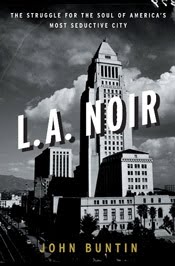 Some of the most interesting material involves Dragnet and how Parker used the show in all its forms to remold the LAPD’s image. It’s hard to overstate Dragnet’s popularity; at one point it was the most watched TV series in America after I Love Lucy while still drawing a huge radio audience. The next step, obviously, was a feature film. At the time of production, the LAPD’s more invasive tactics were being challenged in the courts; in instances where the department couldn’t get permission to place wiretaps, it would simply break into a suspect’s home, install a dictograph, and record conversations that way. Parker offered Dragnet’s Jack Webb a sensational case file to serve as the basis for the film, which ended up defending the techniques then under siege. The 1954 Dragnet movie, by the way, is uncommonly grim and brutal. Even for Jack Webb. It’s kind of great. It’s not currently on video, but it is available via streaming on Netflix.
If you’re a fan of Chandler, Chinatown, or Ellroy, L.A. Noir is essential reading. It’s one of the best books of the year.
Friday, December 18, 2009
Book: Hollywood Moon, by Joseph Wambaugh (2009)
Gaze on in wonder as I split hairs.
In writing, there’s formula and there’s formulaic. Formula can be good. Formulaic is always bad. With formulaic writing, you know exactly what you’re going to get. With a formula, you get exactly what you want.
You know who’s got a formula? Coca-Cola. And whenever you crave that particular flavor, you can crack open a can knowing that thirst will be quenched.1
You know who else has a formula? Joseph Wambaugh in his Hollywood books. Like every good recipe, it’s simple and satisfying.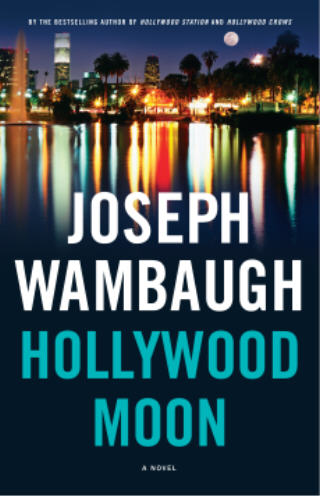 Take the regular roster of LAPD officers who work the mean streets of Hollywood – the neighborhood, not the state of mind. The surfer cops Flotsam and Jetsam. Nate Weiss, always ready with his SAG card. Toss in some newcomers to the patrol, like tough single mom/sergeant-to-be Dana Vaughn. Find the right balance of humor and heartbreak.
Add in some criminals, life-size opportunists and screw-ups. The lineup in Hollywood Moon includes a failed actor-turned-master-of-disguise putting in long days on an identity theft scam; the mastermind he lives in fear of, also his wife; a pair of runners wising up to the operation; and a borderline psychotic teenager desperate for an escape. Slowly turn up the heat. Stand back and watch things explode.
You have to season to taste. There’s too much of the surfers in this outing – a little of them goes a long way – but the heavies are the strongest yet. Wambaugh could write one of these books a month and I’d read it.
1Sometimes a successful formula can work against you. I had my first Mexican Coke recently. I didn’t know it when I bought it. I thought, “Cool! A glass bottle!” and only when I opened it did I notice the label was in Spanish. I didn’t like it. It tasted fine. It just didn’t take like Coke, which is what I wanted.
Wednesday, December 16, 2009
Movie: He Ran All The Way (1951)
The last John Garfield post started an interesting exchange with fine novelist/friend of the site Ed Gorman. Ed suggested that Garfield’s persona might not have worn as well as other noir stars because it can’t be easily reduced. Think of Robert Ryan and you think of that peculiar combination of rage and sorrow. Dana Andrews is melancholy. Bogart is coolness under pressure. Lee Marvin is menace.
As usual, Ed’s onto something. Garfield’s mercurial presence was used well in a number of strong films – The Postman Always Rings Twice, Body and Soul, Force of Evil – but not one that you could point to and say, “That is John Garfield.” Plus there’s something boyish about him. Ryan, Bogart, Marvin – these are men, fully grown and set in their ways. Garfield still seemed malleable. I meant it when I said Garfield cast a long shadow, because in an era with far too few men onscreen, Garfield is the best model we’ve got.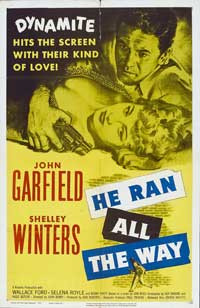 His youthful energy allowed him to play a role he was too old for in what would be his final film, He Ran All The Way. He’s a smalltime, slow-witted criminal still living with his mother (the pitiless Gladys George). After panicking during a payroll heist and killing a police officer, he picks up Shelley Winters, goes home with her, and takes her family hostage.
The movie is a forerunner of the home invasion genre that took root during the post-war suburban boom. Like other films of the type, there are moments that strain credulity. (“Rush him now! Take the gun!”) But it’s also charged with an uncommon mood of paranoia, even doom. Director John Berry and cinematographer James Wong Howe keep the camera uncomfortably close to Garfield’s desperate face, using scenery to trap him in the frame. The actor takes care of the rest, right up to the closing shot. It’s our last image of John Garfield. He died of a heart attack at age 39, haunted by charges of being a Communist sympathizer.
The latest issue of the Film Noir Foundation’s Noir City Sentinel includes a terrific article by Jake Hinkson that looks at He Ran All The Way as a blacklist case study. You can read it online now.
Upcoming: Noir City Northwest
Looks like I’ll be seeing He Ran All The Way again shortly, the way it was meant to be seen. The schedule for 2010’s Noir City Northwest is up. Eddie Muller’s dark carnival hits SIFF Cinema after its run in San Francisco.
This year’s theme is Lust & Larceny. It’s a doozy of a line-up. I’ve seen six of the fourteen films before, only one of them (Pitfall) on the big screen. I’m eager to catch the newly restored print of the crackling Cry Danger, while Rosemarie can’t wait for the aptly titled Larceny, starring John Payne and Dan Duryea as dandy grifters. Come that week in February you know where I’ll be, endeavoring to bring you the coverage you’ve come to expect.
Monday, December 14, 2009
Book: Print the Legend, by Craig McDonald (2010)
Other websites may be offering lists of 2009’s finest1, but around here we’re more forward thinking. Permit me instead to tease you with a word about one of the best books you’ll read next year2. Print the Legend is the third novel by Craig McDonald featuring Hector Lassiter, the man who lives what he writes and writes what he lives. And it’s a full-on tour de force.
Hec’s longtime friend Ernest Hemingway is four years in the ground when Hec consents to address an Idaho conference devoted to Papa’s life and work. But Hec’s got more to reckon with than a speech. There are his own unsettled feelings about his compatriot. And the dogged efforts of a scholar intent on proving that Hemingway’s suicide was in fact a coldblooded murder committed by Papa’s wife Mary – a theory that Hec can’t easily dismiss. Plus Hec’s burgeoning affection for said scholar’s pregnant wife. Not to mention Mary Hemingway’s own plans for Papa’s legacy and Hec’s role in it. And above all, the twisted machinations of Donovan Creedy, the hack novelist, government operative and dirty tricks specialist with shades of E. Howard Hunt.
Not many authors would dare to write a missing chapter from Hem’s A Moveable Feast. Fewer would pull it off as McDonald does here. He then follows up with a beautifully structured section jumping between the POVs of his five major characters at a single treacherous meeting. Late in the book there’s an extended description of let’s say physical courage that Papa himself would approve of. Me, I went pale just reading it.
Print the Legend moves with the intensity of a fever dream, driven by Hec’s zeal for life. If the book has a weakness, it’s the notion that Creedy’s abstract plan has a hope in hell against the force of nature that is Hector Lassiter.
Why am I tormenting you with praise for a book that doesn’t come out until February? Because McDonald offers a few tantalizing hints of the next book in the series, set in 1958 Nashville, and that’s at least another year away. It’s only fair that we all suffer together.
1Don’t worry. Such a post is coming.
2Yeah, FTC, I got a review copy. Whatcha gonna do about it?
Thursday, December 10, 2009
On The Web: Crimespree Cinema
The gang over at Crimespree Cinema has asked some big names to contribute 5 favorites for 2009 – film, TV or DVD. Somehow I slipped through their defenses. My picks are up now.
Sort Of Related: The Fallen Sparrow (1943)/Nobody Lives Forever (1946)
John Garfield may not have the same level of recognition as noir icons like Humphrey Bogart and Robert Mitchum, and the rediscovery of other names from the era like Richard Conte has allowed him to get lost in the cracks. But Garfield’s shadow may extend the furthest. The type of character he often portrayed – streetwise but fundamentally decent, a boyish tough guy who could be tamed – is a standard today. Put it this way: alone among his contemporaries, Garfield could have played either Matt Damon’s role or Leonardo DiCaprio’s in The Departed, and been brought back to read for Mark Wahlberg’s into the bargain. Watching two lesser known Garfield films with serious crime fiction pedigrees brought home the potency of that persona.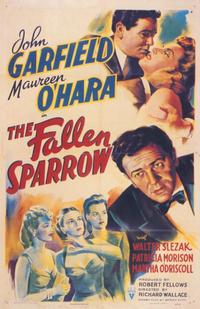 In The Fallen Sparrow, based on a novel by Dorothy B. Hughes (Ride the Pink Horse, In a Lonely Place), Garfield plays a veteran of the Spanish Civil War held prisoner by the Nazis. He’s freed in 1940 and returns to New York only to discover the Germans are still shadowing him while he delves into the murder of the childhood friend who delivered him from harm. The first third of the movie is rough sledding, a muddle with too many characters in a convoluted backstory. And may the gods of cinema take pity on you if you can’t figure out who the villain of the piece is. (Hint: The person it couldn’t be, because that’d be too obvious? Yeah, that’s who it is.)
But Sparrow fascinates for several reasons. There’s a troika of interesting women, foremost among them Maureen O’Hara as an ice princess who only begrudgingly thaws. But it’s Garfield’s work as a proto-Manchurian Candidate, still suffering the effects of torture at the hands of his captors, that compels. The film’s MacGuffin is also just right, a mixture of nobility and stubbornness that suits Garfield to a T.
By comparison, Nobody Lives Forever is light entertainment. W.R. Burnett is credited as writing the original screenplay, but it’s adapted from a story serialized in Collier’s in 1943. Garfield is Nick Blake, recovered from his WWII service and ready to resume his grifting career. He lights out for the coast and sets his sights on a rich widow, but when he falls for her for real he has to deal his partners out. Nothing in Nobody is even remotely surprising, but the machinery is so finely assembled by Burnett and director Jean Negulesco that you’re happy to take a ride to a familiar destination if only to enjoy the scenery. George Coulouris chafes nicely as an aging con man who can’t accept that he’s no longer a pretty boy. Retro crush Faye Emerson is on hand as a bad girl, matched forehead for lovely forehead by Geraldine Fitzgerald as the pigeon who becomes a swan. But Garfield gives the enterprise life, charming as hell in rogue mode, touching when he goes soft on his mark. I’ve got some other Garfield films kicking around. It may be time to dig them out.
Wednesday, December 09, 2009
Book: Ticket to Ride, by Ed Gorman (2009)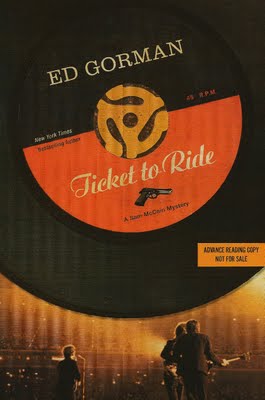 I’ve read quite a few books by Ed Gorman, but somehow the Sam McCain series got by me. So naturally I’m starting with the newest entry, which is also possibly the last. Still, better late than never.
Sam is a lawyer/investigator in Black River Falls, Iowa. It’s 1965. The local minister is burning Beatles records and people are starting to pay attention to the conflict in Vietnam. Some, like Sam, are doing more. They’re organizing protests, incurring the wrath of more conservative friends and neighbors. Shortly after one such rally goes awry, there’s a murder. As far as the sheriff is concerned it’s tied to the demonstration, but Sam unearths connections to a death that rocked the town several years before.
It’s a Gorman novel, so you get a well-turned plot, deft pop culture references, and sharp observations on small town life. You also get characters who don’t conform to expectations. The golden boy activist railroaded into jail? He’s something of an operator. The die-hard patriot ready to tar and feather is also a grieving father. Then there’s Sam himself, aware of all these incongruities as he struggles to do the right thing.
Here’s Ed in conversation with Tom Piccirilli about Ticket to Ride, the earlier Sam McCain books, and other sundry matters.
Saturday, December 05, 2009
Book: Losers Live Longer, by Russell Atwood (2009)
Exhibit A: The rare horizontal cover.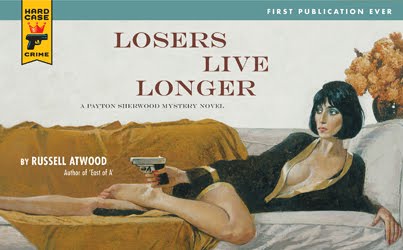 Like I’m not gonna read that.
Exhibit B is the setting in Manhattan’s East Village, specifically a few blocks where I’ve spent my share of time. But what cinched it for me was this review by James Reasoner. When he called this Hard Case Crime book “one of the best private eye novels of recent years,” I stopped in at Seattle Mystery Bookshop and picked it up that day.
Payton Sherwood is the P.I. in question. Down-at-heel (for a few chapters literally), he’s happy to be asked by a legendary retired operative to pitch in for a few hours on a case. When the senior shamus turns up dead on his doorstep, Payton decides to follow through on the job – even though he has no idea what it is. Before his long day is through, he’ll tangle with porn kingpins, indie filmmakers, and, of course, beautiful women. It’s old school pulp served up with a sharp contemporary sensibility. Fast, ferocious and authentically funny. Don’t miss it.
DVD: Edgar G. Ulmer: The Man Offscreen
Cult director Ulmer was the king of Poverty Row, a man who could stretch a budget to the breaking point and, with 1945’s Detour, created true dark magic. This 2004 documentary reveals that the man who made something out of nothing in his work did the same with his own life story. Stylishly shot, featuring comments from collaborators (Ann Savage, William Schallert) and admirers (Wim Wenders, Joe Dante, John Landis). The best stuff comes late as John Saxon and Peter Marshall, costars of Ulmer’s last film The Cavern, bicker in the back of a convertible before a rear-projection screen.
As an extra you get an entire Ulmer movie, 1943’s Isle of Forgotten Sins. It’s the South Seas by way of North Hollywood, the ocean-going scenes shot with models and the deep sea diving done by marionettes. Not good by any stretch, but strangely compelling and, as always with Ulmer, done with ingenuity.
Tuesday, December 01, 2009
Movies: A Phil Karlson Thanksgiving
The Phil Karlson Thanksgiving Weekend wasn’t planned. It was an act of necessity.
The problem is I’d become obsessed with that clip of John Payne and others performing “The Girlfriend of the Whirling Dervish” in Garden of the Moon. (Have you watched it yet? Go ahead. I’ll wait.) After repeated viewings of an impossibly young John Payne deftly tossing off Johnny Mercer’s lyrics, I needed to restore to my memory the older version. His face collapsed yet even more magnetic. In trouble and sinking deeper. The noir John Payne. That actor’s best collaborator was ex-prop man turned director Karlson. Time to revisit their finest hour. In Kansas City Confidential (1952), Payne plays an ex-con whose efforts to go straight mean nothing when he becomes the unintentional fall guy in a daring robbery. The simmering fury when he’s sprung from jail knowing that no one legit will ever trust him again is scorching. That bone-deep sense of betrayal, of hard work going for naught, charges the rest of the film, which despite the title is set mostly south of the border. Karlson as always keeps the action taut, and there’s the added bonus of what has to be the most badass crew in the annals of noir: Jack Elam, Lee Van Cleef, and Neville Brand.
Appetite whetted, I craved more. And had it on hand, thanks to the new Columbia Pictures Film Noir Classics Collection. I’d wanted to see 5 Against the House (1955) for years, and not just for Karlson. It’s based on a Jack Finney story, adapted by Stirling Silliphant (In the Heat of the Night) and William Bowers (Cry Danger, The Mob). Imagine my surprise to discover it’s the rare Karlson film that’s a total misfire.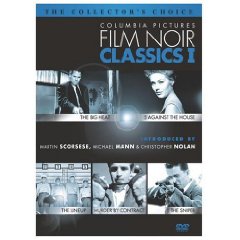 5ATH begins as a tiresome college comedy then becomes a heavy-handed survey of the problems faced by returning Korean War vets taking advantage of the G.I. Bill before settling into a heist groove. The “perfect plan” posited by these aging students would be ridiculous under any circumstances, but on the heels of the ingenious scheme cooked up in Kansas City Confidential it’s downright embarrassing. There’s nice work by Brian Keith as the most damaged vet and a good climax set in an automated parking garage in Reno, but little else.
ASIDE: Also in the Columbia collection is a superior Silliphant-scripted drama, 1958’s The Lineup (reviewed here), that features one of the greatest recent commentary tracks. My friend Eddie Muller and novelist James Ellroy tag-team on this one, Eddie providing a native San Franciscan’s view while Ellroy gives full vent to his obsessions. Eddie gave me a heads up after they recorded the track, saying, “It’s a wild one.” It lives up to that billing.
In the immortal words of Homer Simpson, you can’t go this far and not go further. On to the Karlson films parked on the DVR.
I’d seen 1955’s The Phenix City Story, but never with the reportorial prologue including interviews with several of the people involved in this true story. This segment made it easier to get scenes of still-shocking violence past the censors. Without it the movie opens with a haggard roadhouse number, ‘The Phenix City Blues,’ that swiftly presents the low-rent reality of life in an Alabama town choking on the vice aimed at soldiers in neighboring Fort Benning. Karlson and Georges Simenon make a natural match in The Brothers Rico (1957), with Richard Conte as an erstwhile Mafia accountant who thinks he’s made a clean break to become a cleaner, only to find himself doing the Organization’s bidding when his siblings go astray. With a dandy performance by Harry Bellaver as a local kingpin who orders hits and dinner in the same breath. They’re both tough-minded movies with a view of mobsters similar to the one articulated in Josh Bazell’s novel Beat the Reaper:
Proudly ignorant, personally repellent, absolutely convinced that their willingness to hire someone to beat money out of someone who worked for a living constitutes some kind of genius and an adherence to a proud tradition.
99 River Street, a John Payne/Phil Karlson film that screened at Noir City 2007, is currently available on Hulu and Fancast. You could be watching it right now! Here’s Ivan’s take at Thrilling Days of Yesteryear. I look at Karlson’s final film Framed here.
