There will always be a soft spot in my heart for Abel Ferrara’s Bad Lieutenant. Along with Frequency, it’s on the very short list of movies in which the New York Mets are essential to the plot. I revisited the film last year and while Harvey Keitel’s performance is still galvanizing, it didn’t hold it up as well I’d hoped. It’s very Catholic, and I bring that to the table already. And the truth is a lot of movies from the ‘90s indie film heyday don’t date very well.
You don’t need to have seen version one to make sense of Werner Herzog’s in name only sequel. You may not make sense of it anyway. But I loved every minute of it. Nicolas Cage is the title cop. His Terrence McDonagh is no angel at the outset, but after wrenching his back rescuing a prisoner in the wake of Hurricane Katrina he becomes addicted to painkillers and that accelerates his downward spiral. McDonagh is a dogged but demented detective, determined to find out who murdered an immigrant family while juggling his own criminal endeavors and indulging various appetites.
Cage is almost the whole show here, harking back to his wild, early, Vampire’s Kiss-era performances. His enthusiasm for silent film acting comes across in his walk, which had my back aching after ten minutes. His accent devolves as the movie progresses; halfway through he sounds like Tony Clifton. But his hell-for-leather inventiveness is given a sturdy framework courtesy of the script by TV veteran William M. Finklestein (who saves a few choice lines for himself as a weary gangster).
The movie’s funny, weird, and subversive. The scene in which Cage’s many problems are resolved rat-a-tat-tat plays like some deadpan existential sitcom, as if Samuel Beckett wrote an episode of My Two Dads. Ferrara’s film may come across as more serious; every minute he’s on screen Keitel is wrestling with demons, while Cage merely seems to be playing footsie with fate. Then you get to Port Of Call’s ending, which is moving, even transcendent. I don’t know if Port of Call is a joke or a work of art. I can only say that I enjoyed it tremendously.
Tuesday, April 13, 2010
Movie: Bad Lieutenant: Port of Call New Orleans (2009)

Sunday, April 11, 2010
Keenan’s Klassics: The Money Trap (1965)
Is that second K too much? Rosemarie thinks it’s too much.
In honor of Noir City Los Angeles and the pending release of Warner Brothers’ fifth Film Noir Classic Collection, the Warner Archive is running a sale. Thirty percent off select noir titles through April 19.
I wondered via Twitter why The Money Trap wasn’t on the list. In short order the situation was rectified. Thus did I single-handedly save consumers $5.99 and prove the utility of Twitter. No need to thank me.
Here’s a post from July 2007 explaining why this underrated film is as noir as they come.
Funny how these things work. When the question of forgotten pop culture personalities was raised at Hollywood Elsewhere earlier this month, Glenn Ford was one of the first names mentioned. And not without reason. Then the other day, author George Pelecanos wrote a heartfelt tribute to him, saying that “Ford, more than any other screen actor, is the paternal stand-in for a generation of boys whose fathers served in World War II” and praising the “quiet, confident masculinity that could only have come from someone who had nothing to prove.”
He’s ripe for reappraisal, with Russell Crowe taking over for Ford in his prime in the upcoming remake of 3:10 To Yuma. At Noir City I saw the young Ford in Framed. Time for a film from later in his career. The Money Trap is an unheralded noir with an offbeat pedigree. Director Burt Kennedy is better known for comic westerns. Walter Bernstein adapts a novel by Lionel White (The Killing). Ford plays a weary detective married to a wealthy younger woman (Elke Sommer). The missus begins having cash flow problems just as Ford is handed the case of a thief gunned down in front of an empty safe by connected physician Joseph Cotten. The thief’s dying words have Ford convinced that the safe wasn’t originally empty, and that if Ford can somehow steal the contents Cotten won’t be able to go to the police.
I’m not claiming that The Money Trap is a neglected masterpiece. The plot’s a bit lumpy, and the only thing missing from the opening sequence – Ford and partner Ricardo Montalban rocketing through the rain to a murder scene at a brothel, complete with brassy jazz soundtrack – is a narrator intoning, “A Quinn Martin Production.” But it’s a good movie. More to the point, it’s a bracingly adult one, about sex and money and the need to make a name for oneself.
It has a healthy appreciation for sleaze, always a plus in a thriller. The magnificently fleshy Sommer undressing just at the edge of the frame, loads of shots of curvy women in garter belts.
That sleaze is tied to what drives the movie: Ford’s repressed paranoia that living off his wife’s money has diminished him as a man. At one point Ford looks up the thief’s widow, a woman from the neighborhood he has a history with, played by Rita Hayworth. Ford and Hayworth appeared together several times, most memorably in Gilda. They put that history to work for them in an extraordinary scene in which they compare how their lives haven’t matched the dreams of their youth and end up sleeping together one last time. Neither actor indulges in vanity, the weathered hunk and the ravaged beauty giving each other some small bit of comfort in the long night.
Black-and-white films from the mid-to-late ‘60s seem to carry a sense of their own futility. You can feel history shrugging its shoulders and asking, “Why aren’t you in color?” In a film noir that feeling is only intensified, moreso one with leads in the twilight of their careers. Stumbling onto The Money Trap was like discovering ghosts struggle with their problems, certain in their belief that no one was watching.
Saturday, April 10, 2010
Miscellaneous: Relaunch!
Consider this post the champagne bottle. I am christening version 2.0 of this blog. I’ll tweak the design, add a few bells and whistles, but basically this is the new internet homestead.
The plan, you may recall, was to maintain the blog at the original URL. It soon became apparent that the best way to keep the old links, comments and images intact was to migrate to a subdomain with a slightly different address. Think of it as the website’s backyard. Look, I put in a deck.
I always knew there’d come a day when I moved the blog off the main page. After all, I bought the domain to build the Vince Keenan brand and promote my various products: books, films, articles, video games, my dance album, my personal fragrance (scribe ... pour homme) and my online series of motivational lectures (Take Out the Biggest Guy on the Yard: Management Lessons from Prison).
Speaking of which, I have to get back to work. Hang around all you like. Just turn off the grill when you’re done, and close the gate so the dog doesn’t get out.
Wednesday, April 07, 2010
Miscellaneous: Testing
Pay no attention to this post. This is Vince, making sure the first stage of the blog migration was successful. He has nothing interesting to say. As usual.
This blog has moved
This blog is now located at http://blog.vincekeenan.com/.
You will be automatically redirected in 30 seconds, or you may click here.
For feed subscribers, please update your feed subscriptions to
http://blog.vincekeenan.com/feeds/posts/default.
Tuesday, April 06, 2010
Miscellaneous: Changes Afoot
Some websites are redesigned, and some have redesigns thrust upon them.
Back in the technologically primitive days when I started VKDC, in the long ago year of 2004, publishing via Blogger on a non-Blogspot domain meant using file transfer protocol. Alas, Blogger has decided to stop supporting FTP at the end of this month. Meaning that I now need to do something.
The plan, if it works, will keep the blog at this URL. The migration process will take some time, more if we screw it up. In the interim, follow me on Twitter for updates.
Once the migration is done, I intend to make some visual changes around here. Believe it or not, six years ago this was a fairly slick design. Now I’m sick of looking at it.
If all goes well, there should be no interruption of the top-drawer service you have come to expect. If all doesn’t go well, which is entirely likely, remember me as a consensus builder. Except when it comes to Bigger Than Life.
Sunday, April 04, 2010
Book: Faith and Fear in Flushing, by Greg Prince (2009)
On a recent evening, Rosemarie and I were strolling around our Seattle neighborhood. A gent who’d gotten in his cups a little early stopped before us, turned to Rosemarie, and said, “What’s a good-looking woman like you doing with a Mets fan?”
(I was wearing a Mets cap. As is my wont.)
Rosemarie replied, “This man is my loving husband of almost twenty years. And I’m also a Mets fan.” Appropriately chastened, the interloper took his leave.
We walked on. “So, uh, thanks for sticking up for me,” I finally said.
“Forget it,” Rosemarie replied. “He did say I was good-looking, right?”
Random abuse is part of being a Mets fan. I don’t know how it works between Cubs and White Sox partisans, but in New York you always have to explain why you root for the orange and blue. That’s because the Yankees are the Yankees, and the Mets are the Mets.
But root for them I do. The Mets have been a part of my life for as long as I can remember. Before movies, before crime fiction, there was the Mets. Blame growing up in Queens, just a stone’s throw from Shea Stadium. They were my home team in every sense. (Rosemarie, a product of Flushing, would actually walk to games.) Being a Mets fan is an inextricable part of my identity. Ask anybody who knows me.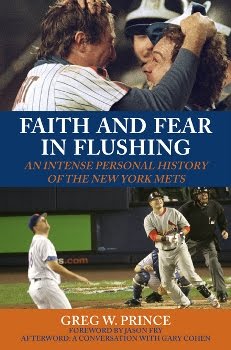 Greg Prince is one of the writers behind Faith and Fear in Flushing, a regular stop for me. He’s spun the blog into a book. Subtitled An Intense Personal History of the New York Mets, that’s exactly what it is: a look at how supporting a team, through good times and bad, becomes a constant, a way of marking the years. It’s about the twinned joy of giving yourself over to something larger, and the agony of being at the mercy of that which you can’t control. Substitute the names and it could be about your team. But if the phrase Grand Slam Single produces chills in you as it does in me, you’ll love it.
So as Opening Day dawns on Monday, I will once again don my cap in support of the most dysfunctional team in professional sports. This in spite of the fact that they’re in a division with the Phillies, the National League equivalent of the Yankees and Red Sox: a perennial contender. That everyone expects them to flirt with .500 and place no better than third this season. That sportswriters have taken to calling for regime change as if the front office is part of the Axis of Evil, or comparing Citi Field to the hell of Dante’s Inferno.
Instead, I’ll focus on the good times. Cementing my bond with my friend Mike, whose blog Metsanity is well worth reading. The 1986 world championship; game six remains one of the high points of my life. Meeting Tom Seaver, the man to this day known as The Franchise. Want to see hero worship? Look at my face.
Or simply helping out another fan. It’s late 2007. Only a few weeks after the Mets’ storied collapse, blowing a seven-game lead with seventeen to play and missing the playoffs entirely.
Whoo. Hang on. I need a minute.
I have to run to the grocery store. It’s raining, so without thinking I put on my Mets inclement weather cap – yes, I have more than one – and head out. I’m in the express line when the guy behind me taps me on the shoulder.
“I have to tell you, I’m so glad to see you,” he says to me in a quiet voice. “I haven’t been able to put on my cap since it happened.”
“You’ve got to man up,” I told him. “Next year starts right now.”
I am way, way too proud of that moment.
Tuesday, March 30, 2010
Movie: Bigger Than Life (1956)
Talking about the latest Criterion DVD release has already landed me in a dustup, so I tread with caution. On Facebook I said the movie was a curio, not a lost classic. That prompted a critic whose work I regularly read to call me a ... well, the exact name was left vague but I’ll go with the most positive option and say philistine. The critic ultimately kicked me to the digital curb. Maybe Errol Morris is right when he suggests that social media is as bad as high school.
Bigger Than Life generated an uncommon amount of publicity when it debuted on video last week. The majority of reviews were laudatory; the word “masterpiece” crops up repeatedly. It was hailed as a neglected landmark, an incisive social critique, a scathing exposé of the American Dream.
All of which should have raised red flags. I don’t have many rules when it comes to movies, but here’s one: when every hosanna fawns over what a movie says but not what actually happens onscreen, odds are you’re in for a tough sit.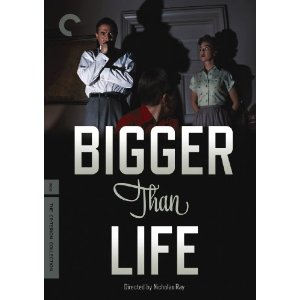 Nicholas Ray directs. The movie is based on a New Yorker article and feels like it. James Mason plays a mild-mannered schoolteacher who moonlights as a taxi dispatcher. He suffers from increasingly frequent bouts of pain which are diagnosed as a symptom of a fatal arterial disease. But there’s a new treatment, the miracle drug cortisone. It saves Mason’s life, but also triggers manic episodes that crescendo into full-blown psychosis with his abuse of the drug. He becomes a suburban Nietzsche, a household tyrant terrorizing his family.
The lopsided script is so focused on Mason and his largely one note fugues that the behavior of the other characters is rendered incomprehensible. His doctors aren’t held to account. As for Mason’s wife (Barbara Rush), I had to keep stepping out of the movie to backtrack her motivations. “I suppose if she thinks X, it makes sense she’d do Y.” Many critics claim Bigger Than Life is fundamentally about issues of class – novelist Jonathan Lethem, a great admirer of the film, offers 27 minutes of cultural background on the DVD – but the movie treats money obliquely. In a key scene, Mason holds up medical bills shot in such a way that I couldn’t tell what they were until he’d already put them down. Here’s another of my rules: if your characters’ actions are essentially prompted by subtext, you’ve failed as a dramatist.
I was interested enough in the story to track down the original article in the New Yorker’s archives. Berton Roueché’s “Ten Feet Tall,” published in September 1955, is an astonishing piece of reportage that answered every question raised by Bigger Than Life’s flawed script. To begin with, the schoolteacher’s wife has a far more substantial presence. During the period in question, she herself was incapacitated by sickness. Her husband’s adverse reaction to cortisone was compounded by his doctor’s refusal to discuss why he was altering the dosage. Here’s the teacher on his physician: “He believes in a minimum of explanation and a maximum of results. And, of course, I said nothing to my wife.” The bath scene that gives the movie its signature image – Mason’s reflection in a shattered mirror – comes from out of left field in the film. The incident in context is smaller and far more devastating.
Roueché’s article is a case study. So is Bigger Than Life, in how not to adapt material.
UPDATE: Jaime Weinman offers a terrific counterpoint to this post.
Thursday, March 25, 2010
Movie: A Prophet (U.S. 2010)
Lots going on, so I’ll keep this brief: you need to see this movie.
It’s a brilliant, hard-hitting epic. Malik, a young French Arab, is thrown into prison for a six-year bid. Without family or friends on the outside, he’s prepared to face his fellow inmates alone – until he comes to the attention of the Corsican gangsters who run the joint ... and need another Arabic prisoner killed. The preparation for the hit and the job itself are ferociously intense. Soon Malik finds himself in a strange no man’s land, protected by men who don’t respect him and reviled by his own kind. So he does what any smart kid would do: he begins exploiting his benefactors, his enemies and the system, and slowly amasses power.
Tahar Rahim manages to chart the transformation of Malik’s character while nailing down the true hard case’s complete lack of affect; he becomes a new man without it ever registering in his face. Rahim is matched by Niels Arestrup as the aging kingpin who didn’t expect the world inside the prison’s walls to change, too. Jacques Audiard’s direction is supple without stinting on detail. Seek this brutal, relentless and powerful movie out.
Sunday, March 21, 2010
Related: Lonelyhearts, by Marion Meade (2010)/Five Came Back (1939)
They make an unlikely couple. Nathanael West, an author whose comic sensibility is so dark it can be difficult to find. And Eileen McKenney, a Midwestern girl whose big city adventures spawned a miniature empire.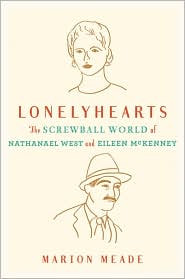 Theirs may not have been a “screwball world,” as author Meade subtitles her joint biography; West and McKenney both died too young in a car accident caused by West’s notoriously bad driving mere days before the debut of the play that would make Eileen’s exploits even more famous. But Meade’s telling has that tone. She writes with an informal, almost jaunty voice that suits what is ultimately a tale of kindred spirits finding each other, and prior to that a recounting of literary circles in 1920’s New York and ‘30s Hollywood. The most interesting material is about those orbiting the star-crossed twosome, like West’s overbearing mother and Ruth McKenney, the staunch Communist who gained her greatest fame chronicling her superficial sibling’s antics in My Sister Eileen (filmed twice, adapted into a play and later the musical Wonderful Town).
It’s the rare biography that makes you think less of its subject – well, one of them – but it happens here with West, who comes across as pretentious and scheming. Amazingly, a stint in the Poverty Row salt mines matured him. The Day of the Locust, with its parade of grotesques and apocalyptic sense of alienation, is a book I respect without actually liking. Give me the realistically grim but more humane work of West’s Republic Pictures stablemate Horace McCoy.
West’s greatest success as a screenwriter is, ironically, one of the first disaster movies. In Five Came Back he mixed disparate types – among them a gangster’s young son, his pistol-packing “uncle,” an anarchist and the lawman escorting him to his execution, plus Lucille Ball as a woman who’s been around the block with an EZ Pass – on a doomed airplane. Spoiler alert: five come back. The film plods in its early stages, serving as a better showcase for director John Farrow than West. But tropes become tropes for a reason. Once the plane crashes and the action moves to the jungle, the stock characters become more involving. West, expecting to receive sole credit, was dismayed to find himself sharing space with, among others, Dalton Trumbo, who transformed the anarchist villain into the voice of reason.
Five Came Back was the sleeper hit of 1939, launching Farrow to the A-list. (ASIDE: Want to read about Farrow’s glory days? I wrote an article about them that’s in this book.) He would remake the film nearly 20 years later as Back From Eternity. Guess what else is on my DVR?
Tuesday, March 16, 2010
Book: The Detective in Hollywood, by Jon Tuska (1978)
If I’ve learned one thing from the big dogs of the noir circuit, it’s the importance, nay, the necessity of documentation. Talk directly to the people who made the movies, get them on the record, create a body of knowledge. (Exhibit A, as I’ve said before: Eddie Muller’s one-of-a-kind Dark City Dames.)
That’s what makes Jon Tuska’s overview of the private eye genre so vital. He did the legwork when there were still plenty of people around to interview, like Billy Wilder, Alfred Hitchcock, Robert Montgomery.
Even more impressive is that he committed to this undertaking in those dimly remember’d days before video and the internet, when research of this kind meant hard work. Tuska sat down with Lloyd Nolan, who played Michael Shayne, and Nolan brought along something a fan sent that might be helpful: a typewritten list of all of Nolan’s films. An asterisk by the title meant the fan owned a print of the movie.
Tuska’s work is exhaustive but never tiring, guiding you through now-neglected series like the Crime Doctor and Mr. Wong, telling you which Charlie Chan films are worth your while. The chapter on The Thin Man movies also includes their many imitators. Tuska writes with wit and affection, but also a sharp critical eye. Some of his positions I agree with (dismissing all of Boston Blackie), some I don’t (no way is The Drowning Pool better than Harper). And the few stances he cheerily admits are heretical – such as claiming that Montgomery’s subjective camera Lady in the Lake is superior to both Murder, My Sweet and The Big Sleep – are so persuasively argued that I’m willing to give the movies in question another look. The book ends with an affectionate appraisal of the ‘70s troika of The Long Goodbye, Chinatown and The Late Show.
I first learned about the book from Ed Gorman, who wonders why it never got its due. Having read it, I’m now asking the same question. Tuska updated it in 1988 as In Manors and Alleys: A Casebook on the American Detective Film. I’m going to need a copy of one version or the other to call my own. Any fan of The Whistler is welcome around here.
Thursday, March 11, 2010
Book: I Should Have Stayed Home, by Horace McCoy (1938)
One of the knocks on e-readers that baffles me is, “You lose that new book smell!” To which I say, “What about that old book smell?” A few years ago I picked up a paperback in an antique store containing two novels by Elisabeth Sanxay Holding. It was only when I got the book home that I realized it reeked, as if it had been used to prop up a leaky boiler in a basement that doubled as a hobo graveyard. Rosemarie, her eyes watering in the next room, announced, “Either you read that one outside or you don’t read it at all.” As I consigned the leathery pages to the flames, I heard them cry out in torment. (Actually, I just tossed the book in the trash. Several blocks away.)
Since buying my Kindle, I’ve been primarily filling it up with older, somewhat hard to find books. Solomon’s Vineyard and Fast One did not disappoint. Nor did Horace McCoy’s brief and brutal I Should Have Stayed Home.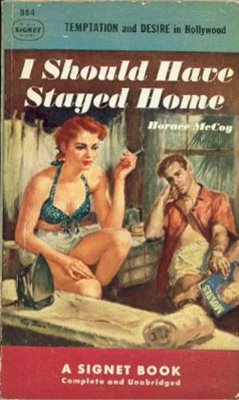 McCoy, a journalist and Black Mask writer, moved to Los Angeles in 1930 with hopes of becoming an actor. He would instead become a screenwriter. But the cattle call experience marked his work, especially his best known novel, They Shoot Horses, Don’t They?, about Hollywood aspirants participating in a grueling dance marathon, and I Should Have Stayed Home.
Georgia-born Ralph Carston headed west with dreams of stardom, but he finds himself short of cash, scuffling for extra work, and sharing a seedy bungalow with his Platonic roommate Mona Matthews. A friend of Mona’s is arrested for shoplifting. A chain of circumstance follows that brings Ralph in contact with an older woman who has designs on him, a disillusioned flack, and a host of other Tinseltown types.
It’s a grim, powerful book. Ralph seethes with desperation and rage. He’s implied in his letters to his mother that he’s already made it in Hollywood, but he soon learns that his accent and his attitude may keep him from success. Scarier is the resentment boiling over into hatred that he feels toward those who have managed to grab the brass ring. (“It made me sore, sitting here looking at Robert Taylor, the biggest star in the pictures, trying to figure out what he had that put him where he was and that, goddam it, one of these days ...”) It’s an unsparing look at the dark reality of show business that deserves to be mentioned alongside Nathanael West’s The Day of the Locust.
Saturday, March 06, 2010
Miscellaneous: Your Weekend Recommendations
Now that Noir City has wrapped, it’s high time for me to get my head back in the twenty-first century. Here are some more contemporary picks.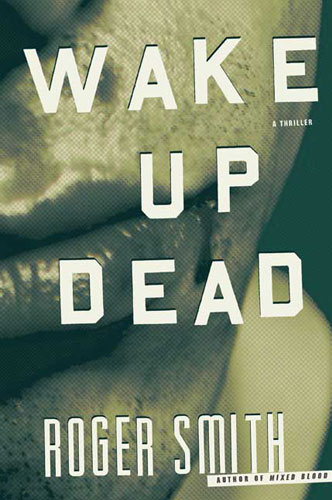 Wake Up Dead, by Roger Smith (2010). Roxy Palmer used to be an American model. Now she’s living in Cape Town, South Africa, trophy wife to an arms trafficker. When two street punks jack their car, Roxy takes advantage of the situation. Thus setting into motion a tortured Elmore-Leonard-meets-Robert-Altman chain of events embroiling Roxy, the carjackers, a mercenary known as Billy Afrika, a psychotic gang boss hell-bent on a reunion with his prison “wife,” and an honest bastard of a cop named Maggott forced to investigate with his son in tow.
The bleakness of this book is, at times, suffocating; each character’s history is so grim that the miasma of misery threatens to become blackly comic. But there’s no denying that every one of Smith’s players pops off the page, and his pacing is relentless. It’s a prison shank of a novel: brutal and hard, driving in deep and leaving a hell of a mess.
The Ghost Writer (2010). A review described Roman Polanski’s adaptation of Robert Harris’ novel as a “town car thriller.” That how it seems for much of its running time, a well-appointed and smooth ride.
Ewan McGregor is the title character, hired to punch up the memoirs of former British Prime Minister Tony Blair Adam Lang (Pierce Brosnan). As Lang is brought up on charges in The Hague for his role in abetting America’s rendition program, the ghost begins to wonder about the mysterious suicide of his predecessor.
There are terrific performances throughout, including one from 94-year-old Eli Wallach. The movie’s final revelation is a doozy, delivered in an extended, largely wordless set piece that is a joy to behold. Sly, meticulously constructed, with a perfect visual capper. Days later, I’m still cackling at it.
Wednesday, March 03, 2010
Miscellaneous: Sherman’s March
Vincent Sherman had a solid career as a director, making melodramas (Mr. Skeffington, The Hasty Heart) and films of a darker, noirish hue (The Hard Way, Nora Prentiss, The Damned Don’t Cry). But he should be remembered for his autobiography Studio Affairs, one of the most honest and therefore best books about Hollywood ever written.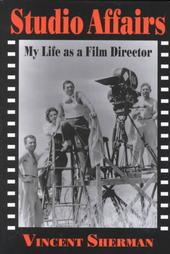 Let’s get the prurient stuff out of the way, shall we? Sherman slept with several of his leading ladies and details those relationships. The dalliances strangely parallel each actress’s films; Bette Davis’ is histrionic with a tragic ending, while Joan Crawford’s is brazen and tawdry. (His one night stand with Rita Hayworth is simply sad.) What emerges from the telling is an astonishing portrait of a lasting marriage; Sherman’s wife Hedda knew of his affairs and even became friends with Crawford.
Sherman is every bit as meticulous when it comes to recounting his professional life. Studio Affairs lays bare how many compromises are necessary for a career in Hollywood, how frequently opportunities fade away. Sherman never forgot his training in the B-movie unit at Warner Brothers, where previous years’ prestige projects were repurposed into programmers. (The first half of The Mayor of Hell plus the end of San Quentin became Crime School, Sherman’s first writing credit.) When a projected adaptation of James M. Cain’s Serenade fell apart, he reworked The Letter into The Unfaithful.
After reading the book, I caught up with a few Sherman films on DVD. All Through the Night (1941) was of particular interest; Humphrey Bogart in an anti-Nazi action comedy? He plays gambler Gloves Donahue, whose efforts to find out what happened to his favorite cheesecake – I am completely serious – lead him to a ring of fifth columnists. Bogart’s gang includes Jackie Gleason and Phil Silvers. And yet somehow, the movie is leaden from the jump. Honestly, it’s dreadful. I only kept watching because I was convinced it had to get funnier.
Still, it does produce my favorite story in Sherman’s book. Peter Lorre, as one of the Nazi spies, has to shoot a lock off a door while Judith Anderson hollers in German behind him. When Sherman requested a second take, Lorre says, “That’s all, brother Vince. I can only do this kind of crap once a day. Besides, it’s six o’clock. Time to go home.” (Can’t you just hear Lorre saying that?) Sherman asks how, if that’s true, Lorre could have made all those Mr. Moto pictures. Lorre retorts, “I took dope!” Later, Sherman learns that Lorre wasn’t joking.
Next up was the movie that cemented Sherman’s reputation. Underground (1941) was meant to be a B-picture, but a strong script and Sherman’s direction made it a surprise hit. A wounded Nazi soldier, loyal to the party, returns home, not realizing that his older brother is a leader of the resistance. They are quickly set on a collision course.
Propaganda? You bet. Effective? And how, especially that ending. The idea that this movie was in theaters months before Pearl Harbor boggles the mind. First and foremost, though, Underground functions as a gripping thriller.
Another good Sherman story: the role of an elderly man who aids the resistance was reconceived for the gorgeous Mona Maris because she was “friends” with the film’s producer – and if he didn’t cast her, she was going to cut up all of his suits. Maris is terrific in the movie, but Sherman never bought her in the part.
Friday, February 26, 2010
Noir City Northwest: Slattery’s Hurricane (1949)
This year’s festival came to a close with a salute to the man Eddie Muller called not a noir actor but a noir artist: Richard Widmark.
I’d been itching to see Slattery’s Hurricane since reading Eddie’s article about it in the Noir City Sentinel, the magazine of the Film Noir Foundation. It’s the least known of Widmark’s films from this era, and is also the only original screenplay by novelist Herman Wouk.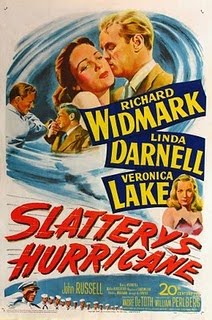 Here’s your slambang opening: Widmark’s Slattery coldcocks a guy, steals a plane, and flies directly into the titular windstorm. The ex-Navy pilot then reflects back on the life that brought him to this point. Think of it as a borderline psychotic version of The Spirit of St. Louis. The long chain of circumstance involves Slattery’s fragile girlfriend Veronica Lake; his ex-lover Linda Darnell, now married to an old pal; and a “candy” company that didn’t hire Slattery to fly to the Caribbean to pick up cocoa leaves.
Very adult stuff, so naturally it ran head-on into opposition from the censors. Eddie correctly called this “a wounded film,” with much of the strongest material excised or heavily edited. Still, those phantom limbs are felt. You can see the movie that Slattery’s Hurricane was meant to be, even though it doesn’t play out onscreen. Widmark’s bristling performance holds the enterprise together, as do the harrowing flight sequences; director André De Toth was a pilot, even though he only had one eye. Lake, then married to De Toth, appears without her trademark hairstyle and is shockingly vulnerable. She would never star in a major studio film again.
Next: Pickup on South Street, one of the best B movies ever made and one that lost its FBI seal of approval because of writer/director Samuel Fuller’s affection for characters scrabbling out an existence in the margins of society.
We’ve seen Pickup several times, so we skipped the screening to have one last round (or two) of drinks with the Czar of Noir and settle up. Rosemarie and I sold hundreds of dollars worth of FNF merchandise during the run of the festival, and were down to the dregs by closing night. It may not be as impressive as the haul the Foundation takes down during Noir City San Francisco, but that festival is in the 1400-seat Castro Theater and has cigarette girls moving the merch in the aisles. Seattle had two people at a table, and that cigarette girl costume chafed something fierce.
My thanks again to Eddie, the FNF, and SIFF Cinema for what has been the most successful Noir City Northwest yet. Great films and strong turnouts all week long. It’s an amazing feeling to watch rarities like Slattery’s Hurricane or Wednesday’s Fly-By-Night and realize that the only people in the world seeing that movie on that day are in the room with you.
Noir City rolls into Los Angeles in April, and elsewhere later this year. Do yourselves a favor: watch The Endless Night, which received an encore screening yesterday, then go to the Film Noir Foundation website and kick in a few bucks. (UPDATE: Or buy the swag that Rosemarie and I were selling, including Annual #2 in which I appear.)
Time for me to catch up on some more current movies.
Thursday, February 25, 2010
Noir City Northwest: Deported (1950)/Fly-By-Night (1942)
Few names are more revered in the annals of film noir than that of Robert Siodmak. He directed some of the classics of the form: Phantom Lady, The Killers, Criss Cross. Last night Eddie Muller showed a pair of rarities that bookend the noir and Hollywood phases of Siodmak’s career. Neither one is exactly noir, but both are fascinating.
The German expatriate was considering a return to Europe when he was offered Deported. One of the few studio films to be shot overseas at the time, it’s a fictional account of Lucky Luciano’s forced return to Italy following his cooperation with the U.S. government during World War II. From prison, Charley Lucky used his control of the waterfront rackets to shut down Axis spies, and his contacts in Italy provided intelligence during the run-up to the invasion.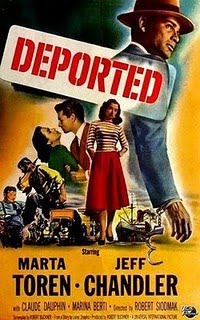 “Vic Smith,” aka Victor Sparducci, (Jeff Chandler) isn’t a player at Lucky’s level, but he did do his bit to help Uncle Sam during the war. Now he’s being sent back to the country he barely remembers, watched by the police and hounded by an ex-partner. As he falls for a beautiful contessa (the Swedish actress Märta Torén), he hatches a brilliant plan to bring the hundred grand he stashed in New York into the country.
Deported is an authentic curio, and I liked it quite a bit. It feels like a European film, moving at a different rhythm. There are some striking scenes of Italy shot by William Daniels, and a sense of the deprivation there after the war. I must mention Marina Berti, bewitching as Gina. The apocryphal story is that Luciano, a die-hard movie fan, met with Siodmak during production to tell him how much he loved The Killers ... and that Siodmak used him as an extra in a movie based on his own life. I didn’t spot him, but then I wasn’t looking for him.
Siodmak burst of the B movie ghetto with Fly-By-Night, a blatant attempt to cash in on Alfred Hitchcock’s success The 39 Steps. Here the innocent man caught up in espionage is played by Richard Carlson, who would go on to be a ‘50s sci-fi stalwart in It Came From Outer Space and Creature From the Black Lagoon. Nancy Kelly, mother of The Bad Seed, is the gal along for the ride.
The script, by one of my heroes Jay Dratler, manages to hit all the comic suspense notes in diabolically inventive ways. And Siodmak stages some impressive stunts on a limited budget. It’s easy to understand why he was earmarked for bigger things. Fly-By-Night is a treat, one of the best faux-Hitchcock films ever made.
Alas, there is exactly one (1) print of the movie in existence. Last night, it unspooled in Seattle.
Wednesday, February 24, 2010
Noir City Northwest: Red Light (1949)/Walk a Crooked Mile (1948)
It was a hoarse Eddie Muller who took to the stage on Tuesday night. SIFF, working him like a government mule, has sent him out to preach the gospel of noir at area schools this week. During his visit to Reel Grrls, he showed The Endless Night. First question: “Why is everyone so angry?”
And thus is the next generation of noirheads born.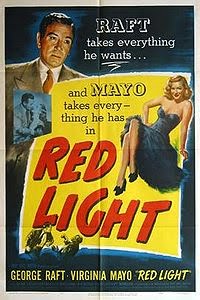 Eddie billed Red Light as biblical noir. He meant this in every sense. A copy of the Good Book is integral to the plot, and there is divine intervention. Trucking magnate George Raft goes on the warpath after his chaplain brother is murdered. It was tough for me to feel his pain because li’l bro is Arthur Franz, who played the title role in The Sniper.
Red Light is a truly odd duck of a film, a tough melodrama shot through with schmaltz and religious undertones. It uses Ave Maria as its action theme. The Coen Brothers must have seen it because Stanley Clements, aka Mr. Gloria Grahame, plays a hotel bellhop who clearly influenced Buzz in The Hudsucker Proxy. There’s also a bizarre flashback featuring a blind veteran and a window washer with no sense of personal space. The script is something of a shaggy dog story; you know exactly how the bible business is going to pay off. But Raft is surprisingly effective within his limited range, and veteran studio hand Roy Del Ruth stages a vigorous ending.
Walk a Crooked Mile was made semi-documentary style, and you know what that means: location shooting and stentorian voiceover. Dennis O’Keefe, joining Dick Powell and John Payne in the parade of song-and-dance men who remade themselves as hard cases, is an FBI agent investigating security leaks at a government energy facility. He teams up with Scotland Yard’s Louis Hayward to smash a red spy ring. A minor but solid suspense film. Director Gordon Douglas also made Frank Sinatra’s Tony Rome movies and Zombies on Broadway starring Bela Lugosi and the comedy team of Brown & Carney, the utterly destitute man’s Abbott & Costello.
Both of last night’s movies were partly filmed in San Francisco and feature Raymond Burr as a villain. Burr’s best known for playing heroic leads in Perry Mason and Ironside, but those TV shows were before my time. I’ve never seen an episode of either one. I’ll always think of Burr as an overweight, sweaty psychosexual lunatic from movies that are even more before my time.
Tuesday, February 23, 2010
Noir City Northwest: Inside Job (1946)/Human Desire (1954)
So about Sunday ... the double feature was devoted to John Garfield. I’ve seen The Postman Always Rings Twice a time or three, and I watched He Ran All the Way not all that long ago – and didn’t particularly care for it. (Great opening 20 minutes, but it gets very stagy very quickly.) Consequently, I chose to forego them both and dine with the czar instead. But I was on hand to sell merch and hear Eddie’s introduction, which touched on how the former Julius Garfinkle spearheaded the Group Theater-born school of naturalistic acting that prefigured Clift, Brando and Newman; Postman’s transformation from the definitive work of noir fiction to high-class women’s picture; and the blacklist’s effect on the careers of everyone involved with He Ran All the Way. When Eddie wrapped up by noting that he’s in regular contact with Garfield’s daughter and she asked him to tell the audience, “Julie sends his love,” I almost regretted my decision. I’ll revisit Postman again soon.
Monday’s movies? Both brand new to me.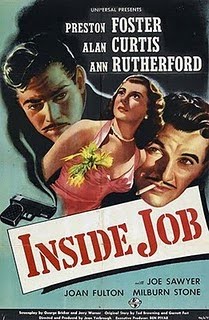 The authentic B picture Inside Job was aptly described by Eddie as “67 minutes of craziness.” Ex-con Alan Curtis, coerced by his old boss into robbing the department store where he’s working a straight gig, opts to hit the joint himself with wife Ann Rutherford. Sounds noir, right? Well, it ain’t. I don’t know what to call Inside Job other than baffling. Featuring a photo of a Robert Benchley lookalike in a bathing suit and the most annoying child actor in screen history. Curtis is the target of a police dragnet, but when he goes out in broad daylight – to buy a radio, yet – he doesn’t bother to shave off his distinctive mustache. Which I can understand; without the ‘stache, even the camera wouldn’t notice him. The truly downbeat ending makes it the weirdest Christmas movie ever. Tod Browning is credited with the story, the last time the legendary horror director’s name appeared on a film.
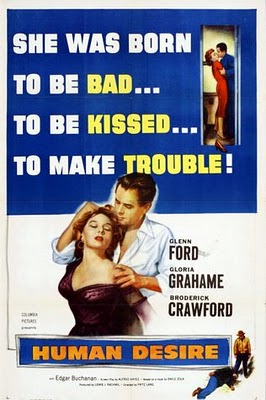 It was unfair of Eddie to show a Fritz Lang movie next. The opening sequence of Human Desire, showing train engineers at work, is more suspenseful than all of Inside Job ... and nothing is happening. The film is based on Émile Zola’s 1890 novel La Bête Humaine, previously filmed by Jean Renoir in 1938. Glenn Ford, an actor Noir City has taught me to appreciate, is a Korean war vet returning to his railway job. He falls for the wife of colleague Broderick Crawford, unaware that her interest in him is spurred by the need to cover up a murder Crawford has committed.
Human Desire is another showcase for Gloria Grahame and her stiletto vulnerability. The psychology of her character is so dark that the movie itself seems frightened of it. The beautiful quality of the print only emphasized the truncated scenes and abrupt ending. For its occasional skittishness, however, Human Desire has intensity and atmosphere to spare. From Fritz Lang, I would expect no less.
Sunday, February 21, 2010
Noir City Northwest: Cry Danger (1951)/The Mob (1951)
It’s good to see your money at work.
The Film Noir Foundation takes its mission seriously, funding restorations of movies that would otherwise be lost. Organization capo Eddie Muller explained the many hurdles in the process before the Northwest premiere of the Foundation’s latest effort, done in conjunction with the UCLA Film & Television Archive. Because Cry Danger was produced independently by star Dick Powell, it was at genuine risk of disappearing. The FNF’s intervention has given this underrated film – and VKDC favorite – a new lease on life.
Powell’s Rocky Mulloy is released from prison after serving five years on a robbery charge when a witness resurfaces to back up Rocky’s claim of innocence. That the witness has never seen Mulloy before and alibis him only in the hope of making a few bucks is the first indication that Cry Danger isn’t going where you expect. Rocky looks up Rhonda Fleming, his ex-flame/current wife of his still-in-stir pal, and sets his sights on the man behind the frame, the “now 60% legit” Louie Castro (William Conrad). William Bowers’ script is a marvel of construction, especially as it was written with producer Powell looming over his shoulder. (“We just lost another fifty grand from the budget. Cut something.”) Cry Danger’s greatest asset is the character of Powell’s unlikely savior DeLong, a bibulous one-legged Marine and thinly-veiled self-portrait of Bowers. Richard Erdman gives what I rank as one of the greatest supporting performances of all time, abetted by classic dialogue. (“Occasionally, I always drink too much.”) Erdman is not only still acting, he has a recurring role on NBC’s Community as one of Greendale CC’s more mature students. Amazing considering his career began with Mr. Skeffington in 1944. Cry Danger is a terrific film well worth saving.
Bowers and director Robert Parrish next collaborated on The Mob. I saw this film for the first time last year and was floored by it. Eddie explained why it’s not better known: when Columbia’s On The Waterfront became a hit, their earlier, lower-budgeted effort about corruption on the docks was forgotten.
Time for some blasphemy: The Mob is better than On The Waterfront. It’s faster, funnier, more suspenseful and less ... psychological.
Broderick Crawford is a cop sent undercover to investigate the rackets. (“I gotta go underground. You know, like gophers and Communists.”) On his way to identifying mysterious kingpin Blackie Clegg he’ll tussle with an authentic rogue’s gallery: Neville Brand, Ernest Borgnine, John Marley. A young Charles Bronson turns up for a scene. And Bowers’ treatment of Richard Kiley’s character, a too-friendly longshoreman, is an object lesson in screenwriting. A sensational double-bill.
Saturday, February 20, 2010
Noir City Northwest: Pitfall (1948)/Larceny (1948)
A capacity crowd was on hand for the opening night of the fourth Noir City Northwest. Master of ceremonies Eddie Muller gave the new converts the full spiel on the mission of the Film Noir Foundation, dedicated to “preserving America’s noir heritage” and rescuing films from the “poor stewardship” of the conglomerates that own them.
This year’s theme is Lust & Larceny, and the kick-off double bill summed it up nicely. The first four films are also a mini-tribute to screenwriter William Bowers, a longtime VKDC favorite whom Eddie described as the Robert Towne of his day, brought in regularly to punch up scripts.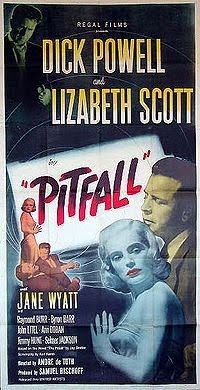 Bowers’ work isn’t credited on Pitfall, but his fingerprints are all over it. Crackling dialogue, sharply-etched supporting players, tight plotting. Married insurance executive Dick Powell is no longer settled with being settled, chafing at his perfect life. A claim brings him in contact with Lizabeth Scott, a good-hearted girl who’s a magnet for men of poor character. Like shady shamus Raymond Burr, who found her for Powell and wants to make his connection with her permanent.
I first saw Pitfall at Noir City several years ago and had a reservation or two about it. That’s because I went in with certain expectations. Revisiting it, I could appreciate Pitfall for the gem that it is. Burr’s character is a stalker plain and simple, played with a modern edge. Lizabeth Scott’s Mona, who does the right thing at every opportunity to no avail, breaks your heart. And Jane Wyatt as Powell’s pragmatic wife may be the hardest nut of them all.
The more light-hearted Larceny is the movie Rosemarie was most interested in because it pairs up two of her favorite actors, John Payne and Dan Duryea. The twosome are part of a ring of con men who set out to fleece grieving war widow Joan Caulfield. There are only two problems: inside man Payne starts falling for Caulfield, and Duryea’s girl, who carries a torch for Payne, arrives to gum up the works. She’s played by Shelley Winters at her brassy best, delivering one Bowers zinger after another. Throw in noir favorite Percy Helton and a slew of lookers pining after Payne, and a good time is had by all.
All that plus the FNF’s beautifully produced 2009 memorial reel and Serena Bramble’s extraordinary The Endless Night: A Valentine to Film Noir. For an amazing price of ten bucks, people. How can you go wrong?
Rosemarie and I are selling FNF merch in the lobby before each show. (She’s the eye candy, I’m the numbers man.) We did land-office business yesterday. Our most popular item is the second edition of the Noir City Sentinel Annual, collecting the best of the pieces that appeared in the FNF’s subscriber newsletter. Eddie’s in there, as is Edgar Award winner Megan Abbott and other luminaries – plus several pieces by yours truly.
Last night, I was asked to sign a copy of the book. That is a personal first that I won’t soon forget.
Friday, February 19, 2010
Noir City Northwest: Your Reminder

This post is basically an excuse to run that banner.
It starts tonight. Here’s the program. You know where I’ll be. If you’re in Seattle, come on out and see two movies for ten bucks. Movies that in many cases aren’t available on video and rarely if ever air on television. Movies presented by the Czar of Noir himself, Eddie Muller. Movies brought to you courtesy of the Film Noir Foundation. Movies the way they were meant to be seen.
And if you’re not in Seattle, I will, in spite of multiple deadlines and an abnormally high tree pollen count, endeavor to bring you the coverage that this website is known for.
Into the shadows we go.
Tuesday, February 16, 2010
Movies: The Red Riding Trilogy (U.S. 2010)
For several reasons, I will keep what had been planned as a lengthy post brief.
See these movies.
OK, not that brief.
David Peace wrote a quartet of novels weaving together a decade’s worth of true crime in the north of England with his own fevered imaginings of corruption, guilt, and the merest glimmers of redemption. Those four books have been condensed into a remarkable trio of films. Each one scripted by Tony Grisoni but helmed by a different director. Characters drift between them, their roles transforming. Loose ends ravel. Mysteries resolve.
You really should see these movies. 1974 (Julian Jarrold) focuses on a hotshot young reporter who didn’t cut it in London and is back on his old stomping grounds. He’s convinced he’s onto the case of a serial murderer of young girls, and equally certain that this story will return him to the top. The poor sod has no idea he’s stumbled into a nest of tangled motives and vice that has pulled better men down.
1980 (James Marsh) sees an outsider arrive, a straight arrow cop (the brilliant Paddy Considine) called on to determine why the local police haven’t apprehended the Yorkshire Ripper. He thinks his history in this neck of the woods will aid him in his endeavors. He is wrong.
1983 (Anand Tucker) finds chickens coming home to roost, sinners struggling to the light, and Shakespeare being proven right: at the length, truth will out.
The series, which aired on U.K. television last year, has been compared to Twin Peaks, The Wire, the collected works of James Ellroy, and Zodiac. All somewhat valid, none truly accurate.
What Grisoni and company have crafted here is an epic vision of evil. Of the domestic variety, petty and insidious, dwelling in institutions, the hearts of men, the landscape itself. It’s a haunting, harrowing piece of work. It’s noir for the 21st century. Yes, you’ll like one film more than the others (I’d opt for 1980 myself). Granted, it’s not perfect. What is? But in its ambition, its execution, its belief in the power of the accretion of detail, its faith in the audience, its sheer fucking adultness, it’s the most thrilling thing I’ve watched in ages.
The movies are being screened around the country, including at Seattle’s Northwest Film Forum, in the coming weeks, often back-to-back-to-back. I pity those who absorb them that way; priests and publicans should be on call. Right now the entire trilogy is available via IFC On Demand, which is how I watched them over the course of three days. It made it easier to weep for my fellow man and rage at an indifferent God. Plus, no parking problems!
Clear your schedule. See these movies. Thank me later.
Monday, February 15, 2010
Movies: Race Street (1948)/Scene of the Crime (1949)
Noir City Northwest kicks off this coming Friday – if you’re in Seattle, come on out and say hello to yours truly at the Film Noir Foundation table in the lobby – and the time has come to get into shape. I’ve been on a vigorous training regimen, running wind sprints, downing extra cocktails. I’ve also got to keep those blogging muscles limber, so here’s a practice post on a pair of films noir.
You know you’re in trouble when William Bendix is the most charismatic member of your cast. That’s where we find ourselves in Race Street. The stolid George Raft is a bookie aiming to go legit in the nightclub business. But close pal Harry-then-Henry Morgan is bumped off when he refuses to pay protection money, and Raft decides to track down the killers himself. Bendix is his childhood friend turned police detective. The story’s no great shakes, and there are some odd directorial choices. Morgan’s potent death scene – a tumble down a brutally long flight of stairs – is ruined by a slow push-in at the end, and there’s a bizarre musical number featuring Raft’s torch singer sis filmed Spike Jonze style without explanation. I have higher hopes for another Raft noir, Red Light, scheduled for the festival.
Sometimes actors can surprise you. Van Johnson gained fame as MGM’s all-American boy, but in Scene of the Crime he’s surprisingly plausible as big city cop Mike Conovan. When his former partner is gunned down under suspicious circumstances Mike sets out to clear his name, even if it means cozying up to former gangster’s moll Gloria DeHaven. All while long-suffering wife Arlene Dahl lobbies him to quit the force altogether, even conspiring with an old beau to land him a cushy private sector job.
Charles Schnee’s script features pungent dialogue (DeHaven is described thusly: “Figure like champagne, heart like the cork”), still-shocking violence, and a nice mix of authentically shady characters, like Norman Lloyd’s stoolie Sleeper. Plus there’s a richness of detail at the margins. The killers are knocking over Syndicate joints, so the Outfit starts staging its own lineups. Moments like that lift Scene of the Crime a rung or two above the ordinary.
Thursday, February 11, 2010
Movie: The Red Shoes (1948)
Patience, ladies and gentlemen, is rewarded.
I had deliberately avoided the landmark Michael Powell/Emeric Pressburger film The Red Shoes on TV because I knew it demanded to be seen on the big screen. Last night I not only watched a gloriously restored new print, but it was introduced by Thelma Schoonmaker, the widow of director Michael Powell and Martin Scorsese’s longtime (and multiple Academy Award-winning) editor. She cut Goodfellas, people.
The film, about a ballet company and the dancer who becomes muse to two men, overwhelmed me. It’s unmatched in its depiction of a collaborative art form and the ways one individual can unite others in service of a vision. The boldness of its filmmaking still astounds. The CGI in, say, Avatar is about making a physical world seem real. The effects deployed in The Red Shoes are used to bring an emotional universe to life. They’re far riskier, and the rewards that much greater when they succeed.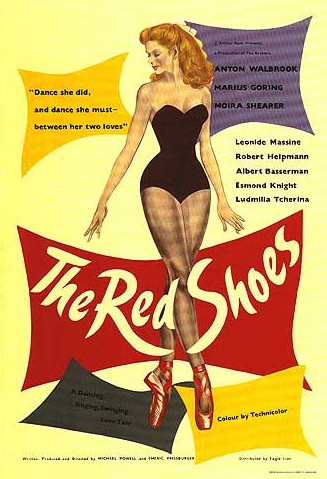 The evening began with a brief before-and-after comparison highlighting the work of the UCLA Film & Television Archive with the support of The Film Foundation. The restoration was an extraordinarily difficult one; The Red Shoes was shot in three-strip Technicolor on a camera so enormous Powell nicknamed it “the cottage.” Over the decades the individual strips shrank at different rates and were damaged by mold. The result is astonishing. Jack Cardiff’s photography contains colors I’d only previously seen on the insides of my eyelids. A single shot of several pairs of the title shoes presented for the approval of the company’s impresario features so many discernable shades of scarlet that it’s almost unseemly.
Ms. Schoonmaker walked us through the film’s history. Powell’s determination to cast a ballet dancer (Moira Shearer) in the lead role, his willingness to replace technical personnel when they told him he was going too far. Producer J. Arthur Rank loathed the movie, finding it too “artistic,” and did everything he could to bury it. Only the efforts of a pair of New York exhibitors changed its fortunes. They converted a legitimate theater to screen it, and it wound up running for two straight years.
Gene Kelly dragged studio executives to showings in order to make his case for the ballet at the end of An American in Paris. Ms. Schoonmaker talked about the many others who had been inspired to commit their lives to the arts after seeing The Red Shoes, including writer Nicholas Pileggi and painter Ron Kitaj. To say nothing of the legion of girls driven to join the ballet.
She said that The Red Shoes was the one constant on Scorsese’s list of desert island films. “Every movie Marty has made was influenced by this one,” she said, going so far as to point out a specific homage that appears in the upcoming Shutter Island.
The Red Shoes screens at the Northwest Film Forum beginning Friday, and next week it returns to New York’s Film Forum by popular demand. A DVD is due out later this year, but see it in a theater if you can. As Ms. Schoonmaker observed, Michael Powell didn’t make his movies to be watched by one person on a small screen. He meant for them to be shared by strangers in the dark.
Wednesday, February 10, 2010
Book: Fast One, by Paul Cain (1933)
Clearly the universe is urging me forward in my quest to read the novelistic equivalents of the twenty-minute egg. Fast One had been on my radar for some time. I finally acquire a copy only weeks after finishing Richard Rayner’s A Bright and Guilty Place, which lays bare the miasma of Los Angeles vice that inspired Paul Cain; all Cain did was change the names. Then I pick up Max Décharné’s book to learn that Raymond Chandler called Fast One “some kind of a high point in the ultra hardboiled manner.” Décharné, naming Ted Lewis’ Jack’s Return Home (filmed as Get Carter) a spiritual descendant, dubs Fast One a “masterpiece ... another nihilistic train-wreck of a book where virtually every character comes to a bad end.” Believe me, those two are not kidding.
Fast One is the story of Gerry Kells, an East Coast gambler ensconced in L.A. Local kingpin Jack Rose, seeing a gang war coming, wants Kells on his side. Kells is content to stay neutral, so Rose frames him for murder. Kells then decides to seize control of the city’s rackets himself. The only problems are Rose, L.A.’s other crooks, some interested out-of-town players, the deeply bent police department, the equally suspect power structure, a woman he can’t trust, and his own appetites. And he still damn near pulls it off.
Originally serialized in Black Mask, Fast One is terse almost to the point of incomprehensibility; Cain not only omits needless words, he skimps on a few of the useful ones as well. I had to turn back a few pages on a regular basis. That didn’t diminish the blazing speed with which the book moved, and the fever dream of corruption that it creates. Fast One may not be a good book, but it is a singular one, and it deserves its reputation.
Cain was born George Carrol Sims but called himself Peter Ruric when he worked as a screenwriter. He had an affair with actress Gertrude Michael, a Chez K favorite, basing the character of the duplicitous and dipsomaniacal Miss Granquist on her. Knowing that only enhanced my enjoyment of the book.
Update: The Rap Sheet paired this post in its Friday’s Forgotten Books round-up along with another take on Fast One from Evan Lewis at Davy Crockett’s Almanack. More good information over there.
Sunday, February 07, 2010
Book: Hardboiled Hollywood, by Max Décharné (U.S. 2010)
My first problem? This new reprint of a 2003 No Exit book is called Hardboiled Hollywood, yet two of the eleven movies in it – Hell is a City and Get Carter – are as English as Bobby Charlton eating crisps at a snooker match.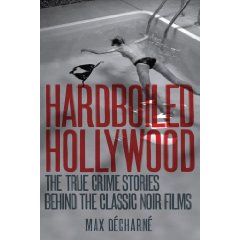 The bigger problem? It’s subtitled The True Crime Stories Behind the Classic Noir Films. Which led me to believe that it would be about the true crime stories behind the classic noir films. Silly Vince. In truth not even half the movies covered have specific historical antecedents, and those are dispensed with in cursory fashion. Some prime candidates are overlooked; despite numerous references to James M. Cain there are no chapters on Double Indemnity or The Postman Always Rings Twice, both inspired by an actual murder. Instead the focus is on the well-trod ground of the making of the films themselves.
(ASIDE: In the interests of completeness I’ll also say that it’s appalling publisher W.W. Norton would release a book with jacket copy citing “Anthony Perkin’s” performance in Psycho. Here’s the rule: if you’re not sure where the apostrophe goes, leave it out. Better we think you forgot it.)
That said ... misleading title aside I enjoyed Hardboiled Hollywood. Décharné knows the terrain, writes with passion, and consistently turns up overlooked perspectives. Here’s a great quote from the Spectator on Nicholas Ray and They Live By Night: “If the director had taken the trouble to be French, we would be licking his boots in ecstasy.” The Get Carter material is particularly strong, with Décharné rightly taking director Mike Hodges to task for his misinterpretation of the word “nails” in Ted Lewis’ source novel Jack’s Return Home. Décharné correctly points out that the Parker in Richard Stark’s The Hunter is smarter and more ruthless than Lee Marvin’s incarnation in Point Blank. And it’s good to be reminded that Bonnie and Clyde were not folk heroes but venal small-time killers.
There’s some bait and switch involved, but Hardboiled Hollywood is worth reading.
Miscellaneous: Golden Boot Link
Author and noir historian Alan K. Rode attends the Golden Boot Award ceremony for legendary stuntman Bob Hoy.
Wednesday, February 03, 2010
Books: Kith and Kindle
During the week that Amazon got into a feud with Macmillan (fragging Macmillan’s authors in the process) and Apple introduced the iPad, I finally received my Kindle. Once again demonstrating the flawless timing that has made Keenans valued participants in ballroom dances, cavalry raids and open mic nights throughout history.
(ASIDE #1: Want cogent commentary on Amazon v. Macmillan? Read John Scalzi. Everyone else is. As for the iPad, I’ve lived to the biblical age of however old I am without buying a single Apple product. I’m not about to start now.)
I dithered about the decision to purchase a Kindle for months. By rights I should have been an early adopter; I’m e-reading’s ideal customer. I love books but am rigorously unsentimental about them as physical objects. I want the stories, not the pages.
Money kept me on the fence. Not only the cost of the device but the fact that many of the books I read come courtesy of Seattle’s excellent public library. I can work their hold system like a pinball machine. Graze it with my hip and new releases tumble my way.
But the SPL, feeling the economic pinch, has been forced to make changes. They’ve capped the number of titles you can reserve. And they’ve added a fee to an essential service for researching: interlibrary loans. I could request titles the SPL didn’t carry and a few weeks later a copy would turn up, marked with an orange band. The book, borrowed from the Cerritos, California library or a small college in Minnesota, would be my responsibility for two weeks, a charge I took seriously.
A few weeks ago I had my nose pressed to the Kindle store’s window when I noticed that a research book I wanted for a project, unavailable at the library and retailing for forty dollars, could be mine for only five bucks over the ILL fee. Wheels started turning.
(ASIDE #2: Yes, naysayers, I know that I don’t technically own a book on my Kindle, that I only license it and have therefore allowed the serpent of copyright into my intellectual garden. Or something. For good or ill, this doesn’t bother me.)
Then another discovery. Years ago I’d had a conversation with a book store owner who told me that the three most hardboiled novels were Green Ice by Raoul Whitfield, Fast One by Paul Cain, and Jonathan Latimer’s legendary, censored Solomon’s Vineyard. (I give you no less an authority than James Reasoner on that last title’s history and worth.) I’d found a copy of Green Ice – truth be told, I didn’t care for it – but not the others, aside from imperfect online and POD editions.
The Kindle store had both. Total cost: $4.98.
And so, I placed my order.
It was strange to fire up the Kindle and see the text of John Buntin’s L.A. Noir, which I’d read in hard copy, without page numbers. The interface was simple and intuitive. The e-ink display was astonishingly easy on the eyes. I opened Solomon’s Vineyard, read the introductory note promising “everything but an abortion and a tornado,” and scrolled to Chapter One.
From the way her buttocks looked under the black silk dress, I knew she’d be good in bed. The silk was tight and under it the muscles worked slow and easy. I saw weight there, and control, and, brother, those are things I like in a woman. I put down my bags and went after her along the station platform.
I don’t know about you, but if I found that smeared on shopping bags I’d keep reading. Which is what I did, devouring half of the book in a single sitting, never aware that I was looking at a screen, letting words written 70 years ago work their magic.
And having the text-to-speech voice read that Latimer paragraph aloud? Priceless.
Miscellaneous: Links
My friend award-winning sportswriter Mike Gasparino has launched Metsanity, a new blog about our mutual favorite team. Go. Read. Enjoy.
My friend award-winning author Christa Faust inked her new deal, then inked her new deal.
Get your genres confused? Donna Moore sorts it all out.
Monday, February 01, 2010
Miscellaneous: Weekend Roundup
Wallander. Don’t ask me to compare these BBC adaptations to Henning Mankell’s novels about Swedish detective Kurt Wallander. I’m woefully unschooled in Scandinavian crime fiction, a failing I will soon remedy thanks in part to these films. They have a striking look, the Swedish locales shot in part by last year’s Academy Award winning cinematographer Anthony Dod Mantle. Kenneth Branagh is sensational as Wallander, a compassionate investigator who is never fully present in his own life. The ninety-minute running times allow the personal scenes room to breathe. Sometimes they overwhelm the mystery; I was more involved in Wallander’s reconciliation with his troubled artist father (David Warner in Old Testament prophet mode) than the main story in Sidetracked. The films improve as they go; the last, One Step Behind, is as good as television gets. All three are suffused with a weary, bone-deep sadness that’s haunting.
Whatever Works (2009). Minor Woody Allen, but still entertaining. The movie’s notion that living in New York makes you a better person is naïve, but I happen to agree with it. Larry David’s inability to be anyone other than Larry David actually helps to put it over. A pleasant surprise.
Girls on the Loose (1958). The lovely Mara Corday leads a distaff team of heisters in a payroll job. I don’t know why she turns to crime. She says something about needing to live on the edge, but I think it’s because she’s going broke booking her gamine sister’s Bohemian burlesque act in her nightclub. Mara assembles some crew: a nervous wreck, an alcoholic French beautician, and a truck-stop tough blonde (Joyce Barker, a true Gold Medal gorgon who only appeared in this movie). The whole enterprise is nicely sleazy – Joyce is a masseuse! – and not all that badly plotted. Amazingly it’s directed by Casablanca’s Victor Laszlo, Paul Henreid. That this movie is not on DVD is a travesty. Here’s the trailer.
Friday, January 29, 2010
On The Web: Lem Dobbs
Sorry I haven’t posted this week. So much time and so little to do.
Wait a minute. Strike that. Reverse it.
One thing I have made room for in recent days is this Cosmoetica interview with screenwriter Lem Dobbs, whose credits include Dark City, The Limey, and The Limey’s commentary track, which is so good it deserves to be treated as a separate project. The interview is truly epic – 53,000 words, 90 pages – wide-ranging, and brutally honest. It’s also one of the best things I’ve read in years. Some excerpts:
Books are published now – crime novels, for example, which is a field I still follow – that are so horrible, it’s mind-boggling. Covered in laudatory review quotes and blurbs, listing all the awards they’ve won – you can’t believe it. It’s quite often impossible to find a bad review of a book, that’s how much of a racket it’s become.
I agree with him. Which kills me, because when I read a lousy crime novel – and lately I’ve read a few, all blurbed by writers I respect and touted elsewhere – I hold my tongue. Bill Crider recently summed up my feelings on the subject of reviews perfectly. I don’t see myself as a critic. I like to use my tiny corner of the internet to call attention to the good stuff. But every once in a while, when for reasons of my own I finish a book that’s a dud, I question that approach.
Dobbs on Hollywood now:
They’d much rather hear what they think is a “cool take.” But not knowing what’s old, they have no idea what’s new. So the whole phony, broken system is an exercise in futility and another reason movies are much more uniform in their awfulness. There’s absolutely no patience for, or respect or appreciation for, ideas outside the airless dome of a very limited frame of reference. If you engage in a discussion of who the “villain” is, for instance, you’d better do it in an excited and animated way (this is why it’s helpful to have a writing partner who’s also wearing big ol’ baggy shorts and a Hawaiian shirt and a turned-round baseball cap and chortling) – because to roll your eyes and sigh and question whether there even has to be a villain would be to challenge the whole current paradigm. And the “villain,” of course, once established, has to be motivated by nothing less than destroying the entire world – and so on – from cliché to cliché. If you’re unwilling to – sincerely – play this game, you might as well stay home ... Who was the “villain” in THE GREAT ESCAPE, or THE DIRTY DOZEN? Remade now – and don’t think they’re not trying – there would have to be an evil, evil, evil, evil Nazi in alternating scenes, constantly snarling, “I want them caught, I want them stopped, I want them dead!”
Bookmark it. Go back to it in stages. It’s worth the effort.
Monday, January 25, 2010
Book: The Writing Class, by Jincy Willett (2008)
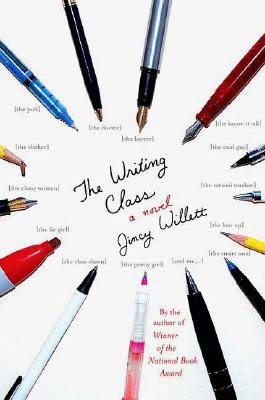 Amy Gallup is a middle-aged loner who hates being alone, a once-promising novelist who now teaches adult extension creative writing courses. She’s been at it for so long she can instantly size up each new group during the first session, knowing at once which students are wasting their time and hers. Then someone in the class begins sending odd notes. Biting parodies, obscene drawings, critiques that cut too close to the bone. The notes turn into pranks, then the pranks become deadly. And nobody really wants to the read the surgeon’s medical thriller.
Jincy Willett’s darkly funny novel is ruthless when it comes to the teaching of fiction. The samples of each student’s work are priceless. But every barb contains useful writing advice. The book is also an affectionate portrait of a prickly character in Amy, and a sly treatise about what motives people to read, to write, to connect. I missed this book when it was published initially. Thanks to my friend Chad Jones for the recommendation.
Miscellaneous: Elsewhere
What I Learned on Twitter. I’ve spoken before about The Three Investigators books, which got me hooked on crime fiction as a tyke. Turns out the boys are so popular in Germany that there’s a movie. Here’s the trailer.
I’d Link If I Could. The article on the cryonics movement in the January 25 issue of the New Yorker (not online unless you’re a subscriber) is fascinating reading. Jill Lepore analyzes several of the Amazing Stories yarns that inspired Robert Ettinger to start freezing people. Ettinger is the kind of crackpot utopian visionary – briefly famous in the 1960s and 70s, interviewed by Johnny Carson, David Frost and others – that we don’t see enough of any more. A taste of Lepore’s article:
In ‘Man Into Superman,’ Ettinger throws around a lot of Nietzsche and George Bernard Shaw, but shows more evidence of having whiled away the hours reading Penthouse, which began publication in 1965. The world of tomorrow will be unimaginably better than the world of today. How? There will be transsex and supersex! Scientists will invent “a sexual superwoman ... with cleverly designed orifices of various kinds, something like a wriggly Swiss cheese, but shapelier and more fragrant.” Animals will be bred as sex slaves; even incest might be allowed. Also, scientists will likely equip men with wings, built-in biological weapons, body armor made of hair, and “telescoping, fully adjustable” sexual organs. (Hold on. That last one. Doesn’t the existing model already come with that?)
Thursday, January 21, 2010
TV: The Greatest Broadcast in the History of the Medium
Five years ago today, a landmark broadcast went out over the airwaves ... of digital cable. An episode of the Independent Film Channel’s Ultimate Film Fanatic, featuring yours truly as a contestant.
The strangest thing about the show is that a few weeks after it taped, Rosemarie was selected to be on Jeopardy! Making 2005 our year of game shows.
UFF’s entire run lives on via YouTube. So I might as well mark the occasion by embedding it here. Again.
Two vital points before watching –
1. I now have the sense to wear contact lenses.
2. Also, my hair looks much, much better.
First, intros and round one: trivia. We were asked to come up with our own opening lines, which the producers then “improved.” Still, I sell the moment and cap it off by staring down the camera Lee Van Cleef-style.
I had a strategy in this round. My competitor is Tom Tangney, critic for several Seattle radio stations, and I knew from our pre-show conversation that he was an erudite gentleman of taste. I therefore decided to force him to answer questions about crappy thrillers, which I regard as my forte. Watch as careful planning almost blows up in my face.
Round two: debate. (Spoiler alert: I make it through round one. To this day, I can’t believe I remembered the name of that damn doll.) Your celebrity judges are Academy Award winner Tatum O’Neal and certified badasses Keith David and Henry Rollins.
The producers stopped tape before this round to ask for topic suggestions. I confess that Kevin Costner was my idea. Again I had a strategy, namely degree of difficulty. If I could ably defend an unpopular position, maybe I’d earn the judges’ respect. For the record, I stand by the argument I made and would add the additional exhibits of The Upside of Anger and Mr. Brooks. As for Rumor Has It ...
Round three: obsession. Or as I thought of it, collections.
In a rare moment of prescience, I announced to Rosemarie after my audition, “If I get on the show I’ll make it all the way to the third round, then crash and burn.” Which is exactly what happened. See for yourself. Any of the other contestants would have fared better than me in this section.
Problem #1: I don’t collect things. Scrounging up three items was a reach. (BTW, the key broke on the flight home.)
Problem #2: I’m up against Tony Kay, now host of Seattle’s Bizarro Movie Night. I didn’t stand a chance.
Note the raw sexual chemistry between Tatum and myself. What Rollins says about me is still one of the high points of my life. It was almost worth losing the five grand in prize money to be spared his scorn. Almost. And my popcorn line was used in TV spots throughout the season, so I won the battle for airtime.
In closing, my hair really does look better now. Honestly. I can’t stress that enough.
