Truth be told, I didn’t think the man was serious. And yet here we are.
When Lawrence Block turned up on Twitter I began following him at once. But then I’ve been following him for years, ever since I picked up Eight Million Ways to Die when I was in high school and read it twice in one summer. That book served as my gateway to crime fiction, and I’ve never looked back. I read every other book Block wrote about Matt Scudder, the recovering alcoholic ex-NYPD detective turned occasionally licensed private eye. Not to mention the ones about genial thief Bernie Rhodenbarr, and the professional killer Keller, and many more, some published under other names. He picks up one of those names anew with Getting Off, which I reviewed last week.
On Twitter, he said he was looking for opportunities to guest post. I responded at once. As I said, I didn’t think the man was serious. And yet here we are, with another VKDCQ&A. The world is a mysterious place.
Q. What can you tell us about Getting Off?
That I can’t recall ever having more fun writing anything. I fell utterly in love with my lead character, and enjoyed every minute I spent with her. That doesn’t always happen.
 Q. You’re returning to the Jill Emerson pseudonym after several decades. What made this a Jill Emerson book, as opposed to an Andrew Shaw or a Sheldon Lord? Are these alter egos at all like characters? To put it another way, do you know what Jill has been doing these last few years? Teaching at a small liberal arts college in New England, perhaps?
Andrew Shaw and Sheldon Lord were just pen names. Jill Emerson was something beyond that, though it would be hard saying just what. Add in the fact that I liked – and indeed still like – all seven of the Jill Emerson books.
I wanted an open pen name for the book for the same reason I wanted the “A Novel of Sex & Violence” subtitle: so that no one would pick up the book by mistake, hoping for something fluffy about a charming burglar and his stubtailed cat. This is not to denigrate the Burglar books or their readers, and indeed I’m sure there’ll be plenty of overlap. But I got email calling me to account for the erotic content of Small Town, by people who felt they’d been ambushed, and I didn't want that to happen again. I want to sell books, but only to people who are likely to enjoy them.
Still, I could have managed that without a pen name. So I think what it comes down to is I just plain wanted to be Jill again. Go figure.
And it’s given me the opportunity to have dialogues with Jill, which I then get to post on Jill’s page of my blogsite.
Q. Getting Off is subtitled “A Novel of Sex & Violence.” And brother – or sister, as the case may be – that ain’t the half of it. In your experience, are readers more comfortable with violence than sex? How has writing about sex changed since Jill debuted with her lesbian novels? Who in your opinion writes about sex particularly well?
Some don’t mind sex, some don’t mind violence, and I have to hope there are some who can stand a healthy helping of both. The sex was very discreet in the first two Jill Emerson novels. It got a little more intense later on. I think the big change in erotic realism, if you will, happened in the late ‘60s, when a lot of mainstream novelists began writing far more candidly about sex. That was around the same time Jill published her middle three books with Berkley.
I don’t read enough these days to say who writes well about sex. Sixty or more years ago, without running into censorship problems, John O’Hara was writing scenes I found intensely erotic. He did it almost entirely via dialogue. You want a master class in the subject, that's where to go.
 Q. Getting Off closes out what’s been a remarkably busy 2011 for you. Earlier this year you published A Drop of the Hard Stuff, the latest Matt Scudder novel, set in the early days of Scudder’s sobriety. You’ve written elsewhere about the challenges of revisiting the New York of the 1980s. But what about your own work? How much research did you have to do into what you’d already written about Scudder?
None that I can recall. I was writing about an unrecorded period in his life, so that gave me a lot of leeway.
Q. Your short story “See The Woman” appeared in the companion anthology to the videogame L.A. Noire. Did you see the game before you wrote the story? What kind of experience did you have with video games in general? Care to share any high scores? You’ve been an early adopter of many publishing advances – audiobooks, e-books. What do you think videogames have to contribute to storytelling?
No, I didn’t see the game, or even bother reading the descriptions. I just wanted to write a story that would work, and one that was right for the period. As for video games in general, I’ve had zero experience with them – unless you count a video matching game that I use as a form of time-passer to punctuate stretches at the computer. That is to L.A. Noire and Grand Theft Auto what simple solitaire is to tournament-level Duplicate Bridge.
Q. Perhaps your most impressive writing this year has been in your embrace of Twitter and blogging. What have you learned in your Year of Social Networking?
That the entire landscape of publishing has already changed beyond recognition, and that only an idiot would hazard a guess as to what the future holds. And it’s not just publishing and its world. That’s just the part of change that’s most evident to me. All changed, changed utterly – and it ain’t done yet, either.
Cocktail Q. In Getting Off, Kit Tolliver changes her cocktail of choice as quickly as she changes identities. Do the drinks tell us something about her persona of the moment? What can you infer about a person from what their poison is?
Good question, but I’m not sure I know the answer. Back in my drinking days I recall we attached significance to that sort of thing, but I don't know that it was warranted. You might even warm to someone because he smoked the same brand of cigarette. Does seem silly in retrospect, but then I’m talking from the standpoint of someone who hasn't drunk or smoked in a good many years, so what do I know?
I recently wrote something that called for the name of a trendy cocktail, and had no idea what’s new in that realm. So I Googled “trendy cocktails” and a couple of candidates presented themselves. (What did we do before Google?) Later I realized I should have done what Raymond Chandler did in respect to slang. He made it up so he wouldn't have to worry that it would be dated.
Movie Q. What movie best captures Hard Stuff-era New York?
Two Sidney Lumet films come to mind right away, Prince of the City and Q&A.
Baseball Q. There’s only one question I can ask an inveterate New Yorker like yourself, and I hope you don’t take Hillary Clinton’s politic way out. Mets or Yankees?
I don’t know that Hilary was being politic; my guess is she doesn't pay any attention to baseball. I pay more some years than others, and in either league I’m a New York loyalist, but my dad was a Yankees fan all his life, and so, albeit in a lackadaisical way, am I.
Monday, August 22, 2011
Q&A: Lawrence Block

Thursday, August 18, 2011
Movies: Recent Release Round-Up
There are some good movies in release now. But you may have to work to find them, and you’ll probably have to act fast.
Dominic Cooper made a splash in the best of the summer blockbusters, Captain America, as Iron Man’s dad Howard Stark. But he’s giving the performance(s) of the season in The Devil’s Double. In this liberally adapted true story Cooper plays both Uday Hussein and Latif Yahia, the lookalike soldier compelled into his service. Cooper’s Uday is an unusually vivid psychopath with absolutely no impulse control. The movie, directed by Lee Tamahori, is charged with a feverish paranoia that conveys the sense of life under a dictatorship, with the entire country held hostage to the whims of a madman and his deranged family. For once, the Scarface excesses are come by honestly. Here’s the excellent trailer.
 Character of the summer honors go to Gerry Boyle, the drinking, drugging and whoring hero of The Guard. Played by the brilliant Brendan Gleeson, Gerry is the law of Connemara in the west of Ireland. FBI agent Don Cheadle arrives to track down a massive drug shipment – the actual size is in dispute – and a mighty culture clash ensues. Written and directed by John Michael McDonagh and produced by his playwright brother Martin (responsible for In Bruges, one of my favorite films of the last few years), The Guard packs every kind of humor into 96 minutes: running jokes, shaggy dog stories. All of it seen through that uniquely Irish sensibility that is at once angry, profane, highly verbal and attuned to the absurdities of life. Gerry himself is a fully developed, vastly interesting character, and the scenes between him and his terminally ill mother (Fionnula Flanagan), while hilarious, are also poignant. The accents are a wee bit thick; I howled all the way through a scene between Gerry and the local head of the IRA (“There’s still a high command?”) only to discover that Rosemarie didn’t catch a word of it. Of course, that meant I got to perform the scene in its entirety on our way to the cocktail bar. I described the movie to a friend and he said it sounded like a comic version of One False Move, which in a sense it is. It’s also the best thing currently in theaters.
Monday, August 15, 2011
Book: Getting Off, by Lawrence Block writing as Jill Emerson (2011)
My short review: Damn, this book is fucked up. Would that Kirkus could be so succinct.
 Getting Off is a landmark in a number of ways. It relaunches the indispensible Hard Case Crime after the line’s hiatus. It’s Hard Case’s first hardcover. It’s the first original novel Lawrence Block has written for them. And it marks Block’s return to the Jill Emerson pseudonym he used for a number of shall-we-say earthy novels several decades ago.
The protagonist is Kit Tolliver, although she so scarcely uses that name it’s strange for me to do so. She dons a new identity, chooses a man, has sex with him, and then kills him. It’s a pattern of behavior that erupts out of a childhood trauma. Then Kit realizes that there a few men – five, to be precise – who have bedded her and lived to tell the tale. And she decides that’s five too many.
It’s a testament to Block’s skill that you end up embracing Kit’s lunatic logic. But you do; you want her to track down those five men who are at once lucky and hugely unlucky. The book has something of a picaresque structure, with Kit moving around the country and acting as a magnet for trouble, attracting people who are even worse than she is. Getting Off is frequently very funny, with a sharp satirical edge that cuts into sexual mores and the notion of healing through closure. But it also has real insight into Kit’s state of mind. The prose is smooth – no surprise there; this is Lawrence Block, after all – which lends an added kick to the plentiful sex and equally plentiful violence. And above all it’s a non-judgmental book, which for some may be the biggest shock of all. Compelling and fascinating, it’s a welcome return for both Hard Case and Jill Emerson.
UPDATE: Here’s my Q&A with Lawrence Block.
Wednesday, August 10, 2011
Q&A: Ray Banks
The last time I saw Ray Banks we were standing a few blocks from the Louvre at 3AM, recovering from French beer and Lawrence Tierney. It was also the first time I saw Banks, the payoff on years of correspondence that covered subjects ranging from Johnnie To films to easy listening music, and include an alarming number of references to the Carry On movies. (Those are all Ray’s.) He’s one of the most distinctive voices in contemporary crime fiction. His new book Beast of Burden is officially published in the U.S. tomorrow; I was fortunate enough to read it last year. I exploited our friendship and subjected him to a VKDCQ&A, because that’s the kind of guy I am.
Q. You’ve been a busy boy lately. Let’s start with the print stuff. What can you tell us about Beast of Burden?
Well, Beast of Burden is the last of the Cal Innes novels, and in it we find our battered hero with aphasia and a limp thanks to a massive stroke, a dead brother and not much in the way of prospects. The poor bugger can't even get a job as a barista. Then good old Uncle Morris turns up and asks him to find his wayward psychotic son, Mo. Meanwhile, Detective Sergeant Donkin sees an opportunity to finally put Cal behind bars and grabs it with both scarred fists.
It's kind of a romantic comedy.
 Q. You ring down the curtain on the Cal Innes series with this book. Was it a conscious choice to stop with four titles? When did you realize you were ready to walk away from the character?
Originally it was a conscious choice to stop with five titles - all the Scottish stuff in Beast of Burden was originally going to be its own book (even had a working title of Sunshine on Leith) - but I realised I was repeating myself thematically and plot-wise with the last two books, so rather than string it out for another 300 pages, I thought I'd roll them both into one. So yeah, it was definitely a conscious decision to write a limited series. Cal isn't the kind of character who could carry on indefinitely, and I very much doubt either of my publishers would consider the books mainstream enough for an ongoing series.
So bearing all that in mind, I was ready to walk away from Cal about a chapter from the end of Beast of Burden, which is lucky. I'd been writing him on and off since 2002, so it was definitely time to take stock and move on, try some other voices for size.
Q. Innes is a singular interpretation of the private investigator, an ex-con who at times is reluctant to own up to the job. What was it about the P.I. form that spoke to you? What did you want to bring to bear on it?
The P.I. is the happy medium between the amateur sleuth (which is incredibly difficult to do with any kind of realism) and the police procedural (which requires far too much research, is too crowded a market, and didn't hold much interest for me). Besides, while I loved the American P.I. novels, I thought there was something decidedly lacking in their British counterparts, notably a sense of how strange and untenable the American P.I. archetype was in a British setting. So I decided to do something about it, and along the way mess with some of the more egregious clichés. It's a pretty negative starting point for a series, I know, but I hope it led to some positive results.
Q. As dark as your books can get, they’re always deeply funny. Why is a sense of humor – or, if you prefer, humour – a necessity in noir? Who’s another cut-up in this current class?
First off, thank you. Very kind indeed. I think a sense of humour is absolutely vital if you're writing noir because otherwise you're just writing about a series of terrible events that lead to inexorable doom, which isn't so much tragedy than monotonous nihilism. Comedy is the yang to tragedy's yin; they're absolute co-dependent. You can't have an effective comedy without tragedy, and you certainly can't have an effective tragedy without comedy. Humour at its best - when it isn't a call to poke fun at a parade of grotesques - is empathetic, it allows us to connect with characters we wouldn't otherwise find attractive. Without empathy, comic characters like Steptoe and Son, Basil Fawlty, Norman Fletcher, Alan Partridge and David Brent would be absolute monsters.
Currently, I think Allan Guthrie writes noir farce beautifully, Donna Moore is the Queen of the one-liner, and Charlie Williams has an almost Thompsonesque sense of the Absurd. I don't think Stuart MacBride gets enough credit for the kind of quotidian comedy he presents in his novels, either. There's a big dose of Galton and Simpson in there.
Q. Take a moment to pimp your wares on the e-book front. You’ve been vocal about the opportunities presented by the changes in publishing to return to an older model of pulp fiction. Is shorter better? Discuss.
 Brevity is the soul, just like time is the secret of comedy ing. For some odd reason, the book buyer has been taught to think that bigger is somehow better, that they're somehow getting more value for money in a 600-page novel they'll read once, than a 200-page novel they'll read time and time again. I know for a fact that one very popular author who started off writing shorter books was advised to write longer otherwise he'd never be taken seriously. I know of others who have word counts of over 100k written into their contracts. That kind of demand can only lead to padding.
With the advent of e-books, content is king. So if something is padded, by God, it reads padded. I’m hoping this will result in a revival of shorter, faster books that, with the price points dropping, will be ultimately pretty disposable. That, to me, sounds like the perfect circumstances for the emergence of a new pulp. And like any pulp, there’ll be a plethora of rubbish, but it’ll also let less obviously commercial writers get their stuff out there and build an audience that may ultimately sustain them.
At the moment, it’s slim pickings from me – just the one. I released an e-book version of my novella Gun, which people have been very kind about. I’ll be doing the same with California some time early next year, and have a few ideas for some e-only releases. We’ll see.
Q. What prompted you to start Norma Desmond’s Monkey, your new blog about movies?
I used to write reviews and what-not on the old blog, but it never felt particularly relevant to the overall point of the site, which was primarily self-pimpage, so when I decided to get back on the blogging horse last month, I also decided to separate the movie stuff out. It just feels more natural to ramble on in a movie-centric environment than it did under the old regime. It’s also more attractive to any guest posters (hint, hint) that may want to chip in.
As for content, I have a few more Forgotten Films to look at – I think the next one on my list is Looking for Mr. Goodbar. A few Neo- and Classic Noirs, and I may even get a couple of Top Tens in there – I know how much the interwebs loves a good list.
Q. What can we expect next from you?
After Beast of Burden? I wish I could say with any confidence. I have a book under consideration with my publisher at the moment, which is a page-one rewrite of my first novel. I’ll probably be bringing out a collected version of Wolf Tickets at some point in the future, and I’m currently up to my eyes with a casino robbery novel. Then there’s the e-only novella thing and a couple of screenplays I’m messing with. Nothing is solid at the moment, though. Give me another couple of months and I might have something concrete to tell you.
Movie Q. Best UK horror film, in both Hammer and non-Hammer divisions?
 Best Hammer – The Devil Rides Out. Sixties Hammer was the best Hammer and The Devil Rides Out (along with The Nanny) is the best of the best. You have Christopher Lee battling Charles Gray, a Richard Matheson script and Terence Fisher in the director’s chair – what’s not great about that? It also scared the everlovin’ shit out of me when I was a nipper. Remember kids, don’t mess with Mr S. On The Buses is also a terrific horror film, which isn’t much of a compliment, considering it’s based on a sitcom. Still a Hammer movie, though.
Best British non-Hammer is a tough one. Nothing recent springs to mind. I have an abiding fondness for the Amicus portmanteau horrors like Asylum and Tales from the Crypt (some excellent gurning from Patrick Magee in “Blind Alleys”), as well as the quieter British horror movies like The Innocents and The Haunting (which I’m not actually convinced is that British, but hey ho …). But if I absolutely had to pick one to watch over and over, it’d have to be Theatre of Blood. Vincent Price as ham actor takes Shakespearean-flavoured revenge on the critics who scorned him, with the help of his chorus of meths-drinking vagrants and Diana Rigg in male drag. Hell of a cast – where else could you see TV’s Miss Marple and the British Marilyn Monroe in the same movie? – and everyone appears to be having so much fun. They don’t make ‘em like that anymore. Which is probably a good thing, because they’d fuck it up.
Baseball Q. The GM Maxi Senior Cricket Bat may be “the bat of choice for awesome hitting,” as you claim in Saturday’s Child. But better for doing GBH than a baseball bat? C’maaaaaan.
A cricket bat has a bevelled edge. It gives an assailant a choice of attack - flat or choppy - and can break the skin and bones a lot quicker than your average cylindrical baseball bat. It's also more patriotic than a baseball bat, Gawd bless yer, marm.
Cocktail Q. You’re in a well-stocked bar. What do you order?
A single malt, probably a nice big Bunnahabhain, ideally twice as old as me. I know you enjoy your umbrella drinks, but I have trouble ordering something with more than one mixer. Makes me feel ... unusual.
Monday, August 08, 2011
Recent Reading: Ace and a Joker
 Ace Atkins takes a break from his brilliant period crime thrillers like Infamous and Devil’s Garden to work in the here and now. Quinn Colson is the title character of The Ranger, who leaves patrol in Afghanistan for territory almost as treacherous: home in Mississippi. He’s there to lay to rest his uncle Hamp, the sheriff, dead by his own hand. Or so goes the official story. But Quinn’s in no hurry to leave – considered too old to “storm the castle,” he’s about to be pulled from active duty and made an instructor – so he starts digging. Soon he turns up a nest of trouble involving a meth dealer preparing for end times and a local power broker who covets his uncle’s property.
As usual Atkins conveys a tremendous sense of place, here a stretch of Northern Mississippi were the land “had always seemed used up.” In Tibbehah County everyone knows everyone else, which makes the betrayals that are all too common cut deep. That sense of old entanglements wrapping themselves around Quinn anew is present on every page. The book’s pace occasionally flags – when I hear “trailer fire” in a rural crime novel I don’t need a thorough investigation to know that a pan of eggs is not the cause – but Atkins’s vigorous prose powers through those patches. Atkins will be taking over the late Robert B. Parker’s Spenser series. I have reservations about continuing those books, but there’s no doubt that Atkins is an inspired choice; Quinn’s rapport with his one-armed ex-Army buddy Boom owes a lot to Spenser and Hawk. While I’d prefer another Colson novel, I’ll have to give one of Atkins’s Spensers a try.
 Wayne Ogden was a different kind of soldier in a different kind of war. He has things pretty sweet at the start of The Adjustment by Scott Phillips. WWII is over. He’s back in Wichita, the nominal head of Publicity and Marketing at Collins Aviation. His real job is making sure company chieftain Everett Collins has a good time, all the time. But Wayne’s feeling chafed at even that much responsibility, hemmed in by his wife Sally and the prospect of fatherhood, and nostalgic for his glory days as a crooked supply sergeant and pimp during his Army hitch. And someone is sending him anonymous threatening letters, intent on settling his hash for one of the countless crimes he committed during the war. It’s enough to drive a good man crazy – or a bad man to plot for a better tomorrow.
A truly reprehensible character, Wayne is conniving, opportunistic, utterly unfeeling. And I loved every minute in his company. Scott Phillips has crafted one of the finest contemporary versions of a classic pulp novel that’s also a savage send-up of the American dream. The Adjustment reads like Jim Thompson’s version of Revolutionary Road. Profane, perverse, startling and always funny, it’s one of my favorite books of the year.
Monday, August 01, 2011
On The Web: Bill James
 Once again I am temporarily hanging my hat at the Abbott/Gran Medicine Show, the fabulous blog co-hosted by Megan Abbott and Sara Gran. My post this time around is about Popular Crime, an obsessive and compelling overview of true crime stories from a somewhat unlikely author: baseball stats guru Bill James. I call it “one of the strangest books I’ve ever loved.” Read the post to find out why.
Wednesday, July 27, 2011
Book: You’re Next, by Gregg Hurwitz (2011)
The thriller with the everyman protagonist always makes me leery. The purported regular Joes of the genre are often grab bags of awesomeness, checklists of plot-convenient traits. Meet our just-plain-folks hero, a garden variety biochemist who studies krav maga and has the world’s largest collection of 18th century Swiss clocks. He suffers from synesthesia and is estranged from his sister, the Attorney General of the United States, with whom he shares a Dark Secret. When an army of ruthless assassins starts hunting him down, he asks, “Why? There’s nothing special about me!” You’re Next by Gregg Hurwitz avoids Checklist Syndrome. Mike Wingate actually is an ordinary guy, one who has triumphed over adversity. After being abandoned to foster care at age four, he has built a life for himself as a husband, father, and businessman. When mysterious figures come gunning for him, Wingate fears it has to do with a childhood he doesn’t remember.
Every detail pays off smartly. The “green” housing project Mike is building that initially seems like, well, the kind of way-cool job a guy in a book like this usually has, sets up an interesting moral dilemma and brings Mike unwanted public attention. Mike’s troubled history also allows Hurwitz to make effective use of another thriller convention: the genially psychotic sidekick. And the explanation for why Mike has been targeted is both unexpected and plausible. Factor in Hurwitz’s usual craftsmanship and the result is a winner.
ASIDE: A recent Hollywood Reporter article about the surprise success of Woody Allen’s Midnight in Paris suggests that the movie struck a chord with audiences because of Owen Wilson’s “everyman” lead character. A rich Hollywood screenwriter willing to chuck his career to become a novelist and who is engaged to Rachel McAdams, gorgeous in a manner reminiscent of Rachel McAdams? This is an everyman? I refer you to my learned colleague Mr. Montoya. Then again, Wilson is not playing a fallen Norse god or a kid with a sentient robot car. He’s just a guy trying to sort out his life. Maybe that does make him an everyman, or at least as close as we’re going to get during the summer movie season.
Sunday, July 24, 2011
Q&A: Megan Abbott
Megan Abbott is an Edgar Award-winning novelist, co-headmistress of one of the finest blogs on the web, and – be still my heart – a current resident of Queens, New York. I’ve already sung the praises of Megan’s latest book, The End of Everything. It’s my pleasure to welcome Megan to the website to participate in a VKDC Q&A. Q. What can you tell us about The End of Everything?
It’s the story of one early summer and Lizzie, a 13-year-old-girl, whose best friend Evie Verver vanishes. It’s inspired mostly by my own sense memory of Midwestern suburban summers of the early 1980s, a time before the predominance of central air conditioning and a time before the internet and the peak of stranger danger, when the suburbs felt like dark and thrilling places and yet places you were permitted to explore. All screen doors and drunken block parties and uncovering secrets through open windows.
Q. How easy was it for you to tap into your own childhood? Name one breakfast cereal and one cartoon show that this process made you remember vividly.
Apple Jacks and Yogi Bear! It was stunningly easy, and I never would have guessed that. You think you don’t remember anything and then suddenly you do. Once I started opening up those tunnels into the past, I couldn’t stop. They started opening without me trying. I include a very specific blow-up raft in the book—a yellow one festooned by the Hawaiian Punch mascot. I didn’t precisely know where it came from until last week when my brother, having just finished the book, reminded me that we had the same raft when we were kids, had spent countless afternoons at the community pool floating on it.
Q. The language is in the book is quite striking. You provide your protagonist Lizzie with a dreamy interior monologue that is frequently immediate, but occasionally provides Lizzie with the perspective of an older woman remembering that time in her life. How did you achieve that effect? Is the book set then, now, or somewhere in between?
I wanted the first chapter to be past tense and clearly from the perspective of Lizzie well past early adolescence and then we’d jump to present tense and to Lizzie at 13. I wanted to begin with a slightly larger view of the insular world of Lizzie’s head and then push us right into its center. But I have no idea how old the Lizzie of the first chapter is. Isn’t that funny? All I know is she still hasn’t fully lost all the gleam to her eye. Despite everything, she still finds enchantment and wonder in the Verver world. Which I’m glad about.
Q. You’ve written at your blog about the books of your youth that inspired you. What are some of your favorite coming of age novels?
I guess it depends how one defines coming of age, but certainly A Tree Grows in Brooklyn by Betty Smith, and Starring Sally J. Freeman as Herself by Judy Blume and all the S.E. Hinton. Later, Catcher in the Rye and The Bell Jar. I’d add, in more recent years, Winter’s Bone by Daniel Woodrell. Q. These kids today, with their cell phones and social networks and playdates. Having revisited your own childhood, what do you think children today are missing out on? What do they have now that you wish you had then?
I think they are hindered from being the explorers we once were. I was not a particularly bold kid, but I certainly felt a sense of exploratory freedom. Parents today, so aware of various dangers and with so many means by which to track their children, seems to have eyes everywhere. I do think you learn so much as a kid by getting into trouble, getting (a little) lost, discovering some corners of the world on your own.
What I wish I’d had from now? Access to all the old movies in the world. Of course, if I’d had that, I’d probably not have left the house.
Movie Q. What movie released during your 1980s childhood best captures that time for you?
I’d say Little Darlings, The Outsiders, or Seems Like Old Times, which I inexplicably watched countless times as a kid.
Baseball Q. Speak to me of Jack Morris and the Detroit Tigers.
Growing up, my family members were (and remain) hardcore Tiger fans and I remember a household forever echoing with the sound of Ernie Harwell, my dad bemoaning Kirk Gibson’s mercurial bat and my brother and I assuming, respectively, Lou Whitaker and Alan Trammell personas. I was always the least immersed in my immediate family, but it just formed the pulse of my summer youths. I still remember my first game—watching Mark Fidrych in his rookie year—and I still have my Tiger doll, dubbed Milt May, slightly battered—like the Tigers—but still roaring along.
Cocktail Q. You’re in a well-stocked bar. What do you order?
A gimlet, always. I must admit I’m basically a beer gal, but the Raymond Chandler lover in me compels me towards the gimlet.
Wednesday, July 20, 2011
Book: The End of Everything, by Megan Abbott (2011)
 Lizzie Hood is not just infatuated with her neighbors the Ververs. She’s intoxicated by them. The charismatic family patriarch. Teenaged Dusty, already breaking hearts. And especially Lizzie’s best friend Evie. The two thirteen-year-olds are inseparable until, all too abruptly, they are not. One day after school Evie Verver vanishes, turning the Michigan suburb they live in upside down. And poor Lizzie knows both more and less than she thinks she does.
Megan Abbott, who won the Edgar award for Queenpin and whose Bury Me Deep is one of my favorite recent crime novels, brings her own unique sensibility to this coming of age tale set in the early 1980s. Lizzie’s voice is a hybrid of right-now and long-ago, at times uncomfortably close to the intimate mysteries of adolescence. What Lizzie mentions in passing about her own family – her parents’ divorce, her father’s distant presence, the strange man in her mother’s life – is every bit as interesting as her obsessive study of the house next door. As the story builds in intensity, Lizzie learns that secrets can still be kept behind doors that are open to you. The End of Everything is like one of those illicit youthful visits to the liquor cabinet at a friend’s house, a swirl of exotic flavors that leaves you dizzied.
UPDATE: Here's my Q&A with Megan about the book.
Monday, July 11, 2011
Book: Fun & Games, by Duane Swierczynski (2011)
Here’s a word they love in Hollywood: setpiece. A setpiece is an extended action sequence in a memorable location. Pick any summer blockbuster of recent vintage. It’s a string of setpieces, most of which are given away in the trailer.
Duane Swierczynski’s impressive accomplishment with Fun & Games is to turn the entire damn book into a setpiece, an epic free-for-all in which you can scarcely catch your breath. Ex-Philadelphia cop Charlie Hardie has been so scarred by tragedy that he’s gone vagabond, wandering the world’s pricier precincts and serving as glorified house sitter. He arrives for his latest gig at a manse in the canyons of Los Angeles only to discover an uninvited guest has beaten him there: Lane Madden, of the fading B-list career and troubled personal history. Lane recently survived a car wreck that she swears wasn’t an accident. In fact, she insists it was caused by The Accident People, shadowy operatives who specialize in staging deaths that no authority will question. She’s certain that they’re still coming after her.
And she’s right.
To say that the book goes from zero to sixty in no time flat implies that there is a zero. There isn’t. Pedal has already met metal on page one. Yet amidst the propulsive pace there’s room for Lane’s story of near-success in Hollywood, and the secret she’s been keeping that makes her the target of these killers. Even better is the revelation of who The Accident People are and how they end up in this rarefied line of work. It’s darkly funny stuff that seems strangely ... plausible. And there are useful statistics on death and dying throughout, so you learn as you go.
Duane is a proponent of what I think of as the Carrie ending*, that one final twist of the knife just when you think it’s safe. He uncorks a doozy here that perfectly sets up the sequel Hell & Gone, due on Halloween, with the last book in the Hardie trilogy to follow next March. Plenty of time for you to get in on this one.
* I have invented an entire cinematic vocabulary based on the work of Brian DePalma. Ask me what it means for a character to be Benny Blanco’ed.
Friday, July 08, 2011
Book: Claire DeWitt and the City of the Dead, by Sara Gran (2011)
 Brooklyn-born Claire DeWitt found herself when she came across a copy of Jacques Silette’s legendary manual Detection. In spite of some trauma in her life and perhaps because of it, the former girl detective is now the world’s greatest private investigator. Just ask her. A year and a half after Hurricane Katrina, Claire returns to New Orleans, a city where she has some history, in order to track down missing D.A. Vic Willing. (We pause now to admire the sheer brilliance of that name.) Claire’s approach is unorthodox, relying on omens and weed as much as shoe leather. And it turns up answers that her client and Claire herself may not want to hear.
Sara Gran, author of Dope and co-ringmaster with Megan Abbott of an excellent blog, has come up with an approach to the mystery novel that toys with the form even as it honors it. Claire is a hugely engaging protagonist with a singular sarcastic voice. She occasionally pushes the edges of likability only to say something unexpected that makes you want to draw her in close. The book brims with New Orleans atmosphere and is breezy in spite of its complexity; it jumps back to Claire’s New York childhood and has a deep but surprisingly organic metaphysical aspect in the form of frequent quotes from Claire’s mentor Silette. City of the Dead is a joy, an intoxicating brew that feels traditional yet wholly new. Like the boy detective books of my youth, it made me want to read the next adventure immediately.
Tuesday, July 05, 2011
Q&A: Bill Crider
Unless my referrer logs are lying to me, most of you don’t need an introduction to Bill Crider. Author of numerous books, proprietor of an essential blog, one of the world’s foremost authorities on pulp fiction, alligator enthusiast. The Wild Hog Murders, the latest in Bill’s long-running and Anthony Award-winning Sheriff Dan Rhodes series, comes out today. The man who drives a sizeable chunk of the traffic to this website made the spectacularly ill-advised decision to participate in a VKDC Q&A. Q. What can you tell us about THE WILD HOG MURDERS?
Well, it has wild hogs in it. It's estimated that there are 2.5 million of them on the loose in Texas, and they’ve become a real problem. They’ve even started to invade major suburban areas. Since I’ve included at least a passing reference to them in every book in the Sheriff Rhodes series since that very first one, I thought it was time to give them the center stage.
Q. Have you had any personal run-ins with feral pigs?
It depends on how you define “run-ins.” I own some land in Limestone County, and I’ve seen hogs there, from a distance, but that’s about it. My brother is the overseer of the property, and he’s had plenty of encounters. He’s trapped them and shot them, and he sees them all the time. He’s not fond of them.
Q. Sheriff Dan has been around since 1986. What have been the biggest changes that the character has had to deal with in terms of doing his job?
The sheriff is sort of stuck in the ‘80s, though now his department does have computers. And everybody in Blacklin County has a cell phone. It’s only a matter of time until somebody records a crime on video, I guess. Aside from that, though, the sheriff still relies a lot more on interviews and intuition than he does on the methods you see on CSI.
Q. Your collection of vintage paperbacks is legendary. Which authors from your groaning bookshelves do you most want to see rediscovered in the e-book era?
Thanks to the independent presses, a lot of my favorites are being rediscovered between covers, Harry Whittington, Day Keene, and Gil Brewer to name three. I’m wondering when John D. MacDonald will be available in e-book format. Somebody’s missing a bet on that. Others I’d like to see: Charles Williams and Lionel White.
Q. Where on earth do you find all those stories that appear on your blog?
I get a lot of them from newspapers and online news sites. And sometimes other people (like, well, you) send me the links. I get a kick out of the stories, and I enjoy sharing my favorites.
Movie Q: What's your favorite movie about Texas?
I have more than one. The Last Picture Show, Tender Mercies, A Perfect World, Giant ... I could go on. Rio Bravo’s not “about” Texas, but it's a personal favorite.
Baseball Q1: What do you think of the proposed realignment plan that would move your beloved Houston Astros to the American League?
I’m all for it. It would be great to see the Astros playing in the same division with the Texas Rangers, though the Rangers would beat them like a drum for the next generation or two.
Baseball Q2: Do you ever wish the Astros were still called the Colt .45s?
No, but watching the Astros attempt to play baseball this year is almost enough to drive me to drink a few bottles of Colt .45.
Cocktail Q: You’re in a well-stocked bar. What do you order?
I’m a guy of plebeian tastes. Give me rum and Coke or a whiskey sour or gin and tonic, and I’m happy.
Monday, July 04, 2011
Books: Stranger Than Fiction
A pair of fascinating non-fiction books to recommend ...
Moonwalking with Einstein: The Art and Science of Remembering Everything, by Joshua Foer. Science journalist Foer covers the U.S. Memory Championship. The following year he’s back – as a competitor. The book details his training, utilizing techniques that date back to ancient Greece. Foer also explains our evolving understanding of how memory works, and how it’s changing in the internet age. He avers more than once that the approach described won’t help you remember where you left your car keys. But there’s a sequence where his trainer gets him to remember a random list, and Foer encourages the reader to personalize the technique. I did, and that list is now in my head to stay. This stuff works.
The Psychopath Test, by Jon Ronson. A chilling proposition lies at the core of the book, subtitled “A Journey Through the Madness Industry.” The traits that define psychopaths – confidence, charm, narcissism – are shared by politicians and captains of industry. Does that mean the world is run by lunatics? How do we define madness, anyway? Ronson (Them: Adventures with Extremists, The Men Who Stare at Goats) writes with a hugely engaging style, inserting himself and his own neuroses into the material in a way that illuminates the questions he raises.
Ruth Roberts, R.I.P.
The songwriter died July 1 at age 84. Her work was recorded by Buddy Holly and the Beatles among others. But her greatest accomplishment is my all-time favorite song: “Meet the Mets.”
Friday, July 01, 2011
An Idiot, A Broad: Paris, Part Cinq
For almost 30 years, the summer solstice has been the date of the Fête de la Musique in France, a day and a night of free outdoor music. A salsa picnic was in full swing at the church down the street as we headed out, and a Dixieland quintet greeted us in Saint-Germain-des-Prés.
ASIDE #1: This was the day we passed three different people weeping openly on the street. It must have been ten years since I’d last seen that. Throughout the trip we’d borne witness to passionate wordless embraces, deep conversations held in the middle of bridges. Paris is a city of big emotions, a telenovela on every corner. The Musée Rodin was on Rosemarie’s must list for Auguste Rodin’s famously controversial tribute to her favorite author, Balzac. The museum makes brilliant use of the sculptor’s former workshop and its gardens. But it’s Rodin’s work, still charged with a vitality verging on unseemly, that makes the greatest impression.
Buying tickets provided insight into the French character. The museum offers a joint pass with the Musée d’Orsay, which we also planned on visiting, so that’s what we asked for.
Clerk: I’m sorry, I cannot sell you that. There is a strike.
Rosemarie: Oh. So the d’Orsay is closed?
Clerk: There is a strike.
Rosemarie: Then it’s open?
Clerk: Open, closed. (Gallic shrug) There is a strike. When we eventually wandered over to the d’Orsay, we found this sign on the locked door: We can not guarantee that the museum will be open today. This is what passes for a ‘Closed’ sign in France. C’est la vie.
Thwarted, we explored Saint-Germain-des-Prés. Upon spotting LMDW Fine Spirits, I drew a line in the sand. If this place doesn’t have Amer Picon, I said, ain’t nobody got it. A sweep of the first floor came up empty. We ventured downstairs. Rien. I fell to my knees, prepared to curse an indifferent God. Rosemarie suggested that we ask someone.
This clerk was very helpful. “Did you look upstairs?”
Permit me to clarify. We were in a three-story liquor store. And within those walls, I was happier than I have ever been.
We braved the summit, accompanied by the clerk. Amidst liquid treasures from around the globe, I found their entire stash of Amer Picon.
One (1) bottle.
Which I immediately purchased. Quest complete. I could return to America as a man in full.
ASIDE #2: I have been asked if we drank wine. Yes, regularly, because the French have embraced the concept of the pichet, a smaller jug of wine that is ideal for two people. We sat in the Jardin du Luxembourg, music playing everywhere as I schemed my way to riches by importing the pichet system to America. Rosemarie finally convinced me it’s more than a one-man operation. We embraced our tourist role and took a cruise down the Seine. There’s no better view of the Eiffel Tower than the one from the water, as evidenced by the presence of a film crew on the river bank. Our guide was recounting the tower’s history when Rosemarie pointed. “It’s Jackie Chan!” Turns out she was right.
Still flush with triumph, we visited Prescription Cocktail Club, one of the bars the Zig Zag team recommended. This is a true American-style cocktail bar, tucked away on the rue Mazarine. Sullivan, our bartender, recognized the LMDW bag at once. When I told him what I’d purchased, he asked to see the bottle. Picon was that difficult to acquire. Sullivan said that bartenders truly coveted the earlier incarnation of the drink, with its higher proof and more bitter flavor. He and the staff then proceeded to dazzle us with their own concoctions.
Me: Didn’t you want to have a glass of champagne or a champagne cocktail? This would be the place.
Rosemarie: I want to order a French 75. But do they call it that here? Maybe it’s just a 75.
Me: Huh. I never thought of that.
Rosemarie asked our bartender to recommend a champagne cocktail. He suggested a French 75. She told him that was a good idea.
Another languorous dinner with the Czar followed. We walked home at 1:30 in the morning, the streets still a frenzy of people, music pouring out of windows.
ASIDE #3: Conversation around the table that night focused in part on why French women of all ages looked so good, so pulled together. I would counter that the men do as well; stores sold shirts in an array of bold colors that wouldn’t fly in offices here. Nobody slobs around in sweatpants.
We took it easy on our last day. The Paris Police Museum is located off the beaten path in a working police station, which may be why we had it to ourselves. The exhibits aren’t translated, but my high school French helped me figure out the signs detailing the arrest report for Marat’s assassin, the tools used by “Bluebeard” killer Henri Landru on his victims, the recreated office of criminologist Alphonse Bertillon.
We closed our trip at Experimental Cocktail Club, one of Prescription’s sister establishments. (We never made it to the third sibling, Curio Parlor in the Latin Quarter.) I wanted an Old Fashioned after watching Sullivan make one the night before. When the bespectacled sparrow of a hostess said they made them with “ze Reeten’ouse” – meaning Rittenhouse Rye, my tipple of choice – I made a face, because Rosemarie said to me, “Wow. You just totally fell in love with her a little.” Then she shrugged. “That’s OK.”
And that’s why we’ve been married for twenty years. And why we went to Paris to celebrate.
*** A few days ago, we delivered what may have been the last bottle of Amer Picon in Paris to its new home on the other side of the world, where it was well received. We had a small sample of the drink on its own. It has a lovely floral scent and a dense, almost vegetal taste. Ben P. fixed a Liberal for me, a Brooklyn for Rosemarie, a Creole for another patron. He said that you could make substitutions for the Picon, but you could never fake the color.
At the Prescription Cocktail Club, I mentioned the Liberal to Sullivan. He wasn’t familiar with it. He looked it up, said that it sounded like a fine drink, that he already had an idea for a variation that he could make without Amer Picon. If you find yourself in the bar and it’s on the menu, let me know.
The Perles Noires series continues through the end of July. I have a few more photos on Flickr.
Wednesday, June 29, 2011
An Idiot, A Broad: Paris, Part Quatre
David, the owner of the store into which the shower of our rented apartment was leaking, arrived on Sunday afternoon to escort us to our new place. It was on the border of the Beaubourg and the Marais, and David did a sterling job of selling both the space and the experience. “It’s very Parisian, yes? And you will get to enjoy an entirely new neighborhood as well!”
The apartment was cute, but not perfect. Internet access was nonexistent, and I didn’t fit in the otherwise comfortable bed. The instant I opened the window, a huge mosquito breezed in. How big? It was a driving a Peugeot. (Merci. Je serai ici toute le semaine.) Over the coming days it would give me a Barton Fink-style bite on the face and a stigmata-like one on the back of my hand. Of greater concern was the fact that the street outside was desolate. But that was because I didn’t yet understand the French concept of Sundays. Dimanche is different there; you’d think I’d have tumbled to that when Rosemarie and I had gone out earlier during prime brunching hours and were the only patrons in the café. Many restaurants and supermarkets don’t open at all on Sunday, which starts out slow but finishes strong.
The move forced us to scrap our initial plans. Instead we jumped on the Metro and headed out to Montmartre. We started at Sacré-Cœur. Maybe it was because the funicular railway was out of commission and we had to climb stairs to reach the cathedral, but it struck me as Donald Trump’s version of Notre Dame, a glossy edifice without a trace of the divine. The picturesque neighboring square was the only place we visited that felt like a tourist trap, thronged with bus groups and hustling street artists, and we made a hasty departure. Rewards lay further afield, like the Lapin Agile, the cabaret where Picasso was a regular, and the home Vincent Van Gogh shared with his brother Theo. As is so often the case in France, the day was redeemed by food. That evening we went to Camille, a restaurant in the Marais recommended by our friend Barry, where I had grilled beef skewers served with a ratatouille that provoked the rapture Sacré-Cœur failed to provide, as well as the finest peanuts I’ve ever sampled. Seriously. It’s like they were peanut butter already. Our new neighborhood proved plenty lively on Monday morning, which got us back into the swing at once. We headed to the Jardin des Tuileries adjacent to the Louvre to begin our saunter along the Champs-Élysées. There were some detours before we reached the Arc de Triomphe. The first came at David’s suggestion. He strongly encouraged us to stop by the Grand Palais, a monumental Beaux-Arts structure built for the 1900 World’s Fair that was currently housing Anish Kapoor’s Leviathan. This specifically-commissioned sculpture was a mind-altering way of viewing the space – you saw it from the inside first – and easily a high point of the trip. Odds are we would have missed it if our shower hadn’t been faulty. (We’re silver lining kinda people.)
Also on our list: seeing an English-language film with subtitles in a French theater. London Boulevard has been out in Europe for some time but seems to have fallen off the U.S. release calendar. The Departed screenwriter William Monahan’s loose adaptation of a Ken Bruen novel tells a familiar story – recently-released hard man Colin Farrell is determined to go straight – in sprawling fashion, with characters disappearing for great swaths of the movie. I still found it entertaining, thanks to Bruen’s inspired Sunset Boulevard riff and David Thewlis’ performance as the drug-addled Erich von Stroheim manqué. And of course, we were still searching for Amer Picon. Things had gotten desperate enough that Rosemarie decided to investigate a wine store, where the salesman suggested that we check ... the supermarket. It couldn’t be that simple, could it?
As it happens, it couldn’t. The supermarkets we visited stocked plenty of Suze, the aperitif that was a distant second on our Zig Zag shopping list, but no Amer Picon. In my darker moments I began to suspect that French storekeepers saw us coming and spirited our spirit of choice away for a laugh. We had two days left. Were we going to pull this off?
Monday, June 27, 2011
An Idiot, A Broad: Paris, Part Trois
It may seem like a charmed voyage so far, with the possible exception of the andouillette incident. But no trip is perfect, kids. Long about Day Six, things took a strange turn. Saturday morning. We’re planning the day’s adventure when there’s a knock at the door. It’s the caretaker employed by the apartment’s owner accompanied by the proprietor of the store downstairs, a gent I’ll call David. David informs us that our shower is leaking into his electrical room, and he’d like us to stop using it so he can assess the damage. Half an hour later comes the verdict: he can look through a hole in his ceiling at the bottom of our bathroom tiles. If either of us uses the shower again, we could go crashing through the floor. Meaning the apartment is unsafe. But never fear. David and the apartment’s owner have already secured new digs that we can move into the next day. Without showering first.
Rosemarie and I chose to find this mishap, with its prospect of imminent death, hilarious. Later we’d learn that plumbing woes are very Parisian, as is David’s resourcefulness in solving our problem. We stuck to the plan and visited the cathedral of Notre Dame, as we now had something for which to give thanks. The glorious structure had a humbling effect on this lapsed Catholic. Hunchback hunting wasn’t in the cards, as a spate of bad weather convinced us not to climb the bell tower. Instead we crossed to Île Saint-Louis for some famous Berthillon ice cream, then over the Pont Neuf to try out a spirit store that the Mullers told us about in our search for Amer Picon. (It’s amazing how I can rope other people into my silly quests.) We came up empty. All I picked up there was the news that in France, it’s called Picon Amer.
I am beginning to fear for the success of the mission.
Next it was back out to Bercy for a film noir triple bill. First up: The Hunted, which we saw back in February at Noir City. It remains an odd duck of a film with a disappointing ending, but on second viewing the twisted dynamic between the two leads in Steve Fisher’s script, each feeling betrayed but desperately wanting to trust the other, registered even more strongly. And lead actress Belita certainly had ... something.
We had company for the next two features. I’ve raved about the work of Ray Banks here for years; Beast of Burden, the final entry in his brilliant Cal Innes series, comes out Stateside in August. Ray and his wife, the effervescent Anastasia, popped over to Paris for a pair of B-movie gems with a combined running time of less than two hours.
1944’s Strangers in the Night is an early film from future noir titan Anthony Mann. A soldier hurts his back during the War and is immediately rotated home, because it’s not like we need supply sergeants in fighting the Axis powers. He falls in love with Rosemary, a woman he begins corresponding with, and heads to California to visit her. En route he meets a gorgeous doctor (Virginia Grey) who instantly banishes Rosemary from his thoughts. He still goes to her rambling cliffside home. There’s no Rosemary, just her creepy mother (Helene Thimig) who is obviously harboring a Dark Secret. (What you think said Dark Secret is? Yeah, that’s it.) This is a straight-ahead Gothic, at times goofy and ludicrously plotted but always compelling. That’s due in equal measure to Mann’s direction and Thimig’s strangely moving performance. Adding to the fun: Thimig’s Austrian accent renders her daughter’s name as “Rosemarie.” Clearly the only suitable follow-up to that hothouse confection is the lunacy of The Devil Thumbs a Ride (1947). Lawrence Tierney – who better to play the devil? – is a robber who hitches a lift from amiable lunkhead Ted North. Soon there are girls, a highly ill-advised beach house party, and bodies galore. Surprises abound in this homicidal farce with whiplash pacing. All you can do is hang on and marvel at the mayhem. Ray said he could use a bit of Tierney, and brother, did he get the full serving.
Along with the Czar of Noir we headed to a nearby bar filled with what I’m going to guess was a Ukrainian football club celebrating a birthday. The ensuing conversation was far too brief; Anastasia proposed a theory about Kurt Russell that warrants an international symposium of its own, one that I will organize in the coming months.
What kind of apartment do we move into? Do I ever find Amer Picon? Or Picon Amer? Tune in to the next installment.
Saturday, June 25, 2011
An Idiot, A Broad: Paris, Part Two
Another source of sage counsel prior to our departure was Walter Satterthwait, fellow OSS: 117 fan and author of wonderful novels like Masquerade, set in Paris of 1923. Among the many tidbits that Walter passed along was the rigorous standards applied to the preparation of andouillettes, tripe sausages that tread the fine line between delicacy and dare. Rosemarie had this information in mind on Day Four when we ventured into a restaurant serving andouillette as the lunch special and she ordered it. (“It’s in tribute to my ancestors,” said Mrs. Keenan, née LeFave.) The only person more surprised than me was our waiter, who tried to talk her out of it. “It’s made from the stomach,” he warned, complete with extravagant hand gestures. He would ultimately present the dish to her with the words, “Good luck.” As for how it tasted, Rosemarie reports that the accompanying potatoes were very good.
Strong stomachs were needed for the next stop, the Paris catacombs. This subterranean ossuary holds the remains of approximately six million people transported from various cemeteries throughout the city. To move through this space – the ceiling low and dripping, mortal remains carefully stacked to maximize space and occasionally in symbolic shapes – is a profound, almost overwhelming experience. We followed our sojourn through a realm of shadows and dust with a walk through sunny Montparnasse. This in turn was broken up by our first experience with a Paris staple: the raucous protest march. We never did figure out what the hubbub was all about. We next visited the Musée Bourdelle so Rosemarie could see the exhibit on the fashion designs of Madame Grès. A grievous error regarding caffeine intake forced your correspondent to shut down for several hours, but he rallied in time for dinner followed by drinks at Le Fumoir, a cocktail bar that Eddie Muller and his fabulous wife Kathleen tipped to us. The drinks menu was simple, offering a fine whiskey sour. That night the bar was filled with groups of people dressed entirely in white, like cricket teams, involved in some activity at the nearby Louvre. We never ascertained what it was. Paris, we were learning, is about mystery. The bar served no Amer Picon, nor did we find any that day.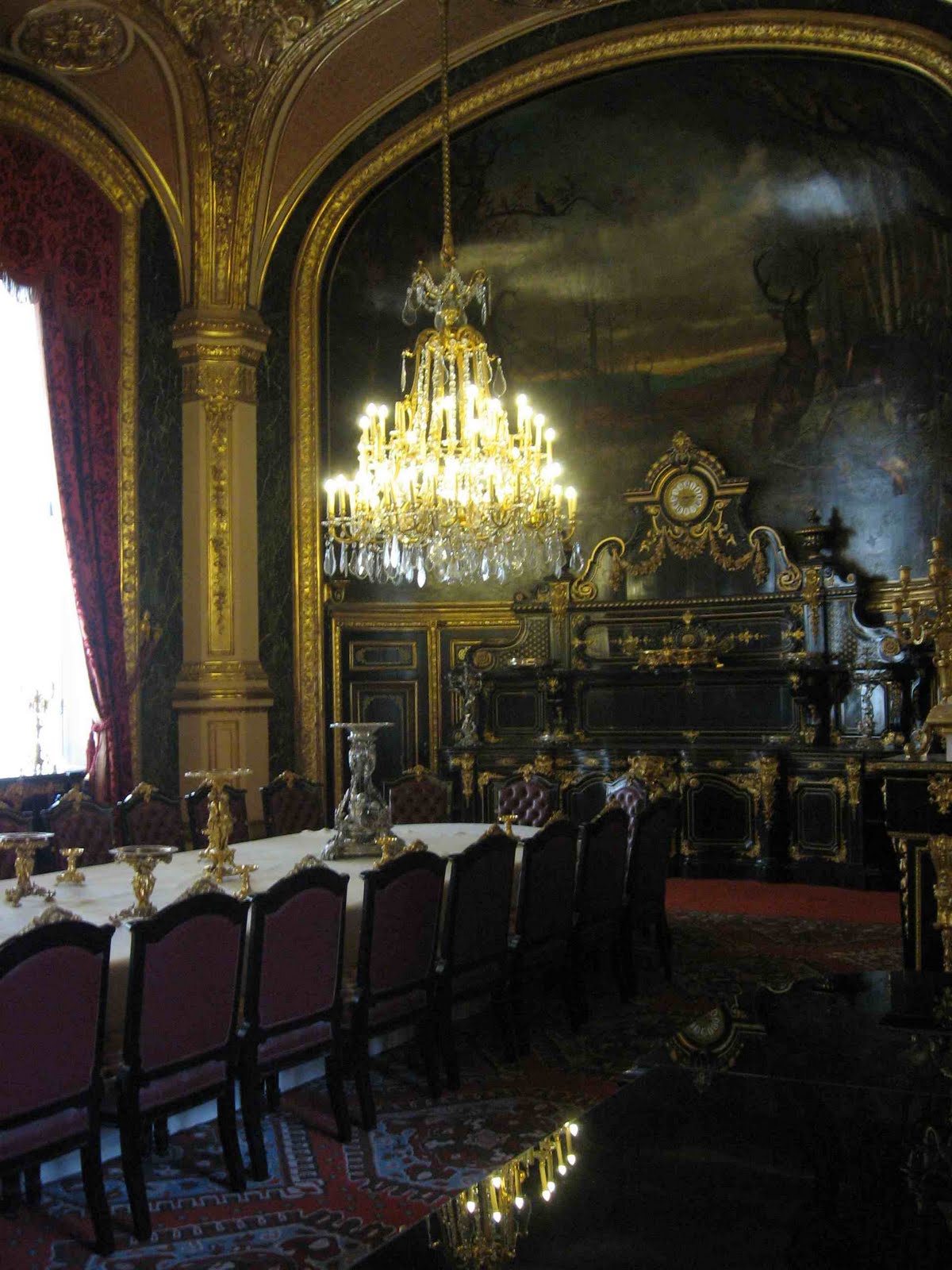 Day Five was spent at the Louvre. Visiting the world’s most famous art museum was somewhat baffling. When did people start taking photographs of paintings? For a good length of our trip we were followed by a hangdog Italian man who stood grimly before each artwork as his wife snapped a picture, setting up the most dour slideshow in Christendom. Several people posed at the foot of El Greco’s The Crucifixion as if they were Wolf Blitzer in The Situation Room. “How do you feel about the death of Our Lord? Send us your Tweets.” The apex of ridiculousness was reached in the Mona Lisa room, with hundreds of tourists blindly snapping away and no one actually looking at La Jaconde, protected behind glass. I ended up mesmerized by the grounds of the museum and some astonishing work by Giovanni Paolo Panini.
 It was back to the Cinémathèque Française for more Perles Noires that evening. The Breaking Point is the lesser known but more faithful version of Ernest Hemingway’s To Have and Have Not. Eddie Muller has sung its praises for years, calling it the best adaptation of Papa’s work. But it’s been impossible to see. (Ironically, only days earlier the Warner Archive announced that they’d be making it available on DVD.) John Garfield, in easily his greatest performance, plays the fishing boat captain stretched to his limits by circumstance to learn that a man alone ain’t got no chance. Patricia Neal is the singular femme fatale who tempts him, Phyllis Thaxter the wife who keeps him grounded. The movie is devastating, ending on a note of existential dread rivaled only by Night and the City. It’s more than just the best screen Hemingway, it’s one of the great films of the 1950s.
Afterward, a party of noir fans and filmmakers adjourned to Le Fumoir again. Among them was Nicolas Saada, whose entertaining thriller Espion(s) would be my in-flight entertainment on the trip home. Sitting in a Paris cocktail bar, discussing Hitchcock and Preminger with a French director who actually used the term mise-en-scène in conversation, I thought I’d died and gone to heaven.
Friday, June 24, 2011
An Idiot, A Broad: Paris, Part One
When Midnight in Paris ended, Rosemarie turned to me and said, “You do realize that if we didn’t have this trip planned you’d have to carry me out of here in hysterics, don’t you?”
Occasionally you get lucky. Only a week after seeing Woody Allen’s beguiling bauble of a film we were winging our way to Paris to celebrate our twentieth wedding anniversary. It was the first visit to the city for both of us.
Some people consult guidebooks before an excursion. Others check with a physician. Me, I ask my bartender. A few days prior to our departure I stopped by the Zig Zag Café to find out where to drink in Paris. I could last ten days without watching baseball, but no way was I going to give up cocktails. Erik advised me that Paris, like much of Europe, didn’t have an active cocktail culture, then preceded to mention several suitable bars. Next, I asked if I could bring anything back.
“Amer Picon,” Erik said without hesitation, naming the bitter orange liqueur featured in drinks like the Liberal and the Brooklyn. “You can’t get it here. It can be tough to find even in France.”
I now had what I needed to make this vacation complete. I wasn’t just going to learn how long a man could subsist on nothing but gazpacho and Calvados. I had a quest.
Day One: Transit. A long but pleasant flight, punctuated with surprisingly decent airplane food. Air France’s many entertainment options allowed me to catch up with a terrific French film not yet released in the United States. In The Night Clerk, Jean-Pierre Bacri is the manager of an upscale mountain resort forced to cover up an accidental death caused by his son. The title character, a recently paroled young convict, knows what happened but keeps schtum, leading to a bond between the two men that is destined to be tested. It’s the kind of elegant, chilling thriller that only the French can make, and it got the voyage off on the right foot.
Day Two: Paris Fog. I know Day Two happened. I have receipts. But a readjusting biological clock has reduced most of it to a blur. We trained in from the airport, settled into the small, modern, functional apartment we’d rented near the Louvre for our stay, wandered out for a croque-monsieur, then slept most of the day. That evening we strolled over the Pont Neuf to the Île de la Cité for the first of many languorous French dinners. We found a lovely restaurant in a small square, which a pair of jazz musicians took over for the evening, and gazpacho was had. On the walk back, Rosemarie noticed that one of her brand new shoes sounded odd. Turns out the cobblestones on the street had pried loose the heel. Checking online, we discovered that a cobbler – the only one authorized to replace the red soles on Christian Louboutin shoes – was located directly across the street from us. Clearly, this was to be a charmed trip. (NOTE: The preceding is a literary technique known as foreshadowing.)
Day Three: Darkness in the City of Light. We spent the day strolling through the Marais, swinging past the Centre Pompidou and visiting the Musée Carnavelet, a town house now given over to the history of Paris. Fascinating shops abounded in the neighborhood. None carried Amer Picon. That evening we headed to the Cinémathèque Française for the start of the Perles Noires series. Our friend Eddie Muller, founder and capo of the Film Noir Foundation, had been invited to present some films, and we pushed our trip back a month to coincide with the festival. The opening night feature was the FNF-restored Cry Danger. I’ve written about the film twice before, and can only add that it plays as well in France as it did at Noir City. A late dinner with Eddie and the Cinémathèque staff followed. We’d be spending a lot of time at the theater in the days to come.
Tuesday, June 14, 2011
On The Web: L.A. Noire at Crimespree
One of several reasons why posting has been somewhat scarce around here lately is that I’ve gone down the rabbit hole that is L.A. Noire, the new video game from Rockstar and Team Bondi. Over at Crimespree, I offer a review.
I’d be remiss if I didn’t steer you toward this piece on the game by Extra Lives author Tom Bissell at Grantland. More than a review, it’s a consideration of how L.A. Noire prefigures massive changes in storytelling. A brilliant, must-read take.
Monday, June 13, 2011
Movie: Carancho (U.S. 2011)
Forget the Dos Equis ads. For my money the most interesting man in the world, as well as the best actor, is Argentina’s Ricardo Darín. Criminally charismatic and with a taste for dark material, he starred in the only two films directed by the late, much-missed Fabián Bielinsky as well as my favorite movie of last year. In the now-on-DVD Carancho, he’s working in the shadows again. Darín plays Sosa, a disgraced lawyer hustling for clients injured in collisions on the lethally dangerous streets of Buenos Aires. The title means “vulture,” and while we don’t actually see Sosa chasing an ambulance he does follow one very closely. He’s not above staging accidents to turn a buck. Doing so brings him into the orbit of Luján (Martina Gusmán), a hard-working doctor concealing a drug addiction. Trapped in a deeply corrupt system, they wonder if they can trust each other – and if so, whether they can make a clean break.
Carancho admirably doesn’t hold the viewer’s hand, although at times I wouldn’t have minded. It’s still unclear exactly why Buenos Aires’ traffic is so deadly, or how Sosa fell to his lowly state. But the intensity of emotion between these two broken people is unmistakable, setting up a hair-raising ending. Noir to its very core and further proof of Ricardo Darín’s unassailable awesomeness, Carancho is not to be missed.
