Friday, August 09, 2013

Cocktail of the Week: The Between The Sheets

Dr. Egon Spengler: Don’t cross the streams.

Dr. Peter Venkman: Why?

Dr. Egon Spengler: It would be bad.

From GHOSTBUSTERS


The timeless advice of a trusted academic is also my usual response to the mixing of base spirits. One, typically, is enough. The case of the Between The Sheets isn’t abetted by its name, which can also be appended to anything read from a fortune cookie. It was a bitter disappointment, then, that the Playboy Bartender’s Guide, always a reliable source of vaguely smutty drink advice, simply observed that the Between The Sheets is a variation on the rum Sidecar.

The cocktail dates back to the Prohibition era and is credited to the usual places; Harry’s New York Bar Paris comes up, but Harry’s New York Bar Paris always comes up. Given the combustible combination of potent potables, it’s not surprising that some experts viewed it askance. In early editions of The Official Mixer’s Manual, it was branded with the advisory asterisk that was essentially Patrick Gavin Duffy tossing up his hands and saying, “I’ll tell you how to make it. I’m not telling you to drink it.” Charles H. Baker, Jr. first sampled it in the King David Hotel in Jerusalem on a day of rioting between Arabs and Jews. “We won’t go into the politics of the thing,” he observes in his customary style in The Gentleman’s Companion, “but it was a nasty mess.” As for the cocktail itself, he declares it “totally sound.”

And it is. Partisans of the Sidecar may want to give it a whirl, the rum bestowing a tropical kick on the proceedings. There are versions prescribing Benedictine in place of rum, but if you’re going to baffle the palate, says I, baffle it but good. I personally don’t sugar the rim of the glass, as you would in a standard Sidecar, because the rum (or the Benedictine) will provide sufficient sweetness. And depending on which recipe you consult, the amount of lemon juice varies from a dash to a portion equal to the other ingredients. Here I’ve opted for enough to keep the drink squarely in the Sour family, where it belongs. Whatever preparation you settle on, the Between the Sheets is better than its name.

The Between The Sheets

1 oz. light rum
1 oz. brandy (Cognac)
1 oz. Cointreau
¾ oz. lemon juice

Shake. Strain. No garnish.

Thursday, August 01, 2013

Movies: The Hitchcock 9

The British Film Institute recently undertook the massive project of restoring all of Alfred Hitchcock’s surviving silent films. (Of the ten he made, only his second, 1927’s The Mountain Eagle, is lost.) The nine movies span and frequently combine genres, linked mainly by the director’s restless cinematic intelligence. The series is currently on tour, and recently wrapped up a run at Seattle’s SIFF Cinema. Where else would you expect your correspondent to be?

It’s a mixed bag of titles, but essential viewing for any Hitchcock fan. The thrills come from watching the director discover his voice, charting his burgeoning command of visual narrative, glimpsing the first Hitchcock blonde, his debut cameo. Adding to the experience was the performance of a live original soundtrack, making each screening a singular event.


Blackmail (1929). Czech actress Anny Ondra of the hugely expressive eyes is Alice, who slips away from her boyfriend to respond to the flirtations of an artist (a magnificently odious Cyril Ritchard). When he attempts to rape her, she kills him. Alice is still reeling from the discovery that the investigating detective is her boyfriend when a criminal who witnessed everything threatens to destroy them both unless they pay up. A masterful piece of work, stronger than Hitchcock’s more celebrated The Lodger. It already shows the director’s love of climactic set-pieces with a chase through the British Museum achieved through camera trickery, and features an unsettling ending that never would have passed muster at a U.S. studio. Hitch made a sound version simultaneously, with Ondra lip-syncing dialogue spoken by off-camera actress Joan Barry. That version closes SIFF’s tribute tonight, but having seen this gorgeous print of the silent film I’m in no hurry to watch a weaker iteration. The soundtrack was by Diminished Men, their music described as a combination of Link Wray and Ennio Morricone. Not what one typically associates with Hitchcock but their surf noir sound worked wonderfully, adding a contemporary dimension to a nearly-85-year-old film that remains plenty lively on its own.

The Farmer’s Wife (1928). Billed as a comedy but steeped in sadness. A gentleman farmer and widower watches his daughter marry and leave home. Afraid of spending the rest of his days alone, he and his devoted housekeeper draw up a list of eligible women, and the farmer goes a’-courtin’. Once romance is in the offing the stoic farmer becomes a stubborn, hapless fool, forever saying the wrong thing. The women who are his quarry are given definition, each spurning him for her own reasons. This warm and funny film, also a gentle burlesque of village life, was the find of the festival, abetted by the strongest soundtrack. Violinist Julie Baldridge and a DJ whose name I didn’t catch played in deft counterpoint, the DJ using samples to serve as motifs for the characters.

The Pleasure Garden (1925). Hitch’s first film, made when he was twenty-five, is a strange one. It begins as a backstage melodrama, with a penniless chorine arriving from the sticks only to be watched over by “poor but honest” Patsy Brand. Then it becomes a bizarre tale of Far East survival. I wish it had stayed in the theater, a proto-Showgirls. You can tell from the opening shot of chorus girls’ legs that’s where Hitchcock’s heart lies. A jumble goosed along by an inventive, multi-instrument soundtrack courtesy of Miles & Karina.

The Ring (1927). Hitch’s boxing drama was the film I was most excited about, so naturally it proved the biggest disappointment. Like many of his early efforts it’s a love triangle, about a carnival fighter signed to be the sparring partner for an up-and-coming heavyweight – only to have the champ fall for his wife. While the midway milieu feels authentic and lived-in, the boxing world (aside from the use of champagne to spritz the pugs between rounds) is never remotely believable. And there’s not enough boxing. The cello/vocal score emphasized that The Ring is a chamber piece and only made a constrained film seem even smaller.

Downhill (1927). Schoolboy honour leads to disgrace. Then-heartthrob Ivor Novello, fifteen years too old for the role, willingly besmirches his own name to save a chum’s and winds up a taxi dancer in the south of France. It’s impossible to tell how seriously to take this story when Hitchcock himself seems to be playing it for laughs. Further complicating my reaction was the soundtrack, provided by a local DJ and the one authentic misfire. The DJ wasn’t scoring the film so much as commenting on it, playing obvious yet inappropriate selections (The Police’s ‘Don’t Stand So Close To Me’ during scenes of schoolroom romance) and banking on the audience’s associations with tracks by the Doors and Rihanna. Worse, of all the films in the series Downhill has the most opportunities for music to make an impact given its structure and the DJ squandered them all, settling for glib choices. SIFF’s programmers deserve credit for thinking out of the box, but here the music nearly overwhelmed Hitchcock’s artistry.
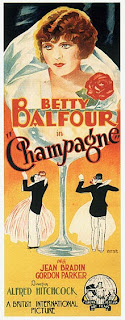
Champagne (1928). Screwball Hitchcock, complete with runaway heiress. Betty Balfour is the flapper who finally pushes her wealthy father to the point of feigning poverty – but that only unleashes the girl’s inner moxie. The sole surviving print is a back-up consisting of second-best shots and takes, but even B-level Hitchcock has its charms. Featuring Rosemarie’s new all-time favorite line of dialogue: “I’ve met some lively people, invented a cocktail, and bought a lot of snappy gowns!” Harpist Leslie McMichael contributed a suitably effervescent score.

The Manxman (1929). Anny Ondra again stars in yet another triangle drama set on the Isle of Man. Possibly the best-looking film of the bunch, but a one-note melodrama only occasionally enlivened by the director’s eye, and with too many instances of histrionic “silent movie acting” by the male leads. Another cello/vocal score, heavy on the keening, only underlined how frightfully intimate the action is.

Easy Virtue (1928). The restoration of this adaptation of Noel Coward’s play was struck from a 16mm print with more than fifteen minutes whittled out of it. As such it feels fragmentary, only hinting at the expansive approach to the source material. Another fine Miles & Karina score helped.

I skipped 1927’s The Lodger because I’ve already seen it, it didn’t feature live music (instead using a recording of the BFI-commissioned score), and nine movies in three days is too much even for me. SIFF continued the Hitchcock tribute with a selection of his early U.K. films. I ventured back to the Uptown for a few that I’d missed.

Murder! (1930). A famous actor (Herbert Marshall) seated on a jury reluctantly votes to find a fellow thespian guilty of the title offense, then applies the tools of his trade to clear her name. A who-done-it was not the ideal vehicle for exploring the use of sound in a movie. Hitchcock occasionally succeeds, as in a multi-party interrogation set in the wings of a theater during a play, and even pushes what the medium was then capable of; to achieve the relatively simple effect of having Marshall hear his thoughts while listening to the radio, Hitchcock played a recording of the actor’s voice while an orchestra thundered on the other side of the set’s wall. More often than not, though, the new technology results in scenes in which dialogue is barked too fast to be processed. And the plot is ridiculous. The curio does have a tip-top big top climax, though.

Number Seventeen (1932). An old dark house story. Mysterious characters – including a hobo best described as The Wire’s Dominic West meets Gollum – turn up at said structure, all lying about who they are. Hitchcock wasn’t a fan of the original play and didn’t want to direct the film, so his solution was to treat the entire enterprise as a joke, piling on the twists and keeping the pace moving. It’s a fleet hour of gimcrack nonsense culminating in a daring race between a model bus and a model train. Once I embraced its silliness, I had a fine time.

Young and Innocent (1937). By the time Hitch made this film, which he felt great affection for, he’d already become ‘Alfred Hitchcock’ with the original The Man Who Knew Too Much, The 39 Steps and Sabotage. He’d reached the point where he was capable of tossing off bon-bons like this – about a wrongly accused man on the run, a favorite theme – effortlessly. Sly, flirtatious banter, barbed send-ups of social mores, and multiple bravura shots. It’s a Hitchcock movie, fully formed, and he’d be in America soon enough. With the divinely named Nova Pilbeam.

Friday, July 26, 2013

Cocktails of the Week: The Tuxedo/The Imperial

This started out as a post about one drink, but events quickly overtook me.

About the only thing that can be said with reasonable certainty regarding the Tuxedo cocktail is that it was spawned at the swellegant Tuxedo Park Club in New York’s Ramapo Mountains, the selfsame establishment where the namesake menswear was introduced Stateside in 1886. The drink’s recipe is featured in many early bartending books, with every Harry (Craddock, Johnson, and McElhone) getting into the act. The formula evolved with each appearance, leading to great confusion in the land. The original Tuxedo was likely made with sherry and dry gin – unless it was made with Old Tom gin, as in some reports – and bears only a distant resemblance to the cocktail’s current conception. In the revised Official Mixer’s Manual, Patrick Gavin Duffy blithely offers three different Tuxedos with no explanation, including one that doesn’t have gin at all.

Duffy’s third stab at the recipe is the drink I set out to make, essentially a very wet martini with the traditional orange bitters, enlivened by a splash of maraschino and served in a glass rinsed (or in my case misted) with absinthe (or any anise liqueur, in my case Pernod). Traditionally the cocktail was prepared with equal parts gin and vermouth, but I adhered to contemporary custom and opted for a more spirit-forward version, which has the added benefit of throwing a little more light on the spark of cherry sweetness provided by the maraschino.

Forego the dash of anise and switch to more flavorful Angostura bitters and you have the Imperial. I mentioned this drink the other night at the Zig Zag Café when Rosemarie said she wanted something like a martini but different. We turned to the redoubtable Ben Perri, who in turn consulted Jones’ Complete Barguide to confirm that I had the recipe correct. (Turns out there are an assortment of Imperial Fizzes as well as a brandy-based Imperial Delight muddying the brand.)

Jones calls for equal parts gin and vermouth in the Imperial. More intriguingly, it says the drink can be garnished with a cherry or an olive. The former would seem the favorite, given the presence of maraschino. But Ben said “I’m not feeling it” and went with the olive, which proved the right decision. The taste of cherry is already in play, and the martini profile is strong enough that the olive feels right at home. Before Rosemarie finished drinking hers, three other customers had ordered Imperials of their own. Single-handedly starting a mini-craze for an obscure cocktail. It’s my proudest moment of the year so far.

The Tuxedo

2 oz. gin
1 ½ oz. dry vermouth
¼ oz. maraschino
2 dashes of orange bitters
dash of absinthe or Pernod

Combine the first four ingredients. Stir. Strain into a cocktail glass rinsed or misted with absinthe or Pernod. Garnish with a lemon twist and a cherry.

The Imperial

1 ½ oz. gin
1 ½ dry vermouth
¼ oz. maraschino
dash of Angostura bitters

Stir. Strain. Garnish with a maraschino cherry or an olive, but for variety’s sake start with the olive.

Friday, July 19, 2013

Cocktail of the Week: The Left Hand

The thing about hobbies is people generally know what to get you when gift-giving occasions roll around. A friend was kind enough to pick up an assortment of Bitter Truth bitters to mark an event. The Xocolatl Mole variety, inspired by the chocolate sauces of Mexico, was included in the order by mistake. A bit of lagniappe, to mix two completely different languages and cultures. I added them to my bitters shelf – yes, I have one – and there they stayed, because I didn’t know what to do with them.

Paging through Jim Meehan’s The PDT Cocktail Book, I came across a drink called the Left Hand. I blew the dust off the bottle, made the drink, and it instantly joined the ranks of Chez K favorites.


The Left Hand was created by Sam Ross, a New York bartender with a track record featuring one esteemed watering hole after another: Little Branch, The Pegu Club, Milk & Honey, and the current occupant of the original M&H spot, Attaboy. The drink is frequently described as the blessed union of the Negroni and the Manhattan, although I prefer to think of it as a twistless twist on the Boulevardier. Meehan’s book claims the drink is named after Al Pacino’s character in Donnie Brasco, although a chicken-and-egg bit of inspiration must surely be the Right Hand, devised by Ross’s M&H colleague Michael McIlroy around the same time and essentially the identical cocktail made with aged rum.

Meehan’s recipe specifies the robust Carpano Antica sweet vermouth. I started by using my default choice, Dolin, and was not disappointed. Inspiration struck and I shifted to Cocchi Vermouth di Torino. Its notes of cocoa are heightened by the chocolate bitters, giving the drink an extraordinary texture. I’ve yet to make the Right Hand, but I know what the Left Hand is doing and it’s something special.

The Left Hand

Sam Ross, New York, 2007

1 ½ oz. bourbon
¾ oz. Cocchi Vermouth di Torino (or other sweet vermouth)
¾ oz. Campari
2 dashes Bitter Truth Xocolatl Mole bitters (or other chocolate bitters)

Stir. Strain. Garnish with a cherry.


Want more Cocktail of the Week? The first fifty-two essays are available in the Kindle bestseller DOWN THE HATCH: ONE MAN’S ONE YEAR ODYSSEY THROUGH CLASSIC COCKTAIL RECIPES AND LORE. Buy it now at Amazon.com.

Thursday, July 18, 2013

Movies: Some Summer Viewing

Time to do for a few movies what the previous post did for books.

Hey, Bartender. I awaited no film more than this documentary about the craft cocktail movement, which is probably why I found it such a colossal disappointment. It’s too muddled and New York-centric to do justice to its subject. Hey, Bartender is several movies elbowing each other for space. You’ve got a host of well-chosen experts offering a hasty history of mixed drinks with no insight into the current revival. There’s a look at Employees Only, a fine Big Apple bar reduced here to an obnoxious scenester hangout. One of EO’s bartenders, Steve Schneider, has a compelling story, but the film mistakenly relies solely on him to tell it; it would be far more interesting to learn why Dushan Zaric, Employees Only’s owner, took a chance on putting a wounded ex-Marine behind the stick. Lastly, there’s the proprietor of a struggling Connecticut tavern who foolishly listens to a liquor rep’s advice to go to Tales of the Cocktail in scenes wouldn’t make a decent episode of Bar Rescue. He gets to New Orleans and immediately buys himself a hat, which perfectly sums up the film’s superficial approach. A bartender friend told me that the great boon of the cocktail renaissance is its democratizing effect; you can walk into a dive bar in the middle of nowhere and find a bottle of maraschino on the shelf. That’s a story worth telling, and Hey, Bartender stumbles onto it several times, most notably when spirits historian David Wondrich describes his amazement at learning that Boise, Idaho “only” has two craft cocktail bars. Too bad the movie keeps on walking.

The Call. Brad Anderson may be having the definitive post-indie film career, moving effortlessly between inexpensively made auteurist features (The Machinist, Transsiberian), smart TV series (The Wire, Boardwalk Empire) and studio fare like his latest, which I caught up with on DVD. Halle Berry plays a 911 operator who, following a mistake that resulted in a teenage girl’s death, is on training duty. She gets a chance to redeem herself when the same killer resurfaces. Anderson, Berry and company relish the opportunity to explore the fresh terrain of an emergency call center. The villain’s backstory is believable, even tragic, and cagily doled out. It’s a thoughtful, well-structured movie that continually ratchets up the tension.

Then the last 90 seconds ruin it.

After what should clearly be the film’s final image comes a scene that smacks of studio interference and plays like an alternate ending meant to be exiled to DVD. Everything about it feels off, the actors giving wholly different performances as if going through the motions on a rewrite they hope will never see the light of day. It’s actually impressive, how thoroughly this addition undoes all that’s gone before. What would be an authentic sleeper leaves only a bad taste.

Jesus, did I see anything I liked? Well, yes.


In Berberian Sound Studio, Toby Jones is a reclusive English technician who goes to Italy in the 1970s to work with a director obviously based on Dario Argento. We never see a frame of his film, aside from its gloriously overwrought title sequence. We only hear it, in detailed descriptions of the degradations it depicts and Jones’s construction of the soundscape that brings it to life. It will not come as a surprise that our man slowly goes nuts. Beautifully and meticulously assembled, down to a soundtrack that fiendishly mimics those of Argento films. Watch that trailer. It’s a masterpiece.

Wednesday, July 17, 2013

Books: Some Summer Reading

Don’t let the blog go all cocktails all the time. I told myself that more than once. But a summer full of deadlines and other pressing business later, that’s exactly what happened. To make it up to you, here’s a quick roundup of books I’ve read in recent weeks worth your time.

Middle Men, by Jim Gavin (2013). Confession #1: I never read the fiction in the New Yorker. I don’t know why. Confession #2: I made an exception for Jim Gavin’s ‘Costello’ only because the illustration featured a Dodgers cap and I thought it was about baseball. (I’m really a very simple man.) Love of the game is part of the background in the finest short story I’ve read in years, about a widowed plumbing supplies salesman making the adjustment to living the good life in California alone. ‘Costello’ is the closing entry in this aptly-named, terrific collection of stories about men of varying ages accepting their limitations in the Golden State. ‘The Luau’ is a companion piece to ‘Costello’ about Costello fils. ‘Elephant Doors’ follows an aspiring stand-up comic who works as a production assistant on a game show that is nothing like Jeopardy! The uproarious, shaggy-dog ‘Illuminati’ includes a brilliant bit of show business lunacy, while ‘Bewildered Decisions in Times of Mercantile Terror’ contains as lethal a dissection of the modern workplace as you’ll see. (A sales team consists of “a pack of hyenas from third-tier MBA programs who spent their days quoting Old School and refreshing ESPN.com.”)

The Legends of Last Place, by Abe Streep (2013). In this brief ebook, the editor of Outside magazine (and former college baseball player) spends a season following the Santa Fe Fuego, the worst professional team in these United States. ‘Professional’ is used advisedly here; Fuego players earn fifty bucks a week, crash with local families, and double as the grounds crew. Streep dives deep into what keeps players and fans committed to the game at its lowest level. FYI: Roswell, New Mexico’s club is called the Invaders.

Big Maria, by Johnny Shaw (2012). If it’s been too long since you’ve read something heartwarming yet filthy – or filthy yet heartwarming, your choice – have I got the book for you. Three outcasts in the high desert, a place fabled for outcasts, decide to turn their sorry lives around by joining forces to find a forgotten gold mine. That the mine is now part of a government artillery range is the least of their problems, given what bone-deep screw-ups they are. It’s a scatological Treasure of the Sierra Madre, or a Donald E. Westlake Dortmunder novel where the heisters are cursed-by-God unlucky. Shaw balances a willingness to rush headlong into grim (and gross) comic terrain with genuine affection for his misfits, and damned if you’re not rooting for these sad bastards come the end.

Friday, July 12, 2013

Cocktail of the Week: The Bee’s Knees

Offering multiple uses for every ingredient, no matter how homely, is part of the Cocktail of the Week ethos. Thus we turn again to honey syrup, previously discussed in re: the Brown Derby.

Given its name it should come as no surprise that the Bee’s Knees is a Prohibition era concoction. The common lore holds that the honey concealed the generally poor taste of bathtub gin, with an alternate version claiming that it was used to trick the nose, its scent masking that of the booze on the imbiber’s breath. I don’t buy either theory. The Bee’s Knees is a simple gin sour with honey as a sweetener. No further explanation required. Put maraschino in the same role and you have a violette-less Aviation, but honey’s floral notes blend with the gin in such a fundamentally different way that they’re not close to being the same drink.

The general time period of its creation is the only part of the Bee’s Knees’ history that experts agree on. (Some books refer to it as “The Bees’ Knees,” so even the number of insects involved is unclear.) At least two different cocktail guides from the 1930s contain the recipe, with one including orange juice. There are multiple variations – a Honey Bee is made with Jamaican rum, a Bee’s Kiss with rum, honey and cream – which only compounded the confusion over time. The formula in my edition of the Playboy Bartender’s Guide features five ingredients, and somehow gin, honey and lemon juice are not among them. “A speakeasy heirloom whose orange accent is most mellow,” says Playboy. This is why I only read it for the pictures.

The orange accent is so mellow in the recipe below that you’ll never taste it. Know that a 1930s Bee’s Knees was extremely spirit forward, with only a teaspoon of honey versus a jigger of gin. Know also that contemporary bartenders have been known to make the drink with lavender honey. I haven’t tried that take on it yet, but I badly want to.

The Bee’s Knees

2 oz. gin
¾ oz. honey syrup
¾ oz. lemon juice

Shake. Strain. No garnish.

Friday, June 28, 2013

Cocktail of the Week: The Harvey Wheelbanger

We’re changing the rules around here this week. The spotlight falls on a brand new drink, one I have yet to make myself but had a hand in inventing.

Ask friend and foe alike for a précis on my character and at some point, friend/foe’s voice will drop to the whispered tone reserved for the names of afflictions. “You know he’s ... a Mets fan,” friend/foe will say with commingled pity and wonder, both emotions apt.

It’s true. I remain stubbornly, stupidly loyal to the baseball team of my youth. There have been highs. There have been many, many, many more lows. Especially of late. But there is also hope. For the New York Metropolitans now have Matt Harvey, second year pitching phenom, possible starter of this year’s All-Star Game in Flushing, repository of all my dreams for the future. (No pressure.)

Ask friend and foe alike, etc., etc., and friend/foe will say, “Guy likes drinking.” So little wonder that more than one person suggested in the wake of Harvey’s dazzling first half that I should concoct a cocktail in his honor. It’s nice when a man’s hobbies overlap. I brought in a consultant: Ben Perri, estimable bartender at the Zig Zag Café, fellow New York ex-pat and baseball aficionado. We discussed parameters. No Fireball Cinnamon Whiskey, in part because it’s too easy but mostly because I don’t care for the stuff. Sports Illustrated dubbed Harvey “The Dark Knight of Gotham” and he pitched for the University of North Carolina, so clearly the base spirit has to be brown.

Earlier this week I caught up with Ben, who commented on the impressive debut outing of the Mets’ other touted pitching prospect Zack Wheeler. “We need a drink that pays tribute to them both,” Ben said. That’s when it hit me.

Ladies and gentlemen, Mets fans of all ages, Ben and I give you ... the Harvey Wheelbanger.

Sometimes it really is that easy.

The Harvey Wallbanger – vodka, orange juice, and the sweet, vanilla-heavy liqueur Galliano – is one of those cocktails that only could have achieved popularity in the 1970s. Esteem’d tippler Kingsley Amis branded the drink “famous or infamous,” dismissing it as “a Screwdriver with trimmings ... named after some reeling idiot in California.” That last bit comes from a treasured bit of lore claiming that the cocktail’s original advocate was a surfer (go on, guess his name!) who downed so many of them he’d bang off the walls trying to leave the bar. While Gary Regan cites an article crediting the cocktail’s invention to Newport Beach sportswriter Bill Doner, most experts lay blame or credit at the feet of barman Donato “Duke” Antone, who also claimed to have bequeathed unto the world the Rusty Nail.

New York Times writer Robert O. Simonson dove further into the Wallbanger’s history in this piece, discovering that its origins may have been considerably more corporate. Dale DeGroff adds the tantalizing tidbit that the apocryphal surfer downed so many of these drinks solely to collect the distinctive tapered bottles of Galliano. (The liqueur may be slowly making a comeback, but the cocktail that served as its primary introduction is more a liability at this point.)

The drink already has a baseball provenance; the 1982 American League champion Milwaukee Brewers were known as “Harvey’s Wallbangers” thanks to the team’s offensive prowess under the stewardship of manager Harvey Kuenn. The Harvey/Wheeler connection made it a no-brainer.

So what’s in a Harvey Wheelbanger? Galliano, obviously, a tip of the baseball cap to the cocktail’s forebear. Triple sec to complement it. Rye whiskey, as discussed. Not just any rye but Rittenhouse 100 proof, bringing the high heat. Ben then added Root liqueur as “the curveball, the off-speed stuff.” For the long, hot months of baseball season you want a tall drink, a cooler, so serve it over ice with club soda (“the gas”).

I drank the first-ever Harvey Wheelbanger at the Zig Zag on Monday night, and pronounced it good. It’s refreshing with a snap courtesy of the sneaky sarsaparilla finish. Before I left another customer had ordered one, because change is in the wind. The balance of power in the National League East is shifting to Queens, thanks to the presence of Harvey and Wheeler. Together, they are the joint Moses who will lead us to the Promised Land, or at least within hailing distance of a 2015 wild card bid. I’ve been a Mets fan too long to get completely carried away.

The Harvey Wheelbanger*

1 ¼ oz. Rittenhouse 100 proof rye
½ oz. Galliano
½ oz. triple sec
¼ oz. Root liqueur
3 oz. club soda

Combine the first four ingredients with ice. Stir. Strain into a Collins glass filled with ice. Top with club soda. Garnish with an orange slice and a cherry.

*Known as the Starting Rotation in Yankees/Braves/Nationals/Phillies/Marlins bars. Like there are any Marlins bars.

Friday, June 21, 2013

Cocktail of the Week: The Brown Derby

Let’s head to California for this next libation, even though doing so is probably incorrect. A drink called the De Rigueur with the virtually identical recipe appears in Harry Craddock’s The Savoy Cocktail Book and therefore predates this one, but honestly, I’ve talked about Harry enough. It’s the first day of summer and it’s still overcast in Seattle. I could use a little sun. So we’re sticking with the version appearing in the 1933 collection Hollywood Cocktails by Buzza & Cardozo. (Purists will point out that there’s even a second, very different drink called the Brown Derby. Considering the Hollywood connection, maybe it was a reboot of this one.)

Our Brown Derby is indeed named after Los Angeles’ famed hat-shaped eatery, but it wasn’t created there. The drink was born in the Vendôme Club, operated by nightlife impresario Billy Wilkerson. Wilkerson is one of those characters about whom enough can never be written. He started the Hollywood Reporter, using the paper’s gossip columns to stir interest in his clubs like the Trocadero and Ciro’s. He broke ground on the Flamingo Hotel in Las Vegas only to be muscled out by partner Bugsy Siegel. He discovered Lana Turner at a soda fountain.

The Vendôme became the first place where one had to lunch in Hollywood, an essential venue where luminaries went to see and be seen. It was at the Vendôme that Louella Parsons learned about the pending split between Mary Pickford and Douglas Fairbanks, a landmark divorce in that both parties had cocktails named after them. Many spirits historians note that the Vendôme dubbed this drink after its neighbor then cite the original Brown Derby on Wilshire Boulevard. But given the Vendôme’s location on Sunset the more likely namesake is the Derby’s second outpost on Vine Street, alleged birthplace of the Cobb Salad.

The cocktail is basically a showbiz sour – spirit, sweetener, citrus – with the elements given additional pizzazz. Bourbon and honey are perfectly cast opposite each other, while above them grapefruit walks a tart tightrope. The recipe below comes from Jim Meehan’s The PDT Cocktail Book, as does the stronger-than-usual formula for honey syrup: a 2:1 ratio of honey to water, simmered over medium heat until the honey dissolves. If you’re going to include a flavor as distinctive as honey, you might as well taste it.

The Brown Derby

2 oz. bourbon
1 oz. grapefruit juice
¾ oz. honey syrup

Shake. Strain. No garnish.

Friday, June 14, 2013

Cocktail of the Week: The Fancy Free

And then there are the drinks where you don’t have much to say about them other than: I like this one, you should try it. Although it is appropriate for June 14, which is National Bourbon Day.


The Fancy Free had fallen out of my home bartending repertoire. I was reminded of it by Lesley M. M. Blume’s recent book Let’s Bring Back: The Cocktail Edition, and it’s worked its way into the rotation again. Few drinks serve as a better showcase for maraschino, the clear spirit distilled in Italy from sour cherries and typically found in a lanky bottle with a base swaddled in straw. It has hints of sweetness – Ernest Hemingway preferred it in his daiquiri in place of sugar – balanced by notes of almond, and no other commonly used modifier so says ‘cocktail’ to me. The Fancy Free rightly gives it center stage.

The recipe apparently first appears in the immortally titled Crosby Gaige’s Cocktail Guide and Ladies’ Companion (1941). Crosby suggests an unnecessarily fussy presentation, serving it like a Sidecar in a glass with a sugared rim. The Fancy Free is essentially a variation on the Old Fashioned, with maraschino subtly substituting for muddled sugar or simple syrup, and some contemporary adherents treat it thusly, pouring it over ice in a tumbler. I split the difference and enjoy mine up, skipping the added business on the glass’s rim. Bourbon and maraschino complement each other so well they don’t require accessories.

The Fancy Free

2 oz. bourbon
½ oz. maraschino
dash of Angostura bitters
dash of orange bitters

Stir. Strain. No garnish.

Friday, June 07, 2013

Cocktail of the Week: The Dark & Stormy

Let me help you clear that ginger beer from last week out of your fridge. Here’s another drink to use it in. Only be careful what you call it.

The Dark & Stormy, one of the two unofficial national cocktails of Bermuda, has a marvelously evocative name. Dark rum, ginger beer. What could be simpler? A lot, it turns out, once the lawyers get involved.

Blame the Royal Navy for the drink’s existence. Back when it was still issuing a daily ration of rum to sailors, it opened a ginger beer bottling plant at its primary base in Bermuda. The rest of the story writes itself. Gosling Brothers, Ltd., founded in the islands in 1806, became best known for a particularly dark variety of rum first sold only in barrels, then in repurposed champagne bottles liberated from the officers’ mess and resealed using black wax. Hence the name Gosling’s Black Seal rum.

In the 1970s, the company trademarked the Dark & Stormy name, usually rendered Dark ‘n Stormy. As this Diffords Guide article explains, “it is the name of the drink that is protected under law, not its ingredients.” What does this mean? You won’t get hassled by the man if you pour a dark rum other than Gosling’s Black Seal into your ginger beer. But if you choose another brand, choose another name for the resulting beverage while you’re at it, because in the eyes of the law it ain’t a Dark & Stormy. Or a Dark ‘n Stormy. Sorry. The nuances of trademark elude me.

For decades Barritt’s Ginger Beer of Bermuda was the favored partner in this drink. Now Gosling’s makes their own. (I’m still using Crabbie’s out of England.) In America lime juice is typically added, a Yankee innovation that would be frowned on in the islands where even the lime garnish is deemed optional. Some recipes use simple syrup, and at least one deploys peeled ginger root for an additional boost of spice. Dale DeGroff cooked up an alternate take that deploys two kinds of rum as well as pineapple and orange juice, which at least in terms of ingredients pushes the drink closer to a rum swizzle, Bermuda’s other unofficial national cocktail.

My own version trusts the ginger beer to do its job but ups the ante with lime bitters for an extra tropical punch. I haven’t consulted with my attorneys to see whether this change violates the law, so as the legal fog clears I’ve filed a claim on the name The Tenebrous & Gusty. Whatever you call it, it’s one of the great refreshments of summer.

The Dark & Stormy

2 oz. Gosling’s Black Seal rum
3 oz. ginger beer
2 lime wedges
2-3 dashes of lime bitters

Add the bitters to a highball glass filled with ice. Pour in the Gosling’s Black Seal rum. Top with ginger beer. Squeeze the lime wedges into the drink, then add them to the glass. Stir.

Friday, May 31, 2013

Cocktail of the Week: The Moscow Mule

An anniversary is a time to step back and reappraise. To break with tradition. To venture into new terrain. To listen, finally, to all those requests and complaints.

That’s right. In this, the second year of Cocktail of the Week posts, I am at long last featuring a vodka drink. Stop sending me your emails.

Understand, I’m not one of these people who hates vodka. Like Kingsley Amis, who wrote in Everyday Drinking that the role of vodka “is to replace gin in established gin drinks for the benefit of those rather second-rate persons who don’t like the taste of gin, or indeed that of drink in general.” He said it, folks, I didn’t.

I have no strong feelings about vodka, which is why I seldom drink it. It brings nothing to the party in the terms of taste. (Do not start in about flavored vodkas, I beg of you. You do not want to go down that road with me.) When people ask me to suggest a vodka cocktail, I’ll usually opt for something like the Jasmine, which has a few other elements to do the heavy lifting.

There is one vodka cocktail that I enjoy, because it asks the spirit to provide the kick and lets the remaining ingredients, specifically one, shoulder the burden. That the drink was concocted by a major corporation solely to sell booze doesn’t bother me in the least.

In 1939, the food and beverage giant Heublein purchased the North American rights to Smirnoff vodka for next to nothing. This was at this insistence of company president John Martin and over the objections of Heublein’s board of directors. (Heublein may have scored with brands as varied as A1 Steak Sauce, Kentucky Fried Chicken and Grey Poupon, but they also sold a line of pre-made cocktails like Manhattans and sidecars in cans, so it’s not like the outfit had the Midas touch.) Vodka had always struggled in the U.S., and initially Heublein had difficulty marketing it as well. Ultimately they chose to play to the familiar by rebranding it “white whiskey” and in an ad campaign touted the fact that it had no taste or smell by saying Smirnoff left you breathless. Focus groups deemed this approach more subtle that the original slogan, “Ah, Screw It, Get Hammered At Lunch.”

Success was still some distance off in 1946 when Martin found himself in Los Angeles dining with Jack Morgan, proprietor of the Cock ‘n Bull, the faux-British pub to the stars on the Sunset Strip. (The bar lasted until 1987, making it one of the last of the ‘40s Hollywood hot spots to close its doors.) Martin was saddled with Communist hooch nobody wanted, while Morgan made a strong ginger beer few customers could stomach. What to do, what to do?

Their answer, of course, was to combine them. A buck or a mule is a category of cocktail made with a base spirit, ginger ale or beer, and citrus. Given the Cock ‘n Bull’s Tinseltown ties the vodka buck, rechristened the Moscow Mule, became a hit with movie folk and was consequently written up in fan magazines, which fueled its popularity nationwide. So if you ever wondered who to blame for the ascension of vodka in this country, there’s your answer: Hollywood liberals.

The Martin/Morgan origin story sounds too good to be true. Drink historian Eric Felten says credit for the drink’s creation actually belongs to Cock ‘n Bull bartender Wes Price. His inspiration, according to Felten? “I just wanted to clean out the basement.” Price also claims that the first Moscow Mule ever made was sold to film noir favorite Broderick Crawford, so I’m buying his version of events.

Whenever possible, the Moscow Mule is served in a small copper mug. Why, you may ask? This is my favorite part of the story: because Jack Morgan’s girlfriend had inherited a factory that made them, and she couldn’t unload the things. Why shouldn’t she get well along with Morgan and Martin? Many bars maintain this unnecessary tradition and here in Seattle of late, the mugs have been the cause of a crime wave. I would like my parole officer to note that one of them is not pictured.

Key to this drink is a potent ginger beer. In The Fine Art of Mixing Drinks, David A. Embury pushes for Schweppes, an English brand. I’m honoring that request by making mine with Crabbie’s Alcoholic Ginger Beer, a U.K. product with a terrific sharp flavor and a punch of its own. Add a little lime and you have a perfect summer cooler.

The Moscow Mule

2 oz. vodka
4 – 6 oz. ginger beer
½ oz. lime juice

Pour lime juice over ice in a Collins glass or a small copper mug that you probably stole from a reputable bar, in which case you should just turn yourself in to the authorities. Add vodka. Top with ginger beer. Stir. Garnish with a lime wedge.

Friday, May 24, 2013

Cocktail of the Week: The Old Tom Old Fashioned

You don’t need me to tell you that the Old Fashioned has made a roaring comeback. You’ve got lifestyle blogs and magazines illustrated with Mad Men stills for that.

You don’t need me to tell you that the simpler the preparation of your Old Fashioned, the better off you are. You’ve got Old Fashioned 101 for that.

I will say this of the “fruit salad” that used to litter this cocktail: I bought a muddler solely for the purpose of making Old Fashioneds, and I never use it anymore. What a waste of money. On an unrelated note, be sure to pick up my new children’s book Morty The Mournful Muddler, the heartwarming tale of a lonely discarded bar tool that finds redemption through bird watching and community service.

What do you need me to tell you about a drink that’s been analyzed to death? Let me check my notes ... one of David A. Embury’s six basic cocktails ... born in Louisville, Kentucky’s Pendennis Club in the 1880s ... toss in an authentic maraschino cherry if you feel like it ... rye’s really your better option, but you knew that ...

Oh, here you go. Have one with gin. Specifically Old Tom gin.

I’ve raved before about the return of this sweeter variety of gin, closer to the pre-Prohibition incarnation of the spirit. Ransom Old Tom is barrel-aged, resulting in a highly distinctive taste that’s a bit like gin, a bit like whiskey, and very much its own. It makes for a satisfying Old Fashioned, lighter than one made with brown liquor.

A rare warm day put me in the mood for one, so I stopped by the Zig Zag Café. I asked stalwart bartender Ben Perri for an Old Tom Old Fashioned, and he stalwartly asked which brand I preferred, Ransom or Hayman’s. I was poised to reply Ransom, but hesitated. Hayman’s, a U.K. product based on an archival recipe, has become a Chez K staple, my go-to for a Tom Collins. But I’d never considered it in an Old Fashioned. It’s closer to London dry gin, and far sweeter. I was torn, and did what I always do when faced with such conundrums: I asked my bartender for his opinion.

Ben said both make excellent, very different Old Fashioneds. His default choice for Old Tom was Hayman’s, because it was a) English, where Old Tom came from, and b) more gin-like in flavor.

I was torn. Ransom seemed a better fit for an Old Fashioned, but it always tasted like Ransom. The prospect of Hayman’s intrigued, but it was already fairly sweet. What’s a smart man to do?

I have no idea. I only know what I would do, and that’s have Ben make both versions so I could subject them to an on-the-spot taste test.

During this preparatory phase, a dark horse came onto the track. Ben pointed out that Dutch genever, the rich juniper liquor that was an original Old Tom contemporary, is available again from Bols – and is also well-suited to the Old Fashioned. What the hell, said I, let’s have one of those, too. I’m nothing if not thorough. Thus, when Rosemarie arrived at the bar to find multiple cocktails, pony glasses and bottles before me, I got to utter the three words that have been a refrain throughout our marriage: “I can explain.” At least she got to participate in the experiment as well.

The result was a three-way photo finish. There were no losers that night, only winners, with me the biggest winner of all. Ben was right about Hayman’s. Its sweetness was no impediment, Ben’s rendition of the drink beautifully balanced. It took the title by a nose over the Bols genever, which held the middle ground between a more classic gin style and the robust iconoclasm of Ransom. I’ve made Old Fashioneds with Hayman’s since, but still find myself craving the idiosyncratic notes present only with Ransom. I’m not worried, though. I’ve got all summer to wrestle with the problem.

Old Tom Old Fashioned

2 oz. Old Tom gin
¼ oz. simple syrup
3 dashes Angostura bitters

Stir. Strain into an Old Fashioned glass over ice. Garnish with a nice, thick lemon peel and a cherry for old times’ sake. Don’t let your muddler see what you’re doing. You’ll hurt its feelings.

Friday, May 17, 2013

Cocktail of the Week: The Toronto

Pure happenstance. I swear to you. These things aren’t planned in advance. It’s a complete coincidence that I’m highlighting a cocktail called the Toronto right as the mayor of that metropolis apparently turns up in a video speaking way, way, WAY off the record while smoking crack cocaine. We all of us have our vices.

The Toronto is another drink exploiting the peculiar charms of Fernet Branca. For more on Fernet’s history and its idiosyncratic scent and taste, please to consult last week’s post on the Hanky Panky. Further Fernet factoids:

I was desperately hoping there would be a spike in sales of this abrasive amaro following its cameo appearance in The Dark Knight Rises as Alfred’s aperitif of choice. Presumably Bruce Wayne also drinks it; that would account for the Batman voice.

Costume designer Edith Head, of whom Rosemarie and I are inordinately fond, was introduced to Fernet by the English actress Madeleine Carroll. Edith’s take on the Italian liqueur? It’s “guaranteed to save you on the day you want to kill yourself.”

My favorite, oft-repeated Fernet story took place in 1960. Betsy von Furstenberg, the actress born a baroness, was suspended from Actors’ Equity because of a prank she played on her co-star Tony Randall. She playfully poured Fernet into the glass Randall had to drink from onstage. Randall took one sip – and immediately assumed he had been poisoned.

Knowing that, you’re even more keen to use some in a cocktail, right?

The Toronto was originally created to showcase Canadian whiskey. (Irony #1: It’s never made with Canadian whiskey anymore, thanks to the boom in quality American ryes.) The drink was created in the early 1900s, and survived because its recipe was enshrined in David Embury’s The Fine Art of Mixing Drinks. (Irony #2: In Embury’s opinion, “a brief word about Canadian whiskey” was “all it deserves.” His brief word(s) on the subject: “I don’t like it.”) The drink is a variation on the Manhattan – although the presence of simple syrup means it also owes a debt to the Old Fashioned – so naturally it was named after Canada’s first city. (Irony #3: Early in the classic cocktail revival the Toronto was hard to come by in much of Canada because of a scarcity of Fernet Branca there.)

There’s no mistaking Fernet’s presence in a glass, but for all its assertive flavor it complements the base spirit it’s paired with. While it adds a playful edge to gin in the Hanky Panky, in the Toronto – or the T’ronta, as I’ve heard locals pronounce it – it lights a fire under the rye. Strange how a taste so distinctive can be so versatile.

The Toronto

2 oz. rye
¼ oz. Fernet Branca
¼ oz. simple syrup
2 dashes of Angostura bitters

Stir. Strain. Garnish with an orange twist.

Friday, May 10, 2013

Cocktail of the Week: The Hanky Panky

I have reached another milestone on this path I tread. I have at long last purchased my own bottle of Fernet (pronounce the T) Branca. I have joined the ranks of the hardcore cocktail fanatics.

Fernet Branca is the most bitter member of the amaro family. I’ve heard it called Jägermeister for grown-ups but that’s not at all fair – not to Fernet, or Jägermeister, or grown-ups. Fernet’s taste is so, ahem, bracing that most people first drink it as a dare. Before that distinctive taste you’ll notice its aroma, which contains notes of eucalyptus, menthol, roofing tar and regret. (I kid. It’s only two of the four. And maybe not the two you think.) Like many liqueurs it consists of a hodgepodge of ingredients, the exact formula held in secret. Known elements include myrrh, assorted fungi and gargantuan amounts of saffron, with some speculating that production of Fernet Branca consumes the bulk of the world’s supply of the spice. Almost since its genesis in 1845 it’s been bruited as a potent digestif, capable of preventing hangovers and the pains of gustatory excess before they start.

Despite being the working definition of an acquired taste, Fernet has found devotees beyond its birthplace in Italy. How it’s consumed will tell you something about the person who ordered it. Odds are anyone asking for Fernet and Coke is from Argentina. Fernet and ginger ale = San Francisco. And if someone seated next to you orders it straight, turn to them and ask is-THIS-your-card? style, “What bar do you work at?” It never fails. Love of Fernet is a badge of honor in the service industry.

A small amount of this pungent potable makes a noteworthy addition to a handful of cocktails. One of the best known is the Hanky Panky, a variation on the sweet Martini with a history that sets a world record for sheer bloody Englishness. It was created by Ada Coleman, the former bar mistress at Claridge’s who was installed at the American Bar at the Savoy Hotel by her benefactor Rupert d’Oyly Carte, scion of the family famed for producing the work of Gilbert and Sullivan. (See what I mean? And I’m not done yet.) Coley, as she was known, devised the drink at the behest of Sir Charles Hawtrey, the lion of the British stage who appeared in several silent films. More importantly, he taught a young Noël Coward everything he knew about the theater. When Sir Charles sipped Coley’s creation he is said to have thundered in true Wodehousian fashion, “By Jove! That is the real hanky-panky!,” the term then meaning witchcraft as opposed to serving as a Match Game euphemism for, you know, whoopee.

Hawtrey’s remark was an apt one. Some sort of trickery is involved for the miniscule amount of Fernet to become a dominant but never overwhelming taste amidst the gin and sweet vermouth. There are worse ways to be introduced to this most intriguing of flavors.

The Hanky Panky

2 oz. gin
1 ½ oz. sweet vermouth
¼ oz. Fernet Branca

Stir. Strain. Garnish with an orange twist.

Tuesday, May 07, 2013

Me Elsewhere: Memories of Malice

First, an apology: there will be no photographs. I didn’t take many. I was too busy being flabbergasted. Also, eating.

Rosemarie and I are back from our first-ever Malice Domestic conference. It won’t be our last. We’ll enjoy them all, but I daresay that future installments of this convention devoted to the traditional mystery novel won’t quite match this one, and not only because it was Malice’s silver anniversary edition.

As explained earlier, we ventured to deepest Bethesda, Maryland in order to receive this year’s William F. Deeck-Malice Domestic Grant for Unpublished Writers. We’d won the honor for our novel Design For Dying: An Edith Head Mystery. We were eager to meet our fellow recipient Ellen Byron, whose book Reality Checked is set in that most murderous of environments, the private school world of L.A.

The grants committee members gathered us up early and took fantastic care of us. Among the first things that we learned was the incredible number of previous winners who had returned to Malice as published novelists and nominees for the Agatha Awards. More impressive was the willingness of these writers to share their wisdom with us.

This year’s convention featured quite the array of special guests, with Laurie R. King, Aaron Elkins, Carolyn Hart and Peter Robinson receiving honors. There was also a stellar array of panels covering a host of crime fiction topics.

Saturday night was the Agatha Awards banquet, where the missus and I got our moment in the sun. It’s not a moment either of us is likely to forget. When grants committee chair and unofficial guardian angel Harriette Sackler announced the premise of our book – that Hollywood’s most famous costume designer must turn detective to solve a young actress’s murder – an encouraging buzz rolled through the ballroom. In the bar after dinner, newly-minted Mary Higgins Clark Award winner Hank Phillippi Ryan told us, “That was the sound of a roomful of writers saying, ‘Why didn’t I think of that?’” We received congratulations and advice from plenty of attendees including Agatha winners Louise Penny and Catriona McPherson and toastmaster Laura Lippman, who closed the event on Sunday with an inspirational Q&A. (The full round-up of Agatha nominees and winners is here.) And we had several conversations with agents and editors that were, in a word, extremely promising. (OK, that’s two words. Clearly, I need an editor.) I cannot stress this enough: if you have ever harbored any interest in writing a mystery novel, you owe it to yourself to look into this grants program. It is a transformative experience.

But what had the greatest impact was easily the sheer number of mystery readers – Rosemarie and I lost count at two dozen – who walked up to one or both of us to say how much Edith Head meant to them. Not only as a style icon, but as a professional woman who blazed a trail that is still being followed. Writer Carole Nelson Douglas told us about reading an interview in Parade magazine in which Edith described essentially conning her way into a job at Paramount Pictures despite having no training as a sketch artist. “Edith taught me to say yes to things,” Carole said. It’s an invaluable life lesson, and one our Malice whirlwind has made us take to heart anew. We are saying yes to all of this.

Random notes: if you want cocktails in the District of Columbia, I heartily second all the recommendations I heard for The Passenger. The bartender there made me a whiskey smash with pear liqueur that I can taste even now. And I have to commend the staff at the Hyatt Regency in Bethesda, who truly got into the spirit of the occasion including a doorman dressed as Sherlock Holmes and nightly themed drinks at the hotel bar. One was called the Who Done It?, which meant I had Tavares in my head all weekend. Here’s the song. Maybe it will make up for the lack of photographs.

Wednesday, May 01, 2013

Book: The Disaster Diaries, by Sam Sheridan (2013)

Sam Sheridan is an MMA veteran as well as a former EMT and wilderness firefighter – and he feels unprepared for catastrophe. If he’s not ready for The End of the World as We Know It (or TEOTWAWKI, as he helpfully abbreviates it), then yours truly is even worse off. No cocktail ice or Major League Baseball? I might as well lie down and wait for the rampaging hordes to come to me.

In his book subtitled How I Learned to Stop Worrying and Love the Apocalypse, Sheridan asks what you can actually do to prime yourself for The End. He visits with experts and undergoes training on a host of skills that will come in handy in the wake of society’s downfall. Battlefield medicine, hunting, rudimentary auto theft, knife fighting 101 – everything you’ve seen in the movies. His focus always returns to what individuals can do to brace themselves physically and especially psychologically for high-pressure situations. The best material surveys the existing science, much of it conducted by the U.S. military, on how the brain responds to stress.

In addition to the scrupulous research and a surprisingly clear-eyed and optimistic closing chapter, Sheridan frames all of this information in terms of an epic and ongoing calamity. It starts with The Big One striking the West Coast, followed by a mysterious viral outbreak, zombies, an alien invasion, bad weather and cannibalism. Any two of these things in combination would break lesser men yet Sheridan is resolute, curing his own clothes and wood-smoking gunshot wounds. Seriously, I will be of no use to you when shit goes bughouse.

Actually, scratch that. There is one thing I can do. I can lead a ragtag band of survivors to the ruins of a library and point them toward this entertaining, useful book. With any luck, they’ll eat me last.

Friday, April 26, 2013

Cocktail of the Week: The Corpse Reviver #2

In which a fire that had not lost its spark is nonetheless rekindled.

Tackling the obvious question first: what happened to the Corpse Reviver #1? It was hushed up by a covert government agency in the wake of an unpleasant incident at a suburban Pittsburgh shopping mall in 1978. Obviously.

In truth there’s an entire brood of Corpse Revivers, all part of an unruly genus of cocktails. Call them what you like: the bracer, the eye-opener, the hair of the dog. Drinks meant to get you up and out following a night of being down and dirty. Corpse Reviver #1 (now declassified thanks to my Freedom of Information Act request) calls for Cognac, apple brandy and sweet vermouth, and there are a host of other formulae. But #2 has become the standard, to the extent that the number is often omitted. In the Savoy Cocktail Book (1930), Harry Craddock famously warned that “four of them taken in swift succession will unrevive the corpse again.”

It’s a simple recipe, originally consisting of equal parts gin, Cointreau, lemon juice, and Lillet. Which brings us to our problem.

In 1986, Kina Lillet became Lillet Blanc. The new formulation of this French aperitif wine resulted in a product that was both less alcoholic and less bitter, the latter due in large part to the reduction of cinchona bark, a source of quinine. (This recalibration also necessitated a name change, Kina being a diminutive of quinquina.) It’s an all too common story in the cocktail kingdom, one I encountered firsthand while searching every arrondisement in Paris for a bottle of Amer Picon. When I finally scared up a bottle, I was told it was nothing compared to the old version; deep down, hardcore cocktail fanatics are like the eternally wistful Burt Lancaster in Atlantic City, saying the ocean was better in his day. Lillet Blanc was regularly used in place of its progenitor even though it tasted different, meaning that if you’ve been knocking back Vespers since Daniel Craig’s Casino Royale you have not experienced the cocktail Ian Fleming described.

Deliverance came from Italy in the form of Cocchi (pronounced co-key) Americano. This aperitivo, from the same people responsible for the Vermouth di Torino that has of late been elevating my Manhattans, reasonably approximates Kina Lillet. It’s as close as we’re going to get to recapturing lightning in a bottle. I’d always enjoyed a Corpse Reviver #2 made with Lillet Blanc. But substituting Cocchi Americano gives it a structure I’d never noticed it was lacking, the additional bitterness only augmenting the drink’s ebullience. It’s like meeting the cocktail again for the first time, and falling even harder for it.

This discovery will pay immediate dividends. The Corpse Reviver #2 is my go-to selection whenever I’m asked to play bartender at a summer party, to the extent that I even bought a mister. The strong citrus presence means it’s refreshing. Because it’s an equal parts drink you can prepare them by the pitcher, with one in the refrigerator in advance of your guests. When you have to make refills – and you will – everybody gets into the act, one partygoer juicing lemons while another prepares the glasses with absinthe (or Pernod). Try it yourself and tell me I’m wrong. The name may say Walking Dead, but for Mad Men season there’s nothing better.

The Corpse Reviver #2

¾ oz. gin
¾ oz. Cointreau
¾ oz. Cocchi Americano
¾ oz. lemon juice
dash of absinthe (or Pernod)

Shake. Strain into a glass rinsed or misted with absinthe (or Pernod). Garnish with a cherry.

Wednesday, April 24, 2013

Books: Double Down

Quick takes on new titles from veteran hands.

Thomas Perry’s The Boyfriend (2013) kicks off with a strong chapter depicting an awkward lunch between a trio of former sorority sisters, the most content of whom is lying about her livelihood as a high-priced call girl. When she’s brutally killed, the woman’s heartbroken parents hire private eye Jack Till. Till expects to come up as empty as the LAPD did, but instead stumbles onto several other murders of similar looking escorts across the United States. Till’s attempt to outthink the killer sets up a twist that startles even as it anchors the book firmly in Perry’s wheelhouse. The pattern Till unearths stretches credulity considerably, but Perry commands attention with his otherwise compact plotting, the all-too-plausible history of his villain, and a thorough exploration of how technology has altered the business of prostitution.

The great joy of Loren D. Estleman’s mysteries featuring “film detective” Valentino is learning which piece of obscure cinema history sets the story in motion. In Alive! (2013) it’s a screen test for the role of the monster in Frankenstein. Not Boris Karloff’s, but Bela Lugosi’s disastrous, long-thought-destroyed one. The resurrection of the recovered reels has already claimed the life of Valentino’s fading B-list actor buddy, and puts the archivist on a collision course with a Hollywood heavy who’s not playing a role. The set-up is primarily an excuse to spend time with Valentino and his academic colleague Kyle Broadhead as they revel in the pleasures of yesteryear while navigating the world of today, including an excursion into steampunk subculture. Breezy, inconsequential fun.

Friday, April 19, 2013

Cocktail of the Week: The Manhattan

In a serendipitous convergence, the ninth anniversary of this blog coincides with the fiftieth – the fiftieth! – Cocktail of the Week installment. I’m going to celebrate the occasion by paying tribute to the mixed drink you are most likely to find in my glass. And why are you nosing around my glass, anyway? Get yer own. Bar’s over there.

Along with the Martini, the Manhattan is one of the twin titans of the cocktail kingdom. It is enshrined as one of David Embury’s six basic cocktails in his The Fine Art of Mixing Drinks. Kingsley Amis declared it “an excellent drink,” even though it “is in practice the not very energetic man’s Old-Fashioned.” Greater scholars than I have plumbed its history, with many debunking the print-the-legend tale that it was born in New York’s Manhattan Club at an 1874 party thrown by Winston Churchill’s mother in honor of newly-elected governor Samuel Tilden. There is a good chance, though, that the Manhattan Club is indeed where it was first poured.

Quoting the estimable bartender/historian Gary Regan: “(T)he Manhattan is the best cocktail on earth. It’s so simple, but so darn complicated.” Of course, in Chinese the word for complication is also the word for opportunity. (OK, I know it’s actually “crisis” and “opportunity,” and I’m also aware that that saying isn’t technically true. But work with me here. I’ve cranked out fifty of these things.) The Manhattan consists of three ingredients – whiskey, vermouth and bitters – and altering any one of those elements transforms the entire drink. My golden ratio is below, but you owe it to yourself to find the balance of ingredients that works best for you. All cocktails are matters of personal preference, none more than the oh-so-malleable Manhattan.

Whiskey. The Manhattan began as a rye cocktail. For decades, though, it was made with bourbon. It’s only with the recent rye revival that the pendulum has swung back. I still enjoy bourbon Manhattans, but the original will always be my first choice.

Vermouth. “Perfect” Manhattans, featuring equal amounts of rosso and dry vermouth, are now popular, but I have to confess I’m not a fan. Dry vermouth tends to flatten the whiskey’s taste. Plus sweet vermouths offer a great avenue for experimentation. Lately I’ve been making Manhattans with Cocchi Vermouth di Torino, based on a recipe from 1891 and boasting strong notes of cocoa that you won’t find in any other members of its family.

Bitters. I ordered a Manhattan at a bar in Los Angeles once and the chagrinned bartender told me he didn’t have bitters. Any bitters. At all. I did not immediately cancel the order and walk out, mainly because a) I was young and didn’t know any better; b) there were no other bars close by; and c) the place had been a regular haunt of the Rat Pack and I couldn’t bring myself to take my foot off the same rail where Dean Martin had once rested a loafer. (Later, I stood up to use the restroom and literally walked into William L. Petersen, who could not have been nicer. Here ends my best Hollywood story.)

Learn from my rookie mistake, people: it ain’t a Manhattan if it ain’t got bitters. Angostura is the standard in this drink with orange running second, although nowadays you’re spoiled for choice. I often reach for Berg & Hauck’s Jerry Thomas Bitters, a modified version of the formula created by the dean of American bartending. I’ve paired the Cocchi Vermouth di Torino with Fee Brothers Old Fashion Aromatic Bitters. Their savory blend of flavors runs the aforementioned hints of chocolate up the flagpole so high you can’t help but salute. The resulting Manhattan has an extraordinarily dense taste unlike any I’ve encountered, so rich I’d never make it for a neophyte – and yet it’s simply another combination of whiskey, vermouth, and bitters.

Oh, and a cherry. I should probably say a word about the garnish. Man up and get the cherry, just make sure it’s the right cherry. Not one of those sickly sweet maraschino jobs out of a bottle; veteran bartenders have told me that in the bad old days of the 1970s, Manhattans were not only served with these gaudy neon ringers but with some of the juice from the jar slopped in for good measure. You can make your own by steeping sour cherries in maraschino liqueur or you can go to the source – Luxardo, primary producers of the liqueur – and buy a jar. One you sample the genuine article, you won’t be satisfied with anything else. Cheers.

The Manhattan

2 oz. rye (or bourbon) (but ideally rye)
¾ oz. sweet vermouth
2 – 3 dashes of bitters

Stir. Strain. Garnish with an authentic maraschino cherry.

Friday, April 12, 2013

Cocktail of the Week: The Income Tax

It’s too easy, spotlighting the Income Tax around April 15. I should have thought outside the box and featured the Millionaire instead. But I don’t have any apricot brandy on hand. There’s always next year.

Plus, the drink deserves to be remembered, and not just during the IRS’s busy season. That’s because its foundation is a classic that once stood astride the cocktail world like a colossus. In the 1930s, the Bronx was mentioned in the same breath as the Martini and the Manhattan. In the film version of The Thin Man, William Powell’s Nick Charles counsels bartenders to shake the drink in two-step time.

The Bronx is a perfect Martini – gin plus equal parts sweet and dry vermouth – tarted up with orange juice. (I don’t have to tell you fresh orange juice, right? I assume you bon vivants know to treat yourselves well.) Popular lore has it that the drink was created by Johnnie Solan, fabled barman at the then-Waldorf Hotel, and is named not after the borough but the zoo. Johnnie visited it soon after the gates opened and said that it and his domain were virtually indistinguishable.

The Income Tax takes the Bronx and simply adds bitters, an act I am wholeheartedly in favor of. I put bitters in my breakfast cereal. Well-chosen bitters add complexity to any drink and, lest we forget, were an original ingredient in the Martini. Angostura and OJ work particularly well together. The thinking is that the presence of bitters is how the Income Tax got its name. No one’s exactly happy about kicking in their fair share to the government.

Where it gets confusing is that a drink called the Maurice turns up in several older cocktail books including my trusty Duffy’s Official Mixer’s Manual with the identical recipe. Where it gets more confusing is that there are alternate versions of the Maurice where the only difference is the presence of absinthe instead of bitters.

So think of it this way: you just got three cocktail recipes for the price of one. The Bronx, The Income Tax, and The Maurice. Good luck getting that kind of return from Uncle Sucker come Monday.

The Income Tax

1 ½ oz. gin
¾ oz. dry vermouth
¾ oz. sweet vermouth
juice from ¼ of an orange
2 dashes of Angostura bitters

Shake in two-step time, just like William Powell advises. Strain. Garnish with an orange twist.

Wednesday, April 10, 2013

Movies: Paul Williams Still Alive (2011)/Phantom of the Paradise (1974)

Alarm bells go off at the very start of Paul Williams Still Alive. Director Stephen Kessler describes his childhood affection for the once-ubiquitous singer/songwriter/actor Paul Williams only to confess his amazement at discovering Williams is – SPOILER ALERT – not dead. You’re taking a mighty risk building your entire movie on a premise that at best is disingenuous and at worst makes you look like a putz.

Consider it part of an entirely new genre: the cinema of the oblivious. Documentaries in which the filmmakers insist on inserting themselves into the proceedings in order to demonstrate their love of their subject only to reveal their ignorance of its essentials. My favorite example of the form is Ultrasuede: In Search of Halston, which is more about director Whitney Smith’s vintage wardrobe and affinity for period hairstyles than the fashion designer.

Kessler tracks down his one-time idol, now twenty years sober and still possessed of a heroic work ethic, and goes on the road with him. Kessler is at times spectacularly irritating, wondering why he and Williams aren’t hitting it off, grousing about the performer’s wife ruining their time together, interrupting Williams mid-story to focus on the narrative he wants to tell.

What stymies him is Williams’ genial refusal to play along. Like Kessler, I remember Williams as a pop culture staple. A talk show fixture who’d guest on any crime drama, Williams would win an Academy Award one night then parachute out of a plane on Circus of the Stars the next. He’s also genuinely talented, writing terrific songs (“The Rainbow Connection”!) and some brilliant, deliberately bad ones for Ishtar. He’s got a hard-won understanding of what fame has cost him and given him, and he won’t allow Kessler to put him in a convenient box. When the director asks if all those game show appearances harmed his career, Williams essentially says sure, but: “Some part of Paul Simon wishes he’d done more Hollywood Squares, and I wish I’d written ‘Bridge Over Troubled Water.’” Williams’ only regrets stem from his behavior when he was an addict. His dogged refusal to view himself as a has-been or a failure means that Kessler can’t see him that way, either. Williams pointedly tells Kessler that the fact that his life in the last few years has been interesting “fucks up your movie – and I love that.” By the time it’s over, Kessler has grown to love it, too, and the curious bond that develops between putative chronicler and alleged subject makes the film a compelling investigation of celebrity. Here’s Williams appearing, shall we say, in character with Johnny Carson on The Tonight Show.


I followed up the documentary with a project from the height of Williams’ fame. Phantom of the Paradise is Brian DePalma’s rock opera take on The Phantom of the Opera. You’d think that Williams, with his diminutive size and his songs’ facility for tapping into isolation, would make a haunting phantom. Instead he’s cast as the villain, and he offers a game performance. An antic William Finley plays the title role without a hint of tragedy – and, bizarrely, with Williams’ singing voice. Childhood crush Jessica Harper is a rock goddess equal parts Stevie Nicks and Debbie Harry. Only Brian DePalma would end a musical with a split-screen assassination attempt. It’s like the man can’t help himself. Enjoy the trailer.

Monday, April 08, 2013

Extra, Extra!: Noir City

The Spring 2013 issue of Noir City was heaved off the trucks and hawked by our upstanding crew of clean-cut young newsboys on Friday. No doubt you heard their melodious, church-trained voices at appropriate hours throughout your weekend as they enticed you with the wonders contained within the pages of this fine e-lectronic periodical, the house rag of the Film Noir Foundation.

If perchance our adorable cadre of industrious ragamuffins left this tidbit out, permit me to inform you that yours truly took pen in hand to write the cover story on remakes of classic films noir. In the article I go through the decades, trying to figure out what each generation took from the past, and what these return trips to the shadows tell us about the times during which they were made. Don’t expect me to trash all the newer films. While many of the remakes are abysmal, several can stand alongside the films that inspired them – while one or two improve upon the originals. But which ones are the winners? The blaxploitation Asphalt Jungle? The Postman Always Rings Twice that includes the sex scenes? The shitty retread of D.O.A.?*

Also on hand is the latest installment of Keenan’s Korner, featuring crime fiction and cocktails. This outing includes reviews of the latest books by Dennis Lehane, Max Allan Collins and Lawrence Block. Plus a host of other terrific articles like Jake Hinkson on Frank Lovejoy, Imogen Smith’s profile of Jean Gabin, Carl Steward’s tribute to smoky songstress Julie London, Dan Akira Nishimura’s interview with director Monte Hellman (Two-Lane Blacktop), and Philippe Garnier on the dirty little secret of France’s fabled noir publisher. All of it gloriously interactive and impeccably designed by Michael Kronenberg. Seriously, just look at Michael’s amazing cover, inspired by the work of the late comics artist and publisher Carmine Infantino.

All this goodness sent to your inbox with the contribution of twenty dollars or more to the FNF. Help support the restoration of classic films and provide nutritious gruel for our corps of orphaned urchins. Go on, you know you want to.

*I can’t lie to you. The shitty retread of D.O.A. is not one of the winners.

Friday, April 05, 2013

Cocktail of the Week: The Dandy

What we have here is a tale of two mixed drinks. Both with the same basic ingredients – rye whiskey, Dubonnet Rouge, triple sec and bitters. The first, the Deshler, is named after a boxer, the second for a fop. The difference is one of balance and attitude. Or in a word: élan.

Don’t let the handle or the peacock tendencies fool you. Dandies are not to be trifled with. In a recent profile, Andrew Bolton, curator of the Costume Institute at the Metropolitan Museum of Art, said, “Beau Brummell, the original dandy, was defying previous sartorial codes, all that male plumage. He was the grandfather of punk, although he insisted that he wanted to be invisible.” Bolton also cites the Incroyables, the clotheshorses who dressed ostentatiously as a political gesture in response to the Reign of Terror. Albert Camus was even more direct: “The dandy is, by occupation, always in opposition. He can only exist by defiance.” Underneath all that flamboyance there’s a backbone.

I first came across the Dandy in Patrick Gavin Duffy’s Official Mixer’s Manual then rediscovered it thanks to the new cocktail edition of Lesley M.M. Blume’s Let’s Bring Back series. The Deshler is the more spirit forward of the two drinks, with the Dandy using rye and Dubonnet in equal parts, making for a more mellow taste. The Dandy also incorporates the densely flavored Angostura bitters instead of the more floral Peychaud’s. These variations may appear subtle, even superficial, but they have a definite impact. I wouldn’t immediately associate these cocktails with one other despite their reliance on identical core elements. It only goes to show what a little style will do.

And let’s not forget the garnish. The Dandy demands both lemon and orange twists. I tried intertwining them. Why two twists? They don’t call it the Dandy for nothing.

The Dandy

1 oz. rye
1 oz. Dubonnet
1 tsp. Cointreau
1 dash of Angostura bitters

Stir. Strain. Garnish with a lemon and an orange twist.