Miscellaneous: Links
Lorenzo Semple, Jr. on creating TV’s Batman.
Behold the glory that is Road House.
The six (plus) mistakes even best-selling novelists make, from Joseph Finder with an assist by David J. Montgomery.
Here’s your early Bastille Day DVR reminder: TCM will be showing the Anthony Mann French Revolution-as-noir drama Reign of Terror, aka The Black Book, on Monday at 1:45 PM Eastern.
If you’re feeling particularly perverse, TCM will also be re-airing Otto Preminger’s infamous Skidoo at 2AM Eastern tonight. (I know that’s technically tomorrow, but bear with me.) The screening earlier this year, which I watched, must have paid dividends. TCM will also be repeating The Love-Ins again right after it. It’s as bad as I said it is.
Skidoo, as my friend Mike pointed out, features the Riddler, the Joker and the Penguin from TV’s Batman. Which was created by Lorenzo Semple, Jr. Thus is the circle made complete.
Friday, July 11, 2008

Wednesday, July 09, 2008
DVD: Framed (1975)
In 1973, director Phil Karlson, writer Mort Briskin, and star Joe Don Baker had a surprise hit with Walking Tall, the saga of hard-hitting Tennessee sheriff Buford Pusser. Two years later they reunited to make the new-to-DVD Framed, in which every character including the lead is, to use the movie’s term of choice, a shitbird.
Baker plays a small-town Southern gambler with big-time connections. After scoring in a card game he ends up in a bizarre confrontation with a deputy sheriff and kills him in self-defense. He’s railroaded into jail, where the efforts of an exiled Mob kingpin (The Godfather’s John Marley) lead to his parole. Baker heads back home to bust heads and figure out who set him up. But mainly to bust heads.
Describe Framed in one word? Mean. The fight that sends Baker to prison is long, sloppy and brutal, with the chaos and opportunism of real life. Everyone’s out for themselves, including our nominal hero. At times the movie’s vision of crime as a hierarchical, corporate enterprise makes it play like a hillbilly Point Blank. But Framed has no time for style or nuance. Not when there are faces to punch and balls to kick.
The first twenty minutes of the movie are a little hard to take. Some of the performances are ... how can I put this? ... lousy, and it occasionally sounds like the audio equipment was in a port-a-potty just out of frame. But things improve once the pros come in and hit their marks, like Marley, Brock Peters as the only honest deputy in town, and ex-Dead End Kid Gabriel Dell as a sarcastic hit man. And the plot takes several unexpected turns. Framed is crude, and crudely effective. If it’s down and dirty you want, look no further.
I reviewed Phil Karlson’s career in film noir here.
Sunday, July 06, 2008
Saturday, July 05, 2008
Book: Dirty Money, by Richard Stark (2008)
There are plenty of reasons to read Richard Stark. His offhand way with description, for instance:
Oscar Sidd’s car was so anonymous you forgot it while you were looking at it. A small and unremarkable four-door sedan, it was the color of the liquid in a jar of pitted black olives; dark but weak, bruised but undramatic.
But Stark – you all must know who he really is by now, considering how often I bring him up – may have outdone himself with his latest run of books. In 2004’s Nobody Runs Forever, the thief’s thief known as Parker pulls an armored car robbery with some cronies only to be forced to leave the swag hidden in a church. The book ends with Parker scrambling up a hillside to avoid the cops. He reaches the top of the slope in Ask The Parrot (2006), only to be dragooned into another job in return for a hideout. Dirty Money finds Parker heading back to pick up the Nobody stash, making this a heist story without a heist.
That’s three books covering a stretch of, what, two weeks? Let’s see the Victorian novelists top that. Westlake himself considers these last few titles “more a triptych than a trilogy, where the side panels reflect on one story and the center panel reflects on something else.”
Whatever it is, it works like a charm. Dirty Money may be the strongest of the three, but I’m in the odd position of not recommending it outright. So many characters and incidents from the previous two books play into it that I’d read them all in sequence. You won’t regret it.
On The Web: Ready When You Are, SK
Sheer bloody genius. That’s what this commercial is.
Wednesday, July 02, 2008
Movies: Metropolis Reborn
Some big film news breaking in Germany: the discovery of a print of Fritz Lang’s original version of Metropolis. GreenCine Daily’s David Hudson has the details.
DVD: The Furies (1950)
It’s redundant to sing the praises of a title from the Criterion Collection. Of course the movie will be worth a look and the disc immaculately produced. But I’m gonna do it anyway.
Director Anthony Mann made a string of remarkable noirs in the late 1940s. In the ‘50s he reeled off one fine western after another, the best of them being Winchester ’73. The Furies, made the same year, is in many respects the Mann film that bridges the two genres. It’s dark and brooding, with an emphasis on psychology.
Walter Huston, in his final screen performance, plays T.C. Jeffords, owner of the title ranch and therefore king of the New Mexico Territory in 1872. He gallivants all over the coast spending his fortune like water, knowing his whip-smart daughter Vance (Barbara Stanwyck) is a steady hand at home. Vance endures T.C.’s antics because someday The Furies will be hers. Or so she thinks until she shows interest in a gambler that T.C. doesn’t cotton to, and a possible new stepmother appears on the scene.
The Furies is one odd duck of a movie. It’s a western that takes place largely indoors. It has little action, but several startling acts of violence. It’s the sort of film praised for its “complex characterizations,” which is a critic’s way of saying that people exhibit wildly contradictory behaviors that get a pass because they’re entertaining.
But The Furies is also my favorite type of movie, the kind in which shit keeps happening. Empires rise and fall! Great passions are extinguished only to burn anew! Grudges are carried and promises kept! It’s one damn thing after another, and I defy you to look away.
Speaking of Anthony Mann ...
TV: DVR Alert
During Noir City I saw Mann’s remarkable Reign of Terror, which treats the French Revolution as a crime story. Turner Classic Movies will give it a rare TV airing, under its alternate title The Black Book, on Monday, July 14, at 1:45PM EST. I’ll post another reminder as Bastille Day approaches.
Tuesday, July 01, 2008
Miscellaneous: Movie Notes
Frank Cottrell Boyce, who has a few movies to his credit, offers a few tips on how to write one. Lots of good advice here, with my favorite being rule #4, Forget The Three-Act Structure:
When you’re shaping things, it’s more useful to think about suspense. Suspense is the hidden energy that holds a story together. It connects two points and sends a charge between them.
David Mamet said something similar when he observed that movies are simply about getting the audience to ask, “What happens next”? Do that all the way through, and you’ve got it made.
Much attention has been deservedly paid to Mark Gill’s grimly optimistic, or optimistically grim, assessment of the current state of independent film. It’s prompted plenty of analysis, like this column from David Carr of the New York Times. But perhaps the best appraisal comes from director, screenwriter and newlywed John August, who uses his own Sundance film The Nines as a case study.
Monday, June 30, 2008
Book: Hollywood Crows, by Joseph Wambaugh (2008)
Back in April I raved about Wambaugh’s Hollywood Station and said I’d be digging into the sequel post haste. I’d hoped to last a little longer than this, to save the book for when I needed a good one. Still, willpower’s overrated anyway.
Crows is another group picaresque about the men and women of the LAPD. The surfer cops Flotsam and Jetsam are back, as is aspiring actor Nate Weiss. There are plenty of new characters, though, many of whom work as Community Relations Officers, the CROs of the title, responsible for “quality of life” complaints. It’s supposedly a cushy job, but as always with Wambaugh we soon discover that no part of police work is easy.
Again, there’s a gossamer of plot, as a drug addict and a divorcing couple taking their animus to murderous lengths cross paths with various police officers and each other en route to a blowout of a climax. But it’s basically an excuse for the snapshots of cop life, from hilarious to shattering, that no one does better than Wambaugh. These books are like stews made from the same basic recipe, each time with different seasonings. The resulting meals always satisfy, yet never taste exactly the same. As long as Wambaugh is dishing them out, I’ll grab a space at the table.
Comics: Two, Please
This week’s installment is below or here.
Friday, June 27, 2008
Movie: The Crimson Kimono (1959)
Turner Classic Movies aired this Samuel Fuller rarity as part of the network’s Race in Hollywood: Asian Images in Film series. A pair of LAPD detectives (Glenn Corbett and James Shigeta) investigating a murder both fall hard for a material witness in the case. Neither man is sure if the tensions that result in their friendship are the product of sublimated racism or simple jealousy.
All the Sam Fuller touches are here. Startling composition. Excellent location work on the streets of L.A.’s Little Tokyo. A roster of offbeat, lived-in characters, like Anna Lee’s cigar-puffing alcoholic muralist. It’s also a perfect example of the extraordinarily effective storytelling style that Fuller borrowed from pulp fiction: spring wild plot twists on the audience in a way that maximizes their impact, and explain ‘em later. Exposition goes down a lot easier when you want someone to tell you what the hell just happened.
Sam Goldwyn once said, “Pictures are for entertainment, messages should be delivered by Western Union.” Fuller found a way around that. Open your “message movie” with a big blonde stripper running half-naked down a crowded street only to be gunned down in traffic, and brother, you can preach to me about anything you want.
On The Web: Dr. Horrible’s Sing-Along Blog
This Fast Company article explains how Hollywood’s “Geek Elite” is transforming entertainment by creating brands that play out across platforms.
That’s the educational portion of the program, and an excuse to run this, from Joss Whedon:
Teaser from Dr. Horrible's Sing-Along Blog on Vimeo.
Tuesday, June 24, 2008
DVD: Devil-Ship Pirates (1964)
Time for more Jimmy Sangster. Some Hammer Studios swashbucklers he worked on are part of Sony’s new Icons of Adventure DVD set. (Thanks to Fred Blosser, a regular at Ed Gorman’s blog, for bringing these movies to my attention.)
The first movie on the disc, 1962’s Pirates of Blood River, isn’t seaworthy. That’s not a Gene Shalit-style pun. Owing to its low budget, Blood River is the first pirate movie set completely on dry land. After some dodgy history, one cool piranha attack, and a few dull fight scenes, I gave up on it.
But Jimmy only provided the story for Blood River. He wrote the superior Devil-Ship Pirates. He’s also got a ship this time around, even if it spends most of the movie moored near the moors. (OK, that was a Gene Shalit-style pun. What the hell’s the matter with me today?)
Christopher Lee, in fine menacing form, plays the skipper of a privateer in service of the Spanish Armada. When the ship is damaged in battle, Lee is able to steer it to an isolated English village. The plan: convince the townspeople that the Armada has defeated the Royal Navy long enough to repair the vessel and escape.
As plots go it’s a gem, and Sangster finds ways to complicate matters nicely. There’s the lord of the manor in full I for one welcome our new insect overlords mode. And the ship’s sole Spanish naval officer, who slowly realizes that his choices are death at the hands of the English or a life of piracy.
The disc includes commentary from Sangster and other Hammer veterans, plus additional extras. It’s a well-produced package for some lesser-known films.
George Carlin, R.I.P.
I don’t have much to add to the many tributes to the late, great comedian all over the web. I can only say that I had tremendous respect for George Carlin as a writer, performer, and thinker. Particularly because he came from a sensibility I understand, namely New York Irish Catholic. Carlin made me realize it was OK to look at the world askance, to take nothing at face value. I always thought of him as the hipster uncle who’d show up occasionally and say, “Don’t sweat it, kid. It’s all bullshit anyway. You want some of my beer?”
HBO will be rebroadcasting Carlin’s comedy specials in the coming days. And here’s Carlin’s last in-depth interview. Hat tip to Arts & Letters Daily.
Sunday, June 22, 2008
Book: Frames, by Loren D. Estleman (2008)
In January Loren D. Estleman published Gas City, a muscular tale of corruption in a fading Midwestern burg that’s my favorite book of the year so far. That would be enough for most people. But here he is back again, with a novel that’s completely different in tone but every bit as polished.
Valentino, the UCLA archivist who bills himself as a “film detective,” has appeared in several short stories. In his first book-length outing, Valentino is ready to settle down. Where else but in a movie theater? He buys the Oracle, a Hollywood picture palace otherwise destined for the wrecking ball. In the basement he makes a pair of startling discoveries. A human skeleton, bricked up for decades. And a complete copy of Erich von Stroheim’s infamous Greed, long thought to be lost forever. There’s only one way to keep the precious reels of film from becoming the property of the LAPD, and that’s to solve the murder himself.
It’s always strange to read a book that seems to have been conceived with you in mind. I am, need it be said, something of a film geek. My last post was about an Al Jolson movie, for crying out loud. So any novel featuring a character who praises the police by saying “there’s not a Barton MacLane or a Bill Demarest to be found” will go down easy. Factor in Estleman’s sparkling dialogue and evocative prose and I’m in heaven.
OK, I do have one complaint, but it’s not about the book. A few months back Estleman sponsored a trivia contest at his website to promote Frames. I didn’t win, and that’s fine. I never win. But Estleman says only one person answered all ten rather difficult questions correctly. I would argue that technically, I also went ten-for-ten. Still, I’m willing to forgive. That’s another thing I learned from the movies.
Speaking of Erich von Stroheim, I wrote about The Great Flamarion, in which he appeared as an actor, here. And speaking of film geeks ...
Comics: Two, Please
This week’s installment is below or here.
Friday, June 20, 2008
Movie: Hallelujah, I’m A Bum (1933)
I’m not entirely sure how or why the title of this movie became a punchline around Chez K, but I do know this: Rosemarie started it. She said it so frequently that when I found a poster for the movie in a store I bought it for her. Can’t be many research administrators on the West Coast with a picture of Al Jolson in their offices. Maybe four at the outside.
Last week it dawned on me that neither one of us had actually seen the movie.
I expected an amiable bit of fluff. What I got was a politically barbed satire tucked inside an amiable bit of fluff, with enough innovations to mark it as an oddity 75 years later.
Jolson plays Bumper, the hobo known as the Mayor of Central Park. Frank Morgan, always and forever the man behind the curtain in The Wizard of Oz, is the Mayor of New York. You know the movie has several cards up its sleeve when it not only presents these two men as friends, but posits that they’d cross paths on vacation. In Florida.
Also in the cast are silent movie comic Harry Langdon as the city sanitation worker who is Bumper’s sometimes nemesis, and Keystone Kop Chester Conklin as a hansom cab driver.
There’s a plot about the Mayor’s girlfriend suffering amnesia and falling for Bumper that doesn’t kick in until halfway through the movie. The script by S. N. Behrman and the great Ben Hecht is more interested in addressing the Depression head on. It both glorifies and sends up the itinerant lifestyle, even as it suggests that them with money ain’t so bad. More impressively, entire stretches of the script are rendered in rhyming dialogue as lead-ins to peppy songs by Rodgers and Hart, both of whom appear unbilled.
Jolson’s storied charms as an entertainer elude me. His generation of performer simply works too hard; he comes across as your manic uncle who has too much to drink at a family get-together, and throughout his antics you’re pitying the wife who has to pour him into the car for the drive home to Ronkonkoma. But damned if I didn’t feel for him when the simple story drew to a close.
Hallelujah’s avant-garde nature gives it a currency that many films of the era lack. For every device that dates it, there’s another, like a flashback introduction of a character that wouldn’t be out of place on Arrested Development or 30 Rock, that makes it seem almost contemporary. And as a time capsule of its era, it can’t be beat.
You can watch one of the film’s numbers here.
Wednesday, June 18, 2008
Miscellaneous: Links
Studio-style notes on a video game, from John August. I find this funny for several reasons.
This, also. Wait for the phone call.
Tuesday, June 17, 2008
Books: Hard Case Crime Report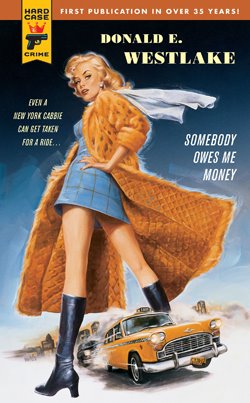 I think of all Hard Case’s covers, the one for Donald E. Westlake’s Somebody Owes Me Money (1969) may be my favorite. I’ve always been a sucker for ... New York cabs.
Chet Conway drives one for a living. He’s a little steamed when a fare gives him the name of a sure thing at the track in lieu of a tip. Until the horse comes in, and Chet ends up nearly a thousand bucks to the good. When he stops by to claim his winnings, he finds his bookie dead and several rival gangs thinking he’s responsible.
At times this book reads like a comic riff on The Hunter, the novel Westlake wrote as Richard Stark that was filmed as Point Blank and Payback. Chet, like Parker, wants what he’s owed, no more and no less. And he’s willing to piss off plenty of people bigger and meaner than he is to get his due.
It’s typical Westlake, fleet and funny with a crackerjack ending. If you can’t get laughs out of Chet responding to an adversary with, “The feeling is mutual ... In fact, the feeling is paramutual,” or an argument about whether one can be winged in the head or only in the arm ... well, I can’t help you.
You couldn’t ask for a bigger change of pace than The Murderer Vine, a 1970 novel by Shepard Rifkin based on the deaths of three civil rights workers later fictionalized in Mississippi Burning. New York P.I. Joe Dunne, who has on occasion demonstrated a willingness to step outside the law if the price is right, is approached by the father of a college student gone missing during a voter registration drive in the Deep South. The man knows his son is dead. He’ll pay Dunne to find the body. And even more to execute the perpetrators.
Rifkin shows Dunne meticulously building a cover story for himself, then exposes how fragile that façade is in the hothouse atmosphere of the times. He muddies the waters by having Dunne enjoy the company of the very men he’s stalking. And he delivers an object lesson in the skillful use of dialect. He’s so determined to avoid romanticizing the genre that he becomes self-conscious about it in the late going, blunting the impact of the ending. But I’m still thinking about it days later. Vine is one of the strongest novels Hard Case has reissued.
Sports Rant: Black and Blue and Orange
It’s never easy being a fan of the New York Mets. But it’s been particularly difficult lately. First there was last September’s epic collapse, presided over by manager Willie Randolph. Then this season’s mediocre run, compounded by constant rumors of Willie’s imminent dismissal and mixed signals from the front office.
All of that paled in comparison to last night’s shenanigans. Following a win in Anaheim, Willie and two coaches were fired at 3:15 AM EST. The Mets management apparently believes that fans, lulled by the pastoral rhythms of the game, are unfamiliar with the internet.
Say what you will about Willie – and I’ve said a lot – he didn’t deserve the treatment he received this season. He certainly didn’t warrant being dismissed under cover of darkness in what Fox’s Ken Rosenthal calls “one of the most shameful episodes in sports history.”
I could rant on and on. Instead, I’ll just point you toward this piece. Or this one. Or this one. Or you can pick your favorite search engine, type in “Mets” and your pejorative of choice, and read what turns up.
All this plus the Mariners have the worst record in the majors, and I’m sucking wind in my first foray into fantasy baseball. It’s a grand old game.
Sunday, June 15, 2008
Comics: Two, Please
This week’s installment is below or here.
Movie: The Incredible Hulk (2008)
Two hours of solid, entertaining superhero action. Rosemarie, who knows about this kind of thing, assigns bonus points for Tim Blake Nelson’s performance as the most believable movie scientist in a long time. Louis Leterrier has directed four films including The Transporter and its sequel, plus the woefully underrated Unleashed with Jet Li and Bob Hoskins. I like ‘em all.
Music: James Hunter, The Hard Way
Perhaps, like Carl Carlson, you have asked, “How ‘bout some new oldies?” If so, ask no more. The latest album from James Hunter is out, and it’s like a wormhole has opened to the early 1960s, pumping out original music with that vintage sound. Part soul, part R&B, all tasty. Give it a listen.
Friday, June 13, 2008
Friday’s Forgotten Books: Violence, Nudity, Adult Content, by Vince Passaro (2002)
I trust you’re all reading Friday’s Forgotten Books, the web series initiated by Patti Abbott. I was flattered when Patti invited me to contribute. Of course, that meant I had to pick a book. Luckily, I had my selection at the ready.
I’m loathe to call Vince Passaro’s Violence, Nudity, Adult Content forgotten. It’s not that old, for starters, so I’d prefer to think of it as a late breaker, the whip end of the long tail. I’ve got an idea of why it perhaps didn’t make the mark it should have, in spite of:
A.) Having a truly awesome title; and
B.) Delivering on the promise of said title.
The biggest problem faced by Passaro’s first and to date only novel is that the book does so many things well that it’s difficult to know how to classify it. Let’s review.
V/N/AC is a legal thriller. Will Riordan is an attorney at a Manhattan law firm, earmarked for partner. His up-and-comer status lands him two difficult clients: a wealthy man accused of murdering the wife in the midst of divorcing him, and a rape victim traumatized to the point of constructing elaborate and plausible revenge fantasies. Both cases develop in unexpected, startling ways. Not perfectly; if the book has a weakness it’s the emails that the latter client begins sending to Will, a device that smacks of an MFA workshop. But even those messages come to exert their own fascination.
V/N/AC is a novel of work. The endless quest for billable hours. The toll those hours take. Humiliations large and small. Compromises both noticed and unremarked upon. All of them ruthlessly anatomized.
V/N/AC is a story of New York. Maybe the best I’ve read in the last ten years. Passaro perfectly captures the endless sense of effort, the twinned feelings of exhaustion and exhilaration, that living in the city brings. Will’s chance encounters on the subway have a fierce, unalloyed beauty to them.
V/N/AC is a portrait of a failing marriage. Will and his wife Ellie are in love with each other, but not with their lives. Passaro pulls no punches in depicting their mutual hostility, or their awkward struggle toward reconciliation.
What’s more, he delivers all of the above with emotional honesty, sharp detail, and a dizzying flair for language. Had Tom Wolfe or Richard Price written this novel, it would have been one of the most acclaimed of its year. Instead, it’s simply a book I haven’t forgotten.
Wednesday, June 11, 2008
Movie: Hysteria (1965)
One of my screenwriting heroes is Jimmy Sangster. Before coming Stateside and cranking out scripts for the staples of ‘70s crime drama, he penned many of the movies that put Hammer Studios on the map. He has a clutch of credits from those days that, in the words of Ed Gorman, “put him in the driver’s seat of the white shimmering Shell Scott Caddy convertible waiting for him in Pulp Heaven.”
Hysteria finds Sangster and frequent collaborator behind the camera Freddie Francis in thriller mode. An American amnesiac in London begins his post-car wreck recovery armed only with a photograph of a fashion model and the aid of a mysterious benefactor. Before long he’s suffering hallucinations and suspecting himself of murder.
Character actor Robert Webber, charter member of the “That Guy!” club, excelled at playing men who were a bit too slick but had the decency to feel bad about it. Here, he makes the most of a rare shot at a lead role.
Movies with an is-he-or-isn’t-he-nuts? premise tend to disappoint in the second half. Sending the character round the bend is fun, but eventually you have to start explaining things. Sangster can’t avoid that pitfall completely, but he does soften the blow with a dandy plot turn that riffs on the Webber persona. I’d love to know the origins of this movie; it seems like one of those projects that came about because the producers had access to an interesting location, in this case a half-completed block of luxury flats complete with creepy abandoned parking lot.
Hysteria is no lost classic, merely a clever diversion assembled by professionals. I would have watched it in any case because it begins with a shot of a spinning hypno-spiral. I’ve never been able to turn off a movie that starts with a hypno-spiral. Not once. In fact, I – hey, wait a minute ...
Sunday, June 08, 2008
Movies: Bargain Basement Report
Kinky thrills on a budget, that’s where my head’s been lately. Herewith, a rundown.
Shock (1946). A woman witnesses a murder, lapses into the title condition – and comes to in a sanitarium under the killer’s care! Modestly entertaining hokum; Vincent Price, as always, is fun to watch as the tortured doc, and Lynn Bari bewitches as his nurse, lover and accomplice. Fox released it as part of its film noir series, but that’s only because they tabled plans for a Gothic Potboiler Collection. The disc is worth checking out for one of the most entertaining and energetic commentary tracks I’ve ever heard, by former Bay Area horror host John Stanley.
Screaming Mimi (1958). Based on a novel by the great Fredric Brown. Dancer Anita Ekberg – yowza – is almost killed by an escaped maniac. While recovering at a asylum, she falls under the spell of a warped psychiatrist. (Hey, another one!) There are slasher murders, a dog, and some weird statues. With Gypsy Rose Lee as the proprietor of that noted nightclub El Madhouse.
Mimi’s not a good movie, but it’s a strangely compelling one. With its dream logic, troubled blonde, and constant under-the-surface carnality, I’d wager that David Lynch has seen it. In fact, if he’d like to remake it with Scarlett Johansson, I’ll queue up right now.
Anita has a bondage-themed dance number that we get to see in its entirety not once but twice in eighty minutes.
Me: Where’d her wrist cuffs go?
Rosemarie: She threw them off. It was like a hockey move. You didn’t see that?
Me: I must have been looking at something else.
Rosemarie: I’ll bet you were.
Wicked, Wicked (1973). A thousand thanks to Turner Classic Movies for finally giving me the opportunity to see the only movie shot in Duo-Vision™! Or, feature-length split-screen. It’s like watching two movies at once. Making Wicked, Wicked the first film to have no deleted scenes. Every inch of footage was used; I’m pretty sure I saw some Super 8 stuff from a kid’s birthday party in there.
The action unfolds at San Diego’s Hotel del Coronado, setting of Some Like It Hot and inspiration for Stephen King’s 1408. The junior handyman, a friendly sort studying embalming by mail, briefly suspends his killing spree when he becomes obsessed with the world’s worst lounge singer. Edd Byrnes plays the surly lifeguard in a performance that inspired the novelty song “Kookie, Kookie, Put On Your Shirt.” The lead character has a name which I forgot once Rosemarie called him Consort For Men. It’s all scored by my Aunt Minna playing the music from the 1925 version of Phantom of the Opera on a pipe organ. Think I’m joking? Watch the trailer.
Writer/director Richard Bare made the Joe McDoakes comic shorts of the 1940s – see some of them here – and he has no idea what tone to go for. Wicked, Wicked veers from tongue-in-cheek to dead serious and back, then goes for a Grand Guignol ending. The killer is saddled with a grim backstory that prefigures that of Francis Dolarhyde in Thomas Harris’s Red Dragon.
To his credit, Bare milks the split-screen gimmick for all it’s worth. Sometimes it offers two angles on the same scene, with characters walking out of one movie into another. Sometimes it shows parallel action. A character will allude to an event and we’ll see a flashback on the other side of the screen, or they’ll lie and we’ll witness the truth. It all adds up to a load of nonsense, but it earns Wicked, Wicked an honorific I rarely bestow: the movie so bad you can’t stop watching.
Saturday, June 07, 2008
Comics: Two, Please
The further adventures of your favorite married film geeks continue below. Or here, if that doesn’t work for you.
Friday, June 06, 2008
On The Web: Ellison Unbound
The AV Club serves up the first half of an interview with Harlan Ellison, coinciding with the release of the documentary Dreams With Sharp Teeth. (UPDATE: Part two is now available.)
For better or for worse, Harlan was a big influence on me when I was growing up. I remember catching him on TV and thinking, “Wait a minute – adults can act like that?” He was cantankerous, but funny about it. I started reading him, primarily his essays, when I was in high school, and promptly became unbearable.
As an adult, I don’t match Ellison’s vitriol. Partly because I don’t have the stamina, and partly because when the Catholics get their hooks in you early, your anger is sublimated into incipient alcoholism and bizarre sexual fetishes. And the truth is Ellison’s antics and his tone often seem childish and self-aggrandizing to me now.
And yet ... I, too, “get very annoyed at the potential that is in everybody, and how little people will settle for.” I’ve got a head full of quotes thanks to Ellison; the Pasteur one he cites is a personal mantra. Here’s another favorite Ellison taught me, from the poet Günter Eich: “Be uncomfortable; be sand, not oil, in the machinery of the world.”
Ultimately, Harlan is on the side of the angels. I’ll always remember one of his appearances on Bill Maher’s Politically Incorrect. Ellison, talking about Nixon’s funeral, used the word catafalque. Maher gave him a hard time about it and Ellison gave it right back, essentially saying, “I know what it means and I’m the asshole?” In a world where college students think it’s elitist to expect people to know information they can look up on the web, we could all stand to let our inner Ellisons out.
Miscellaneous: Filmmaking Links
Screenwriter Larry Gross is publishing his diaries from the production of 48HRS. at Movie City News. They’re already up to part three. Start reading here.
Karaoke with Tori Spelling, crying when the monorail doesn’t come through. All part of making an independent movie in Seattle.
Thursday, June 05, 2008
Book: Child 44, by Tom Rob Smith (2008)
The drums started beating early for Child 44, the debut novel by Tom Rob Smith. Big hardcover sale, film rights snapped up by A-list talent. It’s already represented on the awards circuit.
I would have read it without the hype. I’m a sucker for crime novels set in Soviet and post-Soviet Russia, a genre in which, thanks to Martin Cruz Smith’s Arkady Renko books, the bar is set fairly high.
Set in 1953, Child 44 is inspired by the infamous Andrei Chikatilo case. Leo Demidov is a State Security officer who abruptly finds himself disgraced. He’s exiled to a militia post in the hinterlands, where he encounters a murder that bears startling similarities to one he essentially ignored in Moscow. Leo begins to suspect that a monster the likes of which has never been seen in Mother Russia is on the loose, abetted by the country’s culture of paranoia.
The book’s first third, setting up Leo’s downfall, is too deliberately paced, and Smith’s workmanlike prose – particularly in the murder scenes – doesn’t help matters. PERSONAL GRIPE: I’ve accepted dialogue being set off with dashes as opposed to quotation marks. Smith goes too far by italicizing it as well.
But Child 44 improves as it goes along. Smith doesn’t overdo the sense of oppression that comes from living in a totalitarian state, allowing the steady accrual of soul-crushing detail to do the work. Leo’s shaky marriage to wife Raisa slowly moves to the fore, becoming a rich, full-bodied relationship. And Smith uncorks a dazzling plot twist two-thirds of the way through that made me appreciate the groundwork laid in the early pages. The ending brazenly sets up not just a sequel, but an entire series. Odds are I’ll read what comes next.
Smith acknowledges Robert Cullen’s The Killer Department, a non-fiction account of the hunt for Chikatilo. In 1995 Cullen’s book was adapted by writer/director Chris Gerolmo into the HBO film Citizen X. It’s a terrific, suspenseful piece of work with a marvelous cast: character actor Jeffrey DeMunn as Chikatilo, Emmy winner Donald Sutherland as the wily bureaucrat keeping the investigation active, and Stephen Rea as the dogged and dog-tired detective forced to invent his technique as he goes. With this movie and V for Vendetta, Rea cornered the market in tools of the state with minds of their own.
The Rap Sheet’s Ali Karim interviews Tom Rob Smith here.
Tuesday, June 03, 2008
Movie: Blood on Satan’s Claw (1971)
Everyone knows what travels fastest across a schoolyard: cooties. Unless it’s a Catholic schoolyard, when it’s freaky rumors about Beelzebub.
“You can totally see the Devil’s hand!”
“Nuh-uh!”
“Yeah-huh! And it’s actually a claw, like in the title!”
My Queens schoolyard was alive with such talk years ago after Blood on Satan’s Claw turned up on a late night horror show. One of the older kids saw it, and his description of its grotesqueries was so vivid that the next time it surfaced, I concocted a reason to be up to watch. Here’s all I remember:
1. The devil’s hand. You really can see it. And it is a claw.
2. Patches of dark hair spontaneous growing on the backs and legs of young women marked by Lucifer.
When Blood turned up on Turner Classic Movies a few weeks ago, I made sure to record it. Time to see if it matched those childhood memories.
It didn’t. It was actually much scarier.
The simple story goes a long way toward the movie’s effectiveness. An English farmer plowing a field unearths a demon’s skeleton. Some children steal the bones. Soon they form a cult, sacrificing the classmates who are growing the devil’s skin (the film’s alternate title) on their bodies.
My first thought on watching it this time: this movie would never be made today. Children not only in harm’s way but serving as the agents of destruction. As it happens, demonically possessed kids don’t act that differently from normal ones.
My second thought: I missed the sexual subtext completely back in the day. Clumps of dark hair erupting on the milky white flesh of pubescent girls? Right over my head. (Please bear in mind, as mentioned above, that I was in Catholic school at the time.)
Co-writer/director Piers Haggard would later helm the BBC Pennies from Heaven. (BONUS: He’s also the grandson of famed adventure writer H. Rider Haggard.) From the opening frames he quickly establishes that this story takes place in a far different era, when life was brief, cruel, and expected to end badly. The one authority figure who is on the side of right still comes across as imperious, less concerned about the lives of the peasants than how the presence of a demon would affect his travel plans.
TCM aired the film unedited – including a few shots I know I didn’t see when I was a child – at 2AM Eastern, because it still packs that much of a punch. If a few kids were up late enough to watch, I have no doubt their reports drifted into every corner of schoolyards the following Monday like a chill wind, drawing the unsuspecting near. Which is how it ought to be.
Miscellaneous: Link
Director Whit Stillman names five must-read film books.
Sunday, June 01, 2008
Comics: The King (And Queen) Of All Media
So I’m reading Wired magazine – yours truly has always been a forward-thinking guy – and there’s a shoutout to Bitstrips, a site that allows anyone to create very basic online comics. And I mean anyone, because even I figured it out. Later, I show Rosemarie my handiwork.
Me: So what do you think of the cartoon versions of ourselves?
Rosemarie: I have to admit, they do kind of look like us. What do we do with them?
Me: We could make a comic strip starring a pair of married film geeks.
Rosemarie: (long beat) I’m on it.
And so, without further ado, the premiere installment of Two, Please. Written by both of us, titled and designed by the missus.
Like it? Here’s another one.
In case the reader doesn’t work, here are links to strip one and strip two.
The idea is to do at least one a week. Although we said that about the Shamefaced podcasts, and we all remember how that turned out. But hey, we’re busy people.
Thursday, May 29, 2008
Music: The Kenny Barron Trio
Yeah, I should have just thrown up an Army of Lovers placeholder post. Busy, busy, busy. Multiple projects, staggered deadlines, etc.
I did have a night off yesterday, and marked the occasion in style by seeing the Kenny Barron Trio at Jazz Alley. Featuring Kenny Barron on piano, Kiyoshi Kitagawa on bass, and Francisco Mela on drums. The trio has a lively onstage dynamic. Mela is wildly expressive, his joy in performing unbounded; Rosemarie and I both called him the Jose Reyes of percussion. Kitagawa is the steely virtuoso, while Barron simultaneously hangs loose and rides herd. The result was a fantastic, supple set. I knew I was in for a good time when Barron introduced the opening number, the standard “Beautiful Love,” by saying that Benny Golson had told him the song was featured in The Mummy with Boris Karloff.
Miscellaneous: Links
15 years later, Maxim talks to the principals of True Romance.
I own very few TV series on DVD. Two of them are The Larry Sanders Show and Arrested Development. What do they have in common? Jeffrey Tambor.
Monday, May 26, 2008
Miscellaneous: Game Break
I’m spending this Memorial Day weekend with my nose to the grindstone, so you people will have to amuse yourselves. Why not play 6 Differences, the mesmerizing Flash game by Ivory? Even the music’s good.
Thursday, May 22, 2008
Movie: The Sniper (1952)
I knew The Sniper was a rarity not available on video, which is why I recorded a TCM airing a while back. I only got around to it earlier this week. And there it still sits on my DVR, to serve as a reminder of the many months I let slip by without watching it. It’s that good.
Based on a story by Edward and Edna Anhalt (who won an Oscar two years earlier for another dark gem, Panic In The Streets) and scripted by Harry Brown, The Sniper is a chilly case study of a sex offender and serial killer. Or, as the opening titles put it, an account “of a man whose enemy was womankind.”
The movie was ahead of its time in any number of ways. The remarkably clinical point of view, for instance; Eddie Miller, the title character played by Arthur Franz, is presented as neither a monster nor an object of pity, and even though Freud was in vogue at the time there’s no effort to psychoanalyze him. Miller’s bitter line “My mother never taught me anything” is the closest we get to a motivation.
Or the treatment of violence. Miller’s long-distance executions of women have lost none of their impact; I can only imagine how these scenes played in ’52. I won’t soon forget Miller’s second victim, a middle-aged drunk who made the mistake of trying to engage Miller only to call him on his lies, staggering up to her lonely room and tucking a doll into bed before meeting her fate in front of a window. A sequence involving Miller and a hectoring woman who works in an amusement park dunk tank gets under the skin and stays there.
Stanley Kramer produced The Sniper and even the social consciousness material he’s known for shoehorning into his movies plays here thanks to Richard Kiley, who sells the hell out of it in his role as a police psychiatrist.
Director Edward Dmytryk, behind the camera again after his Hollywood 10 jail term, subverts audience expectations in the tense climax and makes excellent use of the against-type Adolphe Menjou as Lieutenant Frank Kafka (?!?), the weary detective on the killer’s trail.
Best of all is the location work in San Francisco. There’s a direct line from The Sniper to Dirty Harry to David Fincher’s Zodiac. A hellish trifecta if ever there was one.
Tuesday, May 20, 2008
Book: The Finder, by Colin Harrison (2008)
Writing about New York City means writing about money. Few write about money or New York City better than Colin Harrison.
Two young Mexican girls, living anonymous lives far from home, are murdered in grisly fashion on a Brooklyn beach. Another immigrant, this one from China, barely flees the scene with her life. The mayhem is fallout from a series of financial crimes that touches lives from hedge fund barons to garbage men. Harrison depicts all of these characters and their disparate versions of the city with equal skill.
He does fall prey to one of my pet peeves. He has the habit of dropping entire chunks of undigested research into the text. Great unruly paragraphs about stock manipulation or the geographic history of Long Island. When he shoehorns the information into dialogue, he compounds the error by having someone else comment on it, saying, “I don’t need to hear all this.” And even that doesn’t clip Chatty Cathy’s string.
But it’s a minor quibble compared to the rest of Harrison’s writing. He introduces a major character – maybe even the title character, if you want to interpret it that way – obliquely, through the eyes of a secondary figure. She’s a single woman pushing 40, knowing she’s fated to be alone, pouring her affection into her house but hoping to collect a few more memories for her golden years. She essentially disappears after she’s served her purpose, but in those pages Harrison sketches an entire life. He knows New York high and low, and puts its beating heart on the page.
TV: Still More Sinatra
Turner Classic Movies host Robert Osborne said that Frank’s 1967 TV special with Ella Fitzgerald and Antonio Carlos Jobim, which TCM aired on Sunday night, was as good as showbiz got. Who am I to disagree? I paid the show the ultimate Chez K compliment by leaving it on the DVR.
The special’s high point was also a low point. Frank and Ella sit next to a piano and trade off on contemporary songs. Proving that synergy was around even in the ‘60s, Ella takes a crack at the theme from Frank’s then-current movie Tony Rome. The song is lousy to begin with, and having Ella Fitzgerald – Ella Fitzgerald!! – sing it represents a complete waste of talent. But I just watched Tony Rome, so I thought it was great. The segment has a sublime ending, with Frank and Ella dueting on “Goin’ Out Of My Head.” Absolutely electric.
TCM closes out the month with Frank’s 1973 special Ol’ Blue Eyes is Back on Sunday at 8PM Eastern and Pacific.
Saturday, May 17, 2008
Sort-Of Related: Iron Man (2008)/The Ten-Cent Plague, by David Hajdu (2008)
Finally caught up with Iron Man, and it’s as entertaining as advertised. Plus Seattle’s in the midst of a bout of unseasonably warm weather, which worked out perfectly. When I see a summer movie, I want it to feel like summer, dammit.
It was odd watching Tony Stark take it to the bad guys after reading David Hajdu’s The Ten-Cent Plague: The Great Comic Book Scare and How It Changed America. The book is a canny social history of the censorship frenzy surrounding comics in the 1950s. At the time superheroes weren’t the dominant genre that they are now; in fact, Hajdu argues, that transition came about as a result of the controversy chronicled here. But the costumed heroes who were around faced their share of scorn. Critics claimed these “false cartoon gods” promoted paganism and fascism.
Fifty years later, I lined up to see the ultimate Nietzschean power fantasy and before it started sat through trailers for The Dark Knight, The Incredible Hulk and Hancock. Suck it, moralists: the pagan fascists always win!
Hajdu’s book focuses mainly on EC Comics publisher William Gaines, whose gruesome horror books were at the center of the storm. Gaines’s critics condemned the story “Foul Play,” illustrated by ‘Jolly’ Jack Davis. It made enough of an impression on a young Stephen King that he recounted it in detail in his book Danse Macabre, and his description made an impression on a young me. A venal minor league baseball pitcher (King calls him “the apotheosis of the EC villain ... a totally black character, with absolutely no redeeming qualities”) kills an opposing player on the diamond and gets away with it. The dead man’s teammates ultimately play a game of their own with the pitcher – using his heart for home plate, his intestines as basepaths, and his severed head for the ball.
I’ve never seen a panel of that story ... but brother, can I picture it. (Actually, the closing art is here.)
Gaines was eventually driven from the comics business, but he’d have the literal last laugh. He started MAD magazine, which would lampoon the very people who hounded him. A key figure in MAD’s history and Hajdu’s book is artist Will Elder, who passed away earlier this week. Mark Evanier remembers him.
Thursday, May 15, 2008
Miscellaneous: More Sinatra
GreenCine Daily has a round-up of posts related to the tenth anniversary of Frank Sinatra’s death. Which sets up this reminder: don’t forget that this Sunday as part of their Sinatra tribute, TCM will be showing Frank’s 1967 TV special with Ella Fitzgerald and Antonio Carlos Jobim.
This past Sunday I watched 1966’s Frank Sinatra: A Man and His Music, Part II, along with one of the few Sinatra films TCM isn’t airing this month, the 1967 private eye drama Tony Rome. It’s the first of two movies about the character, based on novels by Gold Medal author Marvin H. Albert. In this Mystery*File piece on Albert, Bill Crider says the movies have “a ‘60s smirkiness.” As usual, Bill’s right on the money; Tony Rome not only opens but closes with the camera zooming in on a woman’s shapely backside, accompanied by a BOING! music sting. Frank also spends an inordinate amount of time sporting an oversized sailor’s cap. The cover of the VHS tape doesn’t do it justice; I honestly thought Frank had part of the Sydney Opera House perched on his head.
On the plus side, the movie has a decent plot, some good lines, and a game cast including Richard Conte and the always fetching Jill St. John. I liked it enough to warrant checking out the sequel, Lady in Cement, at some point.
Miscellaneous: Links
David Mamet writes up his own interview with the New Yorker.
The AV Club revisits the most recent films of the biggest screenwriters of the 1980s. My Year of Flops considers one of the oddest movies I’ve seen more than once, Joe Eszterhas’s An Alan Smithee Film: Burn Hollywood Burn. And The New Cult Canon takes on one of the movies I can quote by heart, Shane Black’s Kiss Kiss Bang Bang. Best line:
Watching KISS KISS BANG BANG prompts wishes that Hollywood still had screenwriters talented enough to use explosion-filled trash as a means for personal expression.
Amen, brother.
Sunday, May 11, 2008
Miscellaneous: Surfacing
Coming up for air to weigh in on a few things ...
Spiderweb/Shooting Star, by Robert Bloch (1954/1958). Hard Case Crime revives the double! Two Bloch novels in one, both set in a Hollywood where the tinsel is not so bright. Shooting Star, about a one-eyed literary agent turned gumshoe investigating a cowboy star’s suspicious death, is creaky but fun. Spiderweb is an unmitigated blast. A showbiz wannabe is groomed into a phony psychic so he can work his way to the top of the movie colony. And you know how I feel about phony psychics.
Redbelt. David Mamet has described his latest as both a fight movie and a modern Samurai tale. It’s really about the code of the warrior. Mamet strikes an idiosyncratic tone here, blending a knotty, intellectual plot with Rocky-style uplift. A good chunk of the audience I saw the movie with didn’t get it, which I understand. I, however, was on its wavelength from frame one. I heartily endorse its philosophy, it’s got some great Mamet dialogue (“Everything in life, the money’s in the rematch”) and my favorite scene of the year so far, where Chiwetel don’t-call-him-Chewie Ejiofor trains Emily Mortimer.
Iron Man. Haven’t seen it yet. Yeah, I can’t believe it, either. But I could only squeeze in one movie in the last week, and Redbelt had better start times. Soon, though. In the meantime, Jeff Bridges was kind enough to post his photographs from the shoot on his dandy website.
World Cocktail Week. It runs through Tuesday. Get out there and do your part. I had the boys at the Zig Zag Café fix me a “lost” classic cocktail featured on their website, a Firpo’s Balloon. Ask for it by name and give your bartender fits.
Wednesday, May 07, 2008
Miscellaneous: Links
Some sabbatical taker, I. My problem is that when I find the good stuff, I have to share.
Like this article on a guy who has convinced the city of Seattle that he’s Gary Busey.
Or Isabella Rossellini’s series of short films on the sex lives of insects. Maybe I’m susceptible to the accent, but these are hot. Also, about the snails? I had no idea.
Tuesday, May 06, 2008
TV: Frank’s, For The Memories
I’m on deadline, meaning I’ll be taking a sabbatical for the next few days. Lucky for you it’s Sinatra month on Turner Classic Movies, so you have this widget to tide you over ‘til I return.
UPDATE: Initially I embedded the widget, but it starts automatically and I hate that. So you can find it here.
The High Society number with Bing Crosby is a favorite. TCM is also airing some of Frank’s TV specials on Sunday evenings at 8PM Eastern and Pacific. I’m waiting for his 1967 show with Ella Fitzgerald and Antonio Carlos Jobim, which airs May 18.
Sunday, May 04, 2008
Link: California Crime
My friend the czar of noir Eddie Muller has a terrific article in today’s San Francisco Chronicle on why the city by the bay looms so large in crime fiction. He interviewed 30 writers who live in the area, and the resulting piece explains the importance of community as well as touching on the struggles of the mid-list author. Go read it.
Thursday, May 01, 2008
Miscellaneous: I Got Plenty of Nothing
Interesting times here at Chez K. Lots of irons in the fire, developments on multiple fronts. I may even be able to talk them up soon.
What this means in the short term is work. Here’s how much: on Tuesday night, I had to pass up a free early screening of Iron Man. That was free. And early.
So I haven’t had time to post. Or even to read/see things to post about.
But I want to give you something for stopping by. So here’s a tip: head on over to the new Crime/Noir issue of Storyglossia, edited by wild man Anthony Neil Smith and featuring short fiction from the likes of Kevin Wignall, Vicki Hendricks, Megan Abbott and your friend and mine Ray Banks.
What, that’s not enough? Fine. I give and I give to you people and this is the thanks I get. Here’s more Mitchell and Webb.
Sunday, April 27, 2008
TV: Today’s Mitchell And Webb Moment
If you’re not watching this show, you’re missing out. I have been known to talk about the Mets this way, and will start doing the same with movies.
Miscellaneous: Links, All-Brawl Edition
As a David Mamet fan, I can’t wait to see Redbelt. In an article he wrote for the New York Times, Mamet calls it a “fight film” and discusses a few cinematic battles and battlers that left memorable impressions.
Then, in the Daily News, Mamet calls Redbelt his tribute to classic film noir and mentions a few favorites.
Interestingly, both pieces cite the original Night and the City. Which also earns a place on this list of the 20 greatest movie fight scenes. Hat tip to Bill Crider and, by extension, Walter Satterthwait.
Friday, April 25, 2008
Book: Matala, by Craig Holden (2007)
Craig Holden’s Four Corners of Night is a big, bruising heartbreaker of a novel. His latest, Matala, is short enough to be read in a single sitting and sharp enough to wound. It’s dark, sexy, twisted. Kinky in every sense, which I intend as a high compliment.
Darcy is a spoiled American girl fresh out of high school, sent on a European tour by her wealthy parents. Naturally, she gets bored at once. In Rome she falls in with Will, another American who’s grifting his way across the continent. Will, in turn, is in thrall to the older Justine, a veteran con artist who looks at Darcy and sees nothing but opportunity. The three of them agree to smuggle a package to Greece, and before the trip is over all manner of masks will slip.
Here’s the best way I can plug Matala. A meme currently making the rounds ask you to open the closest book. Turn to page 123. Find the fifth sentence. Post the next three sentences. (Yeah, I don’t get it, either.) No one has tagged me – what, you think you’re better than me? – but Matala was the closest book when I first came across it. I give you the result:
They had each other to keep them amused and happy and satiated. And she certainly felt all three of those things. Will had proved to a robust and durable lover, and Darcy did not feel disappointed in him except at the furthest edges of her desires.
Tell me you don’t want to read more.
Miscellaneous: Links
The AV Club’s exhaustive primer on my musical hero, Elvis Costello. King of America is a personal favorite.
Roger Ebert on Joe Vs. The Volcano. Via Bill Crider, a charter member of the JvTV fan club along with yours truly.
Tuesday, April 22, 2008
Book: Sleeping Dogs, by Ed Gorman (2008)
With the last major primary out of the way and the Democratic party’s electoral future clear – sweet Jesus, this campaign is gonna go on forever – this seems like an ideal time to recommend Sleeping Dogs, the latest from friend-of-the-site Ed Gorman. Ed, an immensely talented writer who’s done some time in politics, knows the territory and covers it well.
Political operative Dev Conrad steps into an Illinois Senate race in the closing stages. The incumbent, a good-enough pol with only a minor history of bimbo eruptions, finds himself in a pitched battle with a downstate “nut job ... (who’d) gone to sanity school recently.” Dev has to deal with campaign sabotage and the suicide of the man he’s replacing, not to mention his own doubts about the candidate he’s working to reelect. The action, as always with Ed, goes down smooth, and is punctuated by his bittersweet observations about life and culture.
Don’t just take my word for it. Bill Crider, Lee Goldberg and James Reasoner like the book, too. I might steer you wrong, but those guys? Never.
Movies: More Blast of Silence
Found: a few panels from Sean Phillips’s graphic novel adaptation of the movie that has altered the way I communicate. Thanks to GreenCine Daily.
Sunday, April 20, 2008
DVD: Blast of Silence (1961)
Remembering ...
You’d heard of this movie before, in whispered tones. Church voices. Blast of Silence. A gritty, low-down noir shot guerilla-style on the streets of New York. Back in the early days of scrounging together bucks to make films on the cheap. You’d never seen it. Figured you never would. But you catch a break when lips slip that it’s getting the Criterion treatment. Five star all the way.
You jump on it as soon as you have the chance. Grass don’t grow under your feet.
You watch it, this movie written and directed by Allen Baron. He even stars in it, playing Frankie Bono, a Cleveland hit man who trains in to New York over Christmas to take care of a guy. But Frankie runs into some people from his past, a girl. He starts thinking about his life. You don’t want to do that. Not with that life.
You know the movie’s not perfect. The plot gets a little convenient, and if he can’t see the ending coming you figure Baby Boy Frankie Bono may not be the sharpest cannon in the shed.
But you’re not watching this one for the story. No. You’re watching it for the mood. The feeling. The energy that Baron finds on the streets of your hometown and channels into every frame. In Harlem. In Greenwich Village, beatniks pounding their drums and their libidos ‘til everything’s raw.
Remembering ...
You read Lawrence Block’s A Diet of Treacle not too long ago, from the same time and set on those same streets. The movie takes you right there. In style, in attitude, you’re watching one of those old Gold Medal paperbacks come to life. Or as close as you’re gonna get.
Most of all, you’re grooving on that voiceover. Written by blacklisted writer Waldo Salt under a phony name. Delivered by blacklisted actor Lionel Stander under no name at all. Putting you in Frankie Bono’s head. Making you feel Frankie’s palms sweat. Or not sweat. You know the meteorology of Frankie’s hands is important. You can’t get enough of that voiceover, think that Dave Kehr had it dead to rights when he called it “second person accusative.” You start doing that voiceover all the time. You can’t stop. You understand why friends of yours lapse into it on the streets of Philadelphia after a showing at NoirCon. You wish you were there to do it, too.
You even dig the extra features on the DVD. Baron’s still around, still kicking, still feisty. You like the guy, Martin Scorsese crossed with George C. Scott from The Hustler. He had a nice career for himself in TV. He takes you back to the locations, thirty, then almost fifty years later. Shows you the ways the neighborhoods change. And the ways they don’t.
You don’t see the best extra, though. A short graphic novel adaptation of the movie by Sean Phillips, one of the genius bad-asses behind Criminal with Ed Brubaker. That’s because you punked out, rented the DVD when you knew you should have bought it. You’ll pony up now, though. You want to come back to it.
Remembering ...
You watched Murder by Contract a few months back, another hit man movie. Picked by another genius bad-ass, James Ellroy. Vince Edwards wandering L.A., starting to feel bad about killing. You remember Ellroy talking up Contract as the first movie to give you the assassin as existential hero. Yeah, maybe. But you think Silence is the first one to get it right.
Friday, April 18, 2008
Meaningless Milestones: Four Candles
Today marks the fourth anniversary of this blog. Three cheers and a tiger for me!
I had planned on writing an epic post detailing all that I’ve learned in four years of blogging, building it around a few simple rules. One of the first rules to occur to me was, “Never, under any circumstances, blog about blogging.” Thus rendering the post moot before I’d even written it. Plus, I am swamped. Things have been nuts around here, and only stand to get nuttier.
So instead, I’ll repeat the news. Today marks the fourth anniversary of this blog. Three cheers and a tiger for me!
Tuesday, April 15, 2008
Sort Of Related: Hollywood Station, by Joseph Wambaugh (2006)/Confessions of a Superhero (2007)
LAPD veteran Wambaugh is perhaps the master of cop fiction. He turns his attention back to his old department for the first time in 20 years – at fellow author James Ellroy’s urging – and it’s obvious the man hasn’t missed a beat.
Station has a plot of sorts, involving a pair of tweakers and some Eastern European thieves whose fates are destined to collide. But the bulk of the novel is devoted to the day-to-day of the police officers who work the still-mean streets of Hollywood. And quite the motley bunch they are: surfers and wannabe actors, single moms and wily veterans. Wambaugh makes no bones about his dislike for the federal consent decree that the LAPD has been operating under in the wake of the Ramparts scandal, but aside from a single chapter it never overwhelms the narrative. It’s rich, compassionate, funny and heartbreaking stuff. A TV series based on the book is in the works, but there’s no sense in waiting for that. I’ll be jumping on the just-published sequel Hollywood Crows ASAP.
Wambaugh’s cops aren’t superheroes. As it turns out, his superheroes aren’t superheroes either. Some of the novel’s action takes place around the intersection of Hollywood and Highland, where people in costume pose for photographs with tourists outside Grauman’s Chinese Theater. Wambaugh spells out exactly how low-rent this spectacle is. According to him, many of the “performers” are meth addicts, and the police ID three similarly clad figures as Fat Elvis, Thin Elvis, and Smelvis.
Matthew Ogens’s offbeat documentary Confessions of a Superhero profiles four people who don capes to stay afloat in Tinseltown. The movie’s Superman, who identifies with his alter ego to an alarming degree, is a recovering addict who’s also the son of Academy Award winner Sandy Dennis – unless he’s not. Wonder Woman’s tale is all too common: the belle of her high school, she heads west to learn that she’s too “voluptuous” to book TV commercials. And wait ‘til you see what happens to Batman. Sometimes “only in L.A.” is the appropriate response.
Saturday, April 12, 2008
Movies: Show Biz Sundays
If there’s one thing we can all agree on, it’s that Sunday evenings stink. That double whammy of disappointment, feeling you didn’t drain the weekend cup dry while dreading Monday’s return to the grindstone. I’ve always held that if aliens were going to invade, they should do so on a Sunday. Humanity would welcome the distraction.
The Chez K prescription for the Sunday blahs: show business melodramas. Plenty of color and movement to distract the eye – and no messy plots! Herewith, a rundown of an almost-month of Sundays.
Torch Song (1953). In the days before Mommie Dearest, when people made fun of Joan Crawford this is the movie they had in mind. Joan plays the Broadway legend who can’t stop giving her all no matter how much we beg her to hold back. In Joan’s first Technicolor feature, she dyes her hair crimson and lemons around in outfits so garish they permanently damaged my TV screen. With Michael Wilding as the world’s most insufferable blind man.
Enjoy the trailer, featuring some choice dialogue and a snippet of Joan’s big number in blackface (and blacklegs).
Alas, the trailer does not include the moment when Joan, still in blackface, yanks off her wig in a titian tizzy. Scarier than Pinhead, Jigsaw and Donald Trump rolled into one.
My Wild Irish Rose (1947). A St. Patrick’s Day perennial on TCM. Dennis Morgan stars as Chauncey Olcott, the tenor who invented stage Irishness. This movie is what is known in the old country as malarkey.
It’s A Great Feeling (1949). Morgan and Jack Carson came to my attention in The Hard Way, a backstage meller with a heart so black that it screened at this year’s Noir City. But to the extent that they’re remembered at all, it’s as Warner Brothers’ answer to Hope and Crosby. Here, Dennis and Jack try to get unknown Doris Day cast in their next project. It’s not a movie so much as a collection of skits with Warners stars like Gary Cooper and Edward G. Robinson. The best of the bunch is Joan Crawford’s scene. She erupts in fury, slapping both Morgan and Carson. When Carson asks why, she says, “I do that in all my pictures” and strides off.
When I say these movies have no plots, I’m not kidding. Absolutely nothing happens in them. Every problem is readily surmountable, with solutions coming in about the time it takes to warble a few bars. Which makes them the perfect way to ease into the long week ahead.
Thursday, April 10, 2008
Movie: The Laughing Policeman (1974)
Flipping channels the other day, I stumbled onto the middle of The Laughing Policeman. After three minutes I thought, “It’s been too long since I’ve seen this. Time to watch it again from the beginning.”
Policeman is one of the great underrated procedurals, a movie with an unerring eye and ear for detail. Screenwriter Tom Rickman skillfully transfers the action of the award-winning Sjöwall/Wahlöö novel from Sweden to San Francisco. Walter Matthau leads the investigation into a massacre on a public bus, a task complicated by the fact that his own partner is one of the victims. Bruce Dern is the callous detective new to the detail who slowly breaks through Matthau’s shell.
Three random observations:
1. It was filmed in a San Francisco still in the shadow of the Zodiac killings. Tremendous location work. Every aspect of the city’s life at the time – hippies, political revolutionaries, Mitchell Brothers-style sleaze – is on display. For crime drama, nothing beats the city by the bay.
2. In 1973 and ’74, Matthau consecutively appeared in Charley Varrick, Policeman, and The Taking of Pelham One Two Three, which as some of you know is the Official Vince Keenan.com Greatest Movie Ever Made™. That’s a stupendous streak of winners. Especially since Matthau’s acting wasn’t stylized. No matter what side of the law his characters were on, Matthau played guys who worked for a living.
3. I think the title was meant ironically.
Tuesday, April 08, 2008
Movie: Daisy Kenyon (1947)
It’s one of the latest releases from the Fox Film Noir Collection. It’s directed by Otto Preminger, who made Laura. It’s got shadowy photography and a plot that’s twisted in every sense.
But trust me on this. Daisy Kenyon is not noir, no matter what the box says. Daisy Kenyon is melodrama. Pure melodrama. Uncut melodrama. Schedule I grade melodrama.
And as such, I couldn’t get enough of it.
Joan Crawford – who else? – plays Daisy, a Manhattan graphic artist who insists on paying her own way even though she’s also the mistress of high-powered attorney Dana Andrews. She’s on the verge of ending their relationship when she meets a veteran (Henry Fonda) shattered by the death of his wife and his experiences in Europe. Daisy awakens something in him, and soon she’s forced to choose between her two suitors.
Sound straightforward? Take my word for it, it ain’t. Nothing is straightforward with Otto Preminger. There’s always a welter of perversions and neuroses beneath the polished sheen of his movies.
Dana Andrews, a Preminger favorite, is at his best here playing a blithe charmer whom Rosemarie described as “Bill Clinton and Eliot Spitzer combined.” Competition for Daisy’s affections and a pro bono lawsuit he takes only to demonstrate what a swell guy he is reveal the hollowness of his life to him. They also expose the deep fissures in his marriage; his high-strung wife (Ruth Warrick) is taking out her frustrations with her husband on their younger daughter, in a subplot that still startles.
Fonda gives an atypical performance as a man whose demons have stripped away his internal censor. His unflinching honesty in word and emotion teeters between charming and unsettling, with the balance tipping toward the latter once Andrews comes back into the picture.
If Fonda is stretching here, Joan Crawford is playing Joan Crawford. Again, I have no problem with that. 42 at the time of Daisy Kenyon’s release, Joan is at least 12 years too old for the role; the noir cinematography by Leon Shamroy isn’t used to establish mood, but to hide the leading lady’s age. Watching Joan at this stage in her career isn’t about seeing her disappear into a character. It’s about bearing witness to a woman trying to stop the hands of time with every weapon in her arsenal. Always a mesmerizing spectacle.
For every aspect of Daisy Kenyon that’s dated, like the divorce proceedings that take up much of the third act, there’s another that remains bracingly fresh and adult. Throw in some well-produced extras that feature several members of the Film Noir Foundation and you can’t go wrong. Noir or not, Daisy Kenyon is a movie that gets under your skin.
Monday, April 07, 2008
TV: Today’s Infotainment Break
There’s a real post coming up, I swear. Witty, impassioned, the whole shebang. In the meantime, here’s a clip from my new favorite show, That Mitchell and Webb Look on BBC America. It’s the kind of educational program that’s all too rare these days. Here, Dave and Rob explain how cheese is made.
Oh, yeah. I should probably say it’s NSFW.
Friday, April 04, 2008
Miscellaneous: Stuff
A reminder to my vast SoCal readership: Noir City begins this weekend. Go.
Tonight, Turner Classic Movies salutes Richard Widmark. On April 20, the network will do the same for Jules Dassin.
UPDATE: Screenwriter William Goldman recalls his one encounter with Widmark.
Having trouble selling books? You could always write erotica. It’s working for novelist Rupert Smith. Can I just say that titling a gay porn version of an Agatha Christie country house murder mystery The Back Passage is sheer genius? Hat tip to Arts & Letters Daily.
The L. A. Times considers James Ellroy and the movies.
Speaking of Ellroy, the Harry Ransom Center at the University of Texas at Austin has made their collection of kinescopes of The Mike Wallace Interview available. There are 65 programs from 1957 and ’58 online. They’re fascinating relics, with Wallace alternating between bullying his guests proto-cable news style and shilling Philip Morris cigarettes with their “man’s kind of mildness.”
Wallace talks to Frank Lloyd Wright, Salvador Dali, a panel of Nobel Prize winners. So who did I watch? Ellroy favorite Fred Otash, the Hollywood detective who dished dirt for Confidential magazine.
I also cued up the interview with stripper Lili St. Cyr. I had read that Lili had a “high pitched, Minnie Mouse-like voice,” and that’s certainly true. Lili talks about how show business is a “pantywaist profession” suitable for women only, and about her belief in UFOs, speculating on what men from Venus are like. Science has since supplanted Lili, as we now know that men are from Mars and women are from Venus.
Twice during the interview, Wallace quotes the stripper Sherry Britton. Who, coincidentally, passed away this week.
Tuesday, April 01, 2008
Book: City of the Sun, by David Levien (2008)
Another day, another screenwriter’s novel. And as it happens, another good one.
With Brian Koppelman, David Levien has written several entertaining movies, among them Rounders and Ocean’s 13. His first foray into crime fiction ventures into some truly dark territory.
In suburban Indianapolis, 12-year-old Jamie Gabriel disappears while on his paper route. Over a year later, the police are no closer to finding him and the marriage of his parents Paul and Carol is on the verge of collapse. Out of desperation and resignation the Gabriels hire Frank Behr, a brooding ex-cop with a tragic past. Behr’s investigation will yield reasons for them to hope – and to despair.
There are a few plot developments that strain credibility, and the ending is a lot to swallow. But I went along with it, because Levien knows how to power through a story. He also peoples it with a strong gallery of characters. Not just Behr and the Gabriels but the range of criminals responsible for Jamie’s abduction, all of whom are given some shred of humanity.
In a recent essay, ESPN’s Bill Simmons names Rounders as one of the only classic sports films of the past decade. Which raises the question: is Rounders a sports movie? Feel free to respond in the comments.
A few years ago, Simmons did a two part Q&A with Koppelman and Levien. Glad to hear that my reaction to Rounders is fairly typical. First time around you can take it or leave it, mainly because the poker scenes leave you in the dust. But for some reason you’re compelled to watch it again, and the lingo makes more sense. By the third viewing, you’re completely on board. And that ending is still ballsy.
Music: Brad Mehldau Trio: Live
I have reached some kind of jazzbo milestone. The new album from the trio – Mehldau on piano, Larry Grenadier on bass, Jeff Ballard on drums – was recorded during an October 2006 run at New York’s Village Vanguard. Rosemarie and I were at one of those shows. Which means that could be us you hear applauding. Only I didn’t applaud. I snapped my fingers beatnik-style and then requested “Freebird.”
Listen to the album. You won’t be disappointed.
Miscellaneous: Folding Links
The New York Times profiles Mad Magazine’s Al Jaffee, complete with interactive gallery of his fold-ins.
