Noir City Northwest: The Spiritualist (1948)/Nightmare Alley (1947)
Is there magic in the film noir world? Sure. Rigging the lights so shadows fall just so or the camera catches cigarette smoke drifting heavenward like a lost soul takes a special kind of alchemy. Pairing up actors who can convey twisted animal longing in a single glance is no easy trick.
But actual magic? No. There’s no room for illusion on these mean streets. If someone says they’re communing with spirits and you don’t see a bottle of rye whiskey, then you, my friend, are about to be rooked. Don’t say you weren’t warned. The best Noir City double-bill so far focused on the genre’s lowest of the low: the phony psychic.
For me The Spiritualist, aka The Amazing Mr. X, is the find of the festival, the B-movie perfectly executed. Turhan Bey dazzles as the title charlatan out to convince a rich widow that he’s in contact with her late husband. But the true star is cinematographer John Alton. He establishes an otherworldly atmosphere in the opening frames that never lets up. The visual tricks he deployed sixty years ago still cast a spell.
The B-movie set up the audience for the main attraction. Nightmare Alley, according to Eddie Muller, is not only one of the greatest noirs but one of the finest American films of the 1940s. I first saw it in what turned out to be its final TV airing for more than a decade owing to copyright issues, and have watched it again on the recent Fox DVD. But a 35MM print on the big screen is encountering a movie anew.
Jules Furthman adapted the singular novel by William Lindsay Gresham. Tyrone Power crosses over to the dark side like no matinee idol before or since as Stanton Carlisle, a carny who concocts a “mentalist” act that takes him from midway to mansions. But he soon learns that bogus religion has nothing on bent science, in the person of sinister headshrinker Helen Walker. Coleen Gray, Joan Blondell and noir staple Mike Mazurki round out a top-notch cast.
I heard some grumbling on the way out of the theater that the story’s outcome was apparent from the start, but far from diminishing its impact that foreshadowing gives Nightmare Alley the force of tragedy. Ignore the studio-imposed “happy” ending. It only underscores how far into hell Stanton Carlisle has fallen.
Thursday, July 12, 2007

Wednesday, July 11, 2007
Noir City Northwest: I Love Trouble (1948)/Pushover (1954)
Three, count ’em, three Mets in the starting line-up, and an inside the park home run from the Mariners’ Ichiro Suzuki. Do I regret missing the All-Star Game? Nope. Not when there’s noir to be seen. Especially two rare titles that have never appeared on video.
What do they have in common? Screenwriter Roy Huggins, one of the stealth giants of popular culture. Creator of Maverick, 77 Sunset Strip, The Fugitive and The Rockford Files. The man was the Stan Lee of television. I’ve already sung the praises of his film Too Late For Tears, which the Film Noir Foundation is in the process of restoring.
Huggins’s debut feature is, in the words of Noir City programmer Eddie Muller, the “egregrious Raymond Chandler rip-off” I Love Trouble. All the elements are in place: wisecracking P.I. (played by a surprisingly effective Franchot Tone), gorgeous dames a’plenty, and a corkscrew plot that ultimately proves irrelevant. Several familiar faces turn up including a few from earlier in the week, like Raymond Burr and noir’s go-to guy for mittel European creepiness Steven Geray. Last night’s femme fatale Janis Carter is back, playing two roles when one is taxing enough for her and sporting an accent that veers between Zsa Zsa Gabor and Lupe Velez. It’s the kind of movie that only a noir fan could love. Naturally, I enjoyed it.
Pushover, on the other hand, is a taut thriller that can be appreciated by everyone. It also gives the lie to the belief that Fred MacMurray never strayed to the dark side of the street again after Double Indemnity. He plays a cop who falls for a bank robber’s moll (Kim Novak, in her, ahem, unfettered screen debut). Meanwhile, his partner in the stakeout on Novak’s place shifts his attention to the nurse who lives next door to her (Dorothy Malone). Things, as they so often do, go wrong, and Huggins is merciless in piling on the complications.
MacMurray could easily walk away from Novak and the sweet life she promises. But somehow he still finds himself on a rain-drenched rooftop, gathering her in his arms and saying, “You win.” In that moment is the essence of noir. Trouble on all sides of the path, and you just keep following it down.
Tuesday, July 10, 2007
Noir City Northwest: 99 River Street (1953)/Framed (1947)
I didn’t do it, y’unnerstand? It was Noir City Day 4! The whole thing’s a set-up!
Phil Karlson is a treasured name among noir aficionados because he made spare, no-nonsense films. He also knew how to get strong performances out of actors like John Payne, a song-and-dance man who might otherwise have been remembered for freezing his charms off with Sonja Henie in Sun Valley Serenade. Karlson was savvy enough to see the caged animal lurking underneath Payne’s nice guy exterior. (A new DVD of an earlier Karlson/Payne collaboration, Kansas City Confidential, streets today.)
That trapped rage comes to the fore in 99 River Street. Payne plays an ex-boxer now reduced to driving a cab and about to have a night worse than any he spent in the ring. His wife leaves him for a two-bit jewel thief planning to make Payne a pawn. Payne’s only ally is a struggling actress (Evelyn Keyes) who causes problems of her own.
Some implausible plot twists go down easy thanks to Karlson’s slick direction. The real gem here is Evelyn Keyes, getting to display several styles of acting in one role. It’s a bravura performance. Ms. Keyes is profiled in Dark City Dames by festival programmer Eddie Muller, a book I expect all of you to read.
Eddie described 99 River Street as the cinematic equivalent of a Gold Medal paperback, but I’d say Framed is a better fit for that bill. Drifter Glenn Ford arrives in town and promptly lands in stir, only to find himself bailed out by Janis Carter and her cheekbones. She’s setting him up as part of an embezzlement scheme, but a strange thing happens halfway through the movie: the patsy gets wise. The devious script by Ben Maddow (The Asphalt Jungle) has Ford and Carter each trying to one-up the other as the cops draw closer. Great fun.
I’m looking forward to the next three nights in the festival more than ever now that temperatures in Seattle are expected to hit the high nineties. Dark alleys may be dangerous, but they’re also cool.
Monday, July 09, 2007
Noir City Northwest: Desert Fury (1947)/Leave Her To Heaven (1946)
Day three’s theme was a cinch to figure out. Black hearts in Technicolor. Throw in Slightly Scarlet and you’d have yourself a party. Just check for your wallet and your kidneys on the way out.
According to the fest’s program notes, 1947’s Desert Fury is a cult classic waiting to happen, ripe with homoerotic subtext. Lizabeth Scott returns to her Nevada hometown and mother Mary Astor, who runs a two-bit casino and asks to be passed off as Liz’s sister. Arriving on the same day is hard-luck gambler John Hodiak and the sidekick with whom he’s unusually close (Wendell Corey in his screen debut). Watching them all askance is town deputy Burt Lancaster. I kept waiting for Burt to ask, “What’s eatin’ everyone in this cockamamie town?,” then pound his undershirted chest and declare that he was “all man, see?”
I think Desert Fury’s cult status may be a while in coming. For one thing, it’s never been available on video. For another, it isn’t very good. (I can’t rave about them all, can I? You’d lose respect for me.) The proceedings are too lethargic; to quote Rosemarie, “I saw the desert, but not the fury.” The good stuff, like an explanation of the true nature of the Hodiak/Corey relationship, is jammed into the closing ten minutes. The scenes that crackle are the ones between Astor and Lancaster, with him as the steadfast Boy Scout who relishes her attempts to corrupt him. As for the gay subtext, it’s there if you look, but we’re not talking The Big Combo here. I can’t swallow no more salami, indeed.
I’d already seen the classic 1946 melodrama Leave Her To Heaven, but never on the big screen. The newly restored print was absolutely gorgeous. When I turn in tonight, the colors of Gene Tierney’s outfits will be starbursting on the inside of my eyelids.
Tierney plays the comeliest psychotic in the history of motion pictures, the woman who “loves too much.” Once she falls for novelist Cornel Wilde, she vows to let nothing come between them. (There’s a TV movie remake starring Loni Anderson and Patrick Duffy. I’ve never seen it. But simply knowing of its existence diminishes me as a person.)
On this viewing, I was struck by the performance of Vincent Price as Tierney’s spurned district attorney lover. He has a brief scene early and dominates the action late. His work here is a reminder of how sly an actor he was in the days before horror movies claimed him, playing well-born men of questionable morals.
Last night Rosemarie dreamt an entire film noir, featuring her, me and Raymond Burr. These movies can be hazardous to your health. And we’ve still got four days to go.
Sunday, July 08, 2007
Noir City Northwest: Pitfall (1948)/Woman on the Run (1950)
There are no introductions at weekend Noir City matinees, so it’s up to me to guess the day’s theme. I’m going to say shaky California marriages. Either that or heavies named Smiley.
Pitfall was the movie I was most looking forward to in the festival’s line-up, because it’s based on a novel by Jay Dratler, one of the great unsung screenwriters of Hollywood. He didn’t adapt his own book, but I wanted to see the result anyway.
Dick Powell stars as an insurance executive living the American Dream – house, job, marriage, son. And it’s slowly killing him. All it takes for him to regain some of his youthful vigor is a brief dalliance with down-at-the-heels model Lizabeth Scott. But the shady P.I. who tracked her down for the insurance company (Raymond Burr) has feelings for Scott as well, and he’s willing to ruin Powell in order to have her to himself.
Powell’s disillusionment with the post-war ideal of success is a powerful motor, so I was disappointed to see his character quickly settle back into suburban contentment. But Burr’s sexually obsessed shamus makes a potent villain, and Scott plays a singular femme fatale in that she doesn’t use her powers for evil. She’s not a homewrecker; she’s looking for a white picket fence life of her own. It’s not her fault if men make fools of themselves over her.
The discovery of a print of the long-thought-lost Woman on the Run gave birth to the Film Noir Foundation. It’s a classic B-movie, fleet and not an ounce of fat. A regular guy witnesses a murder and lams it. His estranged wife (Ann Sheridan in an unflattering hairstyle) teams up with ambitious reporter Dennis O’Keefe to track him down before the killer does, only to find herself falling for her spouse all over again. Norman Foster, who directed several Charlie Chan and Mr. Moto entries, keeps the action brisk and stages a breathless climax at a San Francisco amusement park that puts many a contemporary thriller to shame.
Saturday, July 07, 2007
Noir City Northwest: Thieves’ Highway (1949)/Deadline At Dawn (1946)
Eddie Muller kicked off the Northwest debut of his Noir City film festival with an observation. He’d stopped in for a drink at a nearby watering hole and noted:
A. One (1) sexy bartender
B. One (1) gorgeous woman drinking alone
C. Two (2) guys in jeans and tennis shoes deep in conversation about computer peripherals.
Seattle, he decided, needs some film noir.
Rosemarie and I did our bit. We had drinks before the show, too. I even had a cocktail named after Deadwood’s Al Swearengen. But that’s not going to be enough. Not in the ugly footwear capital of the world. Arguments continue to rage about the definition of noir, but whatever your camp on this we can all agree: no sandals. Nobody ever saw Robert Mitchum’s toes.
The festival began with a dead-of-night double feature. The action in both movies basically unfolds between midnight and 5 A.M., when decent folk should be a-bed.
Thieves’ Highway, directed by Jules Dassin with a script by A.I. Bezzerides from his novel, is more than a terrific noir film. It’s a great working class story about the human cost of getting ahead and making a buck. Richard Conte musters out of the service and sets himself up as an independent trucker mainly to seek vengeance on the middleman who crippled his father. Lee J. Cobb plays the heavy in a relaxed but forceful performance, and Valentina Cortese dazzles as the fallen woman falling for Conte. It’s tough stuff, made with a tabloid gusto that the years haven’t dimmed.
Deadline at Dawn, on the other hand, is simply unhinged. That’s to be expected when Harold Clurman, founder of the Group Theater, collaborates with playwright Clifford Odets on a Cornell Woolrich adaptation. You’ve got your standard Woolrich premise: guy comes to after a blackout and thinks he may have killed someone. In this case, the guy is the dumbest sailor in the Navy. He’s so dumb he thinks he’s in the Army. He’s aided by a taxi dancer (the fetching Susan Hayward) and a cabdriver who waxes philosophic at the drop of a hat. Because in New York City at three in the morning, everybody’s happy to help a rube solve a murder he may have committed. Odets’ dialogue is nicely ripe; now I know what Barton Fink might have accomplished if he’d only licked that Wallace Beery wrestling picture. Deadline at Dawn is weird, posturing nonsense. And I loved every minute of it.
Friday, July 06, 2007
Book: Dope, by Sara Gran (2006)
This novel by Sara Gran racked up plenty of accolades last year. I only just got around to reading it. I’m glad I persevered.
Josephine “Joe” Flannigan is a recovering heroin addict in 1950 New York. Just as she’s getting back on her feet, she’s asked to track down a “good girl” who’s fallen into the drug demimonde. Accepting the job means enough money to begin anew. But it also requires her to return to a life she thought she’d left behind.
The book is a smart homage to the noir novels of the era. Perhaps too smart; the structure is so seamless that at times it feels studied, and I was several steps ahead of the outcome. But a journey where you know the destination is still worth taking with the right guide, and Joe fits that bill beautifully.
Dope excels at capturing the way experience recasts the landscape. Joe’s addiction superimposes its own map over the streets of New York: this is where to score, this is where to hide, this is a place to avoid. Travel the streets with any police officer and you’ll soon realize they’re not seeing the same city you are, but a travelogue of crime and misery. Relationships generate their own cartography. First kiss, first time I said “I love you,” last fight.
Regular readers know that I once appeared on a movie game show. Six of us were flown down to Los Angeles on the same flight, and we were instructed not to talk about movies until after the show was taped. Makes sense, right? And seems easy enough.
The six of us get off the plane, and there’s the “Welcome to Los Angeles” sign from countless films. Can’t point it out. We walk past the tile mosaic featured in Point Blank and Jackie Brown. I keep shtum. On the drive to the hotel we pass the Hollywood police station used in the closing scene of Twilight with Paul Newman, and I don’t say a word. (OK, that last one is a little obscure. But it was a movie game show.) Deny me my landmarks and I’m utterly lost, even if I know exactly where I am.
Miscellaneous: Links
Netflix and other by-mail video services cause rifts in relationships. And Vanity Fair gets its geek on for The Simpsons. I take issue with their 10 best episodes list, however. That “Evita” parody doesn’t belong there.
Tuesday, July 03, 2007
Miscellaneous: Halfway Home
Six months down, six to go. Let’s run the highlight reel. First, 2007’s movies, listed in the order I saw them.
The Lives of Others. It won the Best Foreign Film Academy Award, so technically it’s a 2006 release. But it’s good enough to mention again.
The Host. A monster movie, Korean style. Which means no character is safe.
The Lookout. Scott Frank’s chilly noir thriller deserved better. A lot better.
Black Book. The class of the year thus far. A relentless narrative engine. The kind of movie people say they don’t make any more.
Hot Fuzz. This will undoubtedly be the 2007 title I watch the most times.
Black Snake Moan. Just caught up with this one on DVD. An old-school exploitation movie packed with sex and soul.
I’ve fallen way behind in reading new books. Once again, I’ll tout Then We Came To The End, by Joshua Ferris.
And I’d be remiss if I didn’t point out that the release of Not Just The Best Of The Larry Sanders Show on DVD leaves the rest of the demi-year’s achievements in the dust.
Miscellaneous: More Than Meets The Eye Links
Before rushing out to see Transformers, let us remember that the toys could get the job done, too. And don’t forget the original movie, with its stirring power anthem. Although if you ask me, Dirk Diggler pwns that song.
Sunday, July 01, 2007
Movies: The June Stuff-I-Didn’t-Get-To Post, Part II
Comedy of Power. A working knowledge of France’s Elf Aquitaine scandal would no doubt deepen appreciation of this Claude Chabrol film. I pretended it was an Enron executive being hounded by a meticulous government investigator (Isabelle Huppert) and made out just fine. Rosemarie particularly appreciated the movie’s depiction of a woman in a position of authority. Getting a new hairstyle to go with your new office does not make you any less of a professional.
Bandidas. This comedy western from Luc Besson is a mess, but I enjoyed it anyway. There’s a scene involving Salma Hayek and Penelope Cruz in showgirl outfits seducing a naked Steve Zahn that gets surprisingly sexy, and a great comic bit with a banjo that belongs in a Warner Brothers cartoon.
Major League. I love movies and I love baseball. So imagine my surprise to realize I’d never seen any of the films in this series. By happenstance, I ending up watching the original and both sequels in a span of ten days. I don’t have anything to say about them, aside from I love Bob Uecker. I just want credit for my accomplishment.
Saturday, June 30, 2007
TV/Music: The June Stuff-I-Didn’t-Get-To Post
I didn’t get to a lot of stuff this month, so I’m breaking this post into two parts.
Flight of the Conchords. This is exactly what HBO needs after all those series that pushed the envelope: one that barely tries. To paraphrase The Limey, it’s more of a vibe than a show. I’ve watched every episode twice for the music alone. Exhibit A: The Robot Song.
Man Vs. Wild. Former British soldier Bear Grylls, equipped only with an unusually large knife and a camera crew, is dropped into the world’s most hostile environments. A glacier in Iceland, a canyon in Mexico, the English department at a small liberal arts college. I basically tune in every week to count all the ways in which I’d already be dead. Knowing the names of all the James Bond villains and the actors who played them – in order – is apparently not a survival skill. It doesn’t even impress women.
Pink Martini. After reading a rave review of this band, which does lounge music with an international flavor, I looked them up on Rhapsody. Only one of their songs, “Sympathetique,” was available. Rosemarie was kind enough to translate the chorus:
I don’t want to work
I don’t want to eat lunch
I only want to forget
And then, I smoke
Rosemarie also said, “I bought their new album. This sounds like a band we need to get to know.” As usual, she was right.
Thursday, June 28, 2007
Movie: Fathom (1967)
I kept catching the same scene from this tongue-in-cheek spy film on the Fox Movie Channel, and it seemed goofy enough to warrant taking in the whole thing.
Raquel Welch stars as La Jolla dental assistant/competitive skydiver Fathom Harvill, and already I’m wondering why this movie never appeared on either version of that AFI list. She’s touring Europe with her parachutist pals when she gets roped into a caper at the behest of an intelligence agency known as H.A.D.E.S. Soon she’s tangling with an international man of mystery who talks like Timothy Leary (Tony Franciosa), his Mongolian consort, and an oversexed Russian with a core body temperature of 88.6 degrees. Did I mention that none of this is meant to be taken seriously? The movie’s most preposterous conceit is that Raquel could put on a helmet over all that hair.
The action is directed with more verve than is strictly necessary by TV veteran Leslie Martinson and written by Lorenzo Semple, Jr., a man who knows his way around serious spy fare having worked on Three Days of the Condor and The Parallax View. But who are we kidding? The movie is simply an excuse to take in some lovely Spanish scenery and the equally lovely Raquel in a procession of skimpy outfits.
An enterprising Fathom fan has uploaded all the bikini scenes to YouTube, which is essentially half the movie. But I’ve chosen to offer you the title sequence, by Maurice Binder of James Bond fame. Featuring all the erotic magic of Raquel packing a parachute.
Works for me.
Tuesday, June 26, 2007
Movie: Black Sheep (U.S. 2007)
You know how people have a favorite animal? Rosemarie has always been partial to sheep. She’s got sheep books, sheep notepaper, stuffed sheep, ceramic sheep. The fluffy little critters are all over Chez K. Not in a creepy spinster lady way. More in a “this marriage has snuffed out my dreams and this is my only means of expressing myself” way.
Anywho, when Rosemarie heard there was a new movie from New Zealand in which mutated ruminants go on a killing spree, she had to see it at once.
There’s a plot, involving an evil agricultural scientist and his brother with a lifelong sheep phobia. But it’s mainly a set-up for jokes and gore. The latter is provided by Peter Jackson’s Weta Studios. The former comes with a twisted Kiwi bent. The movie’s reaction to the old saw that New Zealand is a place where the men are men and the sheep are nervous is, “Yeah, and?” Plus it joins 28 Days Later on the short list of films where sanctimonious animal rights activists are to blame for everything. It’s good fun all around.
The movie is in theaters now, but also available via IFC On Demand. It still seems odd, watching a brand new movie in the comfort of your own home. It feels like the wool’s being pulled over my eyes. But if it shepherds more people to this film, I say what the flock.
I’m sorry. That was baaaad.
Miscellaneous: Links
AFI released a new list of the 100 best American films. I didn’t watch the accompanying TV special. Not many people did. But why bother with AFI when you’ve got IGS? As in Ivan G. Shreve, Jr., the mastermind at Thrilling Days of Yesteryear. He’s assembled his own list of the 100 best American films, and it’s one that I could scarcely improve upon. Well, I might put Death To Smoochy on there, but I’m not about to leg-wrestle him over it.
Sunday, June 24, 2007
TV/Music: Elvis ’68 Comeback Special
I can only hope that fried peanut butter and banana sandwiches taste fantastic, and that Elvis Presley enjoyed every one. Because eating them didn’t do the King any favors. Poor dining habits did more than end Elvis’s life. They went a long way toward erasing his legacy. Much of an entire generation knows only the Fat Elvis, the cartoon Elvis, the punchline Elvis.
That’s largely how I knew Elvis, too. The only one of his movies I’d seen in its entirety was Viva Las Vegas, and that was due to the presence of Ann-Margret.
Then, one night a few years ago, the restored version of the 1970 concert film Elvis: That’s The Way It Is aired on TV. “Think I’ll check out a little E,” I told Rosemarie, putting on the drawl I’d cribbed from legions of bad comics. Rosemarie said she was going to read the newspaper instead. By the second number the paper was down for good and we’d both seen the light: Elvis was one of the great showmen of all time. Not to mention a helluva singer.
And That’s The Way It Is ain’t even Elvis at his peak. For years I’d heard his ’68 Comeback Special described with religious reverence. The Beatles and the Rolling Stones had taken the stage while Elvis was off making Kissin’ Cousins and Roustabout. The ’68 special made him relevant again, and in many respects set the stage for his sad decline. I figured it was high time I checked it out.
From the first arresting close-up of Elvis launching into “Trouble” (“If you’re looking for trouble/You came to the right place”), it’s apparent you’re not watching any ordinary TV one-off. No guest stars, no awkward comedy banter. Nothing but Elvis doing what he does best – and thus reintroducing himself to the world – for a solid hour.
It’s an amazingly loose show. When there’s no strap to be found for his guitar during one of the “black leather concert” segments, Elvis stands up anyway and does a rendition of “One Night With You” that’s all the more electrifying for its ad-libbed nature. Production numbers that shouldn’t work, like the gospel medley including jazz ballet or the one that takes place in a “House of the Rising Sun”-style bordello constructed out of leftover bits of the Hee Haw set, become transcendent. (OK, the bordello number isn’t exactly transcendent. It’s still pretty awesome, though.)
By the special’s end, I’d realized three things:
1. Every Elvis impersonator I’ve ever seen sucks. They may capture the obvious – sneer, check, swivel hips, check, rhinestone-bedecked suit, check – but never come close to capturing his essence as a performer or as a man.
2. I am now one with Christian Slater in True Romance. If you’ve seen the movie, you know what I’m talking about.
3. I’d seen something more than a pop culture milestone. I’d witnessed, in a small way and almost forty years late, a bit of history.
Miscellaneous: Link
At the Mystery*File blog, Steve Lewis reviews Hollywood Troubleshooter by W. T. Ballard, which may feature the first “studio detective” to appear in fictional form.
Friday, June 22, 2007
Rant: Deface The Nation
It’s not like it was the first time I checked out a library book and discovered that someone had written in it. I often find scratches in the margins, usually some private code I was never meant to understand.
Still, it’s odd to open a non-fiction book and find ‘ALL LIES’ scrawled on the first page of text. Stranger still to realize that the phantom scribbler actually agrees with the author and is trying to back him up. You’d think lucid, machine-printed prose would be enough.
I flipped through the book and found several more unnecessary contributions. Fortunately, they were made in pencil. (True believers use ink.) The several minutes I spent erasing made me feel like a good citizen. Next time I’ll wait and do it in the library, so as to lead by example.
I get the same feeling removing a new type of spam comment that’s cropping up around here. Recently I made an idle crack about the ad campaign for an upcoming fall TV series that I’m interested in. I won’t mention its name again for obvious reasons. Instead, I’ll take a cue from Knocked Up and call it Shmiva Shmaughlin, whose star Shmugh Shmackman is best known for playing Shmolverine in the Shmex-Men movies.
Since then, I’ve gotten numerous “comments” that are excerpts from newspaper articles about how the show might fare in the ratings. Said “comments” have been deleted. My house, my rules. And if said “comments” keep turning up, maybe I won’t watch the show after all. Take that, ShmeeBS.
On The Web: Cultural Ignorance
From Andrew Sullivan comes this post by Ilya Sonin on “rational ignorance of pop culture.” It was prompted by Forbes’ list of the top 100 celebrities as determined by pay and media exposure. Sonin hadn’t heard of 26 of them, the highest being Jay-Z at #9.
Big surprise: I knew 98. I’d heard of Michael Schumacher (#25), but not his Formula One cohort Kimi Raikkonen at #41. I also couldn’t place motorcycle racer Valentino Rossi (#58); clearly I don’t follow motor sports. I’m going to give myself Rhonda Byrne at #93. Her name was familiar, and I knew she had something to do with self-help, but I had to click on the link to see that she’s one of the people peddling that mystical hooey The Secret. Why not test yourself?
Wednesday, June 20, 2007
Miscellaneous: Links
I’ve added Do The Math, the blog by the jazz trio The Bad Plus, to the permanent roster even though it’s going on hiatus for the rest of June. The latest post, cataloging all their recent entries, will tell you why. Not just interesting material on jazz past and present, but thoughts on Buffy The Vampire Slayer, P. G. Wodehouse, Ross Thomas, the use of music in Terry Gilliam’s Brazil, and more. It’s an embarrassment of riches.
The A.V. Club decrees Joe Versus The Volcano a secret success. I could have told them that.
Real men love The Adventures of Buckaroo Banzai. According to earlier entries, they also love Robocop and The Rocketeer. My feelings about those movies prove, to quote another film that belongs in this category, that I am all that is man.
Speaking of real men: Raymond Chandler, Clive Owen, and Frank Miller. That’s quite the potent cocktail.
Tuesday, June 19, 2007
Books: Hard Case Crime Report
Let’s begin with The Vengeful Virgin by Gil Brewer (1958). In particular the cover painting by Gregory Manchess, which is the finest this line has yet produced.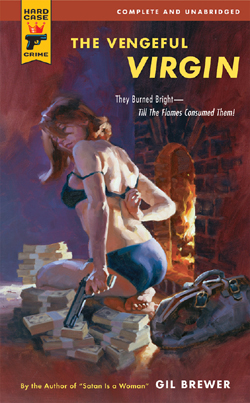
This is what the inside of my brain looks like 24/7. I want a framed version of this painting to hang on my wall. On black velvet, if possible. I’ve got a birthday coming up.
As for the book behind this cover ...
There was a book behind this cover?
Shirley, the virgin of the title*, is tending to her wealthy, ailing stepfather. She meets Jack Ruxton, a ne’er-do-well who’s thrown his lot into the TV business. They conspire to do the old man in, but naturally there are problems galore. Starting with the other women in Jack’s life.
Brewer packs in the suspense, but it’s the characters who truly shine. Shirley is a girl, aware of the power she has over men but unable to understand it. Ruxton is one of those men who “reckoned (he) would take the world by the tail and kick it smack it in the ass. Only it worked the other way around.” The brief but vivid scenes in Ruxton’s shop depict a man on the path to respectability who chafes at every step. It’s a great example of the keen insight the pulp authors of the ‘50s had into the lives of the working men who bought their books.
To prove I’m not a shill for Hard Case: Grave Descend by John Lange (1970) is the first of the company’s reprints I’ve read that’s something of a disappointment. Not that there’s anything wrong with this tale of an expat American diver in Jamaica hired to salvage a ship before it sinks. It’s a solid, serviceable novel. But compared to the other books Hard Case has rediscovered, solid and serviceable isn’t enough.
Lange is a pseudonym for an author who went on to achieve great success. Hard Case hasn’t mentioned his name in any of their publicity, so you can bet JURASSIC PARK I’m not going to tell you who it is.
There. That was subtle, right?
*I could have said “the titular virgin,” but I respect Brewer’s book too much.
Saturday, June 16, 2007
Movie: Ocean’s Thirteen (2007)
Smart, slick summer fun that goes down smooth. My pick for the best of the series. If the phrases “reverse big store” and “the Morecambe & Wise of thievery” provoke any kind of reaction, get thee to the box office.
I mention the movie primarily as an excuse to link to SCTV’s priceless Maudlin’s Eleven, a note-perfect send-up of the original movie and Rat Packery in general. I’ve watched it three times this week and have morphed into Bobby Bittman, prone to yelling out “Oh, yeah! Beautiful!” at the slightest provocation.
Installments #2 - #4 are also available. If you can’t spare the twenty-plus minutes, skip to part 3. It recaps the best jokes and offers Eugene Levy at his absolute peak. You’ll miss Dave Thomas’s rendition of the theme from Exodus, but hey. You’re a busy person.
Thursday, June 14, 2007
Book: Make Love! The Bruce Campbell Way, by Bruce Campbell (2006)
Things have been a bit lax around here on the book front. That’s because I’ve been doing a lot of research reading.
I made room, however, for the latest tome by Bruce Campbell. If you’re at this site, you probably know who Bruce is. Odds are you’ve caught more than a few of his movies. (If you haven’t seen Bubba Ho-Tep, TCB and queue that bad boy up right now.) Currently, he’s onscreen as the highpoint of Spider-Man 3. I link to all of Bruce’s Old Spice commercials, so it stands to reason I’d read all of his literary work. His previous book, If Chins Could Kill, is that rarest of birds, a genuinely interesting Hollywood memoir. That’s because Bruce is brutally forthright about the effort required to be a working actor.
Make Love! is a novel. I’d call it a picaresque influenced by Pirandello, but no doubt Bruce would slap me down for such highfalutin’ talk. He’d say it’s a goof and nothing more.
Bruce – yes, he’s the star of his own novel – finally gets his shot to bust out of the low-budget ghetto when he’s cast in Let’s Make Love!, an A-list romantic comedy directed by Mike Nichols and starring Richard Gere and Renée Zellweger. Bruce isn’t about to blow this opportunity. He insists that everyone call him by his character’s name and throws himself headlong into preparing for his role as a genteel Southerner turned New York doorman. In short order, though, Bruce’s B-movie instincts not only kick in but infect the entire production.
The book is studded with what Bruce calls “graphic sarcasm:” photos, charts, bogus movie posters. Nice to see this kind of po-mo silliness isn’t the exclusive preserve of hipster literary novelists. Many of the episodes, like Bruce’s encounter with a sex ed film mogul, are hilarious. And the Hollywood material is bang-on. Let’s Make Love! is more than a plausible studio movie. I’m pretty sure I caught it on cable one night.
The “B-movie virus” plot doesn’t make much sense, and I can’t help thinking that another draft could have turned this book from an amiable lark into something truly subversive. But that “if only we’d had more time!” feeling is in keeping with Bruce’s B-movie roots, and I’ll bet that’s how he wants it.
Tuesday, June 12, 2007
Movies: The Big Combo (1955)/The Damned Don’t Cry (1950)
All season I’ve been waiting for my beloved New York Mets to play my adopted west coast Dodgers on Pacific time, so I can enjoy the game in its entirety. Last night they kicked off a three-game series in the City of Angels. And I didn’t see a minute of it.
Only one thing could get me out of the house on such a night. That’s noir, baby.
Eddie Muller, the czar of noir and founder of the Film Noir Foundation, was back at the Seattle International Film Festival with another double feature. (I wrote about last year’s twin bill in Mystery*File.) This time out, Eddie offered battle-of-the-sexes night. As he put it, one movie is fueled by pure testosterone, the other by estrogen.
I’ve seen The Big Combo before – and blogged about it here – but I’ll never pass up the opportunity to see John Alton’s extraordinary cinematography on the big screen. Quoting Eddie again, Alton’s camera transforms the movie into a series of live-action woodcuts. It was a treat to see this elemental noir with a packed house. Sure, there were gales of hipster laughter at the none-too-veiled homoeroticism (Earl Holliman’s gunsel wailing to his partner/roommate Lee Van Cleef, “I can’t swallow no more salami!”), but by the end the film’s brute force held the audience rapt.
Who could counter this exercise in swinging dick cinema? Only Joan Crawford. The Damned Don’t Cry is loosely based on the story of Virginia Hill and Bugsy Siegel, but as Eddie observed it’s also the closest Joan ever came to playing herself, a woman from a hardscrabble background who reinvents her identity and claws her way to the top. It’s more of a melodrama than a classic noir, and ridiculously entertaining. Here’s one line worth remembering: “Don’t talk to me about self-respect. Self-respect is what you tell yourself you’ve got when you’ve got nothing else.”
The only thing better than noir is more noir, and luckily that’s what Seattle is in for. Eddie announced that he’ll be bringing his Noir City festival to town for a week in July. Plenty of gems are in store: the “lost” film Woman on the Run, a restored Technicolor print of Leave Her to Heaven, and Pitfall, a rarity based on a novel by my hero Jay Dratler. I’ve already got tickets to the full run, and I plan on posting regular updates. Christa Faust did the same during Noir City’s recent L.A. stint, and it’s time I returned the favor.
For the record, the Mets lost. Rats. But if I’ve learned one thing from noir, it’s that you can’t have everything.
Miscellaneous: Links
A profile of one of Rosemarie’s favorite authors, Edward Tufte, “the world’s only graphic designer with roadies.”
I’ve written before about the jazz trio The Bad Plus, whose new album Prog is phenomenal. They also run an excellent blog. This post on jazz of the ‘90s provides plenty of food for thought. Plus it links to this interview with Ted Nugent from the Beastie Boys’ now-defunct magazine Grand Royal. It truly is as great as Ethan Iverson claims.
Monday, June 11, 2007
TV: Tony & The Tonys
Isn’t that a clever title? I’ll bet I’m the only person who uses it, too.
Thanks to the wonder of the East Coast feed, I was able to watch both the series finale of The Sopranos and the Tony Awards without resorting to the DVR. A few words on each. I’ll insert a SPOILER warning here. But c’mon. If you didn’t watch The Sopranos last night, I’ll assume you just don’t care.
Last chance.
I liked the finale. A lot. Millions of fans didn’t. Want to have a laugh? Head over to Technorati and search for “Sopranos” and “WTF?” You’ll spend the rest of the day there.
If you want to screw with your audience – I mean well and truly upset them – you’ve got two choices. Give ‘em exactly what they want, or exactly what they don’t want. Thomas Harris went the first route in Hannibal. Fans wished there were some way Dr. Lecter and Clarice could get together and make it work. He granted their wish and forced them to consider what they had been asking for.
David Chase took Door #2. Sopranos fans were clamoring for the Russian to wander in from the Pine Barrens, for Tony to go down singing or swinging but to at least go down, goddamn it, for there to be some kind of resolution. And Chase, in a brilliantly shot and scored final scene, said to those fans, “You haven’t been paying attention at all, have you?”
Already there are two interpretations of what transpired when the screen went black, the Tony-got-whacked-and-we-don’t-see-it camp, and the life-goes-on-and-we-don’t-see-it camp. (For the record, I’m firmly in the latter. I never even considered the former.) What matters is what the dual outcomes share. We don’t see it. It’s right there in the haunting final scene with Uncle Junior, when Tony reminds him that he and his brother once ran all of North Jersey. “We did?,” the senile Uncle Junior replies. “That’s nice.” All that work. All that blood and death. Already faded from memory.
The audience may hate it now, but mark my words. In a few years’ time The Sopranos will be remembered for going out without making compromises.
As for the Tony Awards, it was a livelier telecast than in recent years. Several of the numbers have me interested in seeing the shows the next time I’m in New York. But the only nominated performer I saw (Brooks Ashmankas in Martin Short: Fame Becomes Me) didn’t win, and the divine Kiki & Herb lost, so on the whole it was a wash. The Tony audience made like an oil painting during the comedy bits. How can America get excited about the show if the crowd in Radio City can’t?
When I first saw the ad for CBS’s V iva L aughlin, I got chills. When I saw it for the tenth time approximately forty minutes later, I was over it already. It’s a musical. We get it.
Sunday, June 10, 2007
Movie: Rollercoaster (1977)
You gotta get a gimmick, as the song says. What you don’t want is a gimmick that overwhelms.
If Rollercoaster is remembered at all, it’s as one of a handful of movies released in Sensurround, Universal’s experiment in plaster cracking. Which is too bad, because it’s a clever, underrated thriller. I’d go so far as to call it the best movie ever released in Sensurround, a claim that deserves to be in the Guinness Book of World Records as “smallest boast.”
The movie marked a rare foray into features by William Link and Richard Levinson, the storied team of television writers who created Columbo, Mannix and Murder, She Wrote.
The first sign of their consummate craft is their villain, identified only as “Young Man” and played by Timothy Bottoms. He’s a pleasant, low-key sort, never saying a word in anger. He’s also smart, putting his knowledge of demolition to work by rigging bombs on theme park rides and blackmailing the park owners into paying him.
We never learn how he acquired this knowledge. Link and Levinson boldly decide not to explain the character’s motivation or history. The only hint into his past comes in a chilling early scene. Bottoms, killing time before showing off his handiwork, stops by a shooting gallery and drills target after target. The impressed carny rolls up his sleeve to display a military tattoo and asks Bottoms where he was stationed in Vietnam. Bottoms smiles, takes his prize, and walks wordlessly away.
But the movie’s true genius is in its choice of hero. It’s not a hard-bitten cop or an obsessed FBI agent, although there is one of the latter ably played by Richard Widmark. Instead, it’s George Segal as an amiable public safety inspector who gets drawn into the cat-and-mouse action. He’s an everyman, a divorced dad (future Oscar winner Helen Hunt makes her movie debut as his daughter) trying to quit smoking. But his feisty civil servant proves more than a match for Bottoms’ psychotic.
Segal is at his absolute best here. He’s one of the most appealing actors of the 1970s. At the height of his fame he was a late night TV fixture. In William Goldman’s Adventures in the Screen Trade, he talks about seeing Segal be dazzling on a talk show. Segal told him he treated the appearances as acting exercises: “I tell myself I’m playing a character who’s enjoying himself.” Segal has had a long and varied career, but my favorite performance remains his Andy Kelp in The Hot Rock. Every time I read one of Donald E. Westlake’s Dortmunder novels, it’s Segal I see in the role. Kelp is genial, optimistic and a true professional, just like Segal.
Rollercoaster’s not perfect. The story is a bit formulaic, there are too many thrill ride shots meant to showcase the Sensurround technology, and by the time it’s over you never need to hear the song “Big Boy” by Sparks again. (Not that you’ll ever hear it anywhere else.) But it’s also a well-constructed, unpretentious movie that deserves to be more than a technical footnote.
Miscellaneous: Link
ESPN’s Bill Simmons on how greatness recedes in memory. It ain’t just true in sports.
Thursday, June 07, 2007
DVD: Arrested Development
Done.
All 53 episodes, watched in order. I’m sorry that it’s over – but on the plus side, now we get to start from the beginning again.
We marked the occasion with frozen bananas. Have one yourself and enjoy this compendium of the Bluth family chicken dances.
Miscellaneous: Your YouTube Bonus
My new favorite TV commercial. This level of honesty about how I – sorry, we use the internet almost has me ready to switch from Google.
Tuesday, June 05, 2007
DVD: Payback, Straight Up: The Director’s Cut (1999/2007)
If there’s a collecting gene, I don’t have it. I can barely bring myself to buy DVDs of movies I enjoy. So imagine my surprise when I picked up one I didn’t like – at least the first time around.
Payback is based on The Hunter, the Richard Stark (aka Donald E. Westlake) novel already immortalized on film as Point Blank. Screenwriter Brian Helgeland, making his directorial debut, set out to make a movie closer in tone to Stark’s book. Plots don’t come much sparer: thief Parker (here renamed Porter) is double-crossed and left for dead by his wife and his partner. He then begins killing his way up the Outfit’s ladder to get the money back. Not all of it, you understand. Just his share.
It was a troubled production. Helgeland’s cut was deemed too dark, and he was replaced by another director. A voice-over was added, a new third act (complete with new characters) was grafted on. And the seams showed. I didn’t care for the movie, which played like a violent cartoon. Recently, Helgeland got a chance to recreate his version. The resulting DVD serves as an object lesson in the power of editing. From the same material, he’s crafted a substantially different film.
It may not be meaner, but it’s certainly leaner. The ending is simpler. Kris Kristofferson is no longer in the movie. His character is now only a voice, provided by Sally Kellerman. Much of the over-the-top quality of the ’99 film has been stripped away, which helps Gregg Henry’s performance as Porter’s duplicitous partner. The entire earlier version seemed to play at his manic frequency; with the film’s metabolism slowed down, he registers not as a caricature but as the kind of loudmouth hothead who drifts into a life of crime. I’m also happy to report that the scene in which dominatrix Lucy Liu kicks the crap out of Henry while wearing leather chaps is untouched. (Honestly, that’s the only thing I remembered from eight years ago.)
I’m still not completely sold on the new cut. It may be a question of casting. Not that there’s anything wrong with Mel Gibson; he’s always an inventive actor. But he’s also a star, and somehow that seems wrong for a professional who doesn’t want to call undue attention to himself. Parker’s more the character actor type.
The DVD includes a half-hour documentary detailing the movie’s history, in which all parties speak their piece. The best extra is an interview with Westlake, who says his favorite cinematic Parker isn’t Gibson or even Point Blank’s Lee Marvin, but Robert Duvall in the unsung The Outfit. “What Lee Marvin did was a wonderful destroyed Lee Marvin,” Westlake says. “What Robert Duvall did was a wonderful terse, taciturn Parker.” I’m partial to the movie myself. As Westlake says, it was made without a lot of fooling around – just the way Parker pulls a heist.
More Stark/Westlake: at Mystery*File Steve Lewis considers another of his novels, leading to a conversation with Peter Rozovsky of the fine blog Detectives Beyond Borders. That, in turn, prompts a question from me about one of Stark’s characters, who may also be a Westlake character. Understand?
Miscellaneous: Links
Last night I wasted half an hour looking up Manhattan strip clubs in Google Street View. I should have known others were waaaay ahead of me.
Michael at 2 Blowhards considers the question that haunts me: whither the grown-up Hollywood thriller?
You mean Graham Greene wasn’t above using The Third Man to settle an old score? That makes me feel a lot better.
Sunday, June 03, 2007
Movie: Mr. Brooks (2007)
Loads of lurid fun. We’ve got a pillar of the community who’s secretly a serial killer. An unwanted homicidal protégé. A daughter who may have inherited her father’s “addiction.” A millionaire detective. Plus a second serial killer who has broken out of jail to seek revenge. And Portland seemed so laid-back on my visits there. It’s like an entire spinner rack full of airport thrillers packed into one movie, pitched at a level just shy of hysteria but always maintaining its balance. The whole enterprise is agreeably nuts, and I had a hell of a time watching it.
William Hurt is a blast as the title character’s murderous id. But it’s Kevin Costner’s show as the killer, and he’s damned impressive. Of course, I’m on the record about Mr. Costner. I’d now fold this movie into my argument.
Sports: My Impoverished Fantasy Life, Part II
Play, the New York Times’ excellent sports magazine, has not one but two articles on fantasy baseball in its latest issue. Neal Pollack writes about his obsession with leagues that use players from throughout the sport’s history. Bryan Curtis, meanwhile, dubs fantasy baseball’s ascendance “a minor revolution” that’s creating legions of postmodern fans:
“There’s a wrongheaded notion that we are attracted to fantasy baseball because it reinforces all we love about baseball. In fact, we play fantasy baseball because it shields it from all that we hate about it.”
In other words, blame steroids and lousy management.
Personally, I’m more inclined to see fantasy baseball’s popularity as another manifestation of our collective inability to give ourselves over to something larger, along with the impulse toward participation that’s passed off as vaguely democratizing. You know, the same thing that’s affecting literary criticism and porn. And as goes the skin trade, so goes our national pastime.
Or maybe, as I’ve said before, I simply don’t get fantasy baseball. Which is why I’m making my annual pledge: next year, I’m going to try it out. One team in one league, just to see. I’ll probably punk out as usual. But this time, I’m making the promise in public.
Friday, June 01, 2007
Miscellaneous: The May Clean-up Post
AKA stuff I meant to cover last month.
The Dinner Game. I still haven’t gotten to the theater to see Francis Veber’s new comedy The Valet. But Anthony Lane’s review in the New Yorker prompted me to watch this 1998 film. Lane writes, “The very thought of its plot, with its high-spirited misanthropy – a club of worldly friends meet once a week, each of them competing to bring along the most complete idiot he can find – still makes me laugh.” He’s right. It’s a perfectly turned farce, the kind they don’t make any more. Except for Veber, apparently.
28 Weeks Later. I usually think claims of horror movies being allegorical are so much malarkey. Not so here. This film is quite clearly the first post-9/11, post-Iraq, post-Mission Accomplished scarefest, and that only adds to its intensity. The ending sequence hits my personal nightmare trifecta – zombies in the subway in the dark. Jesus. I doubt you’ll see a better sequel in this season of them. You may not see a better movie.
The Naked Gun 33 1/3: The Final Insult. I stumbled onto this while channel surfing. Not only is O.J. in it, so is Anna Nicole Smith. Which means no one will ever laugh at it again. (OK, it’s the least of the Naked Gun movies, but there are still good jokes in it.) Was ever a film so snakebit?
Miscellaneous: Links
The only celebrity interviews worth reading are those in which the subject is either loose or candid. From Cannes comes an example of each. Representing the former, the gang from Ocean’s 13. For the latter, Michael Madsen.
Thanks to GreenCine Daily, I spent some quality time with the latest issue of Bookforum. Featuring Luc Sante on Georges Simenon, authors and filmmakers discussing the art of adaptation, lists of the best books-into-film, and more.
I don’t want a large Farva: movies continue to corrupt today’s youth. Hat tip to The Obscure Store.
Wednesday, May 30, 2007
Miscellaneous: Today’s Random Connection
The other night I take down my copy of David Mamet’s 1988 play Speed-The-Plow. Yes, I keep Mamet around the house. Why? To learn some craft. To have a sense of How Things Are Done. To “study.” Because I – I feel that ... look. Like the man says, if you have to ask ...
Two Hollywood executives are considering a pair of potential projects. One is a prison movie starring a box-office draw. The other is a book being given a courtesy read. A book by “A Very Famous Eastern Writer.” A book called The Bridge, or: Radiation and the Half-Life of Society. Or, as the execs call it, The Radiation Book. Here’s how some of it goes:
“The wind against the Plains, but not a wind of change ... a wind like that one which he’d been foretold, the rubbish of the world – swirling, swirling ...”
And more:
“What was coming was a return to the self, which is to say, a return to God ... And the man saw that ... things were ending. Yes. That things must end. And that vouchsafed to him a vision of infinity.”
What is it? “It’s a novel about the historical effects of radiation.” Yes, but What Is It About? Simple. It’s about The End Of The World. It’s about a man and a child. It’s about what we all feel. Everyone is frightened. Everything is breaking down. Things as we know them are over. Or, to quote the coverage: “the device of God, in all things, to prepare the world for its final decay.”
In other words, it’s Cormac McCarthy’s The Road.
Not that I’ve read the book. I don’t do everything Oprah tells me to do. Besides, I’m waiting for the movie.
Sports: My Impoverished Fantasy Life
In Slate, David Roth writes about how fantasy baseball has destroyed his ability to enjoy the game – and, to his eternal shame, to root unabashedly for the New York Mets, currently riding high atop the NL East.
Every season I say I’m going to join a fantasy league, and every season I don’t do it. I couldn’t tell you why. It just doesn’t interest me. Apparently, the only people left who still watch baseball games for the pure pastoral joy of the sport are Bob Costas, George Will and me. Company that’s not as august as you’d think. Just once I’d like to see one of those guys reach for his wallet when the hot dog vendor comes around.
MLB’s Extra Innings package is pitched to fans who can’t watch their hometown teams. That’s why I sprang for it. But the true market is fantasy fanatics who want to follow their rosters in real time.
You’d think access to a dozen-plus ballgames a day would up my interest in fantasy play. Nope. My viewing remains Mets-centric. Take last night. I caught most of the Mets/Giants game, an extra innings corker that ended with Armando Benitez, a former Mets reliever, getting called for two balks against Jose Reyes to bring the tying run across the plate before Carlos Delgado’s solo HR took it for the Mets in the bottom of the twelfth.
To quote Strangers With Candy, “If you’re paying for cable and not watching TV, you’re losing money. It’s just simple economics.” So on I went to the end of the Braves/Brewers game, hoping the Mets’ division rivals would fall even further back. (They did.) I closed the evening out with a little of the Mariners/Angels. All games that I watched and enjoyed, you know, as games. No divided loyalties. No sweat involved.
OK, I sweated a little during the Mets game. But that’s the price of being a true fan.
Other baseball notes: Sports Illustrated on how Mets’ GM Omar Minaya transformed the team into a contender. Hat tip to my brother Sean. And a terrific baseball blog with a focus on the Los Angeles Dodgers written by ... Alyssa Milano?!?
DVD: Not Just The Best Of The Larry Sanders Show
How did I spend my Memorial Day weekend? Consuming every facet of this extraordinary 4-disc set.
I’ll admit this right off the bat: The Larry Sanders Show is my all-time favorite TV series. I’ll stack it up against any comedy or drama. It helps that Larry is a perfect blend of both, an achingly funny series about a troika of characters so rich and well-defined they’d be at home in a Eugene O’Neill play. Insecure talk show host Larry (Garry Shandling), his loyal producer Artie (Rip Torn), and his talent-challenged sidekick Hank Kingsley (Jeffrey Tambor, giving full voice to the show’s most inspired creation).
Sanders is primarily remembered for the groundbreaking way it used real-life figures to comment on America’s growing obsession with show business, and those scenes draw blood to this day. Plenty of actors did the best work of their careers playing themselves. Like Illeana Douglas, worrying that boyfriend Larry will dump her if she tanks on his show. Jim Carrey’s turn on the final episode, his showmanship curdling into malignant narcissism as soon as the cameras are off, is nothing short of spellbinding. The later shows featuring Jon Stewart as Larry’s heir apparent make for particularly fascinating viewing now that Stewart has not only become this generation’s answer to Johnny Carson but has reinvented the role so completely.
For me, the show’s other true subject is work. You’re always aware of the enormous amount of effort that goes into making a standard-issue talk show that struggles in the ratings.
Aside: I always loved the episodes where something on the show would go so wrong that Artie would announce, “Tonight will be a ‘Best of Larry.’” It got to the point where I became disappointed that Jay and Dave never aired unscheduled reruns. Apparently I should have been watching The View, which had the decency to put the dysfunction front and center.
As the collection’s name implies, the episodes are cherry-picked from the show’s six seasons. Some personal favorites are missing. Artie’s drunken night in the office isn’t here, and neither is Larry’s celebrity roast. But other classics are, such as “Hank’s Sex Tape,” featuring one of the great lines of television history: “Sex is not a crime. It’s a loving act between two or more consenting adults.”
The episodes, though, are mere gravy for the special features. They’re so exhaustive that they essentially constitute a lost season of Larry, focused as they are on the divide between performer and performance, or what Garry Shandling calls “the curtain.” Shandling was intimately involved with assembling this collection; he even handwrites the introductions to his visits with the show’s guest stars. He boxes with Alec Baldwin and has breakfast with one-time paramour Sharon Stone, who played Larry’s love interest in one of the show’s strongest episodes. Their encounter quickly breaks through the playful artifice to plumb emotions with Cassavetes intensity. Shandling also reconnects with people who worked behind the scenes on the show. Protégé Judd Apatow cops to stealing Shandling’s creative method. In light of Apatow’s extraordinary success, that may be the show’s most lasting legacy.
I try to keep blanket statements to a minimum, but I already went big with the “all-time favorite” comment, so what the hell. This DVD package is the cultural high point of 2007 so far.
Saturday, May 26, 2007
On The Web: The Rap Sheet
The crime fiction blog’s One Book Project has been running all week, and what a treat it’s been. I imagine that none of the overlooked titles mentioned by the participants will be overlooked any more. I’ve got some reading to do.
My nomination appears in the series’ last installment. I’d like to thank Rap Sheet editor J. Kingston Pierce both for asking me to play, and for referring to me as a “culture critic.” The description has gone right to my head and my business card. Other answers we would have accepted include gadabout, curmudgeon, and force for good in his time.
Head over to The Rap Sheet. You’ll enjoy yourself.
Anniversary: John Wayne
Today is the centenary of Marion Morrison’s birth. A war movie, not a western, was my introduction to one of the greatest of film stars. The Duke received his first Academy Award nomination for 1949’s Sands of Iwo Jima, playing a hard-bitten Marine sergeant prepping raw recruits for battle even as his personal life falls apart. It’s a well-made film that hits all the standard war movie notes – it may well have invented some of them – but I didn’t know those notes, so Sands made a vivid impression. Particularly Wayne’s final scene. Now I’d see it coming a mile off. Then, I was shattered for the rest of the day. It’s the strength of Wayne’s onscreen presence that gives the moment its impact.
Wayne was honored at Grauman’s Chinese Theater after the success of the movie. The cement in which he left his footprints and his fist print was mixed with sand from Iwo Jima.
GreenCine Daily rounds up tributes to the actor. James Reasoner lists his favorite John Wayne films. I second ‘em all.
Friday, May 25, 2007
Book: Then We Came To The End, by Joshua Ferris (2007)
Two weeks ago I said I wanted to rave about Joshua Ferris’ extraordinary novel Then We Came To The End. The fact that I’m determined to make good on that promise should tell you just how extraordinary it is.
The book, set in a struggling Chicago advertising agency in the waning days of the dot-com boom, is about work. Ferris tells the story largely in the first person plural, hence the ‘we’ of the title. Far from being a literary trick, this device illuminates the book’s essential truth: that for the eight hours a day in which “you walk around on the same bit of carpet” (to quote another brilliant examination of the modern workplace), you and your coworkers are all part of something larger. That something larger changes as people come and go, and will retain some trace of you after you’ve gone. The sad fact is none of us has any say in what part lingers. It’s about nothing less than finding the transcendent in the everyday, which sounds way too high-falutin’, so I’ll conclude thusly: Ferris’ darkly funny book is the best thing I’ve read in ages, and it knocked me on my ass.
TV: Current
Watching Al Gore on The Daily Show last night got me wondering. Is Current, his TV network, still on?
Turns out it is. According to my channel guide, here’s what’s airing in the next few hours:
International Insight
Global Scene
Random Insight
Views & Voices
Random & Riveting
Sum of the Parts
Parts of the Sum
Rebel Journalism
Citizen Journalism
Even better, every show has the identical description. News and current events. Hard to imagine SpikeTV is more popular.
Tuesday, May 22, 2007
On The Web: The Rap Sheet
Today marks the one year anniversary of The Rap Sheet, the crime fiction blog that has quickly become indispensable. Industrious types that they are, they’re not celebrating idly. Instead, they’re using the occasion for The One Book Project. A question was posed to authors, critics, and bloggers:
What one crime, mystery or thriller novel do you think has been most unjustly overlooked, criminally forgotten, or underappreciated over the years?
Answers will be posted all week. Installments one, two and three are available, and my to-be-read pile has swelled accordingly. Plenty of great titles there to be plundered.
It’s always a relief with such lists to see that I’ve read some of these books. Even better, I loved ‘em. Steve Brewer picks any of Ross Thomas’s standalones, singling out The Singapore Wink. Blogger Jiro Kimura names Dover Beach by Richard Bowker. Bowker wrote several SF/mystery hybrids in the 1980s that sustained me through high school, including Replica and Marlborough Street, and I’ve still got them all. Gar Anthony Haywood nominates Eight Million Ways To Die by Lawrence Block, saying it hasn’t “received anywhere near the credit it deserves for turning the P.I. subgenre on its head.” In a recent conversation on Crimespace, I said that this was the book that truly kindled my interest in crime fiction. It’s great to see it remembered here.
Swing on by and unearth some treasures for yourself. Full disclosure: Rap Sheet editor J. Kingston Pierce was kind enough to ask me to participate. With any luck, my answer should appear there before the week is out. I’ll let you know when it does.
Miscellaneous: Links
Bill Crider, who’s already weighed in at The Rap Sheet, on a Gold Medal paperback that might be one of the first graphic novels. Michael at 2 Blowhards sings the praises of Ed Gorman.
GreenCine Daily is always a regular stop, but during the Cannes Film Festival it’s essential. They have complete recaps of reaction to every major film as soon as it debuts. A Bela Tarr adaptation of Georges Simenon in which Tilda Swinton’s dialogue is dubbed by a Hungarian actress? I am so there. Or at least I would be, if Tarr movies ever played Stateside.
Saturday, May 19, 2007
Music: The Bad Plus
Wednesday was our wedding anniversary. Rosemarie and I marked the occasion with a pizza and pushed the festivities to Friday night. Drinks at our usual hangout. Dinner at a fine restaurant. Some live music. And what live music. The Bad Plus was in town.
They’re a jazz trio – Ethan Iverson on piano, Reid Anderson on bass, David King on drums – that mixes terrific original compositions with singular covers. Their latest album Prog includes distinctive takes on “Everybody Wants To Rule The World,” “This Guy’s In Love With You,” and “Life on Mars” by David Bowie*. We lucked out and got to hear their version of Rush’s “Tom Sawyer” live, along with a haunting rendition of “Heart of Gold” by Neil Young.
It was a tremendous set. David King uses a variety of children’s toys to achieve the desired sound, and it’s dazzling to see (and hear) him work his magic in person.
After the show, the boys hung around to sign CDs. I spoke briefly with Ethan Iverson, a big crime fiction buff, about our mutual admiration for Donald E. Westlake – and complimented his version of the opening scene of Dan Brown’s The DaVinci Code as written by Westlake’s alter ego Richard Stark. I told him it was one of my favorite things on the Internet. I wasn’t lying.
All that, and the Mets beat the Yankees. What a day.
The Bad Plus is in Seattle through Sunday, followed by dates across the U.S. and Europe. Catch them if you can.
* Bowie’s song has been everywhere lately. I was getting a haircut when I heard Seu Jorge’s Portuguese cover from The Life Aquatic soundtrack. Looking it up on Rhapsody led me to discover that Barbra Streisand recorded the song in 1974. Nobody says “crashing bore” like Babs.
Upcoming: No Country For Old Men
For me, the rest of the moviegoing year will be a countdown to the Coen Brothers’ adaptation of Cormac McCarthy’s neo-noir thriller, which has electrified the Cannes Film Festival. Variety’s Todd McCarthy raves. GreenCine has a round-up of other reactions.
Thursday, May 17, 2007
Miscellaneous: Links
To quote Rosemarie on this New York Times article, “It keeps getting better!” You’ve got living saint Bono versus the man responsible for the worst dancing ever recorded, a still-feisty at age 95 Mitch Miller, and Marshall Brickman calling in to update his jokes. It’s a story that keeps on giving.
Novelist/gadabout Ray Banks explains the title of his latest book, with a minor assist from yours truly. I’m “a man knows his filth,” and I couldn’t be more proud.
The AV Club on twelve movies that define their decades. As exercises go, picking a single movie that encapsulates its era is a fairly pointless one. Still, the AV Club crew does a pretty good job. Each of the films does capture the flavor of life at the time; the choices for the 1950s (Will Success Spoil Rock Hunter?) and the 1980s (Back to the Future) are particularly strong. The biggest surprise was realizing that the list includes the current decade (their choice: The 25th Hour), because it’s more than half over.
Tuesday, May 15, 2007
Miscellaneous: Today’s Random Thoughts
Watching The Sopranos during the day just feels wrong. Especially when it’s an episode as disturbing as the one that premiered on Sunday.
Interesting article by Lauren Collins in the May 14 issue of The New Yorker about the reclusive graffiti artist Banksy. It stands to reason that Banksy would have a website where he can post comments. Same goes for a professional photographer who may or not have taken Banksy’s picture, and various art critics. But when the head of Los Angeles’ animal services, who objected to the use of a painted elephant in a Banksy installation, has a blog, we have reached a strange cultural stage. This could be the future of journalism. A reporter simply visits the blogs of every person involved in an incident, aggregates them, and creates a semi-definitive version of events. Call it Rashoblog. (That’s trademarked, by the way.)
Collins also makes this interesting comparison, which I’m still pondering:
“The graffitist’s impulse is akin to a blogger’s: write some stuff, quickly, which people may or may not read. Both mediums demand wit and nimbleness. They arouse many of the same fears about the lowering of the public discourse and the taking of undeserved liberties.”
I can resist any TV commercial pitch – unless Bruce Campbell is involved. Hat tip to Bill Crider. What am I going to do with all this body spray?
I’m late to this party, but so what: Mika’s song “Lollipop” is now playing in my head in a constant loop. It’s a strangely perfect blend of Queen and The Jackson 5. It’s like a Pixie Stick for your ears.
Sunday, May 13, 2007
Miscellaneous: Neither Waving Nor Drowning
A New York childhood taught me that the light of the end of the tunnel is usually an oncoming train, often an express at that. Still, I see such a light, and I am hopeful. In the meantime, some tidbits.
The best movie I’ve seen in years debuts on DVD this Tuesday. Jean-Pierre Melville’s WWII resistance drama Army of Shadows receives the full Criterion treatment. Here’s what I said about it last August. Do yourself a favor and watch it as soon as you can.
Arrested Development, season two? Every bit the equal of season one.
Thanks to MLB Extra Innings, I have now seen commercials for every mid-level casino and regional brand of cold cuts in the continental United States.
At other blogs: Bill Crider has Joe R. Lansdale weighing in on zombie movies. And Ray Banks takes apart the Eurovision Song Contest. I demand to know why this spectacle isn’t televised in the U.S.
After weeks of searching, I finally scored some of Stephen Colbert’s Ameri-cone Dream ice cream from Ben & Jerry’s. A quality product. It’s a good thing Jane Fonda didn’t have any on hand during her recent Colbert Report segment. I won’t go as far as Salon’s Joan Walsh. I will say that supermodel Paulina Porizkova did a better job of flirting with the host – and with her husband Ric Ocasek present.
A lovely old brick apartment building around the corner from Chez K is being slowly demolished. I took some pictures of what remains. They’re posted on my Flickr page.
Wednesday, May 09, 2007
Miscellaneous: The Missing Links
It’s at times like this I think I don’t know how to use the Interweb at all.
I’m working like a lackey from rise to set, sweating in the eye of Phoebus. I haven’t read/seen/listened to anything I want to comment on. (OK, that’s untrue. I want to rave about Joshua Ferris’ extraordinary novel Then We Came To The End, but I don’t have time to do it justice. So, for the nonce: read it.)
You’d think I’d be able to throw together a post full of amusing links. Odd news stories, funny videos, bizarre items available for purchase. Only I seldom discover those wacky bits of detritus online. I visit the same handful of sites over and over, hoping they’ve updated. I don’t know where those people find their stuff. And I want to bring something new to the table. I don’t want to be the umpteenth person linking to the music video featuring that insanely cute polar bear cub in the German zoo because I happened to see it on The Colbert Report last night. Maybe I’m doing this Internet thing wrong.
For now, I’ll steer you once again toward Vulture, the New York magazine pop culture blog now enshrined on my Links page. In fact, check out any place on the Links page.
Mark Evanier says it’s an ancient Internet tradition for a blogger to put up a photo of a can of Campbell’s Cream of Mushroom soup when he’s too busy to post. As I said, I strive to be different. So here’s a new VK.C tradition. When under the gun, I will post the video for ‘Crucified’ by Army of Lovers. A band consisting of my first wife, my half-brother Nils, and the guy who used to handle my landscaping. And I’m not talking about yard work.
Sunday, May 06, 2007
Miscellaneous: The Grindstone Report
Been toting that barge and lifting that bail. Lately I’ve had just enough energy to collapse in front of the TV and watch baseball. Luckily the Mets are in the middle of a west coast swing. Related link: New York Times business columnist Harry Hurt III tries his hand as a vendor at Shea Stadium, where more hot dogs are consumed than any other ballpark in the league. In your face, Yankees! Make sure to watch the accompanying video.
If it’s not baseball, it’s season one of Arrested Development. The pangs of retroactive guilt I feel for not fully supporting this series when it originally ran on Fox are eased by the fact that I can take an hour and binge on three episodes in a row. The show produces a dizzying screwball high, particularly the initial 13 episodes, which are as funny as anything that has ever aired on American television.
A critic – I can’t remember who – once said of the Scottish writer/director Bill Forsyth that he was one of the few filmmakers alive to “the comic possibilities of goodness.” The same dynamic is at play on Arrested. Jason Bateman and Michael Cera, playing father and son, wring endless humor out of being the only rational people in a family full of grasping greedheads. The entire ensemble is peerless, but you’d be hard-pressed to top Will Arnett as the deluded “magician” Gob. There hasn’t been such a gloriously self-involved character since Hank Kingsley on The Larry Sanders Show. It’s only fitting, then, that Jeffrey Tambor plays Gob’s father. (I recently ordered the new Sanders collection on DVD. That’s my next big project.)
The commentary tracks on the Arrested DVDs are hilarious. They also provide a fascinating window into the process of making series TV. (David Mamet: “Features are a marathon. TV is running until you’re dead.”) Arrested never had an easy time, a fact reflected on the tracks for the 13th episode, which the cast and crew initially assumed would be their last, and the season finale, filmed while the show’s fate was in doubt. In each case, creator Mitchell Hurwitz and the writers labored to wrap up the storylines while still leaving room for the series to continue. Somehow, they pulled it off. Season two awaits. A sensible man would pace himself, but I’m diving right in.
All this means that I haven’t been to see Spider-Man 3 yet. New York magazine’s Vulture blog considers some less successful threequels. I still maintain that Mad Max Beyond Thunderdome is the best part three. Other nominations welcome.
Thursday, May 03, 2007
Book: Robbie’s Wife, by Russell Hill (2007)
Hard Case Crime has won me over with their reprints. Not a dud in the bunch. I’ve found their original titles to be hit-and-miss.
Robbie’s Wife belongs in the hit category. It starts with what may be the quintessential noir premise: a man, a woman, her husband. But Hill updates it into something quite special. There’s the setting, the English countryside during an outbreak of hoof-and-mouth disease. The characters, a failed Hollywood screenwriter in his sixties and a fortyish dancer-turned-farmwife, are older than the ones typically caught up in a love triangle, giving their actions an edge of desperation. Hill experiments with form, too, rendering parts of the story as scenes in his protagonist’s screenplay. Above all there’s the extraordinarily fluid writing. Hill is also a poet, and that comes across in his prose. This book is one of Hard Case’s best yet. Don’t miss it.
Miscellaneous: Casting Call
One of the joys of spring and summer, as I’ve said before, is listening to the great Vin Scully call baseball games for the L.A. Dodgers. During Tuesday’s showdown with Arizona, Vin recounted the amazing story of D-backs’ pitcher Livan Hernandez’s defection from Cuba with the aid of a mysterious figure known only as “El Gordo,” or The Fat Man (in actuality sports agent Joe Cubas). Vin began speculating on the cinematic possibilities of this tale, casting Antonio Banderas as Hernandez. He was torn on who should play “El Gordo,” however. Sydney Greenstreet was the obvious choice, Vin said, “or, going back a few more years, Akim Tamiroff.”
I was holding out for Thomas Gomez myself. Still, I want to live in Vin’s world, where such a movie would be possible.
It turns out there was a film on this subject in the works several years ago that would have starred Banderas – only as “El Gordo,” with then newly-minted Oscar-winner Cuba Gooding, Jr. playing Livan’s brother and current Met Orlando.
Miscellaneous: Links
Can I buy tickets to this movie right now? Just asking.
The remodeled and expanded Seattle Art Museum looks like a hit.
Slate offers a slideshow chronicling Spider-Man’s journey into darkness in both comics and film. Don’t miss the list of Spidey’s victims, including the separate category of “sentient robots Spider-Man has killed.”
Tuesday, May 01, 2007
Miscellaneous: The April Clean-Up Post
Among the helpful suggestions I received in response to my recent anniversary post was the notion from Alice at Random Musings to recap what I watched/read at the end of each month. It’s a good idea that far outstrips my organizational abilities. I’d have to, you know, keep track of stuff.
Instead, here’s the inaugural edition of the Things I Meant To Get To This Month post.
Friends With Money. I finally caught up with Nicole Holofcener’s movie on cable, and think it’s one of the best films of 2006. A wonderful script that makes smart observations about life, happiness, class and Los Angeles.
Blood of Paradise, by David Corbett. Corbett ventures into Graham Greene/Robert Stone territory with his latest novel. The son of a disgraced Chicago cop finds a new life as a bodyguard in El Salvador. Then faces from his father’s past catch up with him. An intense personal story mixed with a pointed political one, revisiting the scene of an earlier U.S. misadventure in foreign policy.
Miscellaneous: Corrections & Addenda
The Chez K DVR is also recording the fourth season of Hustle on AMC. VinceKeenan.com regrets the error.
Miscellaneous: Link
The AV Club on 13 failed attempts to start movie franchises. I flat-out love two of these films, The Adventures of Buckaroo Banzai Across The 8th Dimension and Master and Commander: The Far Side of the World, and would happily pay to see follow-ups to several others. I’m surprised the list doesn’t include the most egregious offender, Remo Williams: The Adventure Begins, in which the adventure also ended.
